
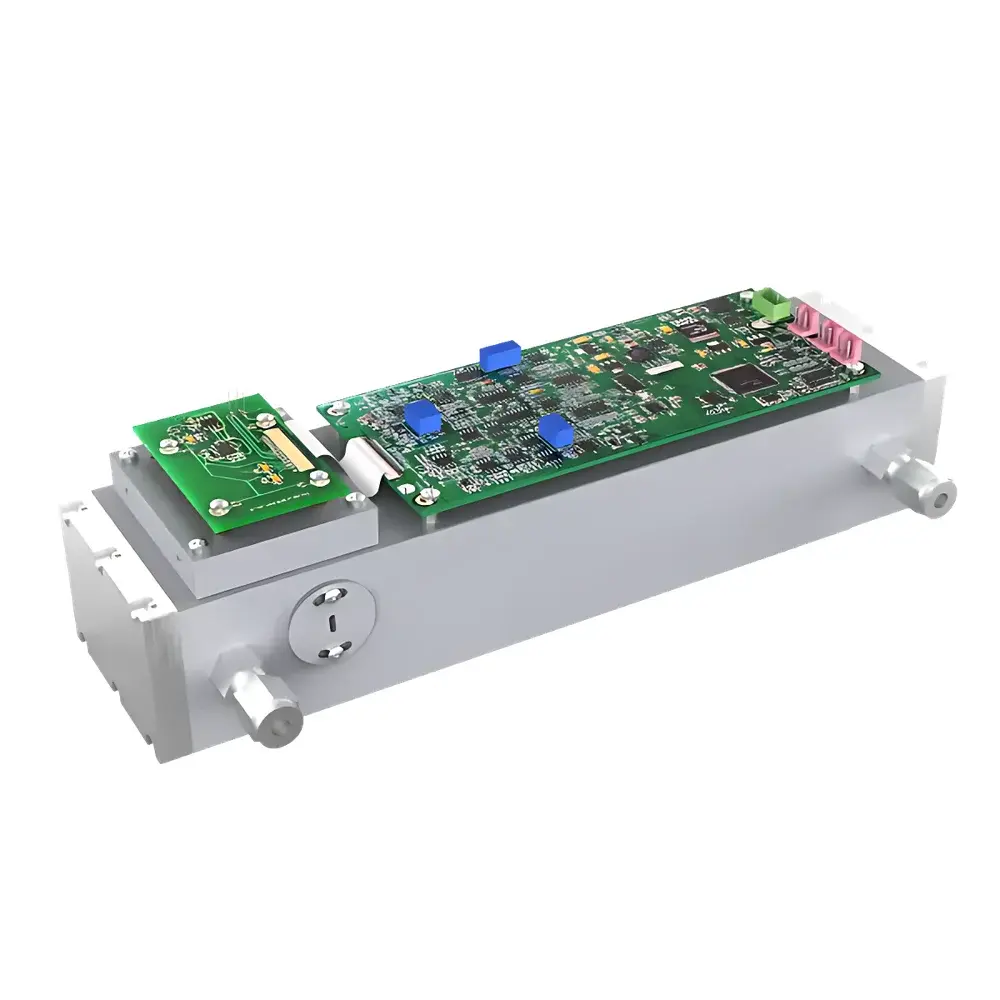
CUBIC INSTRUMENTS Gasboard-2520 TDLAS-Based Multi-Gas Sensor Module
| Brand | CUBIC INSTRUMENTS |
|---|---|
| Origin | Hubei, China |
| Model | Gasboard-2520 |
| Detection Gases | O₂, CO, CO₂, H₂S, CH₄, C₂H₂, HF |
| Measurement Principle | Tunable Diode Laser Absorption Spectroscopy (TDLAS) |
| Response Time | <30 s |
| Accuracy | ±1–2% F.S. (gas-dependent) |
| Resolution | 1 ppm (O₂, CO, H₂S, etc.), 0.01% (CO₂), 0.1 ppm (HF) |
| Operating Temperature | −10 to 50 °C |
| Humidity Range | 0–98% RH (non-condensing) |
| Power Supply | 12 V ±10% |
| Output Interface | RS-232 / RS-485 |
| Constant-Temperature Control | 50 °C ±0.5 °C |
| Dimensions (L×W×H) | 278 × 90 × 70 mm |
| Weight | ~1.2 kg |
| Compliance | Designed for industrial emission monitoring per ISO 14064-1 and EN 15267-3 pre-certification requirements |
Overview
The CUBIC INSTRUMENTS Gasboard-2520 is a high-integrity, OEM-grade multi-gas sensor module engineered for continuous, in-situ gas concentration measurement in demanding environmental and industrial applications. At its core lies Tunable Diode Laser Absorption Spectroscopy (TDLAS), a physics-based optical technique that exploits the unique near-infrared absorption fingerprints of target molecules. Unlike electrochemical or metal-oxide semiconductor sensors, TDLAS delivers inherent selectivity—each laser wavelength is precisely tuned to a specific rotational-vibrational transition of the analyte (e.g., 1392 nm for H₂O vapor interference rejection, 1567 nm for CO, 2004 nm for CO₂), minimizing cross-sensitivity from co-existing gases, particulate matter, or humidity fluctuations. The module integrates a thermally stabilized Herriott-type multi-pass gas cell (effective path length >10 m), high-stability distributed feedback (DFB) lasers, and low-noise photodetectors, enabling sub-ppm detection limits and long-term baseline stability without frequent recalibration. Its compact, sealed enclosure and active temperature control (maintained at 50 °C ±0.5 °C) ensure consistent performance across ambient variations—from cold-stack conditions (−10 °C) to hot flue ducts (up to 50 °C)—making it suitable for integration into continuous emission monitoring systems (CEMS), portable analyzers, and process safety controllers.
Key Features
- Multi-gas capability: Simultaneous real-time quantification of O₂, CO, CO₂, H₂S, CH₄, C₂H₂, and HF using dedicated laser channels—no optical filter wheels or gas switching valves required.
- True TDLAS architecture: Each gas channel employs a discrete DFB laser with wavelength modulation spectroscopy (WMS-2f) for enhanced signal-to-noise ratio and immunity to intensity drift.
- Thermal stabilization: Integrated Peltier-controlled oven maintains the optical cavity at 50 °C ±0.5 °C, eliminating thermal expansion-induced misalignment and spectral shift—critical for field-deployed reliability.
- Digital output & remote configuration: Standard RS-485 (Modbus RTU) and RS-232 interfaces support remote zero/span calibration, firmware updates, diagnostic logging, and alarm threshold setting without physical access.
- Low-power operation: Consumes <2.5 W typical, enabling deployment in battery-backed or solar-powered monitoring stations.
- OEM-ready mechanical design: 278 × 90 × 70 mm aluminum housing with IP54-rated ingress protection, M4 mounting holes, and standardized 12 V ±10% DC input—designed for drop-in integration into third-party analyzers.
Sample Compatibility & Compliance
The Gasboard-2520 is validated for direct sampling of raw, unconditioned flue gas streams containing up to 98% relative humidity (non-condensing), dust loadings ≤10 mg/m³, and temperatures up to 180 °C when used with optional external heated sampling lines. It meets key functional prerequisites for compliance with EN 15267-3 (performance certification of automated measuring systems for emissions), ISO 14064-1 (greenhouse gas quantification), and EPA Method 205 (for HF and HCl). While not itself a certified CEMS analyzer, its metrological characteristics—including linearity deviation <±0.5% of full scale, zero drift <1% F.S./month, and span drift <2% F.S./month—align with Tier 2 verification criteria under EU Directive 2010/75/EU (IED). All internal firmware supports audit-trail logging per GLP/GMP principles, with timestamped calibration events and error codes stored in non-volatile memory.
Software & Data Management
CUBIC provides the Gasboard Configuration Suite—a Windows-based PC application enabling full parametric control via USB-to-RS485 adapter. Users can perform automated zero calibration (using N₂ or clean air), multi-point span validation (with certified gas standards), adjust WMS modulation depth and lock-in time constants, and export raw absorbance spectra for spectral diagnostics. The module outputs ASCII-formatted data packets at user-configurable intervals (1–60 s), including gas concentrations, laser temperature, detector voltage, and internal diagnostics (e.g., “LASER_POWER_LOW”, “TEMP_OUT_OF_RANGE”). For system integrators, a documented Modbus register map (holding registers 40001–40096) allows seamless integration with SCADA platforms (e.g., Ignition, Siemens Desigo, Schneider EcoStruxure) and cloud-based IIoT gateways supporting MQTT/OPC UA protocols.
Applications
- Coal-fired and biomass boiler flue gas monitoring: Real-time O₂ trim control, CO combustion efficiency assessment, and HF/HCl acid gas tracking prior to scrubber inlet.
- Landfill and biogas upgrading plants: CH₄ purity verification, H₂S removal efficiency monitoring, and C₂H₂ detection as a catalyst poison indicator in amine units.
- Steelmaking and non-ferrous metallurgy: In-process CO/CO₂ ratio analysis in blast furnace top gas and converter off-gas for carbon balance modeling.
- Chemical reactor exhaust streams: Trace HF monitoring during fluorination processes where electrochemical sensors suffer rapid poisoning.
- Mobile emission testing: Integration into van-mounted QA/QC analyzers for roadside or refinery perimeter monitoring per ISO 10012 requirements.
FAQ
Does the Gasboard-2520 require periodic optical alignment or manual maintenance?
No. The Herriott cell and laser/detector assembly are factory-aligned and hermetically sealed. No user-serviceable optical components exist—only periodic verification using certified span gases is recommended every 3–6 months depending on operating environment.
Can it measure gases in high-dust environments without filtration?
It is rated for ≤10 mg/m³ particulate loading. For higher dust concentrations (e.g., cement kiln preheater exits), an inline sintered metal filter (5 µm pore size) and heated sample line (≥120 °C) are mandatory to prevent optical window fouling.
Is the module compliant with FDA 21 CFR Part 11 for pharmaceutical cleanroom air monitoring?
While the hardware supports electronic signatures and audit trails, full Part 11 compliance requires system-level validation by the end-user—including documented risk assessment, access controls, and electronic record retention policies implemented in the host software layer.
What is the minimum detectable concentration for HF?
At 100 ppm full scale and standard 1-second averaging, the limit of detection (LOD) is 0.5 ppm (3σ of background noise), verified per ISO 11843-2.
Does it support analog 4–20 mA output?
Not natively—but a third-party RS-485 to 4–20 mA converter (e.g., Phoenix Contact MINI MCR-SL-RSC-UI-2000) can be integrated externally with minimal latency penalty.







