
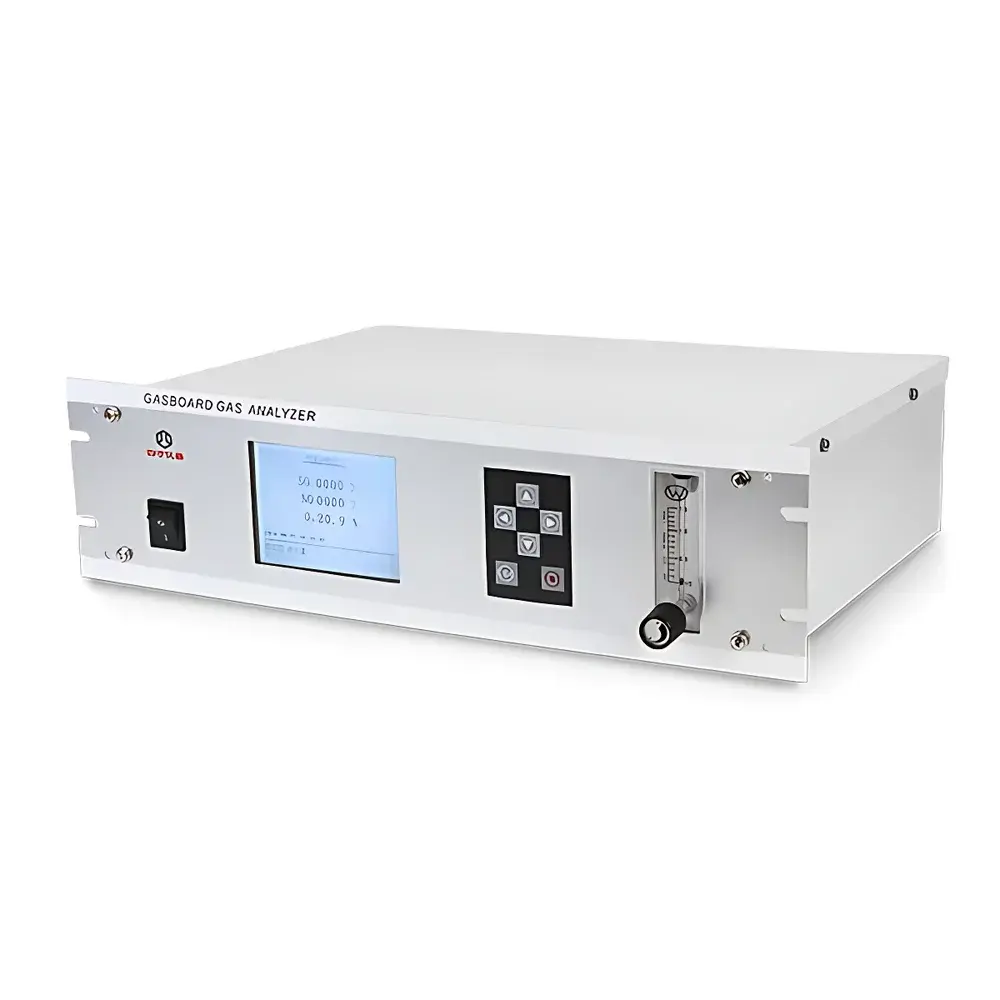

CUBIC INSTRUMENTS Gasboard-3000 Multi-Gas Flue Gas Analyzer
| Brand | CUBIC INSTRUMENTS |
|---|---|
| Origin | Hubei, China |
| Manufacturer Type | Authorized Distributor |
| Country of Origin | China |
| Model | Gasboard-3000 |
| Instrument Type | Multi-Component Flue Gas Analyzer |
| Measurement Accuracy | SO₂, NO, CO: ±1 ppm |
| CO₂, O₂ | ±0.01% |
| Repeatability | ≤1% for SO₂, NO, CO, CO₂, O₂ |
| Response Time (T90) | <10 s (NDIR) |
| Stability | SO₂, NO, CO, CO₂: ≤±1% FS |
| O₂ | ≤±2% FS |
| Measured Gases | SO₂, NO, CO, CO₂, O₂ |
Overview
The CUBIC INSTRUMENTS Gasboard-3000 is a fixed-installation, multi-component flue gas analyzer engineered for continuous emission monitoring (CEM) in industrial combustion processes. It employs dual-sensing architecture: non-dispersive infrared (NDIR) spectroscopy for quantitative detection of SO₂, NO, CO, and CO₂, and electrochemical detection (ECD) for high-stability O₂ measurement. This hybrid optical–electrochemical design ensures selective, interference-free quantification across all five target gases without cross-sensitivity—particularly critical in complex flue streams containing variable moisture, particulate load, and combustion byproducts. The analyzer operates under real-time sampling conditions with minimal conditioning requirements, supporting direct integration into boiler control systems, desulfurization (FGD), and denitrification (SCR/SNCR) process loops. Its core application scope aligns with regulatory compliance frameworks for stationary source emissions, including EPA Method 6C, EN 15267-3, and GB/T 16157–2018.
Key Features
- True multi-gas NDIR platform: Simultaneous, independent quantification of SO₂, NO, CO, and CO₂ using dedicated optical channels with temperature- and pressure-compensated algorithms.
- Robust sensor housing: All wetted components—including sample cell, filter housing, and flow path—are constructed from corrosion-resistant 316 stainless steel and PTFE-lined tubing to withstand acidic condensates and elevated flue temperatures up to 180 °C (with optional heated probe).
- Zero-drift mitigation: Integrated air-purge zero calibration pump enables automated daily or on-demand zeroing without external gas cylinders—critical for long-term unattended operation.
- Flow-insensitive measurement: NDIR-based gas channels maintain accuracy across the specified sample flow range (0.7–1.2 L/min), eliminating need for precision mass flow controllers in most field installations.
- Real-time diagnostics: On-board self-test routines continuously monitor detector responsivity, optical path integrity, and electrochemical sensor health, logging fault codes compliant with IEC 61508 SIL 2 functional safety principles.
Sample Compatibility & Compliance
The Gasboard-3000 is designed for use with conditioned flue gas streams meeting standard CEM pre-treatment criteria: particulate content < 5 mg/m³, dew point < 5 °C, and oil-free sampling. It complies with ISO 14064-1 Annex A for GHG monitoring system validation and supports data traceability per ISO/IEC 17025:2017 for accredited laboratories. For regulatory reporting, its measurement uncertainty budget satisfies EN 14181 QAL1/QAL2 requirements when deployed with certified calibration gases traceable to NIST SRMs. While not intrinsically safe, it meets CE marking for EMC Directive 2014/30/EU and Low Voltage Directive 2014/35/EU.
Software & Data Management
Data output is delivered via dual isolated analog (4–20 mA) channels and digital serial interfaces (RS-232/RS-485 Modbus RTU). The embedded firmware supports configurable alarm thresholds, linearization tables, and span/zero event logging with UTC timestamps. When integrated into centralized SCADA or DCS platforms, raw concentration values, diagnostic flags, and calibration history are transmitted in ASCII or Modbus register format. Audit trails—including user-initiated calibrations and parameter changes—are retained for ≥30 days and exportable via USB port, fulfilling GLP-aligned record-keeping expectations for environmental QA/QC workflows.
Applications
- Coal-fired power plant stack monitoring: Real-time tracking of SO₂, NOₓ, and CO for FGD/SCR performance verification and permit compliance reporting.
- Industrial furnace and kiln optimization: Closed-loop O₂ feedback control to minimize excess air and improve thermal efficiency while suppressing CO formation.
- Coal mill and pulverized coal silo safety monitoring: Continuous CO surveillance at sub-ppm resolution to detect early-stage smoldering or spontaneous combustion events.
- Municipal solid waste incinerators: Co-monitoring of CO and O₂ as combustion efficiency indicators per EU Waste Incineration Directive (2000/76/EC).
- Research-grade emission characterization: Stable baseline performance supports method development for emerging pollutants (e.g., NH₃ slip, HCl) when coupled with optional add-on modules.
FAQ
What gas standards are required for calibration?
Certified calibration gases traceable to NIST or equivalent national metrology institutes are required: SO₂/N₂ (100 ppm), NO/N₂ (100 ppm), CO/N₂ (100 ppm), CO₂/N₂ (10%), and O₂/N₂ (10%). Span calibration must be performed quarterly; zero calibration is recommended daily.
Can the analyzer operate without active sample conditioning?
It requires filtered, dried, and cooled sample gas. While no chiller is mandatory, a thermoelectric cooler or permeation dryer is strongly advised for high-moisture flue streams (>10% H₂O) to prevent condensation in the NDIR cell.
Is FDA 21 CFR Part 11 compliance supported?
The device itself does not provide electronic signature or audit trail features required for Part 11; however, when connected to validated third-party data acquisition software with role-based access control and electronic signature capability, full compliance can be achieved at the system level.
What maintenance intervals are recommended?
Optical windows should be inspected monthly; electrochemical O₂ sensors require replacement every 24 months; NDIR detectors have a service life exceeding 10 years under normal operating conditions.
Does the Gasboard-3000 support remote firmware updates?
Firmware upgrades are performed locally via USB interface using CUBIC’s proprietary configuration utility; remote update capability is not implemented for cybersecurity reasons per IEC 62443-3-3 guidelines.
Related Products







