
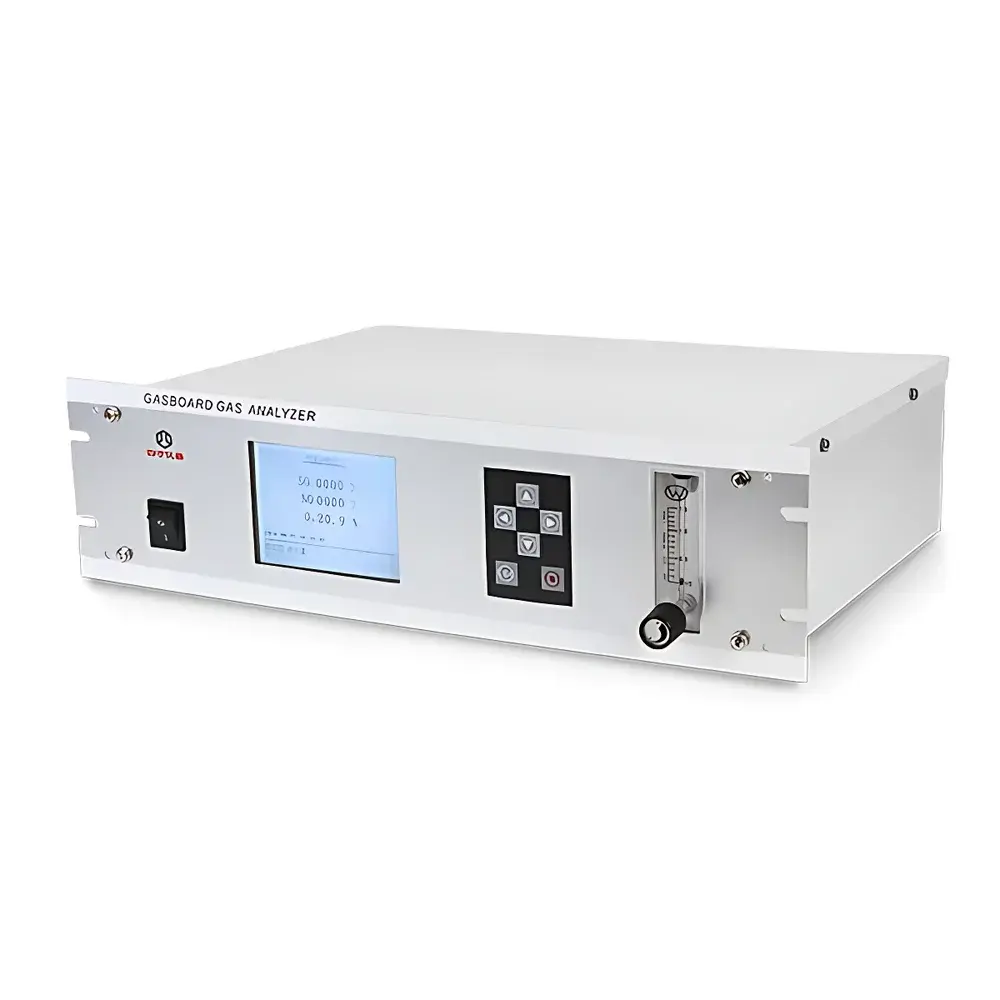
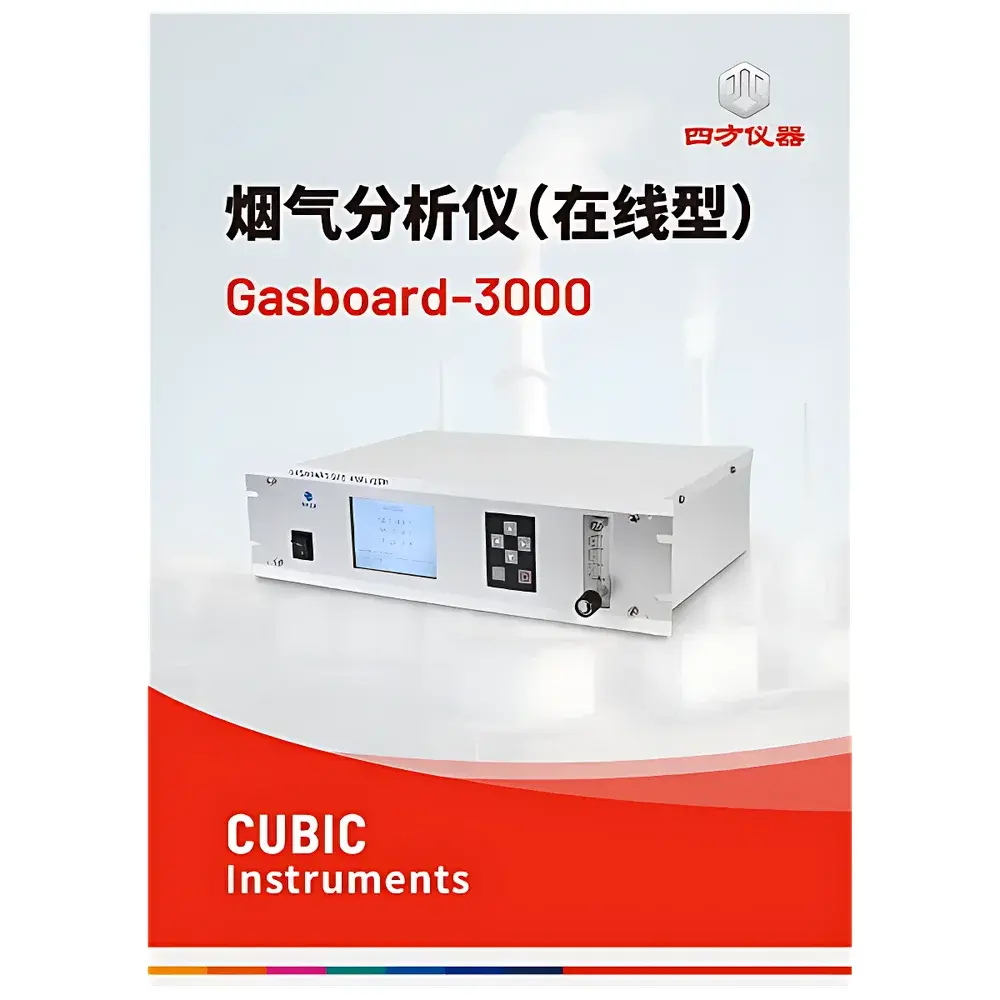

CUBIC INSTRUMENTS Gasboard-3000 Multi-Gas Flue Gas Analyzer
| Brand | CUBIC INSTRUMENTS |
|---|---|
| Origin | Hubei, China |
| Model | Gasboard-3000 |
| Measurement Principle | NDIR (SO₂/NO/CO/CO₂), Electrochemical (O₂) |
| Measurement Range | SO₂/NO: 0–2000 ppm |
| CO | 0–10000 ppm |
| CO₂/O₂ | 0–25% vol |
| Accuracy | SO₂/NO/CO/CO₂: ±1% FS |
| O₂ | ±2% FS |
| Resolution | SO₂/NO/CO: 1 ppm |
| CO₂/O₂ | 0.01% vol |
| Repeatability | ≤1% |
| Response Time (T₉₀) | <20 s (NDIR) |
| Zero Drift Stability | SO₂/NO/CO/CO₂: ≤±1% FS |
| O₂ | ≤±2% FS |
| Sample Flow Rate | 0.7–1.2 L/min |
| Inlet Pressure | 2–50 kPa |
| Sample Requirements | Dust-free, moisture-free, oil-free |
| Output Interfaces | RS-485, RS-232, 4–20 mA |
| Power Supply | AC 220 V, 50 Hz |
| Display | LCD with built-in diagnostics and auto-zero function using integrated air pump |
Overview
The CUBIC INSTRUMENTS Gasboard-3000 is a compact, industrial-grade multi-gas flue gas analyzer engineered for continuous emission monitoring (CEM) of key combustion byproducts in stationary source exhaust streams. It employs dual-sensing architecture: non-dispersive infrared (NDIR) spectroscopy for quantitative detection of SO₂, NO, CO, and CO₂; and electrochemical detection (ECD) for precise O₂ measurement. This hybrid optical–electrochemical design ensures high selectivity and minimal cross-sensitivity across target analytes—critical for regulatory compliance in environments where gas matrix complexity (e.g., variable humidity, particulate load, or co-existing interferents) challenges conventional single-technology analyzers. The instrument is designed for permanent installation in stack ducts or extractive sampling systems, supporting real-time process feedback and environmental reporting under ISO 14064, EN 15267, and EPA Method 6C/7E frameworks.
Key Features
- Multi-component simultaneous analysis of SO₂, NO, CO, CO₂, and O₂ without inter-gas interference—validated per IEC 62942-2 for cross-sensitivity performance.
- Robust wet-gas tolerance: NDIR channels maintain calibration integrity in the presence of saturated water vapor, eliminating need for aggressive sample drying that risks analyte loss or condensation-induced drift.
- Flow-insensitive measurement for SO₂, NO, and CO—enabling stable readings across dynamic extraction flow conditions typical in forced-draft or induced-draft flue systems.
- Corrosion-resistant wetted path constructed from 316L stainless steel and PTFE-lined components, rated for continuous exposure to acidic flue gases up to 180 °C (with optional heated probe).
- Integrated zero-air pump with programmable auto-zero cycle—reducing manual maintenance intervals and supporting GLP-compliant drift verification logs.
- Self-diagnostic firmware with real-time sensor health monitoring, fault logging, and configurable alarm thresholds via front-panel interface or remote command set.
Sample Compatibility & Compliance
The Gasboard-3000 accepts conditioned extractive samples meeting EPA PS-11 and EN 14181 requirements: particulate-free (<1 µm filter), dew-point controlled (<5 °C), and oil-free. Its NDIR modules are compliant with ASTM D6522 for CO/CO₂ quantification and meet the spectral resolution criteria outlined in ISO 12039 for SO₂/NO detection in flue gas matrices. The electrochemical O₂ sensor conforms to EN 50104 for safety-critical oxygen monitoring applications. All measurement outputs support traceability per ISO/IEC 17025 when paired with documented calibration gas certificates (NIST-traceable standards recommended). The analyzer meets EMC Directive 2014/30/EU and carries CE marking for industrial use in Class II, Group IIB hazardous locations when installed with appropriate barrier systems.
Software & Data Management
Data acquisition and configuration are managed via embedded firmware supporting Modbus RTU over RS-485 or ASCII protocol over RS-232. Analog 4–20 mA outputs are individually scalable per gas channel and support HART-compatible configuration tools. Raw concentration values, diagnostic status flags, and timestamped zero/span events are logged internally (non-volatile memory, 30-day buffer) and exportable via serial dump. Optional PC software enables trend visualization, report generation (PDF/CSV), and alignment with EPA’s Continuous Emission Monitoring System (CEMS) Data Acquisition and Handling System (DAHS) architecture—including audit trail functionality compliant with 40 CFR Part 75 Appendix B requirements.
Applications
- Real-time control of flue gas desulfurization (FGD) scrubbers and selective catalytic reduction (SCR) systems—providing closed-loop feedback for reagent dosing optimization.
- Coal-fired power plant boiler efficiency monitoring via O₂/CO ratio analysis and combustion stoichiometry assessment.
- Continuous monitoring of CO in coal pulverizing systems (e.g., mill inerting and fire prevention per NFPA 85 guidelines).
- Regulatory stack testing for Title V permit compliance, including quarterly linearity checks and daily relative accuracy test audits (RATA).
- Research-grade emission profiling in pilot-scale incinerators, cement kilns, and biomass boilers where multi-gas correlation studies inform abatement strategy development.
FAQ
Does the Gasboard-3000 require external calibration gas for routine operation?
No—it features an integrated zero-air pump enabling automatic air-based zero calibration. Span calibration requires certified reference gases at user-defined intervals (typically every 7–30 days depending on regulatory tier and application severity).
Can it operate in high-humidity flue gas without a chiller?
Yes—the NDIR channels are specifically engineered to reject water vapor spectral interference, allowing direct measurement of SO₂ and NO in saturated gas streams up to 100% RH when sample temperature remains above dew point.
Is the instrument suitable for unattended 24/7 CEMS deployment?
Yes—designed for Class 1, Division 2 industrial environments with IP65-rated enclosure, wide operating temperature range (0–50 °C), and redundant power input options. Firmware supports watchdog timers and automatic recovery from brownout events.
How is data integrity ensured for regulatory reporting?
All measurements include embedded timestamps, sensor health metadata, and digital signature-enabled log files. Optional DAHS integration provides full 21 CFR Part 11-compliant electronic records with user access controls and immutable audit trails.
What maintenance is required beyond calibration?
Annual inspection of inlet filters, O₂ sensor replacement (2-year typical service life), and verification of NDIR optical path cleanliness using manufacturer-provided cleaning kits. No consumables are required for NDIR modules.







