
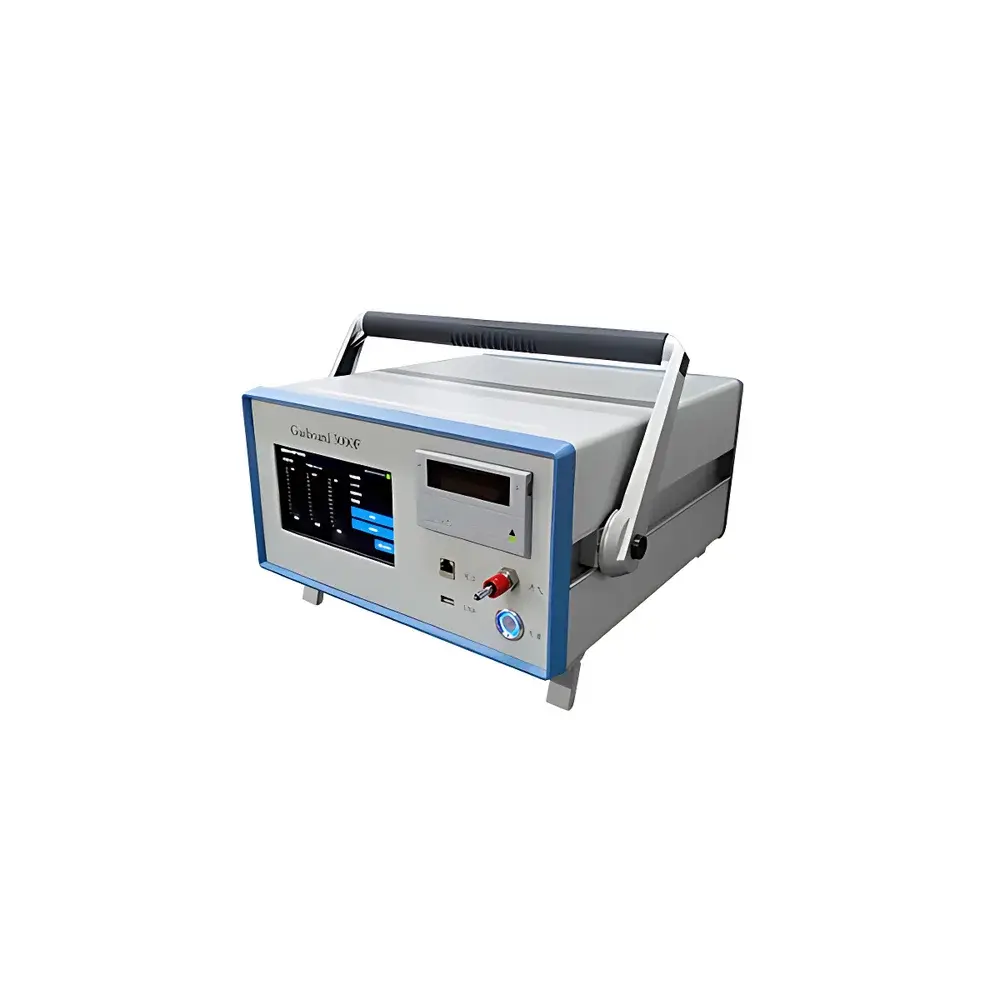
CUBIC INSTRUMENTS Gasboard-3000F SF₆ Multicomponent Gas Analyzer
| Brand | CUBIC INSTRUMENTS |
|---|---|
| Origin | Hubei, China |
| Model | Gasboard-3000F |
| Type | Online Analyzer |
| Measurement Principle | UV-Differential Optical Absorption Spectroscopy (UV-DOAS) & Tunable Diode Laser Absorption Spectroscopy (TDLAS) |
| Response Time | 60 sec @ T90 |
| Repeatability | ≤1% FS |
| H₂S Range | 0–100 ppm |
| SO₂ Range | 0–100 ppm |
| CO Range | 0–500 ppm |
| SF₆ Range | 0–100% vol |
| Dew Point Range | −60 to +20 °C |
| Resolution | H₂S/SO₂/CO: 0.1 ppm |
| SF₆ | 0.01% vol |
| Dew Point | 0.1 °C |
| Linearity Error | ±1% FS |
| Zero Drift | ±2% FS / 4 h |
| Span Drift | ±2% FS / 4 h |
| Warm-up Time | 45 min |
| Power Supply | Internal Li-ion Battery (4 h runtime) |
| Power Consumption | <100 W |
| Operating Temp. | 5–40 °C |
| RH | ≤95% RH |
| Pressure | 70–106 kPa |
| Communication | USB, RS-232, RS-485 |
Overview
The CUBIC INSTRUMENTS Gasboard-3000F SF₆ Multicomponent Gas Analyzer is an online, real-time analytical instrument engineered for continuous monitoring and quantitative assessment of sulfur hexafluoride (SF₆) gas purity and decomposition byproducts in high-voltage electrical equipment—particularly gas-insulated switchgear (GIS), circuit breakers, and transformers. It integrates two complementary optical absorption techniques: Ultraviolet Differential Optical Absorption Spectroscopy (UV-DOAS) for simultaneous, interference-resistant detection of H₂S and SO₂ at sub-ppm levels, and Tunable Diode Laser Absorption Spectroscopy (TDLAS) for highly selective, stable quantification of CO and bulk SF₆ concentration. The system employs a folded-path, temperature-stabilized optical cell with extended effective pathlength (>1 m), enabling enhanced sensitivity and signal-to-noise ratio without chemical reagents or consumables. Its dual-spectrum architecture mitigates cross-sensitivity from background gases (e.g., O₂, N₂, H₂O vapor) and ensures robust performance under fluctuating ambient conditions—critical for unattended operation in substations and power plants.
Key Features
- Dual-technology optical platform: UV-DOAS (200–300 nm spectral range) for H₂S and SO₂; TDLAS (near-infrared, ~2.3 µm) for CO and SF₆
- Integrated dew point sensor with real-time humidity compensation, enabling accurate gas-phase concentration correction per ISO 8573-3
- Thermally stabilized optical module with active temperature control (±0.1 °C), minimizing thermal drift and ensuring long-term baseline stability
- Modular hardware architecture: detachable gas inlet unit, optical sensing core, and embedded controller—facilitating field calibration, component replacement, and OEM integration
- Multi-interface digital communication suite: isolated RS-232/RS-485 (Modbus RTU protocol) for SCADA integration, plus USB for local configuration and firmware updates
- Internal rechargeable lithium-ion battery supporting up to 4 hours of autonomous operation—ideal for mobile diagnostics, commissioning, and emergency response scenarios
Sample Compatibility & Compliance
The Gasboard-3000F is designed exclusively for dry, non-corrosive SF₆-based gas streams conforming to IEC 60480 and ASTM D2472 specifications. It accepts sample gas at pressures between 70–106 kPa and temperatures from 5–40 °C, with automatic pressure and temperature compensation applied to all concentration outputs. The analyzer meets electromagnetic compatibility requirements per EN 61326-1 (industrial environment) and carries CE marking. While not certified for hazardous area use (e.g., ATEX/IECEx), its intrinsically safe design and sealed optical path comply with IP54 enclosure rating. Data integrity protocols align with GLP/GMP principles: full audit trail logging (time-stamped calibration events, zero/span checks), user-access control tiers, and non-volatile memory retention of ≥30 days’ raw spectra and processed results.
Software & Data Management
Bundled PC software (Gasboard Control Suite v3.x) provides comprehensive instrument management: real-time waveform visualization, spectral fitting diagnostics, multi-point calibration wizard, and automated report generation compliant with ISO/IEC 17025 documentation standards. All measurement data—including raw absorbance spectra, calibrated concentrations, dew point trends, and system health metrics—are timestamped, stored in CSV/SQLite format, and exportable for LIMS integration. Firmware supports remote firmware updates via secure HTTPS, and the embedded web server (accessible via Ethernet or USB-RNDIS) enables browser-based monitoring without proprietary drivers. Audit logs meet FDA 21 CFR Part 11 requirements for electronic records and signatures when deployed with optional role-based authentication and digital certificate support.
Applications
- Condition-based maintenance of GIS systems: early detection of partial discharge (PD) and arcing faults via SO₂/H₂S/CO trend analysis per IEEE C37.122.3 guidelines
- Post-arc SF₆ reclamation verification: quantifying decomposition products prior to recycling or disposal per IEC 62271-4
- Factory acceptance testing (FAT) and site acceptance testing (SAT) of new SF₆-filled equipment
- Continuous emissions monitoring (CEM) in SF₆ handling facilities subject to EU F-Gas Regulation (EU No 517/2014) reporting obligations
- Research-grade studies on SF₆ decomposition kinetics under controlled electrical stress conditions
FAQ
What gas components does the Gasboard-3000F measure simultaneously?
It measures H₂S (0–100 ppm), SO₂ (0–100 ppm), CO (0–500 ppm), SF₆ (0–100% vol), and dew point (−60 to +20 °C) in a single gas stream.
Is external gas conditioning required before sampling?
No external dryer or filter is mandatory; however, particulate filtration (≤1 µm) and removal of liquid condensate upstream are recommended to protect the optical cell and dew sensor.
How is calibration performed and how often is it needed?
Zero calibration uses certified nitrogen or synthetic air; span calibration requires traceable gas standards (e.g., SO₂/N₂, H₂S/N₂). Initial calibration is recommended after 30 days of operation, then quarterly under stable conditions—or following any mechanical shock, temperature excursion >10 °C, or maintenance event.
Can the analyzer be integrated into a plant-wide DCS or SCADA system?
Yes—via RS-485 Modbus RTU (addressable node ID, configurable baud rate up to 115.2 kbps) with register mapping provided in the integration manual.
Does the device support automated data logging without a connected PC?
Yes—the internal microSD card (pre-installed, 8 GB) stores 12+ months of 1-minute interval data (concentrations, dew point, status flags) with cyclic overwrite protection.
Related Products







