
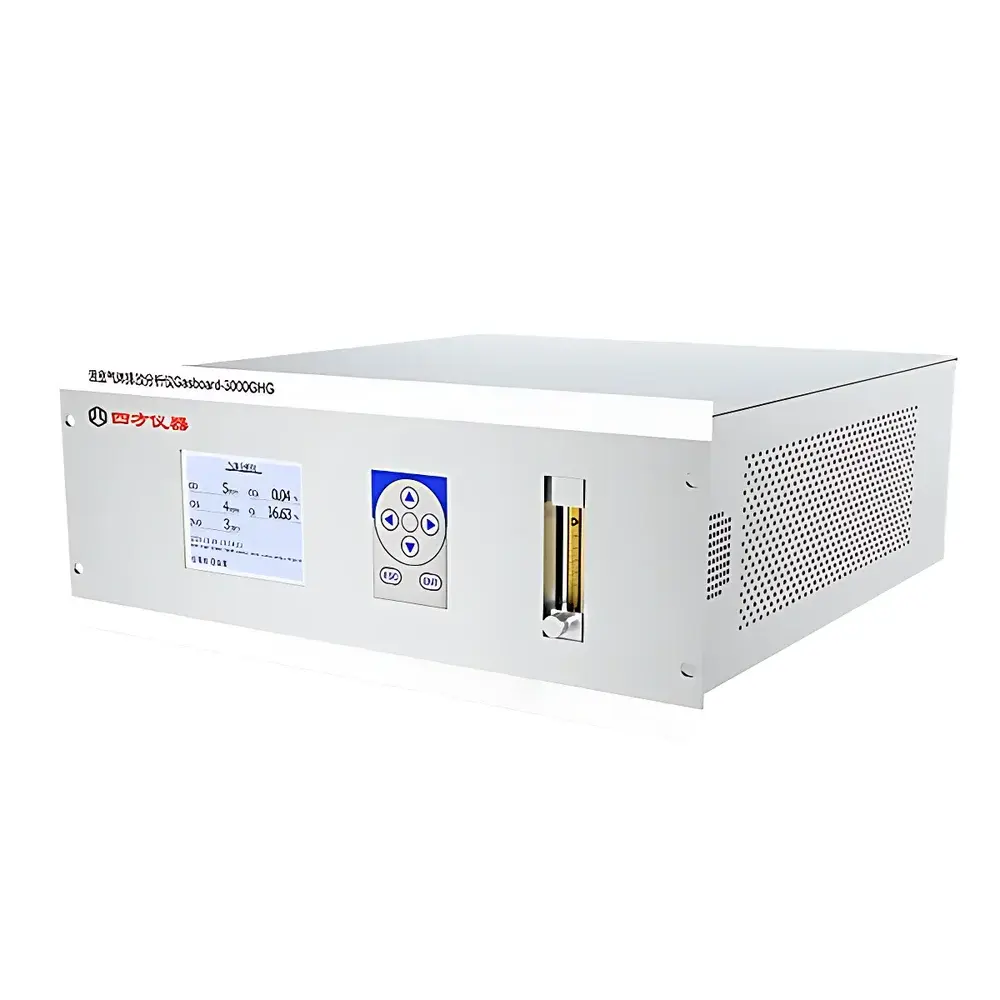
CUBIC INSTRUMENTS Gasboard-3000GHG Greenhouse Gas Emission Analyzer
| Brand | CUBIC INSTRUMENTS |
|---|---|
| Origin | Hubei, China |
| Manufacturer Type | Authorized Distributor |
| Product Origin | Domestic (China) |
| Model | Gasboard-3000GHG |
| Measurement Principle | Micro-flow NDIR (CO₂/CH₄/N₂O/CO), Dual-beam NDIR (high-range CO₂ & mid-high-range CO), Electrochemical Detection (O₂) |
| Accuracy | ±1% F.S. (micro-flow NDIR for CO₂/CH₄/N₂O/CO) |
| Measured Gases & Ranges | CO₂ (0–500 ppm / 0–20% / 0–100%), CH₄ (0–1000 ppm), N₂O (0–1000 ppm), CO (0–200 ppm / 0–5000 ppm / 0–5%), O₂ (0–25%) |
| Response Time | T₉₀ < 25 s |
| Repeatability | ≤ ±1% |
| Flow Rate | 0.7–1.2 L/min |
| Sample Pressure | 2–50 kPa |
| Sample Conditioning | Water removal (no condensate), particulate filtration (<1 µm) |
Overview
The CUBIC INSTRUMENTS Gasboard-3000GHG is a multi-gas emission analyzer engineered for continuous, real-time monitoring of greenhouse gases (GHGs) and combustion-related species in industrial flue gas streams—specifically designed for demanding applications in petroleum refining, petrochemical processing, and energy-intensive manufacturing. Its core measurement architecture integrates three complementary detection technologies within a single, compact platform: micro-flow non-dispersive infrared (NDIR) sensing for low-concentration GHG quantification; dual-beam NDIR for high-dynamic-range CO₂ and CO analysis; and electrochemical detection (ECD) for oxygen. This hybrid sensor strategy enables simultaneous, independent measurement of CO₂, CH₄, N₂O, CO, and O₂ with metrological traceability appropriate for regulatory reporting, process optimization, and carbon accounting under frameworks such as the EU ETS, EPA GHG Reporting Program (40 CFR Part 98), and ISO 14064-3 verification protocols.
Key Features
- Simultaneous five-gas analysis (CO₂, CH₄, N₂O, CO, O₂) in a single instrument—eliminating cross-platform calibration drift and inter-unit variability.
- Proprietary micro-flow NDIR detection with patented half-cell reference chamber design (PCT/CN2018100767; CN201710720122.1), delivering sub-ppm resolution (1 ppm) and ±1% full-scale accuracy for CO₂, CH₄, N₂O, and CO down to 200 ppm—optimized for ambient and dilute stack conditions.
- Dual-beam NDIR modules for high-concentration CO₂ (up to 100%) and mid-to-high range CO (up to 5%), providing enhanced stability against optical contamination and thermal drift in hot, humid flue environments.
- Electrochemical O₂ sensor with 0.01% resolution and integrated temperature/pressure compensation, compliant with ASTM D6522 and EN 15267-3 requirements for combustion efficiency monitoring.
- Robust sample conditioning interface: accepts conditioned gas at 2–50 kPa pressure, requires only <1 µm particulate filtration and dew-point control (no condensate), minimizing maintenance burden in harsh industrial settings.
- Comprehensive diagnostics: automated self-check routines monitor sensor health, optical path integrity, and flow stability—generating event logs compatible with predictive maintenance workflows.
Sample Compatibility & Compliance
The Gasboard-3000GHG is validated for use with dry, filtered flue gas from fossil-fueled combustion sources—including refinery heaters, FCC units, ethylene crackers, sulfur recovery units, and catalytic reformers. It meets the physical and chemical robustness criteria outlined in EPA Method 3A (for CO₂/O₂), Method 10 (for CO), and draft ISO/CD 21258 (greenhouse gas concentration measurement in stationary sources). While not certified to UL/CSA explosion-proof standards out-of-the-box, it supports integration into Class I, Division 2 hazardous area systems via external sample extraction and conditioning skids. Data output formats comply with Modbus RTU (RS-485) and HART-compatible 4–20 mA analog signals, enabling seamless ingestion into DCS, SCADA, and environmental data management systems (EDMS) operating under ISO 50001 or ISO 14001 frameworks.
Software & Data Management
The analyzer operates with embedded firmware supporting local configuration, real-time trend visualization, and alarm thresholding via an intuitive web-based GUI accessible over Ethernet. All measurements are timestamped with internal RTC and stored in non-volatile memory (≥30 days at 1-minute intervals). Raw and processed data export supports CSV and XML formats, with optional integration into third-party platforms including OSIsoft PI System, GE Proficy, and Siemens Desigo CC via OPC UA or MQTT. Audit trails record all parameter changes, calibration events, and diagnostic alerts—fully compliant with ALCOA+ principles for data integrity and meeting the electronic record requirements of FDA 21 CFR Part 11 when deployed in regulated pharmaceutical or fine chemical production environments.
Applications
- Petroleum refining: Continuous monitoring of CO₂, CH₄, and N₂O emissions from fluid catalytic cracking (FCC), hydroprocessing, and sulfur recovery units for compliance with EPA Subpart Ja and EU Monitoring and Reporting Regulation (MRR).
- Petrochemical plants: Quantification of fugitive and vented CH₄ from compressors, flares, and storage tanks—supporting LDAR programs aligned with OSHA PSM and EPA LDAR Rule 40 CFR Part 60, Subpart VV.
- Steam methane reforming (SMR) and hydrogen production units: Real-time CO and CO₂ ratio tracking for catalyst health assessment and syngas quality control.
- Waste heat recovery and boiler optimization: Co-monitoring of O₂ and CO to calculate excess air and combustion efficiency per ASME PTC 4 and EN 12952-15.
- Carbon capture readiness assessment: Baseline GHG profiling across unit operations to inform CCS feasibility studies and techno-economic modeling (TEM).
FAQ
What regulatory standards does the Gasboard-3000GHG support for GHG reporting?
It aligns with EPA GHGRP Subpart Ja (petroleum refineries), ISO 14064-3 verification requirements, and EU MRR Annex IV methodologies for continuous emission monitoring systems (CEMS) measuring CO₂, CH₄, and N₂O.
Can the analyzer operate without external gas conditioning?
No—it requires inlet gas to be free of liquid water (dew point <5°C below sample temperature) and particulates <1 µm; optional heated sample lines and permeation dryers are recommended for high-moisture stacks.
Is calibration traceable to NIST or other national standards?
Yes—factory calibration uses NIST-traceable certified gas mixtures (e.g., Scott-Marrin, Air Liquide); field calibration kits include certified span gases with uncertainty budgets documented per ISO 6141.
How is sensor drift managed during long-term deployment?
Micro-flow NDIR modules feature active zero-reference compensation using the patented half-cell chamber; dual-beam NDIR incorporates real-time reference beam normalization; both reduce baseline drift to <±0.5% F.S./month under typical operating conditions.
Does the system support remote firmware updates and diagnostics?
Yes—secure HTTPS-based firmware updates and diagnostic telemetry are supported via Ethernet; TLS 1.2 encryption ensures data integrity during remote access.
Related Products







