
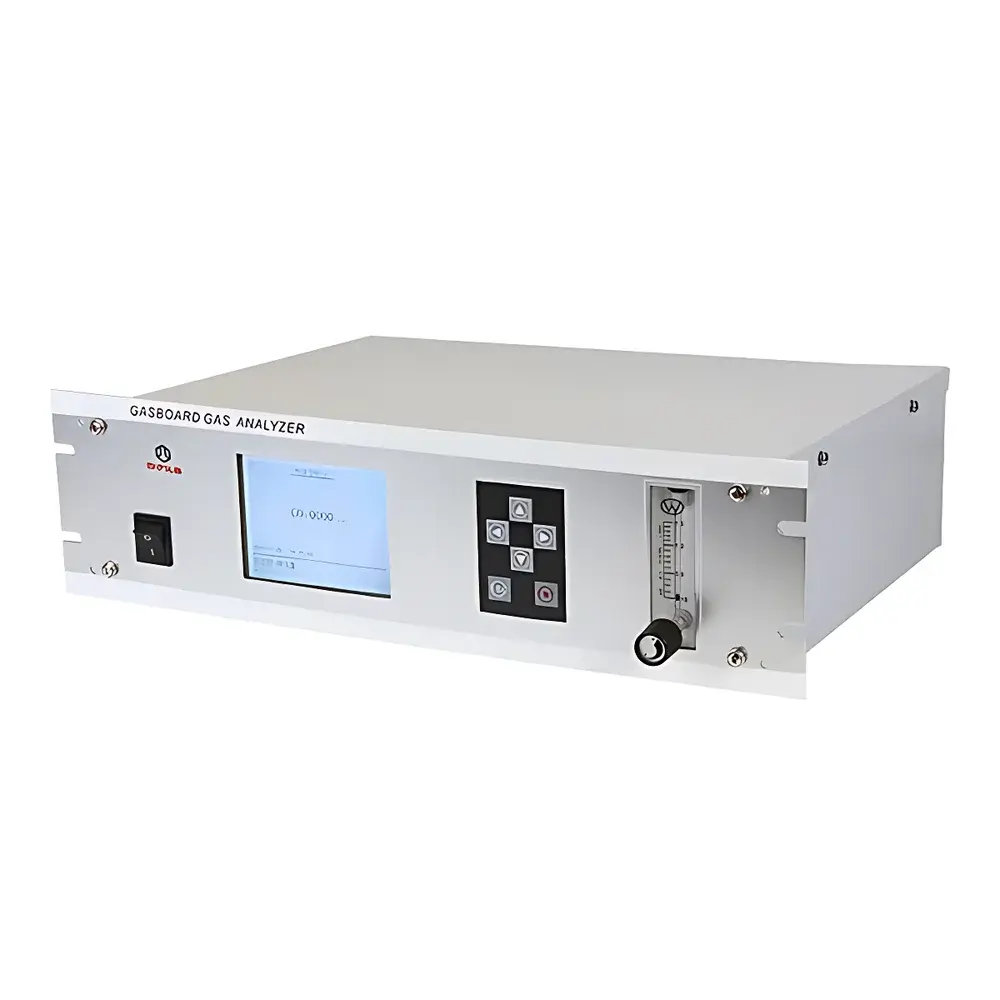
CUBIC INSTRUMENTS Gasboard-3000Plus Online Multi-Gas Emission Analyzer for CO, CO₂, SO₂, NO, and O₂
| Brand | CUBIC INSTRUMENTS |
|---|---|
| Origin | Hubei, China |
| Manufacturer Type | Authorized Distributor |
| Product Origin | Domestic (China) |
| Model | Gasboard-3000Plus |
| Instrument Type | Online Fixed-Mount Analyzer |
| Measured Gases | SO₂, NO, CO, CO₂, O₂ |
| Measurement Range | SO₂/NO: (0–200) ppm |
| CO | (500–5000) ppm |
| CO₂/O₂ | (0–25) % vol |
| Repeatability | < 2% |
| Resolution | SO₂/NO: 1 ppm |
| CO | 1 ppm |
| CO₂/O₂ | 0.01% vol |
| Response Time (T₉₀) | < 25 s (NDIR channels) |
| Linearity Error | ≤ ±2% F.S. |
| Sample Flow Rate | (0.7–1.2) L/min |
| Output Interfaces | RS-485 / RS-232 serial, (4–20) mA analog |
| Power Supply | 100–240 VAC, 150 W |
| Detection Principle | Micro-Flow NDIR (SO₂, NO, CO), Broadband NDIR (CO₂), Electrochemical Detection (O₂) |
| Zero Calibration | Integrated air pump with automatic ambient-air zeroing |
Overview
The CUBIC INSTRUMENTS Gasboard-3000Plus is an online, fixed-mount multi-component flue gas emission analyzer engineered for continuous, real-time monitoring of key combustion byproducts—including carbon monoxide (CO), carbon dioxide (CO₂), sulfur dioxide (SO₂), nitrogen oxide (NO), and oxygen (O₂)—in industrial stack exhaust streams. It employs proprietary micro-flow non-dispersive infrared (NDIR) spectroscopy for SO₂, NO, and CO detection, complemented by broadband NDIR for CO₂ and electrochemical detection (ECD) for O₂. Its core innovation lies in the patented half-cell gas chamber architecture, which minimizes optical path interference, enhances signal stability, and significantly reduces thermal and electrical drift—critical for long-term unattended operation in fluctuating ambient conditions typical of boiler houses, smelters, and cement kiln environments. Unlike conventional extractive analyzers requiring frequent calibration or complex conditioning systems, the Gasboard-3000Plus integrates robust internal compensation algorithms for cross-gas interference (e.g., automatic CO₂ correction during CO quantification), ensuring metrological integrity without external reference gases.
Key Features
- Micro-flow NDIR detection module with dual-beam optical design for SO₂, NO, and CO—optimized for low-concentration accuracy and high signal-to-noise ratio
- Half-cell gas chamber configuration reducing sensitivity to temperature gradients and pressure fluctuations
- Automatic ambient-air zero calibration via built-in diaphragm pump, eliminating need for bottled zero gas
- Real-time cross-sensitivity compensation: algorithmic correction of CO₂ spectral overlap on CO measurement channel
- Integrated self-diagnostic system with status logging for sensor health, optical path integrity, and flow verification
- Ruggedized industrial enclosure rated IP65, suitable for mounting directly adjacent to sampling probe housings or in control room cabinets
- Compliant with EN 15267-3 (QAL1 certification pathway) and aligned with technical requirements of EPA Method 6C, ISO 12039, and GB/T 16157 for stationary source emissions monitoring
Sample Compatibility & Compliance
The Gasboard-3000Plus is designed for hot/wet or conditioned extractive sampling configurations, supporting inlet gas temperatures up to 180 °C (with optional heated line) and particulate loading ≤ 100 mg/m³. It accepts standard 6–8 mm OD PTFE or stainless-steel sample lines and interfaces seamlessly with common heated probe assemblies and condensate removal units. All gas measurement channels meet linearity and repeatability specifications defined under ISO 12039 Annex B for CO and CO₂, and EN 14792 for NO and SO₂. The instrument supports audit-ready data logging with timestamped calibration events, zero/span checks, and fault codes—fully traceable for GLP/GMP-aligned environmental QA/QC programs. While not pre-certified for US EPA PS-11 or TÜV QAL1, its architecture conforms to the functional and performance criteria required for third-party verification under EU Industrial Emissions Directive (IED) and China’s HJ 75-2017/HJ 76-2017 regulatory frameworks.
Software & Data Management
The analyzer operates with embedded firmware supporting Modbus RTU over RS-485 and ASCII protocol over RS-232, enabling direct integration into DCS, SCADA, or EMS platforms without gateway hardware. Analog (4–20) mA outputs are individually assignable per gas channel with configurable scaling and damping filters. Local configuration and diagnostics are accessible via a backlit LCD interface with tactile keypad; remote access is supported via optional Ethernet module (not included). Data logging capacity retains ≥30 days of 1-minute averaged concentration values, flow rate, temperature, and diagnostic flags. Export is possible via USB mass storage in CSV format—compatible with Excel, MATLAB, and regulatory reporting tools such as EnviroPro and Emissions Monitoring Software (EMS) suites. Audit trails comply with ALCOA+ principles: attributable, legible, contemporaneous, original, accurate, complete, consistent, enduring, and available.
Applications
The Gasboard-3000Plus is deployed across regulated thermal process industries where continuous compliance reporting is mandatory. Typical installations include coal- and gas-fired power plant stacks; sintering belts and blast furnaces in integrated steelworks; alumina calciners and aluminum reduction cells; rotary kilns in cement manufacturing; sulfuric and nitric acid production absorbers; catalytic cracker regenerators in refineries; and biomass-fired district heating boilers. Its low-range SO₂/NO capability (0–200 ppm) makes it especially suited for post-SCR or post-FF scrubber monitoring, while the extended CO range (500–5000 ppm) supports combustion efficiency tuning in waste-to-energy incinerators and industrial furnaces operating under sub-stoichiometric conditions.
FAQ
Does the Gasboard-3000Plus require external zero/span gases for routine operation?
No—it features an integrated air pump for automatic zero calibration using ambient air. Span calibration requires certified span gases only during initial commissioning or after sensor replacement.
Can the analyzer operate continuously in high-humidity flue gas without condensation damage?
Yes—when paired with a properly maintained heated sample line and condensate trap, the unit tolerates dew points up to 90 °C. Internal optical chambers are temperature-stabilized to prevent lens fogging.
Is firmware update supported remotely?
Firmware updates must be performed locally via USB drive; remote OTA updates are not implemented for cybersecurity and regulatory validation reasons.
What is the recommended maintenance interval?
Optical windows should be inspected and cleaned every 3 months; electrochemical O₂ sensor life is typically 24 months under continuous operation; NDIR sources and detectors are rated for >5 years MTBF.
Does the device support 21 CFR Part 11-compliant electronic records?
While the embedded system provides full audit trail functionality (user actions, calibration logs, alarms), formal 21 CFR Part 11 compliance requires deployment within a validated IT infrastructure—this includes identity management, electronic signatures, and secure archive—typically implemented at the enterprise EMS level, not at the analyzer firmware layer.







