
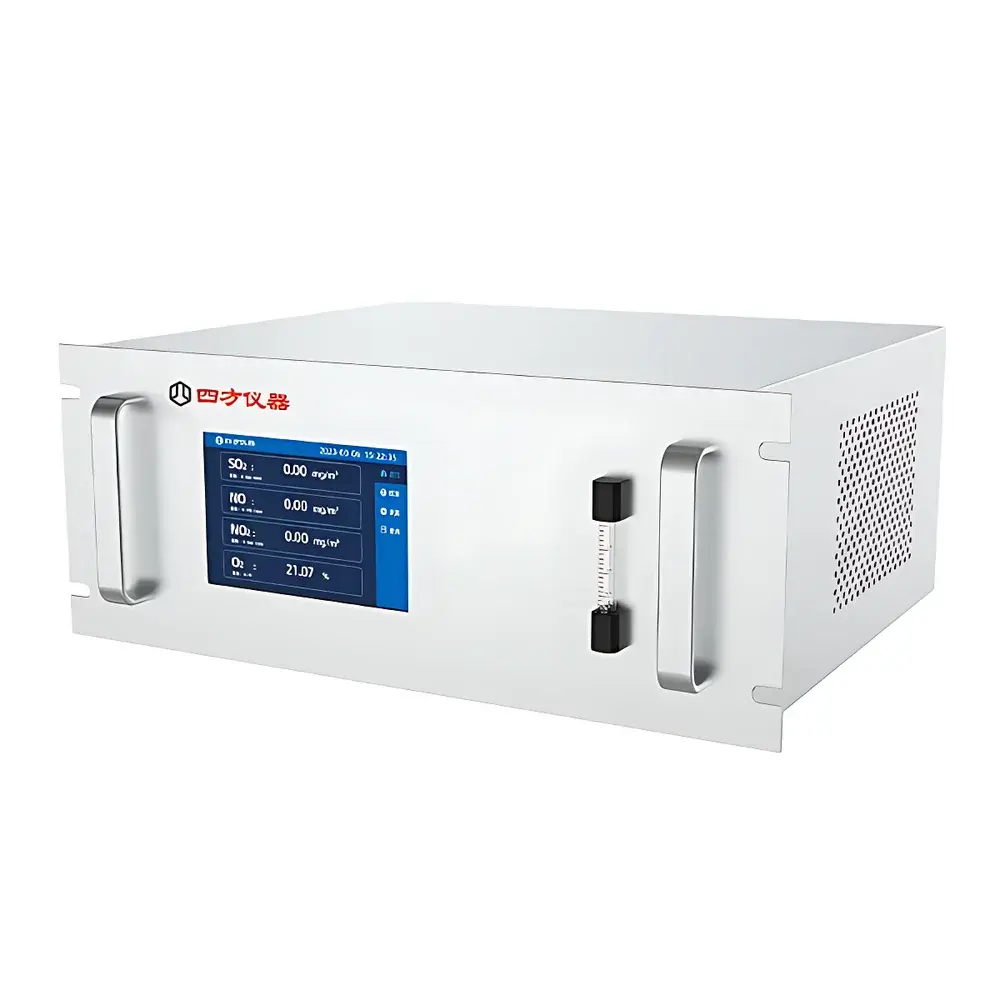
CUBIC INSTRUMENTS Gasboard-3006UV UV Differential Optical Absorption Spectroscopy (DOAS) Flue Gas Analyzer
| Brand | CUBIC INSTRUMENTS |
|---|---|
| Origin | Hubei, China |
| Model | Gasboard-3006UV |
| Measurement Principle | UV DOAS |
| Measured Gases | SO₂, NO, NO₂, O₂ |
| Accuracy | ≤±1% F.S. |
| Repeatability | ≤1% |
| Response Time | T₉₀ ≤30 s at 1 L/min |
| Stability | ≤±1.5% F.S./24 h |
| Linear Error | ≤±1% F.S. |
| Sample Flow Rate | 0.7–1.2 L/min |
| Display | 7-inch color TFT touchscreen (800×480) |
| Dimensions (W×H×D) | 438×173×350 mm |
| Power Supply | 100–240 VAC, 100 W |
| Communication | Dual RS232/RS485, 4–20 mA analog output |
Overview
The CUBIC INSTRUMENTS Gasboard-3006UV is an industrial-grade, continuous emissions monitoring system (CEMS) engineered for real-time, in-situ analysis of key flue gas constituents—SO₂, NO, NO₂, and O₂—using ultraviolet differential optical absorption spectroscopy (UV DOAS). Unlike conventional NDIR or electrochemical sensors, UV DOAS leverages the unique electronic transition absorption bands of target gases in the 190–230 nm spectral range, enabling selective, interference-resistant quantification even under high-humidity and particulate-laden conditions. The analyzer integrates a folded multi-pass optical cell with effective path lengths exceeding 1.2 m, significantly enhancing detection sensitivity and lowering practical detection limits to sub-ppm levels for NO and SO₂. Its robust thermal management system maintains optical alignment and detector response stability across ambient temperatures from 0 °C to 45 °C, ensuring compliance with long-term drift specifications per EN 15267-3 and EPA Method 6C.
Key Features
- High-stability deuterium lamp source with spectral output stability <0.5% over 1,000 hours, minimizing recalibration frequency and supporting ISO 14001-compliant maintenance intervals
- Dual-range measurement architecture (e.g., 0–100 mg/m³ / 0–1000 mg/m³ for SO₂), enabling high-resolution quantification at ultra-low emission thresholds while retaining full-scale linearity up to regulatory ceiling limits
- Integrated pneumatic control module with programmable relay outputs for external sampling pump and solenoid valve actuation—enabling automated zero/span calibration sequences compliant with EPA Performance Specification 2 (PS-2) and China’s HJ 75-2017
- Optimized cross-interference compensation algorithms based on reference spectra libraries for NO₂ and SO₂, reducing mutual spectral overlap errors to <2% of reading under typical coal-fired flue gas matrices
- Industrial-grade 7-inch capacitive touchscreen interface with IP65-rated front panel, supporting multilingual UI (English, Chinese, Spanish), user-defined alarm thresholds, and audit-trail-enabled configuration logging
- Comprehensive analog and digital I/O: isolated 4–20 mA outputs per measured component, dual RS232/RS485 ports with Modbus RTU protocol support, and optional Ethernet connectivity for SCADA integration
Sample Compatibility & Compliance
The Gasboard-3006UV is designed for direct extractive sampling from hot, wet flue gas streams (up to 200 °C inlet temperature with optional heated probe). It requires particulate filtration to <1 µm and condensate removal prior to inlet—typically achieved via a heated sampling line, thermoelectric chiller, and sintered stainless-steel filter. The analyzer meets CE marking requirements under the EU Emissions Trading System (EU ETS) monitoring guidelines and is type-approved per China’s HJ 1045-2019 standard for UV-based flue gas analyzers. Its measurement uncertainty budget satisfies the ±1.5% F.S. 24-hour stability requirement mandated by ISO 14956 for continuous monitoring of combustion emissions in cement, power, and waste incineration facilities.
Software & Data Management
Firmware supports embedded data logging (≥30 days at 1-minute intervals) with timestamped records of raw absorbance spectra, calculated concentrations, diagnostic flags (lamp intensity, cell temperature, flow rate), and calibration event history. All stored data are exportable via USB or serial interface in CSV format. Optional CEMS Manager software provides remote configuration, trend visualization, QA/QC report generation (including daily zero/span checks, linearity verification per ASTM D6522), and 21 CFR Part 11–compliant electronic signature functionality for regulated environments. Audit trails record all parameter changes, user logins, and calibration actions with immutable timestamps—supporting GLP/GMP-aligned quality assurance workflows.
Applications
- Continuous emission monitoring (CEM) in coal-, biomass-, and waste-fired power plants subject to national ultra-low emission standards (e.g., China’s “Ultra-Low Emission” policy: SO₂ <35 mg/m³, NOx <50 mg/m³)
- Process optimization and combustion efficiency control in cement kilns and glass melting furnaces
- Regulatory compliance verification for municipal solid waste incinerators under EU Directive 2000/76/EC and China’s GB 18485-2014
- Stack testing and reference method validation per EPA Method 6C (SO₂), Method 7E (NOₓ), and ISO 12039 (O₂)
- Research applications in atmospheric chemistry labs requiring stable, trace-level NO₂ quantification without chemical conversion artifacts
FAQ
Does the Gasboard-3006UV require periodic lamp replacement? How often?
Yes—the deuterium lamp is rated for ≥1,000 operational hours under continuous use. Lamp life is monitored in real time via spectral intensity feedback; firmware triggers a maintenance alert when output drops below 90% of initial baseline.
Can it operate unattended for extended periods in outdoor CEMS shelters?
Yes. With its wide input voltage range (100–240 VAC), internal thermal regulation, and conformal-coated PCBs, the unit achieves IP54 ingress protection when installed in NEMA-12 enclosures. Field deployments exceeding 12 months without intervention have been validated in multiple provincial environmental monitoring networks.
Is O₂ measurement based on paramagnetic or electrochemical sensing?
O₂ is measured using a built-in zirconia-based electrochemical sensor, calibrated against certified air standards. This hybrid approach avoids optical interference from water vapor while maintaining traceability to NIST-traceable references.
What calibration gases are required for routine verification?
Zero gas: high-purity nitrogen (99.999%). Span gases: certified SO₂/N₂, NO/N₂, and NO₂/N₂ mixtures at two concentrations (e.g., 50% and 90% of upper range), plus synthetic air for O₂. All calibrations follow HJ 76-2017 procedural requirements.
Related Products







