
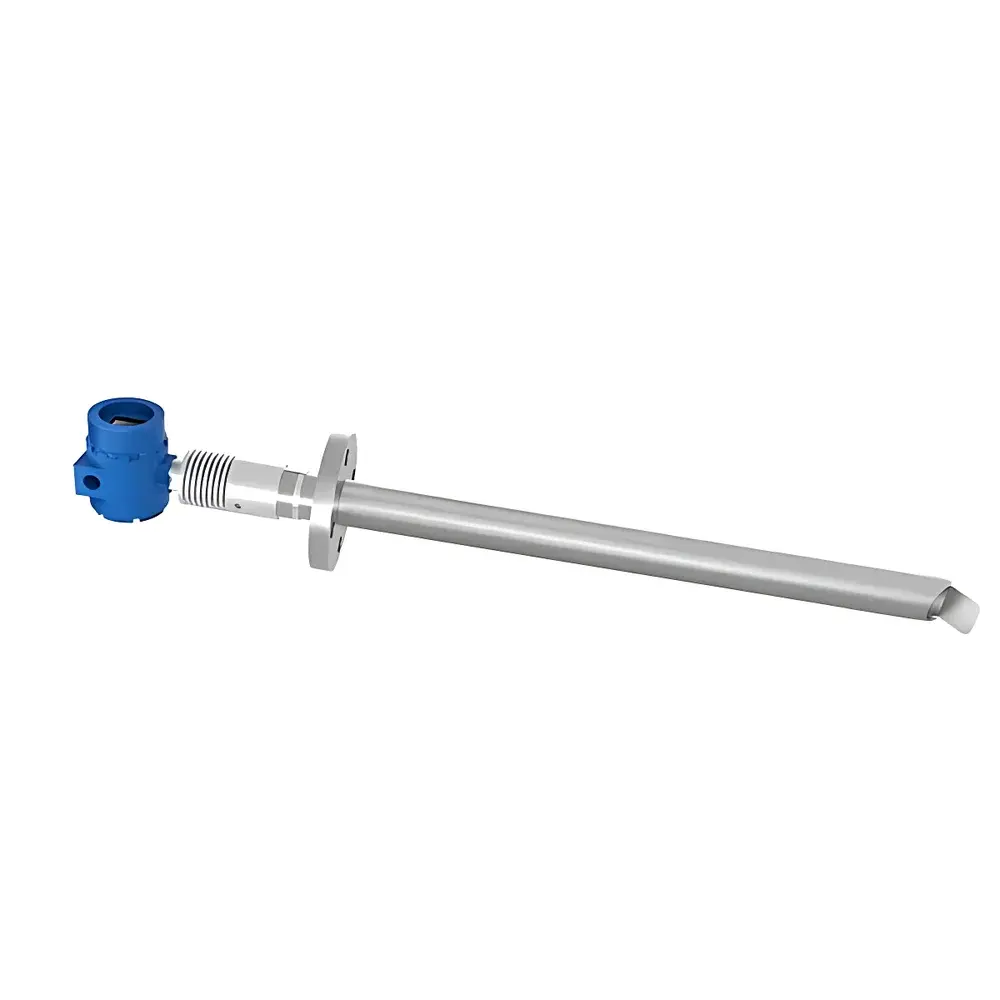
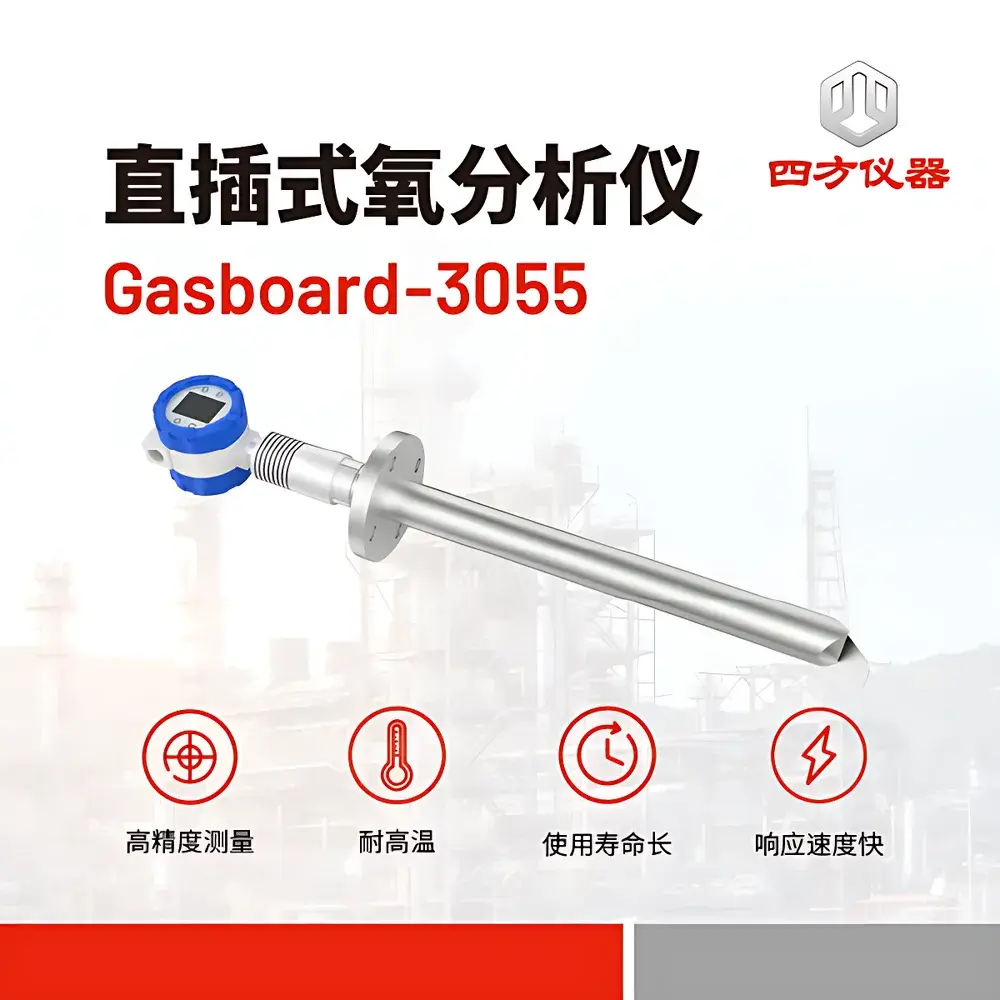
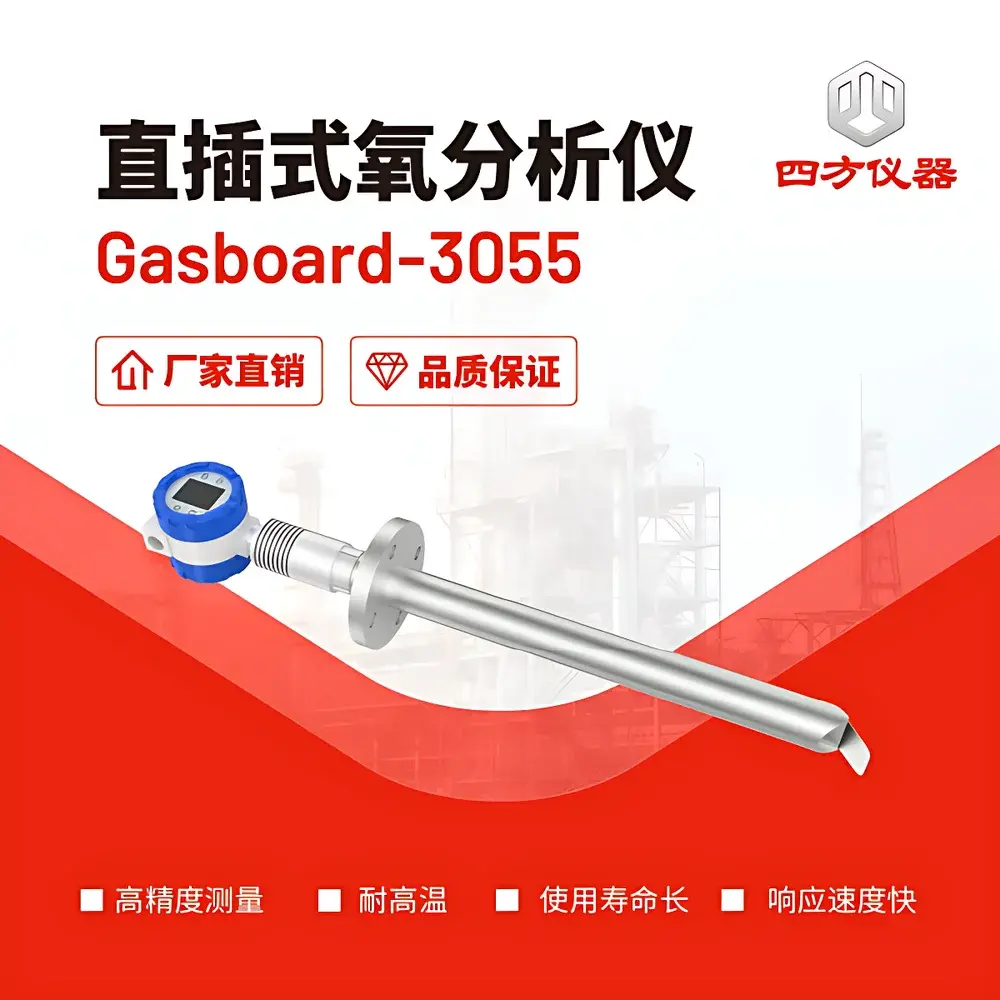
CUBIC INSTRUMENTS Gasboard-3055 In-Situ Zirconia Oxygen Analyzer
| Brand | CUBIC INSTRUMENTS |
|---|---|
| Origin | Hubei, China |
| Manufacturer Type | Authorized Distributor |
| Country of Origin | China |
| Model | Gasboard-3055 |
| Instrument Type | In-Situ Flue Gas Oxygen Analyzer |
| Measurement Range | 0–25% O₂ |
| Resolution | 0.1% O₂ |
| Accuracy | ±2% F.S. |
| Repeatability | ≤±1% F.S. |
| Response Time (T90) | <15 s |
| Stability | ±2% F.S. / 7 days |
| Operating Temperature (Flue Gas) | 0–700 °C |
| Probe Length Options | 500 / 1000 / 1500 mm (customizable) |
| Sampling Method | Flow-guided direct insertion |
| Installation | DN40 flange mount |
| Enclosure Rating | IP65 |
| Display | 128×160 color LCD |
| Output Signals | RS-485 & 4–20 mA |
| Relay Outputs | 2 channels |
| Power Supply | DC 24 V ±10%, 2 A |
Overview
The CUBIC INSTRUMENTS Gasboard-3055 is an in-situ zirconia-based oxygen analyzer engineered for continuous, real-time measurement of residual oxygen concentration in high-temperature flue gas streams. It employs a high-stability yttria-stabilized zirconium dioxide (YSZ) electrochemical sensor operating on the principle of oxygen partial pressure differential across a heated ceramic electrolyte—generating a Nernst voltage proportional to log(O₂ concentration). Unlike extractive systems requiring complex sample conditioning, the Gasboard-3055 features a fully integrated, direct-insertion probe design that eliminates sampling lag, condensation artifacts, and calibration drift associated with cooled gas lines. Its robust construction supports uninterrupted operation at flue gas temperatures up to 700 °C, making it suitable for integration into combustion control loops in industrial furnaces, boilers, kilns, and incinerators where precise stoichiometric monitoring is critical for thermal efficiency optimization and regulatory compliance.
Key Features
- High-reliability YSZ sensor with extended service life (>24 months typical under continuous 600 °C exposure)
- Flow-guided sampling probe architecture ensures representative gas capture without external pumps or purge gas
- Integrated thermal management system with dual-stage temperature monitoring: probe tip and electronics housing
- IP65-rated stainless steel enclosure rated for outdoor and high-humidity industrial environments
- On-site two-point calibration capability using ambient air (20.9% O₂) and certified zero/span gases (e.g., N₂ or 5% O₂)
- Dual alarm functionality: programmable O₂ concentration thresholds + independent over-temperature warning (electronics compartment)
- Redundant analog and digital outputs: isolated 4–20 mA current loop compliant with IEC 61000-4 immunity standards, plus Modbus RTU over RS-485
- Configurable relay outputs for interlock signaling to DCS/PLC systems (e.g., burner shutdown, damper adjustment)
Sample Compatibility & Compliance
The Gasboard-3055 is validated for use in dry or moderately wet flue gases containing CO, CO₂, NOₓ, SO₂, and hydrocarbons—common in coal-, oil-, gas-, and biomass-fired combustion processes. It excludes applications involving halogenated compounds (e.g., Cl₂, HF), heavy metal vapors (e.g., Pb, As), or particulate loading exceeding 10 g/Nm³ without upstream filtration. The instrument meets CE marking requirements per EN 61326-1 (EMC) and EN 61010-1 (safety). While not certified to SIL2 per IEC 61508, its hardware architecture supports integration into safety-related systems when deployed with external logic solvers. Data integrity aligns with GLP/GMP principles through timestamped calibration logs, alarm event records, and non-volatile memory retention (≥1 year of 1-minute interval data). Optional firmware enables audit-trail logging compatible with FDA 21 CFR Part 11–aligned validation protocols.
Software & Data Management
Local configuration and diagnostics are performed via the built-in color LCD interface with intuitive menu navigation. For centralized deployment, the embedded Modbus RTU protocol allows seamless integration into SCADA, DCS, or MES platforms. Optional PC-based configuration software (Gasboard ConfigTool v3.x) provides advanced functions including multi-point linearization, dynamic response tuning, and export of CSV-formatted trend logs. All calibration events—including date/time stamp, operator ID (optional field entry), reference gas values, and post-calibration deviation—are stored in tamper-resistant memory. Remote firmware updates are supported via secure serial download; no cloud connectivity or internet dependency is required, preserving network security in air-gapped facilities.
Applications
- Power Generation: Real-time O₂ trim control in pulverized coal, CFB, and waste-to-energy boilers to maintain optimal excess air (typically 3–6% O₂) and minimize stack losses
- Metallurgical Processes: Monitoring combustion efficiency in blast furnace stoves, reheating furnaces, and sintering strands where oxygen imbalance affects product quality and refractory wear
- Cement & Lime Production: Kiln main drive and calciner zone O₂ profiling to balance fuel input with clinker formation kinetics and NOₓ suppression strategies
- Chemical & Petrochemical: Combustion safety interlocks in thermal oxidizers, flare stacks, and cracking furnace convection sections
- Municipal & Hazardous Waste Incineration: Ensuring minimum 6% O₂ (dry basis) per EU Directive 2000/76/EC and EPA 40 CFR Part 60 Subpart Eb for complete destruction of organic pollutants
FAQ
What is the maximum allowable flue gas dust loading for reliable operation?
The probe is rated for continuous use with particulate concentrations ≤5 g/Nm³. For higher loadings (e.g., cement precalciner exhaust), a ceramic filter sleeve (optional accessory) must be installed upstream.
Can the Gasboard-3055 be used in reducing atmospheres (e.g., with >5% CO)?
Yes—the YSZ sensor remains stable in stoichiometric and slightly fuel-rich conditions. However, prolonged exposure to CO >10% may accelerate electrode degradation; consult application engineering for extended-life configurations.
Is third-party calibration certification available?
CUBIC INSTRUMENTS offers ISO/IEC 17025-accredited calibration services traceable to NIM (China National Institute of Metrology); certificates include uncertainty budgets per GUM guidelines.
Does the unit support HART communication?
No—only RS-485 (Modbus RTU) and 4–20 mA analog outputs are provided. HART requires additional hardware and is not natively integrated.
How often should field calibration be performed?
Initial commissioning requires air-zero and span calibration. Subsequent verification is recommended every 3 months in stable installations, or monthly in high-dust/high-thermal-cycling environments per ISO 14001 internal audit requirements.







