
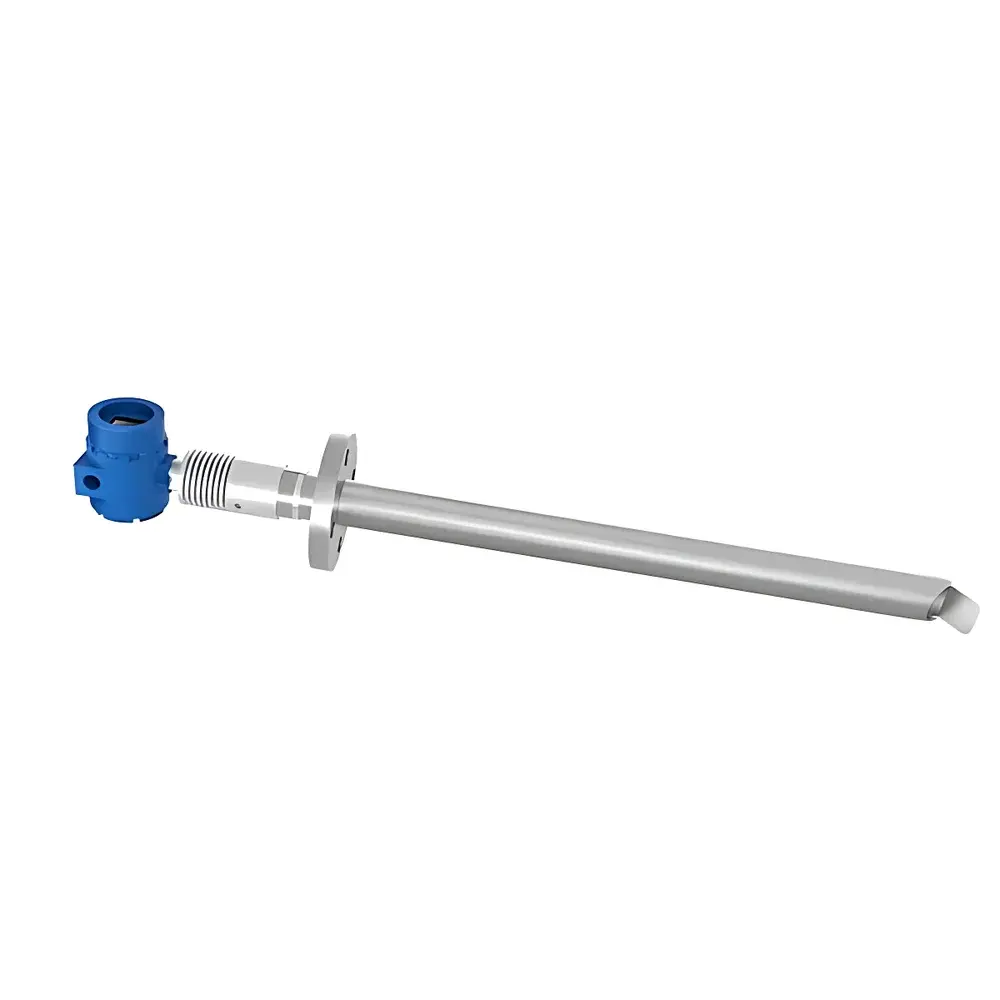
CUBIC INSTRUMENTS Gasboard-3055 Zirconia-based In-situ Oxygen Analyzer
| Brand | CUBIC INSTRUMENTS |
|---|---|
| Origin | Hubei, China |
| Manufacturer Type | Authorized Distributor |
| Country of Origin | China |
| Model | Gasboard-3055 |
| Instrument Type | In-situ Flue Gas Oxygen Analyzer |
| Repeatability | ≤±1% FS |
| Response Time | T90 < 15 s |
| Stability | ±2% FS / 7 days |
| Measured Gas | O₂ |
| Measurement Range | 0–25% vol |
| Resolution | 0.1% vol |
| Accuracy | ±2% FS |
| Sampling Method | Direct-insertion, flow-guided probe |
| Operating Temperature | 0–700 °C |
| Enclosure Rating | IP65 |
| Output Signals | RS-485 & 4–20 mA |
| Power Supply | DC 24 V ±10%, 2 A |
| Probe Length Options | 500 / 1000 / 1500 mm (customizable) |
| Display | 128×160 color LCD |
| Alarm Outputs | 2 relay channels |
| Calibration | Field-calibratable with ambient air or certified O₂ standard gas |
Overview
The CUBIC INSTRUMENTS Gasboard-3055 is a high-reliability, in-situ zirconia-based oxygen analyzer engineered for continuous, real-time monitoring of residual oxygen concentration in high-temperature flue gas streams. It operates on the principle of solid electrolyte potentiometry: at elevated temperatures (>650 °C), stabilized zirconium dioxide (ZrO₂) becomes an oxygen ion conductor, generating a Nernst voltage proportional to the logarithmic ratio of oxygen partial pressures across its sensing membrane. Unlike extractive systems requiring complex sample conditioning, the Gasboard-3055 employs a direct-insertion, flow-guided probe design—enabling robust measurement without gas cooling, dilution, or filtration. This architecture eliminates condensation-related drift, reduces maintenance intervals, and preserves dynamic response integrity under transient combustion conditions. The analyzer is purpose-built for integration into industrial combustion control loops where precise O₂ feedback is critical for optimizing air-to-fuel ratios, minimizing excess oxygen, and reducing NOₓ formation and fuel consumption.
Key Features
- Zirconia sensor core with integrated high-temperature heater, ensuring stable operation up to 700 °C flue gas temperature without external thermocouple compensation.
- Flow-guided sampling probe with optimized internal channel geometry—self-aspirating under natural draft or forced convection, eliminating need for external pumps or purge systems.
- IP65-rated stainless-steel housing with ceramic-insulated probe stem, rated for long-term exposure to corrosive, particulate-laden flue environments including sulfur-rich and alkali-laden exhausts.
- Field-calibratable using ambient air (20.9% O₂) or certified calibration gas—no disassembly required; zero and span adjustments executed via intuitive menu-driven interface on the 128×160 color LCD.
- Dual independent relay outputs configurable for high/low O₂ alarms, sensor fault alerts, or over-temperature warnings triggered by internal thermal monitoring circuitry.
- Simultaneous dual-output architecture: isolated 4–20 mA analog signal for PLC/DCS integration and Modbus RTU over RS-485 for bidirectional communication, data logging, and remote configuration.
Sample Compatibility & Compliance
The Gasboard-3055 is validated for use with dry or saturated flue gases from coal, oil, natural gas, biomass, and waste-derived fuels. It tolerates dust loading up to 10 g/Nm³ and transient moisture spikes common in start-up/shutdown cycles. While not intrinsically safe, it complies with IEC 61000-6-2 (EMC immunity) and IEC 61000-6-4 (EMC emission) standards. Its measurement methodology aligns with ASTM D6522 (Standard Test Method for Determination of Oxygen in Gaseous Fuels) and supports compliance with ISO 14001 environmental management systems through documented energy efficiency verification. For regulated facilities operating under EPA 40 CFR Part 60 or EU Industrial Emissions Directive (IED) requirements, the analyzer’s traceable calibration protocol and 7-day stability specification facilitate routine QA/QC reporting and audit readiness.
Software & Data Management
No proprietary PC software is required for basic operation; all configuration, calibration, and diagnostics are accessible via the onboard LCD interface. For centralized monitoring, the RS-485 port supports Modbus RTU register mapping—including real-time O₂ reading (holding register 40001), status flags (e.g., sensor health, temperature alarm), and calibration history timestamps. When integrated into SCADA or MES platforms, the device supports time-stamped data export compatible with CSV ingestion for trend analysis. Audit trails—such as calibration events, parameter changes, and alarm activations—are retained in non-volatile memory for ≥30 days, satisfying GLP-aligned record-keeping expectations. Firmware updates are performed via serial command-line interface using standard terminal emulation tools.
Applications
- Power Generation: Continuous O₂ trimming in pulverized coal, CFB, and gas-fired boilers to maintain optimal excess air (typically 3–5% O₂), directly improving boiler efficiency by 0.5–1.5%.
- Metallurgical Processes: Real-time control of oxygen enrichment in blast furnaces, sintering plants, and ladle metallurgy units to stabilize slag chemistry and reduce coke rate.
- Cement & Lime Kilns: Monitoring kiln exit O₂ to detect refractory breaches, optimize secondary air injection, and prevent clinker over-burning.
- Waste Incineration: Ensuring minimum 6% O₂ in post-combustion zones per EU Waste Incineration Directive to guarantee complete destruction of organic pollutants (DRE > 99.99%).
- Chemical Crackers & Reformers: Safeguarding against oxygen ingress in hydrogen-rich process streams by detecting trace air leaks upstream of catalyst beds.
FAQ
What is the maximum allowable flue gas temperature for continuous operation?
The probe is rated for sustained exposure to flue gas up to 700 °C. Internal sensor heating maintains optimal zirconia conductivity regardless of ambient stack temperature fluctuations.
Can the analyzer be calibrated without removing it from the stack?
Yes—zero calibration using ambient air and span calibration using certified O₂ gas (e.g., 10.0% or 21.0% in N₂) can both be performed in-situ via the front-panel interface.
Is the 4–20 mA output linear across the full 0–25% range?
Yes—the analog output is factory-configured for 0% = 4 mA and 25% = 20 mA, with optional user-defined scaling available via Modbus register.
How often does the zirconia sensor require replacement?
Under typical industrial conditions (≤600 °C, low sulfur), service life exceeds 24 months; accelerated aging may occur above 650 °C or in high-alkali environments.
Does the device support Modbus TCP or only Modbus RTU?
Only Modbus RTU over RS-485 is supported; Ethernet or wireless connectivity requires an external protocol converter.
Related Products







