
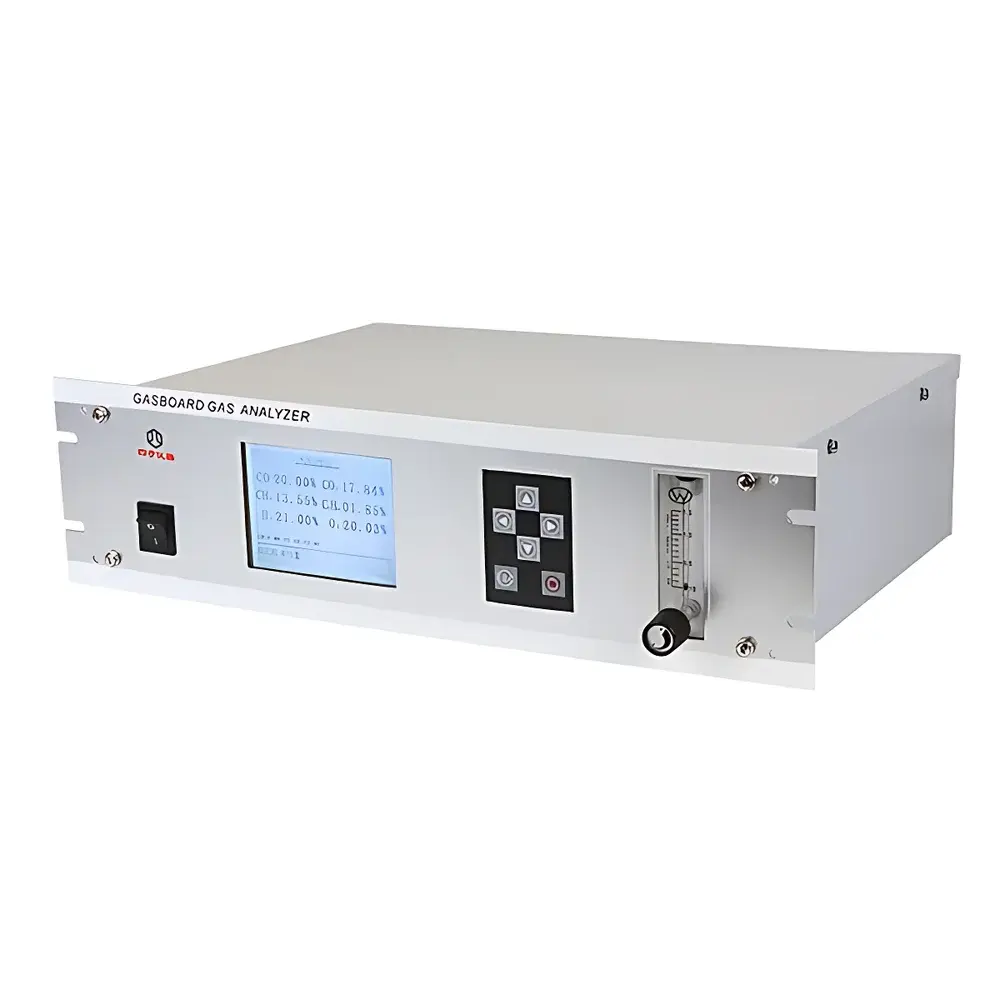
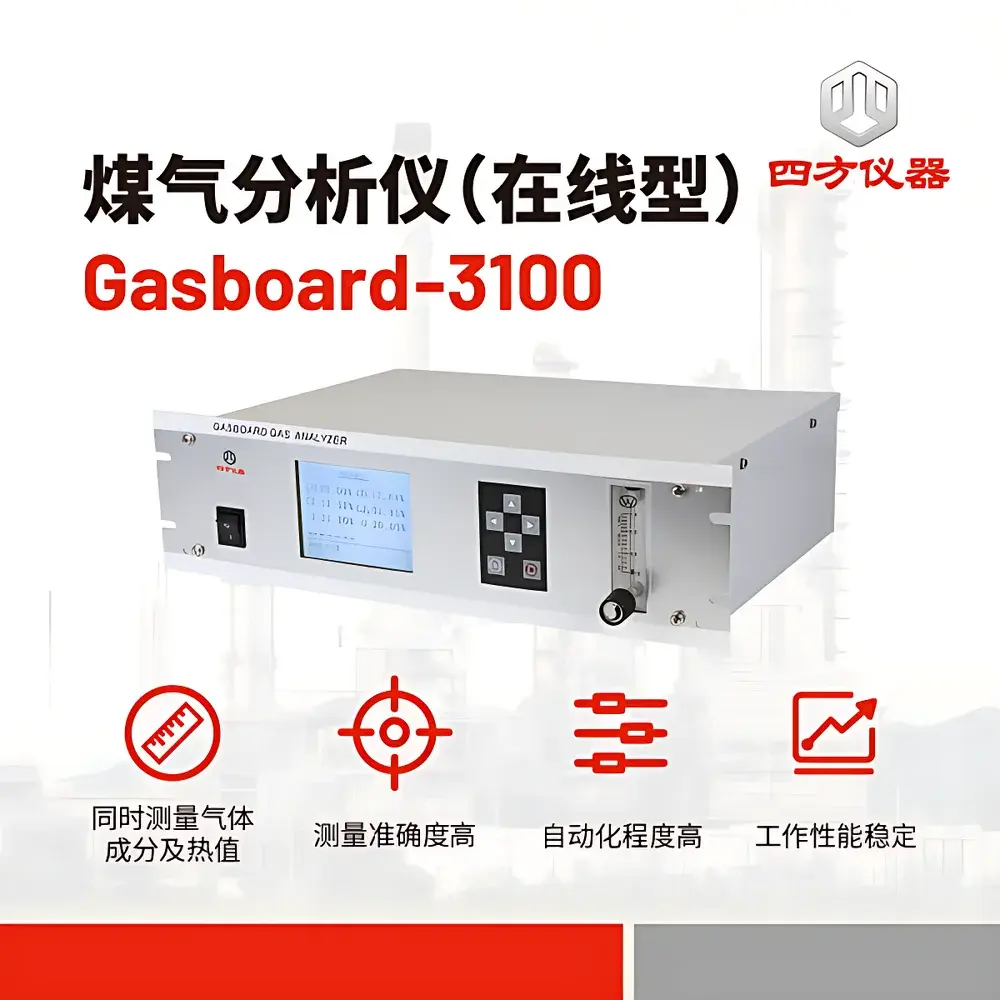
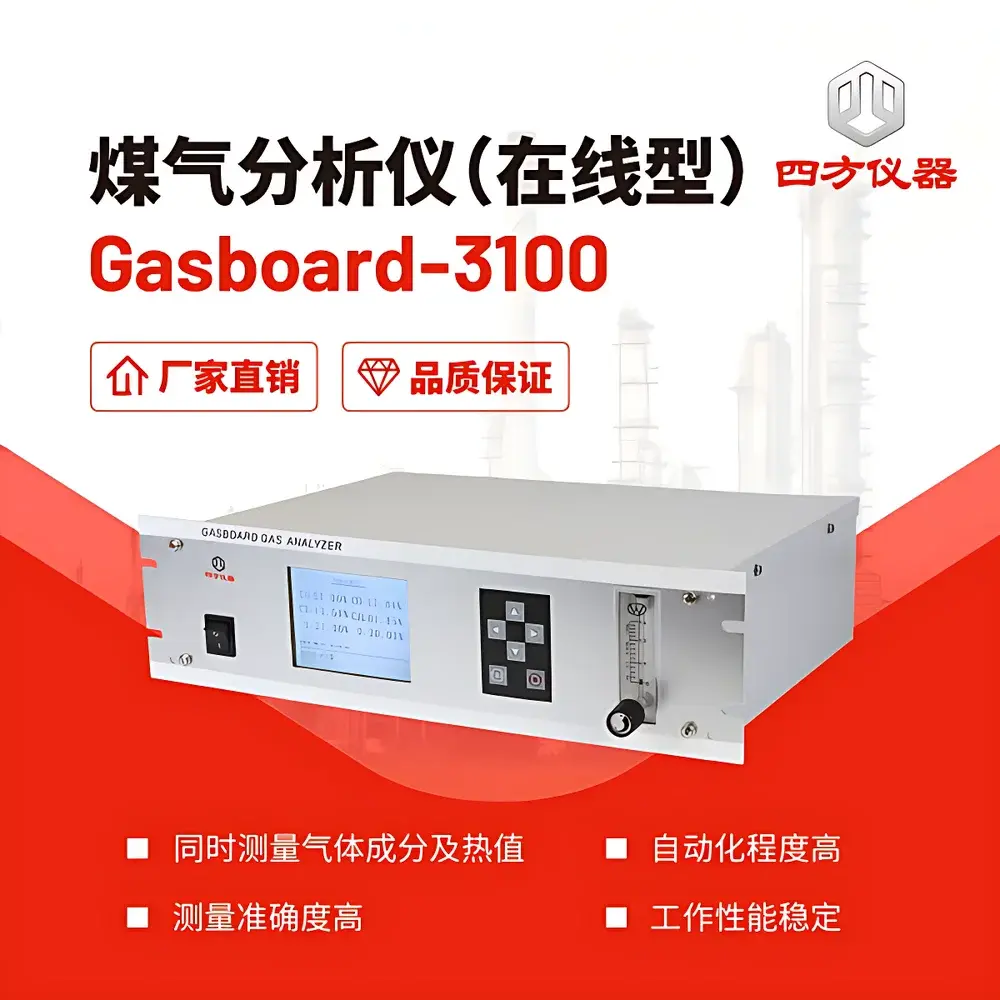
CUBIC INSTRUMENTS Gasboard-3100 Flue Gas Analyzer
| Brand | CUBIC INSTRUMENTS |
|---|---|
| Origin | Hubei, China |
| Model | Gasboard-3100 |
| Measurement Principle | NDIR (CO/CO₂/CH₄/C₂H₂/C₂H₄/CnHm), TCD (H₂), ECD (O₂) |
| Measurement Range | CO/CO₂/CH₄/H₂: (0–100)%, O₂: (0–25)%, C₂H₂/C₂H₄/CnHm: (0–10)% (optional) |
| Accuracy | ±1% FS (CO/CO₂/CH₄/C₂H₂/C₂H₄/CnHm), ±2% FS (O₂/H₂) |
| Repeatability | ≤1% |
| Response Time (T90) | <15 s (NDIR) |
| Flow Rate | 0.7–1.2 L/min |
| Inlet Pressure | 2–50 kPa |
| Resolution | 0.01% |
| Output | RS-485/RS-232, 4–20 mA |
| Power Supply | 100–240 VAC, 100 W |
| Display | LCD |
| Thermal Value Units | kcal/m³ & MJ/m³ (switchable) |
| Auto-Zero | Built-in air pump |
| Diagnostics | Real-time sensor health monitoring |
| Sample Requirements | Dust-free, moisture-free, oil-free gas |
Overview
The CUBIC INSTRUMENTS Gasboard-3100 Flue Gas Analyzer is an integrated, multi-parameter online gas analysis system engineered for continuous, real-time compositional and calorific value assessment of industrial fuel gases—including coke oven gas, blast furnace gas, producer gas, biogas, and syngas. It employs a hybrid sensing architecture combining non-dispersive infrared (NDIR) spectroscopy for CO, CO₂, CH₄, C₂H₂, C₂H₄, and total non-methane hydrocarbons (CnHm); micro-electro-mechanical systems (MEMS)-based thermal conductivity detection (TCD) for H₂; and electrochemical detection (ECD) for O₂. This multi-technology platform eliminates cross-sensitivity—e.g., CnHm does not interfere with CH₄ quantification, and CO/CO₂/CH₄ exert no measurable influence on H₂ measurement—enabling trace-level accuracy in complex, variable matrices typical of metallurgical, chemical, and renewable energy processes.
Key Features
- Simultaneous composition and calorific value analysis: Measures volumetric concentrations of up to eight gas species (CO, CO₂, CH₄, H₂, O₂, C₂H₂, C₂H₄, CnHm) and computes higher heating value (HHV) in real time using ASTM D1826–18 and ISO 6976–2016-compliant algorithms—replacing conventional bomb calorimetry for routine process control.
- Cross-interference mitigation: Proprietary optical filtering and signal processing ensure NDIR channels operate independently; MEMS-TCD design maintains stability across flow fluctuations (0.7–1.2 L/min), eliminating need for precision mass flow controllers.
- Environmental robustness: All wetted components—including sample path, filters, and sensor housings—are constructed from corrosion-resistant 316 stainless steel and PTFE, rated for continuous exposure to acidic, sulfurous, and condensable gas streams at temperatures up to 80 °C.
- Thermal stabilization: NDIR detectors incorporate active temperature control (±0.1 °C), minimizing drift induced by ambient fluctuations—critical for unattended operation over extended campaigns (>6 months without recalibration).
- Embedded diagnostics & auto-calibration: Onboard self-test routines monitor sensor baseline, zero drift, and response decay; integrated air pump enables automatic zero-point verification against ambient air at user-defined intervals (e.g., every 4 hours).
Sample Compatibility & Compliance
The Gasboard-3100 is validated for use with dry, particle-free, oil-free gas streams meeting ISO 8573-1 Class 4 particulate and Class 3 moisture specifications. It complies with EN 15267-3 for automated emission monitoring systems (CEMS) when deployed with certified pre-treatment (e.g., chilled mirror dew point control, sintered metal filtration). While not intrinsically safe certified, it meets IEC 61000-4 electromagnetic compatibility standards and supports integration into SIL-2-rated safety instrumented systems (SIS) via hardwired 4–20 mA outputs. Data integrity adheres to ALCOA+ principles—audit trails, electronic signatures, and change logs are available when connected to compliant SCADA or DCS platforms satisfying FDA 21 CFR Part 11 requirements.
Software & Data Management
Local operation is managed via a 5.7-inch backlit LCD interface supporting multilingual menus (English, German, Spanish, Chinese). Remote configuration, real-time data streaming, and historical trend export are enabled through standard Modbus RTU (RS-485) or ASCII protocol (RS-232). Optional OPC UA server integration allows seamless connection to PI System, Ignition, or Siemens Desigo CC for centralized analytics. Raw sensor outputs, computed HHV values, and diagnostic flags are timestamped with millisecond resolution and stored onboard (up to 30 days at 1-min intervals) or streamed continuously to cloud-based dashboards compliant with ISO/IEC 17025:2017 data handling guidelines.
Applications
- Metallurgical process optimization: Continuous monitoring of blast furnace top gas and coke oven off-gas for carbon balance calculations, combustion efficiency tuning, and coke quality assessment per ASTM E2921–22.
- Biogas upgrading & valorization: Quantification of CH₄, CO₂, H₂S (via optional add-on), and CnHm in anaerobic digestion effluent to determine grid injection readiness per EN 16723-1.
- Gasification R&D: High-frequency sampling during pilot-scale biomass or coal gasification trials to correlate feedstock composition with syngas H₂/CO ratio and lower heating value (LHV) for reactor modeling (e.g., ASPEN Plus inputs).
- Academic combustion research: Validation of flame chemistry models using time-resolved flue gas profiles from burner test rigs, with trace C₂H₂/C₂H₄ detection enabling soot precursor analysis.
FAQ
What calibration gases are required for routine maintenance?
Certified NIST-traceable gas mixtures containing CO, CO₂, CH₄, H₂, and O₂ in nitrogen at concentrations spanning 10–90% of full scale; CnHm calibration requires propane or butane blend per ISO 6141.
Can the analyzer operate in high-humidity environments?
Only with external conditioning: integrated desiccant or refrigerated dryer is mandatory—sample dew point must remain below 5 °C to prevent condensation in NDIR cells.
Is firmware upgrade supported remotely?
Yes—via secure FTP or USB flash drive; all updates include cryptographic signature verification and rollback capability per IEC 62443-3-3.
How is CnHm defined and quantified?
CnHm represents the sum of all non-methane hydrocarbons (C₂–C₈) expressed as propane-equivalent concentration; measured via dual-wavelength NDIR with proprietary spectral deconvolution to resolve overlapping absorption bands.
Does the system support GLP/GMP audit trails?
When interfaced with validated third-party LIMS or MES software, full electronic record retention—including operator actions, calibration events, and alarm history—is achievable under 21 CFR Part 11 Annex 11 compliance frameworks.
Related Products







