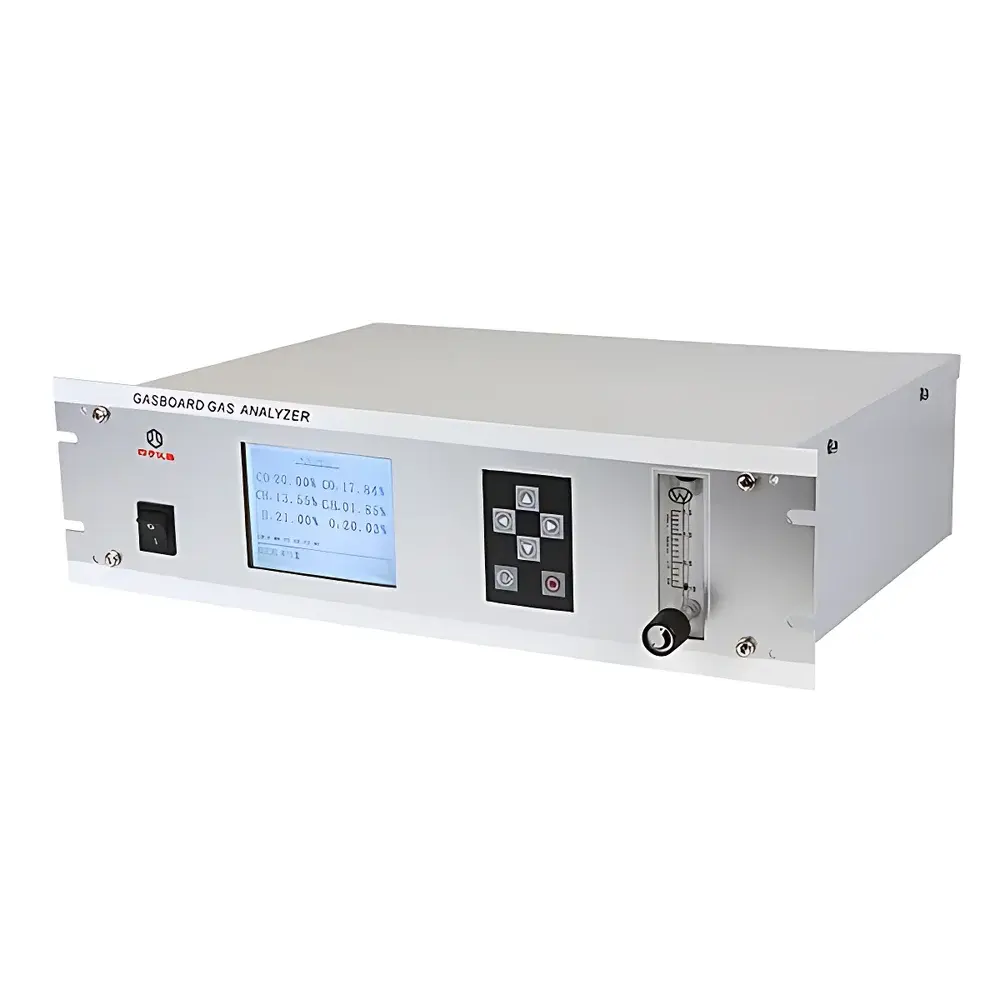
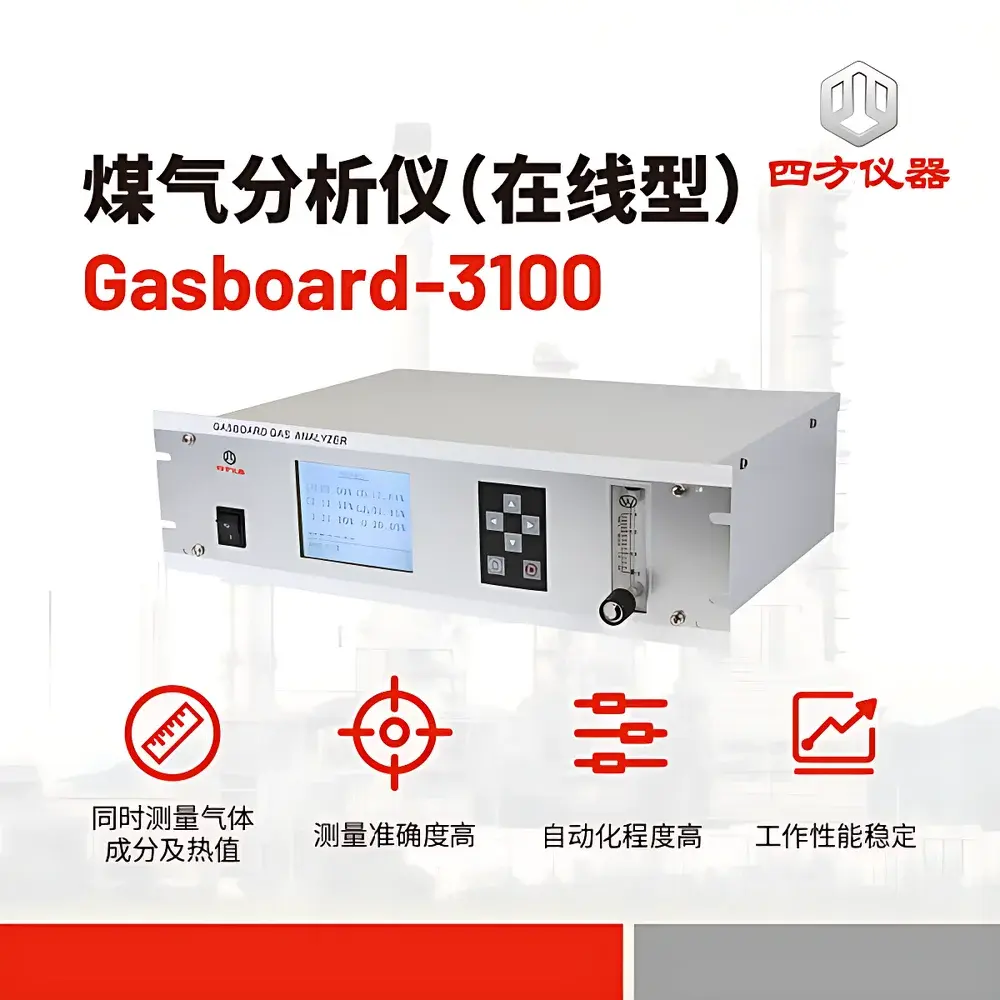
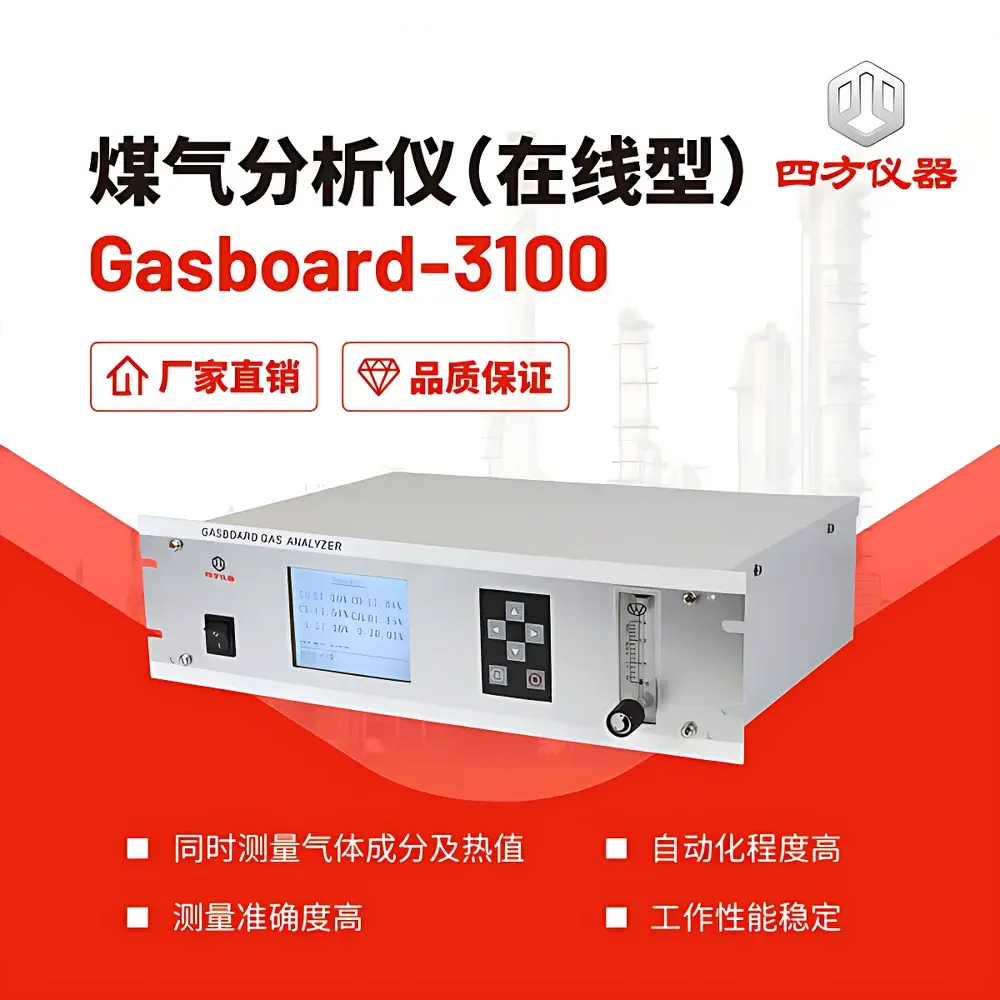
CUBIC INSTRUMENTS Gasboard-3100 Online Multi-Gas Analyzer with Calorific Value Calculation
| Brand | CUBIC INSTRUMENTS |
|---|---|
| Origin | Hubei, China |
| Model | Gasboard-3100 |
| Linear Error | ±1% FS (CO/CO₂/CH₄/C₂H₂/C₂H₄/CnHm) |
| Repeatability | ≤1% |
| Response Time | T90 < 15 s (NDIR) |
| Measurement Principle | NDIR (CO/CO₂/CH₄/C₂H₂/C₂H₄/CnHm), TCD (H₂), ECD (O₂) |
| Flow Range | 0.7–1.2 L/min |
| Sample Pressure | 2–50 kPa |
| Output | RS-485/RS-232, 4–20 mA |
| Power | 100–240 VAC, 100 W |
Overview
The CUBIC INSTRUMENTS Gasboard-3100 is a high-integrity, industrial-grade online multi-gas analyzer engineered for continuous, real-time measurement of gas composition and calorific value in demanding process environments. It integrates three complementary analytical technologies—non-dispersive infrared (NDIR) spectroscopy for CO, CO₂, CH₄, C₂H₂, C₂H₄, and total non-methane hydrocarbons (CnHm); thermal conductivity detection (TCD) for H₂; and electrochemical detection (ECD) for O₂—within a single, compact analyzer platform. This hybrid architecture enables simultaneous, interference-free quantification of up to eight gas components without cross-sensitivity: notably, CnHm does not bias CH₄ readings, and CO/CO₂/CH₄ do not affect H₂ determination. The instrument computes higher heating value (HHV) and lower heating value (LHV) in real time using standardized thermodynamic algorithms compliant with ISO 6976 and ASTM D3588, eliminating reliance on offline combustion calorimetry. Designed for unattended operation in harsh industrial settings—including blast furnace gas, coke oven gas, biomass syngas, and biogas streams—the Gasboard-3100 features active temperature stabilization of NDIR optical cells, corrosion-resistant wetted materials (316L stainless steel and PTFE), and robust sample conditioning integration.
Key Features
- Multi-technology sensor fusion: NDIR (CO, CO₂, CH₄, C₂H₂, C₂H₄, CnHm), TCD (H₂), and ECD (O₂) ensure orthogonal selectivity and minimal inter-component interference.
- Real-time calorific value calculation: Automatic computation of HHV and LHV in kcal/m³ and MJ/m³ units per ISO 6976:2016, traceable to NIST-certified gas standards.
- Stabilized optical performance: Thermally regulated NDIR detector housing maintains spectral baseline stability across ambient temperatures from 0 °C to 50 °C, ensuring long-term drift < 2% FS/year.
- Low-maintenance architecture: Integrated zero-air pump enables automated air-based calibration without external gas cylinders; self-diagnostic routines monitor sensor health, signal-to-noise ratio, and flow integrity.
- Industrial-grade sample handling: Accepts raw syngas or biogas with particulate filtration, condensate removal, and pressure regulation (2–50 kPa inlet range); compatible with standard CEMS pre-treatment skids.
- Dual analog and digital I/O: Isolated 4–20 mA outputs per measured component + calorific value, plus RS-485 Modbus RTU and RS-232 for SCADA integration and remote firmware updates.
Sample Compatibility & Compliance
The Gasboard-3100 is validated for continuous analysis of complex, variable-composition fuel gases including blast furnace gas (BFG), coke oven gas (COG), producer gas, landfill gas, anaerobic digester biogas, and pyrolysis syngas. Its NDIR channels are calibrated against certified reference mixtures traceable to ISO 6141 and ISO 6145 standards; TCD and ECD modules undergo periodic verification per ISO 10723:2012 for natural gas analysis systems. The analyzer meets EMC Directive 2014/30/EU and Low Voltage Directive 2014/35/EU. While not intrinsically safe certified, it is rated IP65 for panel-mounted installation in non-hazardous Zone 2 environments. All firmware and data logging comply with ALCOA+ principles for audit readiness in GLP/GMP-regulated R&D labs and pilot-scale bioenergy facilities.
Software & Data Management
The embedded firmware supports configurable data logging intervals (1 s to 1 h), local storage of ≥12 months of 1-minute averaged values, and timestamped event logs for calibration, alarm, and diagnostic triggers. Optional PC-based configuration software provides graphical trend visualization, user-defined alarm thresholds (e.g., CH₄ > 35% vol triggering safety shutdown), and CSV export compliant with ASTM E2500-22 for data archival. Audit trails record all parameter changes, zero/span executions, and user login events—fully traceable for FDA 21 CFR Part 11 compliance when deployed in pharmaceutical fermentation monitoring or academic grant-funded combustion research.
Applications
- Metallurgical process control: Real-time monitoring of BFG and COG composition for blast furnace burden optimization and energy recovery efficiency calculations.
- Biogas upgrading and utilization: Quantification of CH₄, CO₂, H₂S (via optional add-on), and CnHm to determine biomethane eligibility per EN 16723-1 and support membrane/PSA system control.
- Gasification R&D: In-situ analysis of syngas from coal, biomass, or waste feedstocks during thermal conversion trials, supporting kinetic modeling and tar content estimation via CnHm correlation.
- Academic combustion laboratories: High-frequency sampling during burner rig tests, engine exhaust studies, and catalytic reforming experiments where simultaneous multi-species and calorific data reduce experimental uncertainty.
- Energy trading and billing: Certified calorific value reporting for municipal biogas injection into natural gas grids under national regulatory frameworks (e.g., UK Gas Safety Regulations, German GasNZV).
FAQ
What gas standards are used for factory calibration?
Certified binary and multi-component reference gases traceable to NIST SRMs and ISO 6141, with uncertainty budgets documented per ISO/IEC 17025.
Can the Gasboard-3100 measure H₂S or NH₃?
Not natively; however, optional electrochemical modules for H₂S (0–100 ppm) and NH₃ (0–50 ppm) can be integrated as field-upgradable add-ons.
Is the CnHm measurement specific to individual hydrocarbons?
No—it reports total non-methane hydrocarbons as a summed concentration (C₁–C₆ equivalent), calibrated using propane and butane standards per ISO 8573-5.
How often is manual calibration required?
Zero calibration is automated daily; span calibration is recommended every 3–6 months depending on sample matrix severity and regulatory requirements.
Does the analyzer support Modbus TCP or Ethernet/IP?
Standard communication is Modbus RTU over RS-485; Ethernet gateway modules (Modbus TCP, OPC UA) are available as OEM-configurable options.