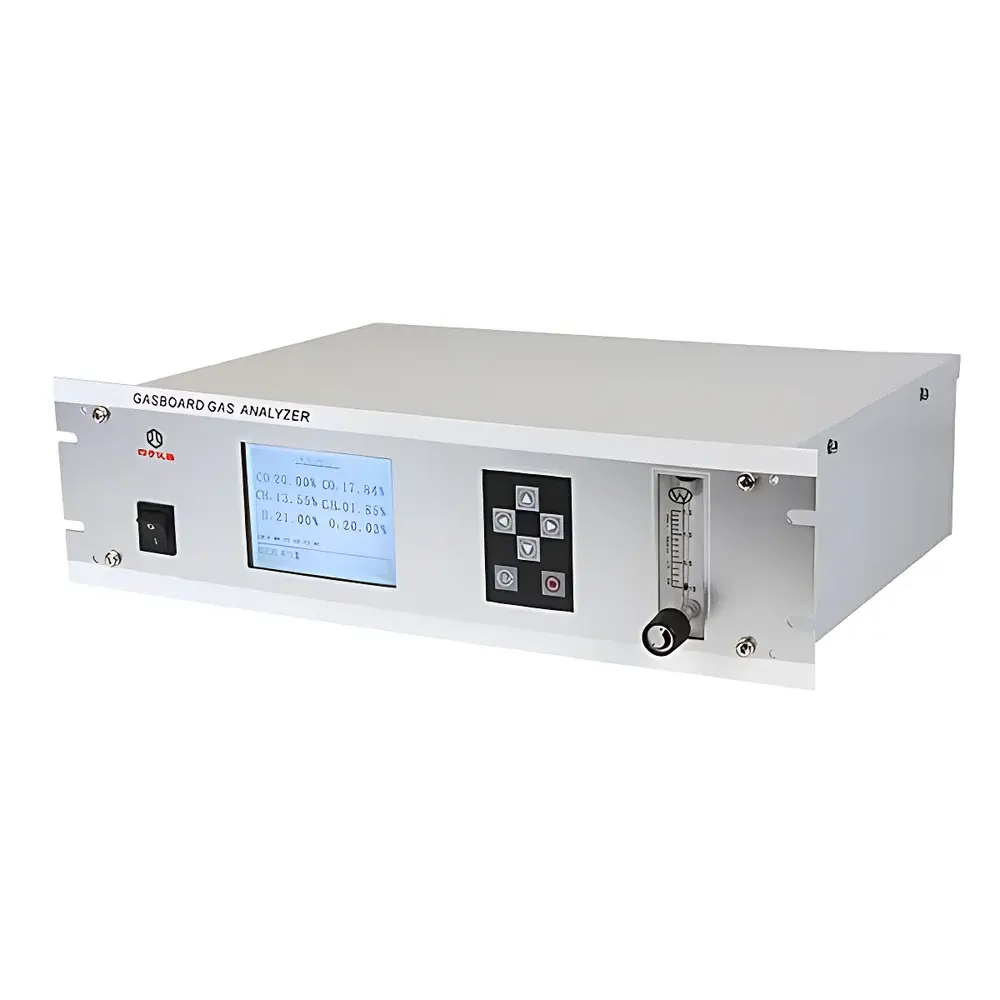
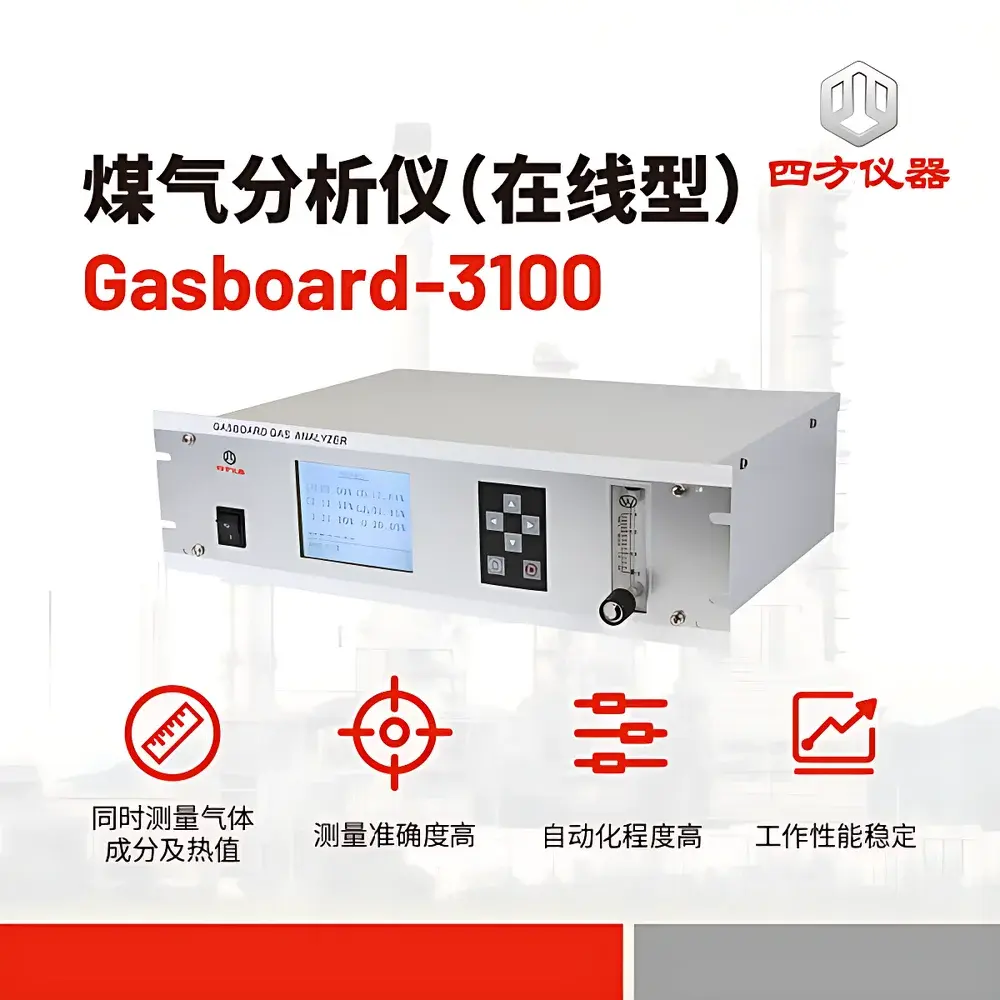
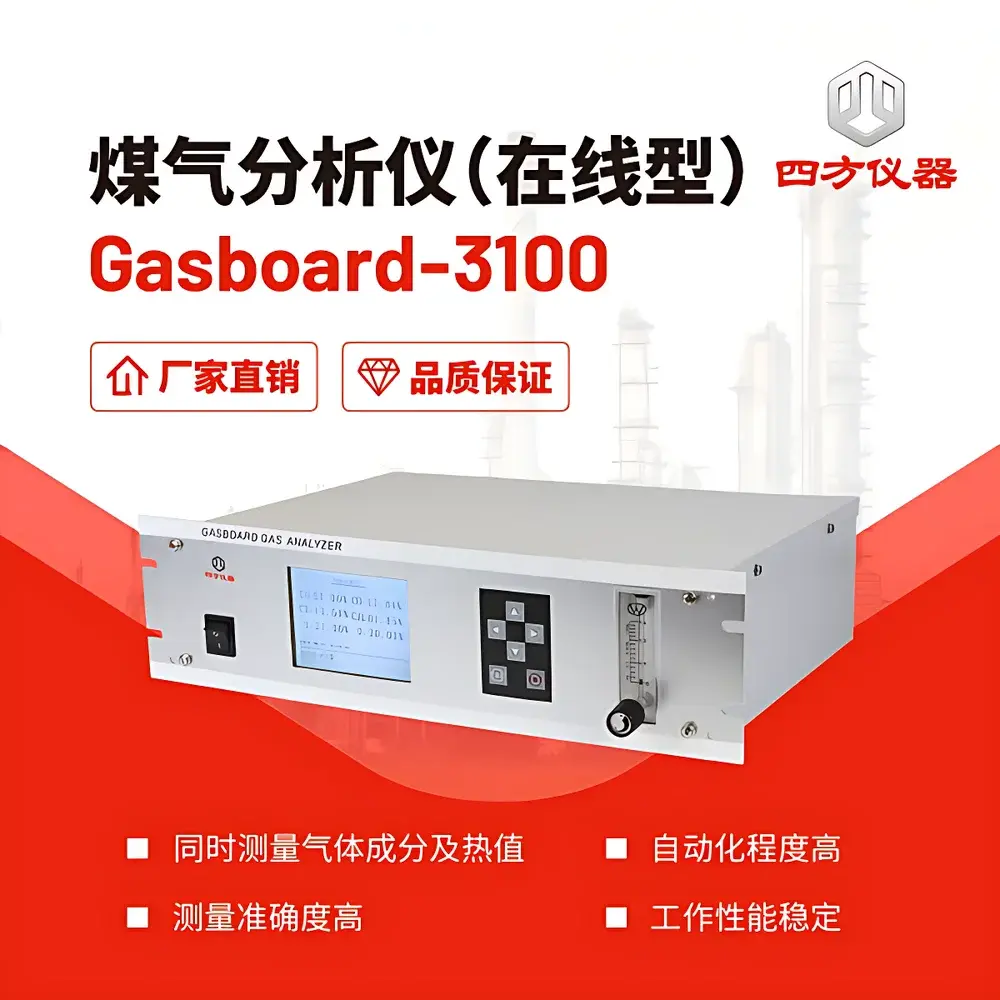
CUBIC INSTRUMENTS Gasboard-3100 Online Multi-Gas Analyzer with Calorific Value Calculation
| Brand | CUBIC INSTRUMENTS |
|---|---|
| Origin | Hubei, China |
| Model | Gasboard-3100 |
| Linear Error | CO/CO₂/CH₄/C₂H₂/C₂H₄/CnHm: ±1% FS |
| O₂/H₂ | ±2% FS |
| Repeatability | ≤1% |
| Response Time | T90 < 15 s (NDIR) |
| Measurement Principle | NDIR (CO, CO₂, CH₄, C₂H₂, C₂H₄, CnHm), TCD (H₂), ECD (O₂) |
| Flow Range | 0.7–1.2 L/min |
| Inlet Pressure | 2–50 kPa |
| Output | RS-485/RS-232, 4–20 mA |
| Power | 100–240 VAC, 100 W |
| Display | LCD |
Overview
The CUBIC INSTRUMENTS Gasboard-3100 is an industrial-grade online multi-gas analyzer engineered for continuous, real-time measurement of gas composition and calorific value in demanding process environments. It integrates three complementary analytical technologies—non-dispersive infrared (NDIR) spectroscopy for hydrocarbons and carbon oxides, thermal conductivity detection (TCD) for hydrogen, and electrochemical detection (ECD) for oxygen—within a single, compact platform. This hybrid architecture enables simultaneous quantification of CO, CO₂, CH₄, H₂, O₂, C₂H₂, C₂H₄, and CnHm (total non-methane hydrocarbons), while computing higher heating value (HHV) and lower heating value (LHV) in kcal/m³ or MJ/m³—replacing traditional combustion-based calorimeters. Designed for integration into metallurgical coke oven gas, blast furnace gas, biomass syngas, and biogas upgrading systems, the Gasboard-3100 delivers traceable, interference-resistant measurements under fluctuating flow and ambient conditions.
Key Features
- Multi-technology sensor fusion: Independent NDIR channels eliminate spectral cross-sensitivity between CO, CO₂, CH₄, and CnHm; TCD-based H₂ detection remains unaffected by sample flow variations (0.7–1.2 L/min); ECD O₂ sensing maintains stability across humidity and pressure gradients.
- Calorific value computation: Real-time HHV/LHV calculation per ISO 6976 and ASTM D3588, using measured volumetric concentrations and standardized thermodynamic coefficients—validated for coal-derived gases (e.g., coke oven, producer gas), biogas, and landfill gas.
- Robust thermal management: All NDIR detectors operate within a temperature-controlled enclosure (±0.1°C stability), mitigating drift from ambient fluctuations and ensuring long-term baseline integrity (>12 months calibration interval under GLP-compliant operation).
- Corrosion-resistant wetted path: Sample contact surfaces fabricated from 316L stainless steel and PTFE-lined components withstand acidic condensates (e.g., H₂S, HCl), particulates, and trace tars common in gasification and anaerobic digestion effluents.
- Automated diagnostics & zero calibration: Integrated air pump enables periodic automatic zeroing against ambient air; self-diagnostic routines monitor sensor health, optical path integrity, and signal-to-noise ratio—logging events compliant with FDA 21 CFR Part 11 audit trail requirements.
Sample Compatibility & Compliance
The Gasboard-3100 accepts raw or pre-treated gas streams meeting ISO 8573-1 Class 4 purity (dew point ≤ −20°C, particle size ≤ 5 µm, oil aerosol ≤ 0.1 mg/m³). It complies with IEC 61000-6-2 (EMC immunity) and IEC 60079-0 (general explosion protection principles), suitable for Zone 2 classified areas when installed with appropriate barrier systems. Data integrity adheres to ISO/IEC 17025:2017 clause 7.7 (result reporting) and supports GMP-relevant validation protocols (IQ/OQ/PQ) through configurable digital I/O and Modbus RTU register mapping.
Software & Data Management
Firmware v3.2+ supports dual communication modes: ASCII protocol over RS-232/RS-485 (Modbus RTU optional) and analog 4–20 mA current loops (fully isolated, HART-enabled). Local LCD interface provides real-time concentration plots, alarm status, and maintenance logs. Remote configuration and firmware updates are enabled via secure serial tunneling. Data export formats include CSV and XML, compatible with SCADA systems (e.g., Siemens WinCC, Rockwell FactoryTalk) and LIMS platforms. Audit trails record all parameter changes, calibration events, and sensor fault alerts with timestamp, operator ID, and reason code—meeting GLP/GMP electronic record retention standards.
Applications
- Continuous monitoring of blast furnace gas, coke oven gas, and mixed generator gas in iron & steel plants—enabling dynamic air/fuel ratio control and energy optimization.
- Biogas quality assurance in anaerobic digesters and upgrading facilities—verifying CH₄ content, detecting siloxanes via CnHm trend analysis, and validating grid injection compliance (e.g., EN 16723-1).
- Process R&D in catalytic reforming, Fischer–Tropsch synthesis, and pyrolysis reactors—tracking H₂/CO ratios, methane slip, and hydrocarbon speciation for kinetic modeling.
- Academic combustion research labs—providing time-resolved flue gas composition for flame stability studies, NOₓ formation mechanisms, and alternative fuel characterization.
FAQ
What gas matrices is the Gasboard-3100 validated for?
It is factory-validated for coal-derived gases (coke oven, blast furnace, water gas), biogas, landfill gas, and syngas from biomass gasification. Custom calibration kits are available for specialty streams containing >500 ppm H₂S or halogenated compounds.
How does the instrument handle moisture and particulate contamination?
A heated sample line (60°C) and integrated cyclonic filter prevent condensation and coarse particulate ingress; optional chiller/dryer modules meet ISO 8573-1 Class 2 specifications for critical applications.
Is the calorific value calculation certified to international standards?
Yes—algorithm implementation conforms to ISO 6976:2016 Annex B (ideal gas assumption) and includes correction factors for real-gas behavior per AGA Report No. 8, traceable to NIST SRM reference gases.
Can the Gasboard-3100 be integrated into a DCS with redundant I/O?
It supports dual 4–20 mA outputs (primary/backup) and Modbus TCP via optional Ethernet gateway, enabling seamless redundancy with Emerson DeltaV, Honeywell Experion, or Yokogawa CENTUM VP systems.
What maintenance intervals are recommended under continuous operation?
Optical windows require cleaning every 6 months; NDIR source lamps are rated for 5 years; electrochemical O₂ sensors have a 2-year service life; full system verification (span/zero check) is advised quarterly per ISO 14644-1 cleanroom-grade QA protocols.