
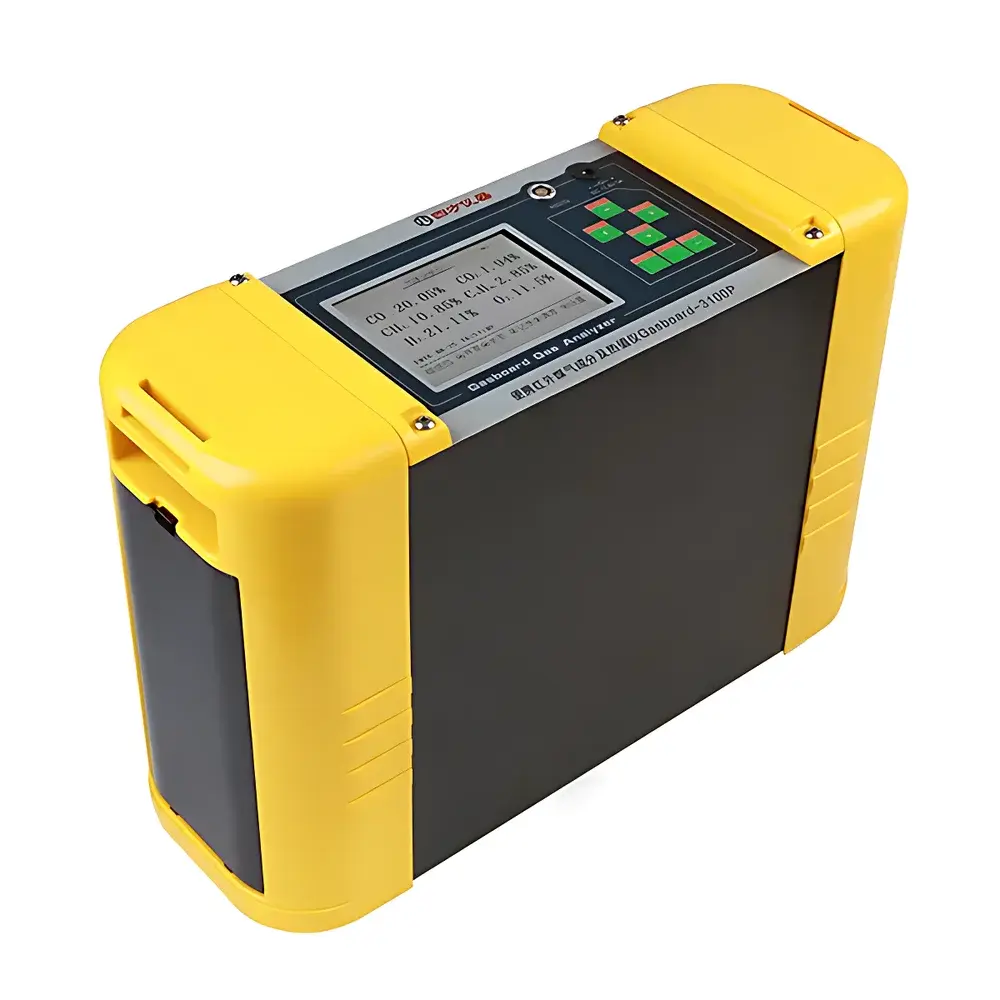
CUBIC INSTRUMENTS Gasboard-3100P Portable Multicomponent Syngas Analyzer
| Brand | CUBIC INSTRUMENTS |
|---|---|
| Origin | Hubei, China |
| Model | Gasboard-3100P |
| Principle | NDIR (CO/CO₂/CH₄/C₂H₂/C₂H₄/CnHm), TCD (H₂), ECD (O₂) |
| Type | Portable |
| Measurement Range | CO/CO₂/CH₄/H₂: (0–100)% |
| O₂ | (0–25)% |
| C₂H₂/C₂H₄/CnHm | (0–10)% (optional) |
| Resolution | 0.01% |
| Repeatability | ≤1% FS |
| Response Time (T90) | <15 s (NDIR) |
| Linear Error | ±1% FS (NDIR gases), ±2% FS (O₂/H₂) |
| Sample Flow Rate | (0.7–1.2) L/min |
| Inlet Pressure | (2–50) kPa |
| Dimensions (L×W×H) | 412×152×294 mm |
| Weight | 9 kg |
| Power | Rechargeable Li-ion battery, external 12.6 V charger |
| Communication | RS-232 |
| Thermal Value Units | kcal/m³ & MJ/m³ (switchable) |
| Self-diagnostic capability | Yes |
Overview
The CUBIC INSTRUMENTS Gasboard-3100P is a field-deployable, multi-parameter syngas analyzer engineered for real-time, simultaneous quantification of combustible and inert gas components in industrial and biogas streams. It integrates three complementary analytical technologies within a single compact platform: non-dispersive infrared (NDIR) spectroscopy for CO, CO₂, CH₄, C₂H₂, C₂H₄, and total non-methane hydrocarbons (CnHm); thermal conductivity detection (TCD) for hydrogen (H₂); and electrochemical detection (ECD) for oxygen (O₂). This hybrid architecture eliminates cross-sensitivity between key analytes—such as interference from CnHm on CH₄ measurement or from CO/CO₂/CH₄ on H₂ response—enabling robust, matrix-independent analysis across variable gas matrices including blast furnace gas, coke oven gas, producer gas, biogas, and landfill gas. Critically, the instrument computes higher heating value (HHV) in situ using ASTM D3588-98 and ISO 6976-compliant algorithms, directly from measured volumetric concentrations—replacing labor-intensive bomb calorimetry or empirical combustion-based methods.
Key Features
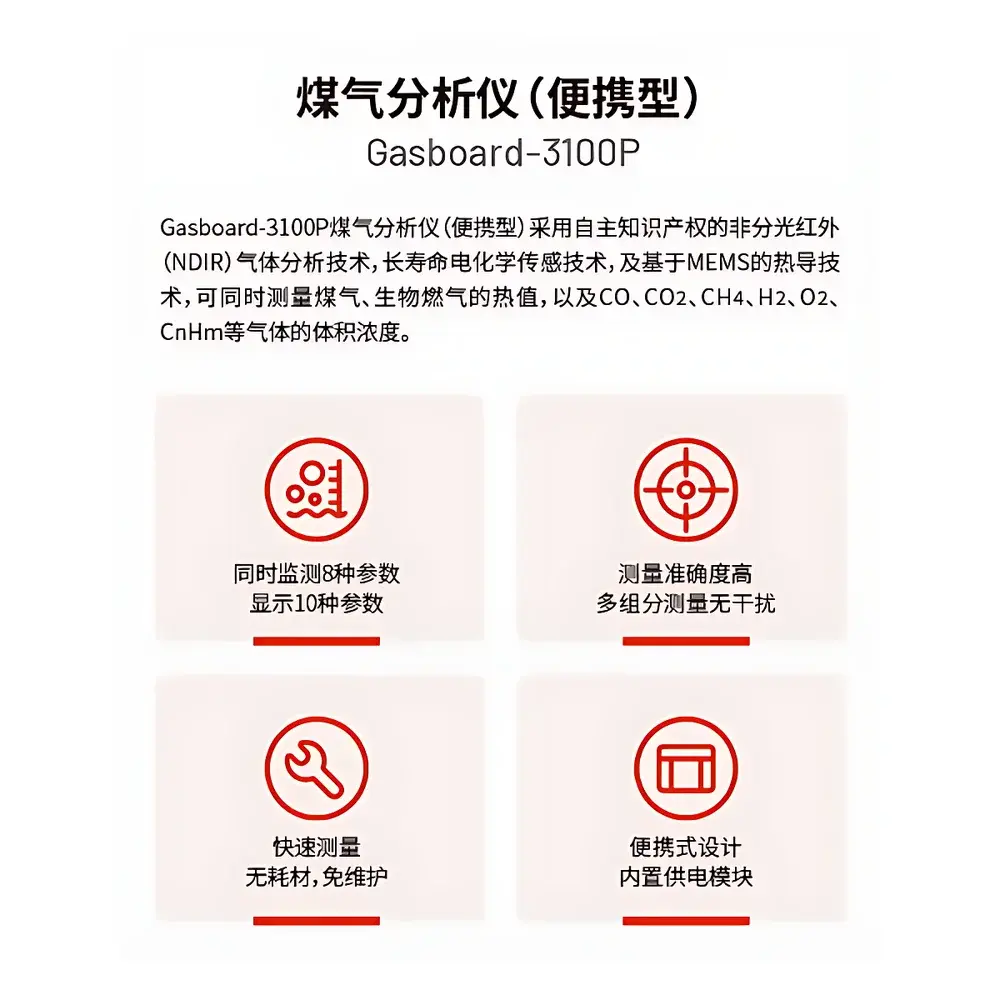
- Simultaneous measurement of up to eight gas species: CO, CO₂, CH₄, H₂, O₂, C₂H₂, C₂H₄, and CnHm (sum of C₃+ hydrocarbons), with automatic thermal value calculation in kcal/m³ and MJ/m³
- Multi-technology sensor fusion ensuring minimal interferences: NDIR channels employ optical filters and temperature-stabilized detectors; TCD for H₂ is flow-insensitive within specified sample flow range (0.7–1.2 L/min); ECD for O₂ delivers stable baseline under varying humidity conditions
- Integrated sampling pump with adjustable flow control and optional heated/particle-filtered pre-treatment module for wet, dusty, or corrosive sample streams
- Intelligent power management system featuring soft-start switch-on, low-voltage cutoff, and battery state-of-charge monitoring to prevent measurement drift during discharge cycles
- Ruggedized portable enclosure (IP54-rated ingress protection), weighing 9 kg with ergonomic carrying handle—designed for repeated field deployment and lab-based bag sampling workflows
Sample Compatibility & Compliance
The Gasboard-3100P accepts raw or pre-conditioned sample gas meeting basic cleanliness requirements: particle-free (<1 µm), dew-point controlled (<5 °C), and oil-free. It complies with IEC 61000-6-2 (immunity) and IEC 61000-6-4 (emissions) for industrial environments. Data integrity meets GLP/GMP-aligned practices through timestamped internal storage and audit-ready event logging (e.g., calibration events, sensor diagnostics, power interruptions). While not certified for hazardous area use (ATEX/IECEx), it is routinely deployed in Zone 2 per IEC 60079-10-1 when operated with appropriate sampling interface and purge protocols. All measurement algorithms adhere to fundamental thermodynamic relationships defined in ISO 6976:2016 for natural gas calorific value determination and ASTM D1945 for gas chromatographic equivalence validation.
Software & Data Management
Measurements are stored automatically in non-volatile memory (≥10,000 records), each tagged with date/time stamp, sensor status flags, and flow/pressure metadata. Data export is supported via RS-232 serial interface to SCADA systems, DCS historians, or PC-based acquisition software. The embedded firmware includes full self-diagnostic routines—continuously monitoring detector stability, reference cell integrity, and pump performance—with on-screen alerts and error codes traceable to ISO/IEC 17025 root-cause categories. Firmware updates are performed via USB-to-serial adapter without hardware disassembly. No proprietary cloud platform is required; data conforms to Modbus RTU and ASCII CSV formats for third-party integration.
Applications
- Metallurgical process control: Continuous monitoring of blast furnace top gas, basic oxygen furnace off-gas, and coke oven by-product gas for energy recovery optimization and emissions reporting
- Gasification and pyrolysis plants: Real-time tracking of syngas composition (H₂/CO ratio, tar surrogate CnHm content) to adjust air/fuel ratios and optimize downstream Fischer–Tropsch or methanol synthesis feedstocks
- Biogas upgrading facilities: Quantification of CH₄ purity, H₂S surrogate (via CnHm correlation), and O₂ ingress for membrane or PSA system commissioning and leak detection
- Academic combustion laboratories: High-frequency sampling during burner rig tests, fluidized bed experiments, and catalytic reforming studies requiring sub-15-second temporal resolution
- Regulatory compliance support: Field verification of stack gas composition prior to CEMS certification per EPA Method 3A or EN 15267-3 requirements
FAQ
What gas standards are required for calibration?
Primary calibration uses certified NIST-traceable gas mixtures in nitrogen balance. For routine verification, single-component span gases (e.g., 50% CH₄/N₂, 2% O₂/N₂) suffice. Zero gas is ambient air filtered through activated carbon.
Can the instrument measure H₂S or NH₃?
No. H₂S and NH₃ are not supported natively. Optional electrochemical modules for these species are available separately but require mechanical and firmware integration beyond standard configuration.
Is the thermal value calculation compliant with ISO 6976?
Yes. The algorithm implements the molar-based gross calorific value model in ISO 6976:2016 Annex A, using measured mole fractions and standardized enthalpy-of-combustion values for each component.
How often is calibration recommended?
Factory calibration is valid for 12 months under normal operating conditions. Field zero/span verification is advised before each critical measurement campaign or after exposure to condensate or particulate overload.
Does the device support analog output or 4–20 mA signals?
Not natively. Analog output requires an external RS-232 to 4–20 mA converter compatible with Modbus RTU protocol. CUBIC offers OEM integration kits upon request.
Related Products







