
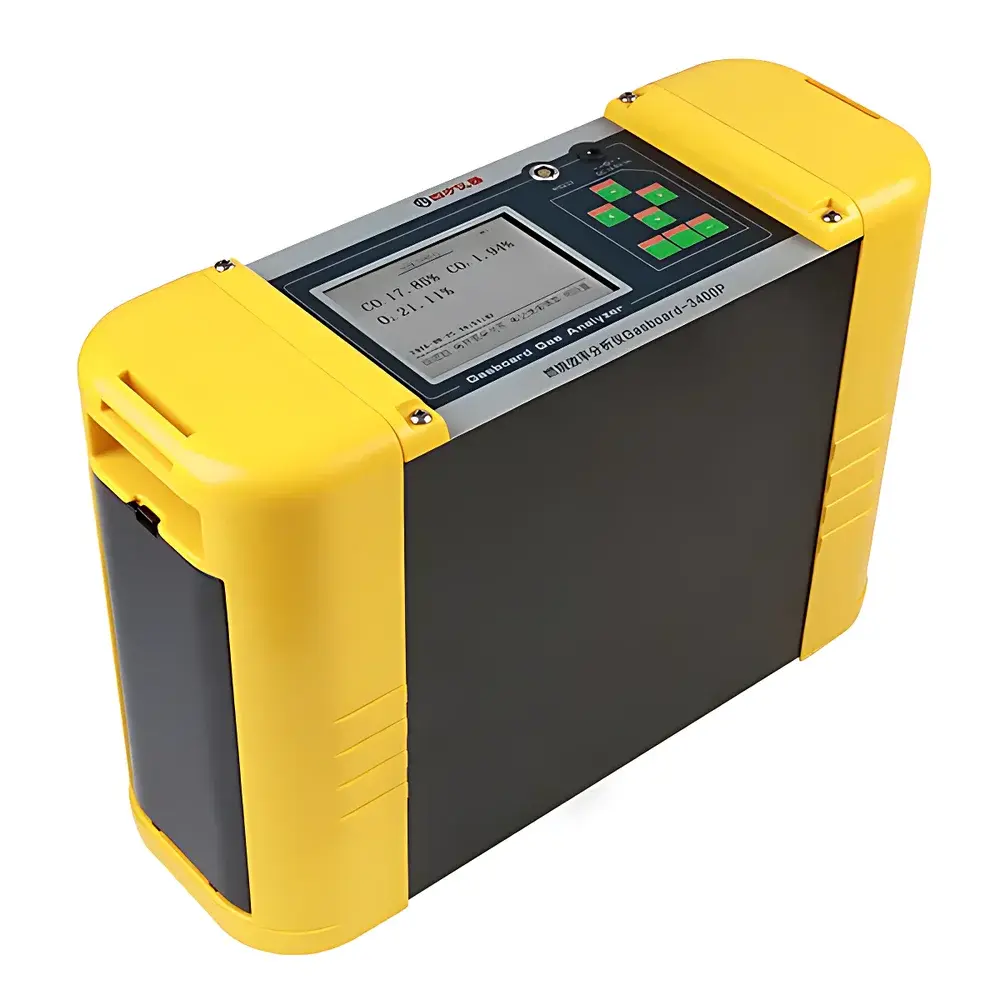
CUBIC INSTRUMENTS Gasboard-3400P Combustion Efficiency Analyzer
| Brand | CUBIC INSTRUMENTS |
|---|---|
| Origin | Hubei, China |
| Model | Gasboard-3400P |
| Measurement Principle | NDIR for CO/CO₂ |
| Measured Parameters | CO (0–5000 ppm), CO₂ (0–25 % vol), O₂ (0–21 % vol), flue gas temperature (0–1200 °C) |
| Accuracy | CO/CO₂: ±1% FS |
| O₂ | ±2% FS |
| temperature | ±3 °C or ±1% of reading |
| Repeatability | ≤1% |
| Response Time (T90) | ≤15 s (NDIR) |
| Resolution | O₂: 0.01% vol |
| CO | 1 ppm |
| CO₂ | 0.01% vol |
| temperature | 0.1 °C |
| Operating Temperature | 0–50 °C |
| Relative Humidity | 5–85% RH |
| Battery Life | >10 h (rechargeable Li-ion) |
| Communication | RS-232 / RS-485 |
| Expandable Sensors | SO₂, NO, NO₂ |
Overview
The CUBIC INSTRUMENTS Gasboard-3400P Combustion Efficiency Analyzer is a portable, field-deployable flue gas analyzer engineered for precision measurement of key combustion parameters in real time. It employs dual-sensor architecture: non-dispersive infrared (NDIR) spectroscopy for quantitative detection of carbon monoxide (CO) and carbon dioxide (CO₂), electrochemical cell detection (ECD) for oxygen (O₂), and Type K or S thermocouples for flue gas temperature profiling. By simultaneously acquiring volumetric concentrations of CO, CO₂, and O₂—alongside high-fidelity temperature data—the instrument calculates critical combustion efficiency indicators, including excess air ratio (λ), theoretical air requirement, and combustion efficiency (%) per ISO 5167 and ASTM D5865 methodologies. Its design targets continuous operational reliability in demanding industrial environments—such as boiler houses, incineration facilities, and energy audit sites—where regulatory compliance, process optimization, and emissions verification are mission-critical.
Key Features
- Integrated multi-parameter sensing: Simultaneous real-time acquisition of CO (0–5000 ppm), CO₂ (0–25 % vol), O₂ (0–21 % vol), and flue gas temperature (up to 1200 °C) with auto-compensated cross-sensitivity correction.
- Ruggedized portable platform: Compact housing with IP54-rated enclosure, integrated sampling probe, and built-in sample pump capable of sustaining −200 hPa differential pressure—enabling stable operation under variable draft conditions.
- Long-life sensor architecture: NDIR detectors feature sealed optical paths and temperature-stabilized reference cells; ECD O₂ sensors incorporate hydrophobic membrane protection against condensate ingress and acid gas poisoning.
- Intelligent power management: Soft-start circuitry prevents low-voltage operation; rechargeable lithium-ion battery supports ≥10 hours of continuous field use; external 12.6 V DC charging interface included.
- On-device diagnostics: Self-test routines verify sensor zero/span stability, thermocouple continuity, and pump performance prior to each measurement cycle—fully compliant with GLP traceability requirements.
Sample Compatibility & Compliance
The Gasboard-3400P is validated for direct in-situ sampling of hot, humid, particulate-laden flue gases from coal-, oil-, gas-, and biomass-fired systems. Its sampling train accommodates both probe-based insertion (via optional heated sampling line) and bag-sampling modes for laboratory-grade validation. The analyzer meets essential environmental instrumentation standards including EN 15267-3 (QAL1 certification pathway), ISO 12039 (CO/CO₂ measurement), and IEC 61000-4-2/4-3 (EMC immunity). Data integrity adheres to ALCOA+ principles: all measurements include timestamp, sensor status flags, ambient conditions, and operator ID (if configured via external authentication). Audit trails support FDA 21 CFR Part 11–compliant workflows when interfaced with validated SCADA or LIMS platforms.
Software & Data Management
Data logging occurs autonomously at user-configurable intervals (1–60 s), storing up to 10,000 records internally with full metadata (date/time, measurement units, calibration epoch, alarm flags). Export options include CSV via USB mass storage mode or real-time streaming via RS-232/RS-485 Modbus RTU protocol. Optional PC software provides post-processing functions: stoichiometric combustion balance calculation, λ vs. efficiency trend analysis, and automated report generation aligned with EN 12952-15 annexes. Firmware updates are delivered via signed binary packages with SHA-256 checksum verification to ensure cryptographic integrity.
Applications
- Thermal power plants: Continuous monitoring of coal- and natural gas-fired boilers for combustion tuning, NOₓ precursor control, and heat rate optimization.
- Hazardous waste incinerators: Regulatory stack testing per EPA Method 3A and EU Directive 2000/76/EC, including O₂-dilution corrected CO/CO₂ reporting.
- District heating networks: On-site efficiency audits of industrial steam generators and biomass cogeneration units per ISO 5167-4 and DIN 1343.
- Academic research: Controlled flame experiments in combustion laboratories requiring synchronized gas composition and thermal profile capture.
- Energy service companies (ESCOs): Field-based ASHRAE Level II energy assessments with automated combustion efficiency scoring and retrofit prioritization.
FAQ
What calibration standards are required for routine maintenance?
Certified gas mixtures traceable to NIST SRMs are recommended: 500 ppm CO in N₂, 10% CO₂ in N₂, and 20.9% O₂ in N₂. Zero calibration uses ambient air or certified zero gas (N₂). Calibration frequency follows ISO 17025 guidelines—typically every 30 days or after exposure to extreme condensation or over-range events.
Can the Gasboard-3400P be used for compliance reporting under EU Industrial Emissions Directive (IED)?
Yes—when operated within its specified accuracy envelope and supported by documented QAL2/QAL3 procedures, it satisfies the technical requirements for periodic monitoring under Annex VI of IED. Full compliance requires integration with an accredited QA/QC program and third-party verification of system performance.
Is the instrument suitable for measuring biogas or syngas compositions?
While optimized for flue gas, the Gasboard-3400P may be deployed for biogas pre-combustion screening (CH₄ estimation via CO₂/O₂ balance) and syngas stoichiometry checks. However, H₂S interference mitigation requires optional acid gas scrubbing; dedicated biogas analyzers are recommended for long-term deployment.
How does the analyzer handle moisture interference in wet flue streams?
The integrated Peltier-cooled condensate trap removes >95% of water vapor prior to sensor inlet. NDIR channels apply H₂O cross-sensitivity compensation algorithms derived from dual-wavelength referencing; ECD O₂ sensors utilize hydrophobic microporous membranes to prevent electrolyte dilution.
What is the recommended interval for sensor replacement?
NDIR detectors typically exceed 5 years of field service life; ECD O₂ sensors have a nominal lifetime of 24 months under continuous operation. Replacement is triggered by diagnostic alerts indicating drift beyond ±3% FS or failed span verification—documented in the device’s internal maintenance log.







