
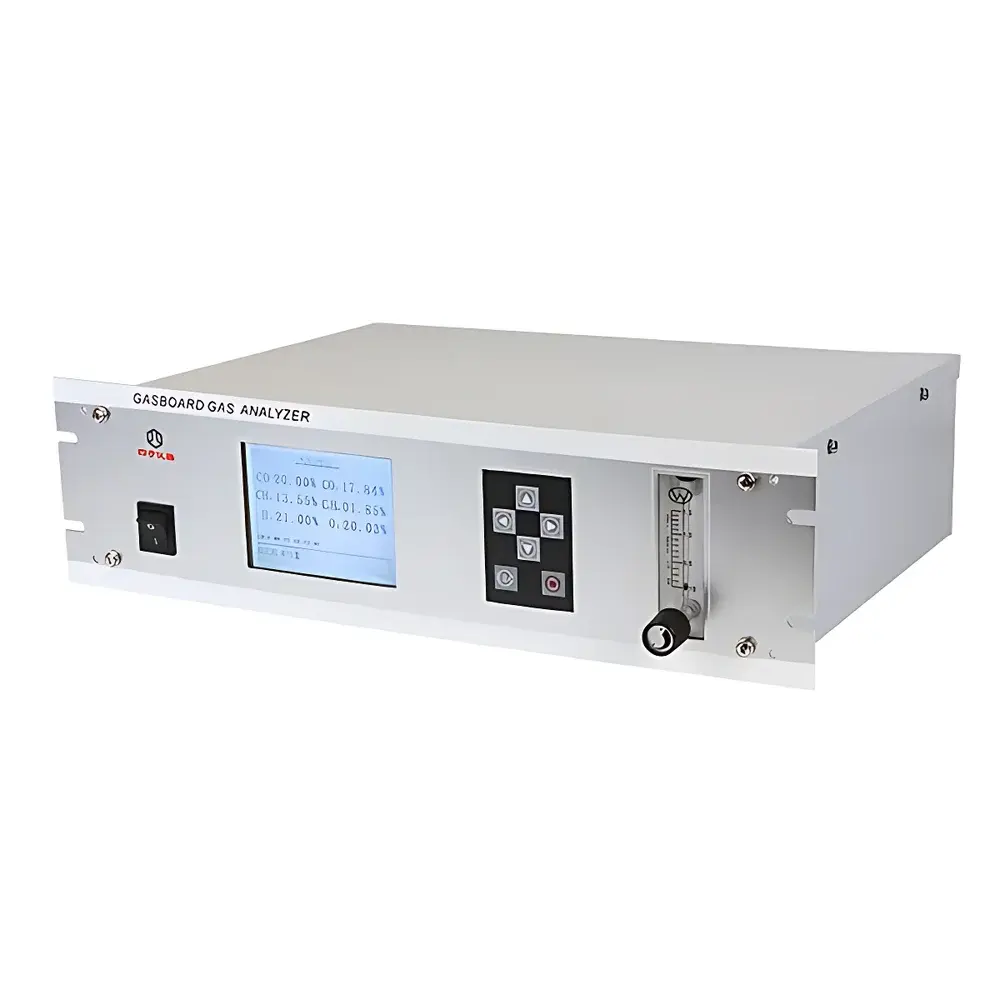
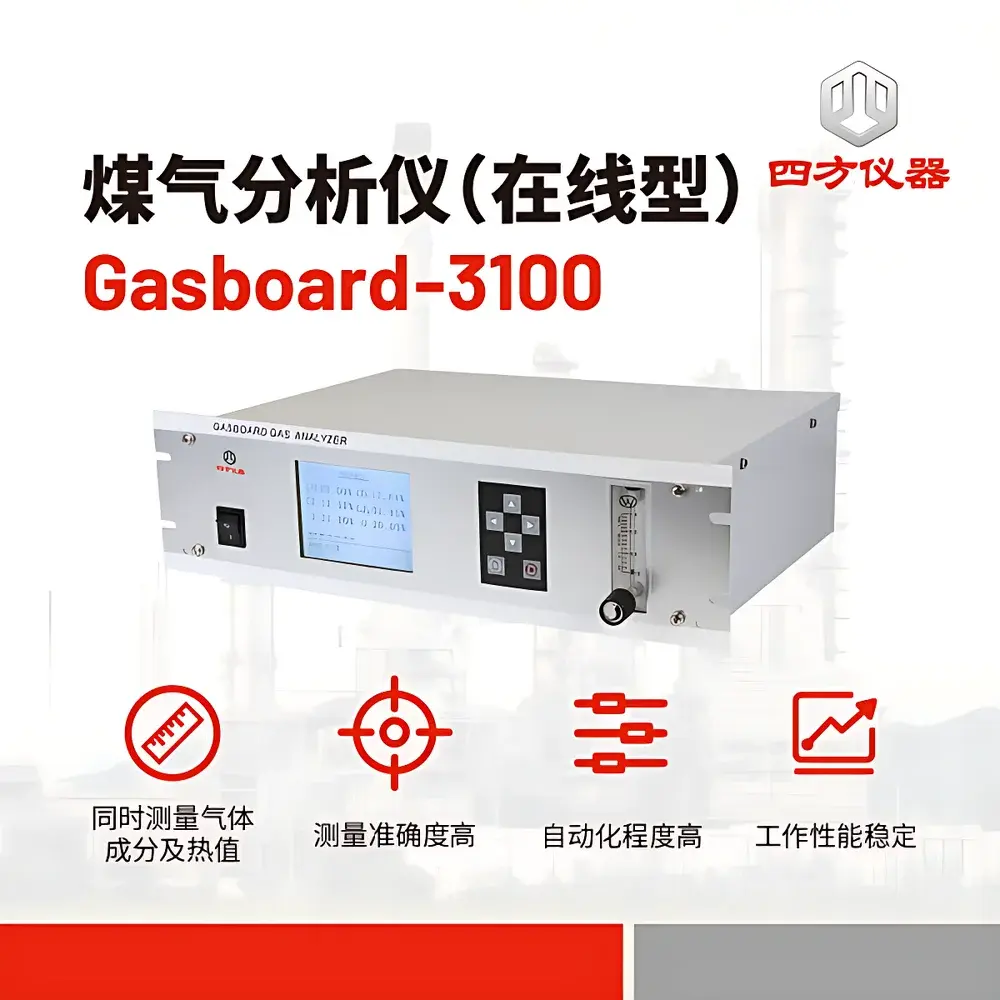
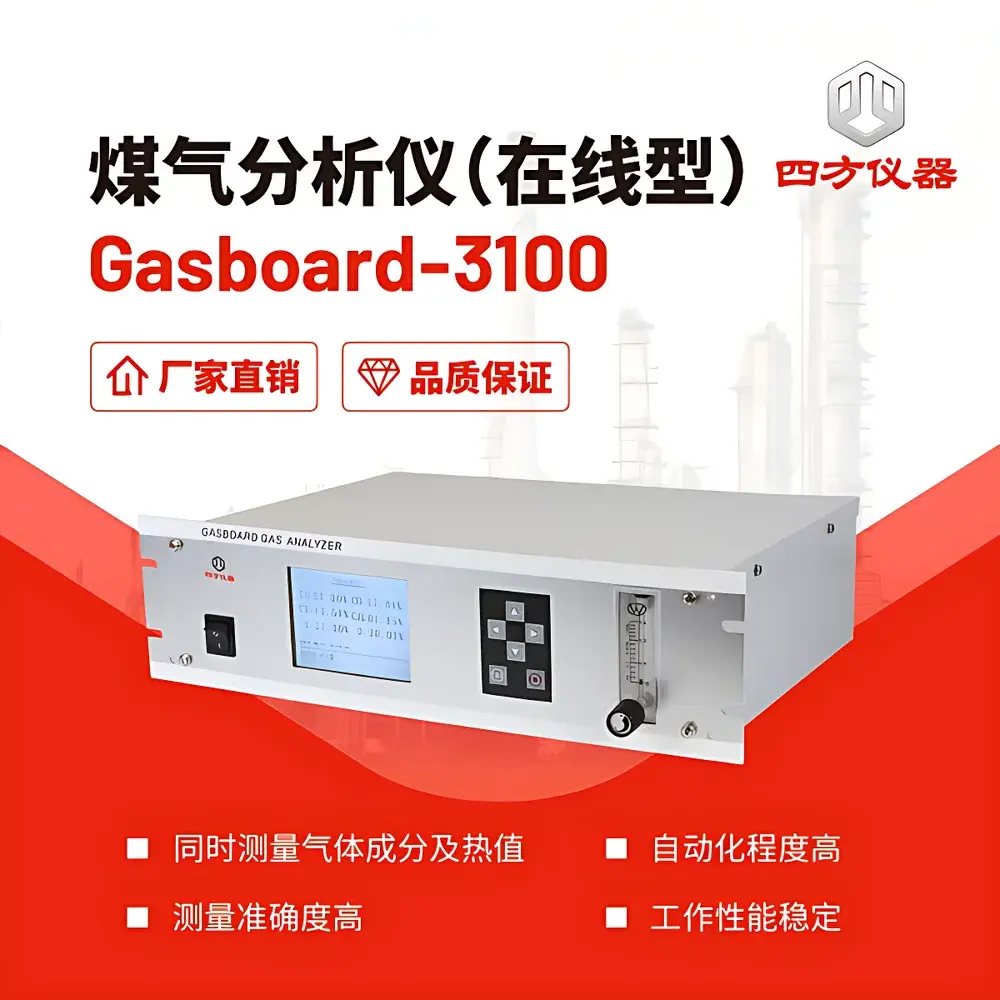
CUBIC INSTRUMENTS Gasboard-3500 Standard Multicomponent Infrared Gas Analyzer
| Brand | CUBIC INSTRUMENTS |
|---|---|
| Origin | Hubei, China |
| Manufacturer Type | Authorized Distributor |
| Product Type | Online Analyzer |
| Model | Gasboard-3500 (Standard) |
| Measurement Principle | Non-Dispersive Infrared (NDIR) and Electrochemical Detection (ECD) |
| Response Time | T90 < 15 s (NDIR) |
| Repeatability | ≤1% FS for CO, CO₂, CH₄, C₃H₈ |
| Measurement Ranges | CO/CO₂/CH₄/C₃H₈: 0–100% vol |
| O₂ | 0–25% vol |
| H₂S | 0–9999 ppm |
| Accuracy | ±1% FS (NDIR gases), ±2% FS (O₂/H₂S) |
| Resolution | 0.01% vol (low-range equivalent to 1 ppm) |
| Sample Flow Rate | 0.7–1.2 L/min |
| Sample Pressure | 2–50 kPa |
| Sample Requirements | Dust-free, moisture-free, oil-free |
| Electrical Interface | RS-485/RS-232, 4–20 mA, Ethernet |
| Power Supply | AC 220 V, 50 Hz |
| Display | LCD with built-in diagnostics and auto-zero function using integrated air pump |
Overview
The CUBIC INSTRUMENTS Gasboard-3500 Standard Multicomponent Infrared Gas Analyzer is an online industrial gas monitoring system engineered for continuous, real-time quantification of up to six critical gas species—CO, CO₂, CH₄, C₃H₈, O₂, and H₂S—in complex process streams. It integrates dual-sensing modalities: non-dispersive infrared (NDIR) spectroscopy for hydrocarbons and carbon oxides, and electrochemical detection (ECD) for oxygen and hydrogen sulfide. This hybrid architecture ensures high selectivity and eliminates spectral cross-interference between co-present analytes—a fundamental requirement in multi-component environmental and industrial applications. The analyzer operates on the Beer–Lambert law for NDIR channels, where gas-specific absorption bands (e.g., 4.26 µm for CO₂, 4.67 µm for CO, 3.3 µm for CH₄) are isolated via optical filters and detected by thermopile sensors. ECD channels employ diffusion-controlled amperometric cells with catalytic electrodes optimized for long-term stability under variable humidity and trace contaminant exposure. Designed for unattended operation in harsh ambient conditions, the Gasboard-3500 meets functional safety expectations for Class I, Division 2 hazardous locations when installed with appropriate enclosures.
Key Features
- Simultaneous measurement of six gas components with independent, interference-free NDIR and ECD channels
- Dual-channel NDIR sensor design enhancing signal stability and mitigating drift from thermal or mechanical perturbations
- Corrosion-resistant wetted materials—including 316L stainless steel and PTFE—ensuring compatibility with acidic, humid, or sulfur-laden sample matrices
- Integrated zero-air pump enabling automated daily or event-triggered baseline correction without external calibration gas
- Onboard self-diagnostic firmware continuously monitors sensor health, optical path integrity, flow consistency, and power supply stability—reporting fault codes via digital interface
- Robust sample conditioning architecture supporting optional heated sampling lines, particulate filtration, and condensate removal modules for demanding field deployments
Sample Compatibility & Compliance
The Gasboard-3500 accepts dry, particle-free, and oil-free sample gas within specified pressure (2–50 kPa) and flow (0.7–1.2 L/min) ranges. It complies with IEC 61000-6-2 (EMC immunity) and IEC 61000-6-4 (EMC emission) standards. While not intrinsically safe certified out-of-box, it supports integration into SIL 2-capable systems when paired with approved barrier systems and documented operational procedures. Data logging and alarm functions align with EPA Method 205 and ISO 14644-8 requirements for continuous emissions monitoring system (CEMS) auxiliary instrumentation. The device supports audit-ready data export for GLP/GMP environments through timestamped, tamper-evident CSV logs with configurable retention policies.
Software & Data Management
The analyzer features embedded firmware supporting Modbus RTU (RS-485), Modbus TCP (Ethernet), and analog 4–20 mA output protocols—enabling seamless integration into DCS, SCADA, or cloud-based IIoT platforms. Optional CUBICView configuration software provides remote parameter setting, trend visualization, calibration history tracking, and diagnostic log review. All communication interfaces support configurable data polling intervals (1–300 s), alarm thresholds with hysteresis, and event-driven notifications (e.g., sensor timeout, flow deviation). Audit trails include operator ID, timestamp, action type, and pre-/post-change values—meeting FDA 21 CFR Part 11 requirements when deployed with validated user access controls and electronic signature workflows.
Applications
- Real-time calorific value estimation of syngas and blast furnace gas via stoichiometric calculation from CO, CO₂, CH₄, and C₃H₈ concentrations
- Early fire risk detection in coal pulverizing systems and silos through continuous CO monitoring at sub-ppm sensitivity
- Process optimization in anaerobic digestion facilities by tracking CH₄/CO₂ ratio and H₂S breakthrough across biogas upgrading trains
- Feedstock quality control in pyrolysis and gasification pilot plants, correlating C₃H₈ and CH₄ profiles with biomass composition
- Combustion efficiency analysis in lab-scale furnaces and burner test rigs, synchronized with thermocouple and pressure transducer arrays
FAQ
What gas standards are required for initial calibration?
No external span gas is required for routine operation due to the built-in zero-air pump. However, NIST-traceable span gases (e.g., 50% CO in N₂, 1000 ppm H₂S in air) are recommended for factory calibration verification and periodic performance qualification.
Can the analyzer operate in high-humidity environments?
Yes—provided the sample stream is conditioned to dew point ≤ −10 °C prior to inlet. Optional integrated thermoelectric cooler (TEC) modules are available for inline dew point suppression.
Is firmware upgrade supported remotely?
Yes—via Ethernet-connected host PC using signed .bin files and secure bootloader protocol. Version history and rollback capability are retained in non-volatile memory.
How is sensor lifetime defined and monitored?
NDIR detectors exhibit >10-year operational life under normal conditions; ECD cells are rated for ≥24 months. Firmware calculates remaining useful life based on cumulative exposure time, temperature history, and electrochemical decay slope derived from zero-span drift trends.
Does the device meet explosion-proof certification requirements?
The base unit is rated for non-hazardous areas. For Zone 1/21 installations, CUBIC offers ATEX/IECEx-certified enclosure kits (Ex d IIB T4 Gb / Ex tb IIIC T135°C Db) with conduit entries and purge interlocks.
Related Products







