
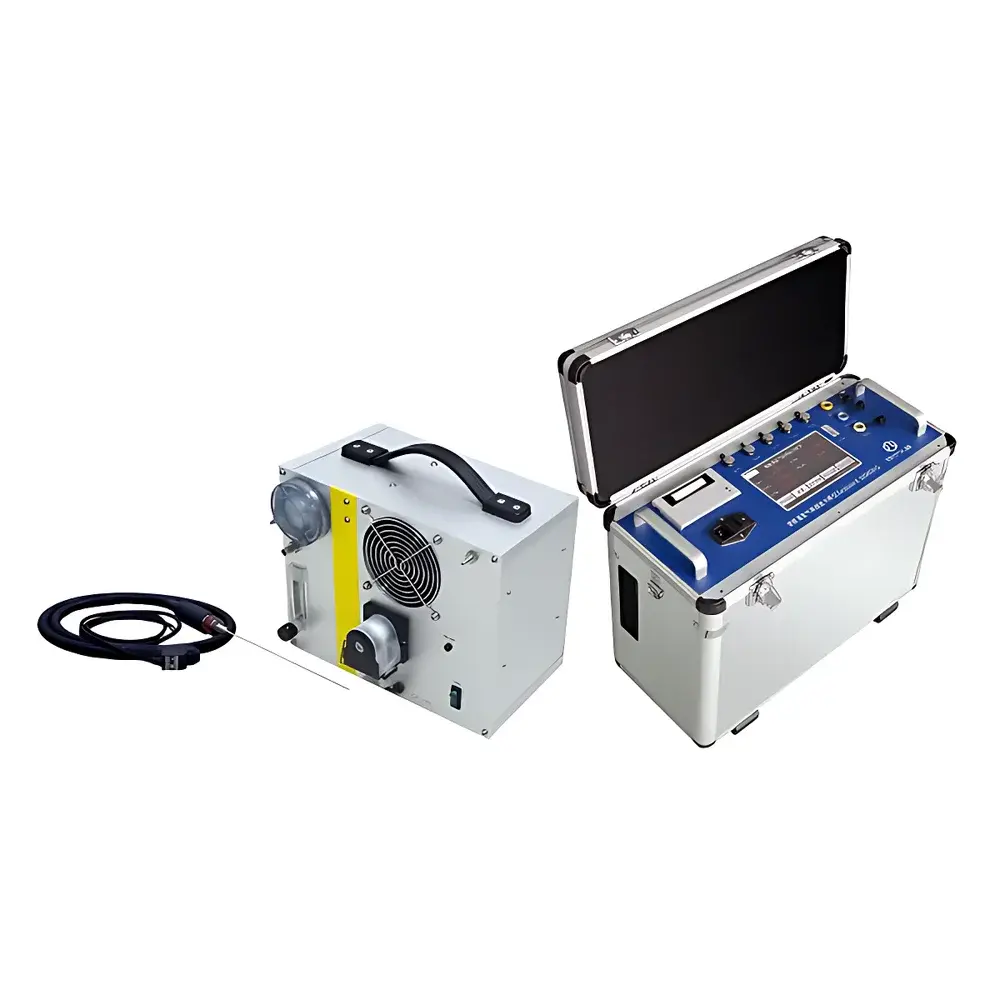
CUBIC INSTRUMENTS Gasboard-3800GHG Portable Greenhouse Gas Emission Analyzer
| Brand | CUBIC INSTRUMENTS |
|---|---|
| Origin | Hubei, China |
| Model | Gasboard-3800GHG |
| Detection Principle | Micro-flow NDIR (CO₂/CH₄/N₂O/CO), Dual-beam NDIR (high-range CO₂ & mid-high-range CO), Electrochemical (O₂) |
| Accuracy | ±1% F.S. (micro-flow NDIR) |
| Measured Gases | CO₂, CH₄, N₂O, CO, O₂ |
| Response Time | T₉₀ < 25 s |
| Repeatability | ≤ ±1% |
| Flow Rate | 0.7–1.2 L/min |
| Inlet Pressure | 2–50 kPa |
| Output | USB, analog, printer interface |
| Power | 100–240 VAC, 150 W |
Overview
The CUBIC INSTRUMENTS Gasboard-3800GHG is a field-deployable, multi-gas emission analyzer engineered for regulatory-grade quantification of key greenhouse gases (GHGs) and combustion-related species in industrial flue gas streams. It operates on the physical principle of non-dispersive infrared (NDIR) absorption spectroscopy—leveraging vibrational mode-specific infrared absorption by heteronuclear diatomic or polyatomic molecules. The instrument integrates two complementary NDIR architectures: proprietary micro-flow NDIR detection for low-concentration, high-precision measurement of CO₂ (0–500 ppm), CH₄ (0–1000 ppm), N₂O (0–1000 ppm), and CO (0–200/5000 ppm); and dual-beam NDIR for enhanced stability and linearity at elevated concentrations (e.g., CO₂ up to 100%, CO up to 5%). Oxygen is measured via temperature-compensated electrochemical cell technology. This hybrid optical-electrochemical architecture enables simultaneous, real-time, and cross-interference-resilient analysis of five critical parameters—CO₂, CH₄, N₂O, CO, and O₂—within a single compact platform compliant with EPA Method 3A, ISO 14064-3 verification workflows, and EU IED (Industrial Emissions Directive) monitoring requirements.
Key Features
- Simultaneous five-gas analysis (CO₂, CH₄, N₂O, CO, O₂) with independent sensor modules and dedicated optical paths to minimize spectral overlap and cross-sensitivity.
- Patented micro-flow NDIR detection with integrated half-chamber reference design (PCT/CN2018100767)—eliminates baseline drift induced by humidity fluctuations and thermal gradients, achieving <±1% full-scale accuracy across low ppm-level GHG ranges.
- Dual-beam NDIR configuration for high-concentration CO₂ and CO measurements, incorporating active reference compensation to suppress source intensity drift and optical contamination effects.
- Robust in-situ sampling system including heated sample line (up to 180 °C), particulate filtration, condensate removal, and pressure-regulated flow control (0.7–1.2 L/min) to maintain representative gas composition during transport.
- Onboard diagnostics with real-time sensor health monitoring, zero/span validation prompts, and fault-code logging aligned with ISO/IEC 17025 traceability requirements.
- Flexible output architecture supporting USB-host data streaming, 4–20 mA analog outputs per channel, and direct thermal printer integration for field audit-ready reporting.
Sample Compatibility & Compliance
The Gasboard-3800GHG is validated for use with hot, humid, and particulate-laden flue gases from stationary combustion sources—including coal-fired power plants, cement kilns, steel blast furnaces, nitric acid production units, and petrochemical crackers. Its heated sampling train prevents water condensation and ammonium salt deposition, ensuring integrity of low-ppm CH₄ and N₂O measurements. All gas path materials are chemically inert (316L stainless steel, PTFE, and Kalrez® seals), minimizing adsorption and catalytic conversion artifacts. The analyzer conforms to EN 15267-3 (QAL1 certification framework), supports QA/QC protocols required under EPA 40 CFR Part 98 (GHG Reporting Program), and provides audit trails compatible with GLP-compliant data governance. Optional integration with stack-mounted temperature, pressure, and velocity sensors enables automated calculation of mass emission rates (kg/h) and annual tonnage per IPCC Tier 2 methodologies.
Software & Data Management
The embedded firmware features a deterministic real-time OS with synchronized 10 Hz acquisition across all channels. Data is timestamped with GPS-synced UTC and stored locally on removable SD card (≥32 GB) with cyclic overwrite protection. The PC-based Gasboard Control Suite (v4.2+) provides calibration management (multi-point span/zero), interference correction tables (H₂O, SO₂, NOₓ cross-sensitivity coefficients), and export to CSV, XML, or EPA-compatible .DAT formats. Audit logs record every user action, calibration event, and sensor diagnostic flag—fully compliant with FDA 21 CFR Part 11 electronic record requirements when deployed in regulated environmental compliance roles. Remote firmware updates and secure SSH access support centralized fleet management for multi-site monitoring programs.
Applications
- Continuous emissions monitoring (CEM) for GHG inventories under national carbon trading schemes (e.g., China’s National Carbon Market, EU ETS).
- Source testing and performance verification of DeNOₓ, SCR, and oxidation catalysts in thermal process industries.
- Stack testing for regulatory compliance with local air quality ordinances (e.g., VOC + GHG co-monitoring in chemical manufacturing).
- Mobile monitoring campaigns for fugitive emission surveys, landfill gas characterization, and biogas upgrading efficiency assessment.
- Research-grade flux measurements in agricultural soil chambers and urban ambient air profiling studies requiring sub-ppm CH₄ and N₂O resolution.
FAQ
What calibration standards are required for field operation?
Primary calibration requires certified gas mixtures traceable to NIST SRMs (e.g., CO₂ in N₂ at 100 ppm, 1000 ppm, and 10% v/v; CH₄ in air at 10 ppm and 500 ppm). Zero gas must be CO₂-free synthetic air with <1 ppm total hydrocarbons.
Can the instrument operate unattended for extended periods?
Yes—when powered via stable AC supply and equipped with external data logger, it supports >30-day autonomous operation with auto-zero cycles every 24 hours and alarm-triggered maintenance alerts.
Is the micro-flow NDIR module susceptible to vibration or tilt during mobile deployment?
No—the detector assembly is mechanically damped and orientation-insensitive; validated per MIL-STD-810G for vehicular mounting on emission survey trucks.
How does the analyzer handle high moisture content (>20% v/v) without desiccant?
The heated sample line (180 °C) maintains dew point suppression upstream of the optical cell; combined with the half-chamber reference design, this reduces H₂O-induced bias to <0.5% F.S. for CO₂ at 15% moisture.
Does the system support remote data transmission via cellular or satellite link?
Yes—via optional 4G LTE module (CAT-M1/NB-IoT) with TLS 1.2 encrypted MQTT publishing to cloud platforms (AWS IoT Core, Azure IoT Hub) or SCADA systems using Modbus TCP.
Related Products







