
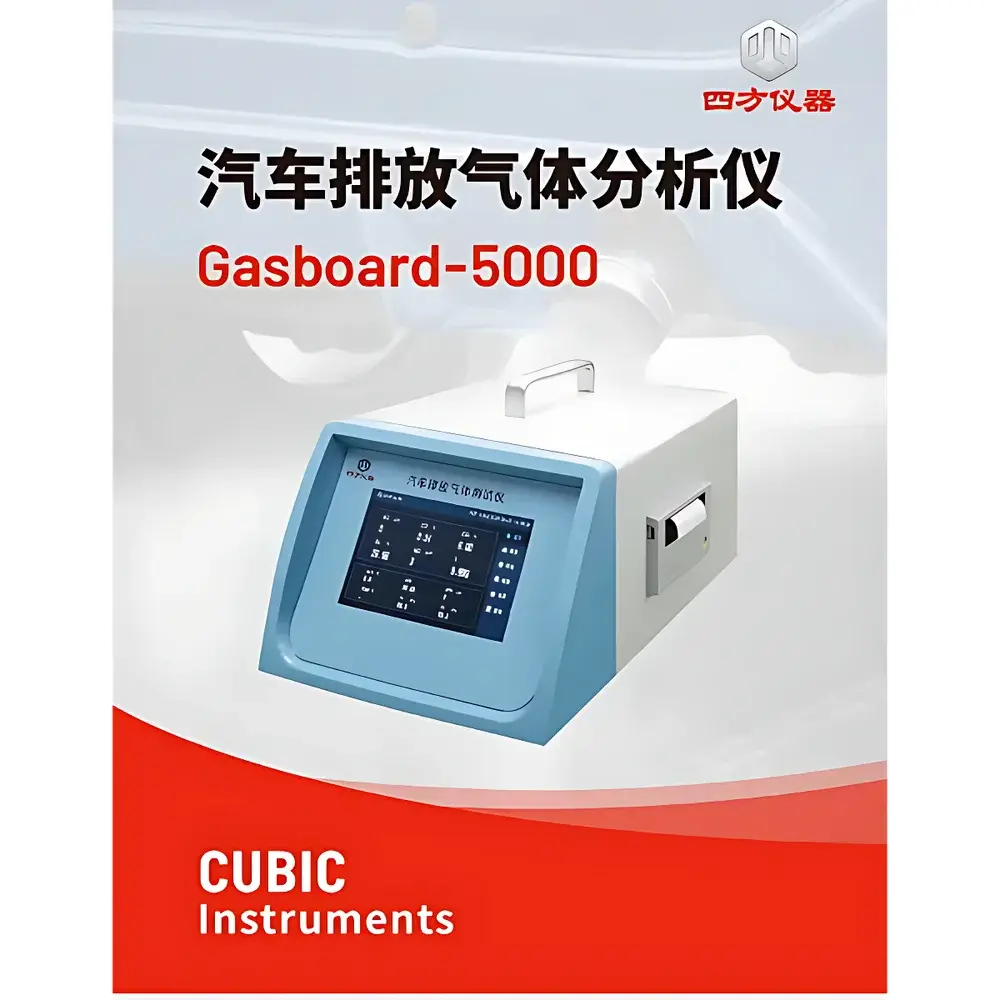
CUBIC INSTRUMENTS Gasboard-5000 Automotive Exhaust Gas Analyzer
| Brand | CUBIC INSTRUMENTS |
|---|---|
| Origin | Hubei, China |
| Model | Gasboard-5000 |
| Instrument Type | Online Analyzer |
| Detection Principle | Non-Dispersive Infrared (NDIR) Absorption + Electrochemical Detection (ECD) |
| Measured Gases | CO, HC, CO₂, O₂, NO |
| Zero Drift | ±1% FS for CO, HC, CO₂, O₂, NO |
| Span Drift | ±1% FS for CO, HC, CO₂, O₂, NO |
| Repeatability | ≤1% for all measured gases |
Overview
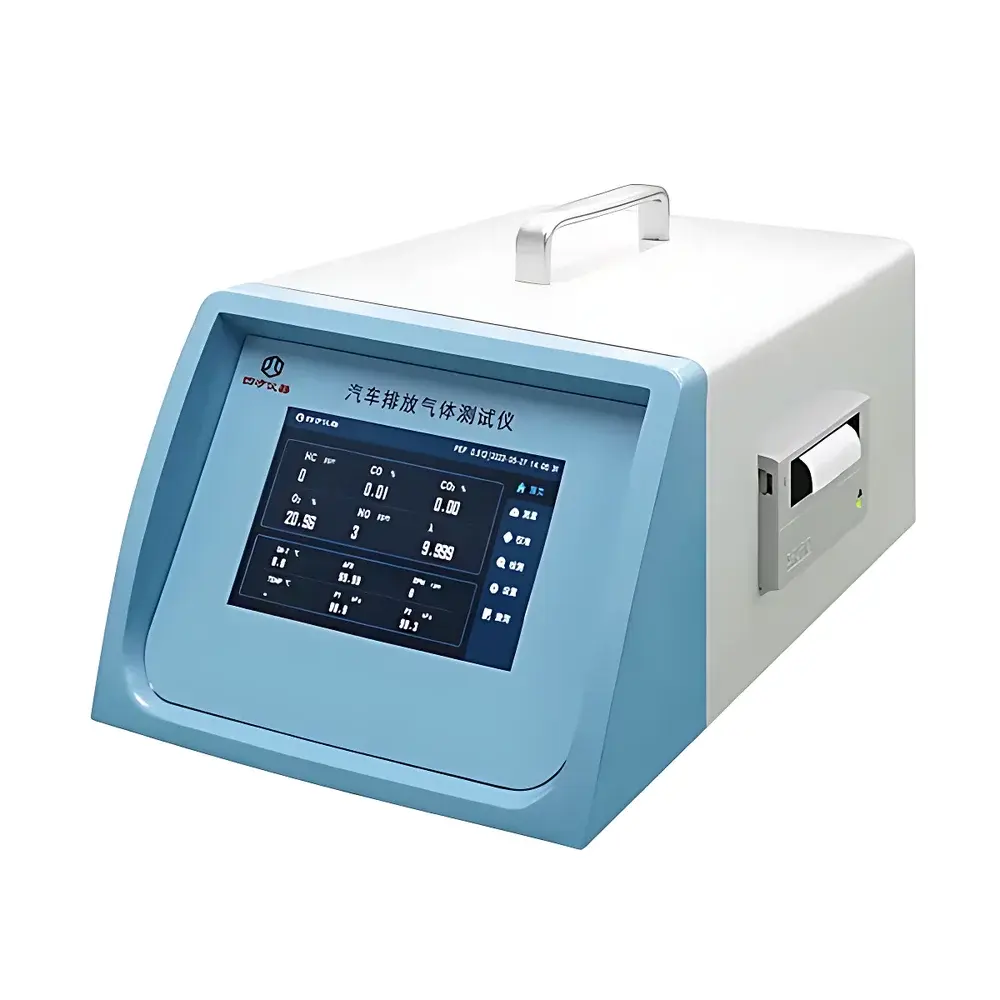
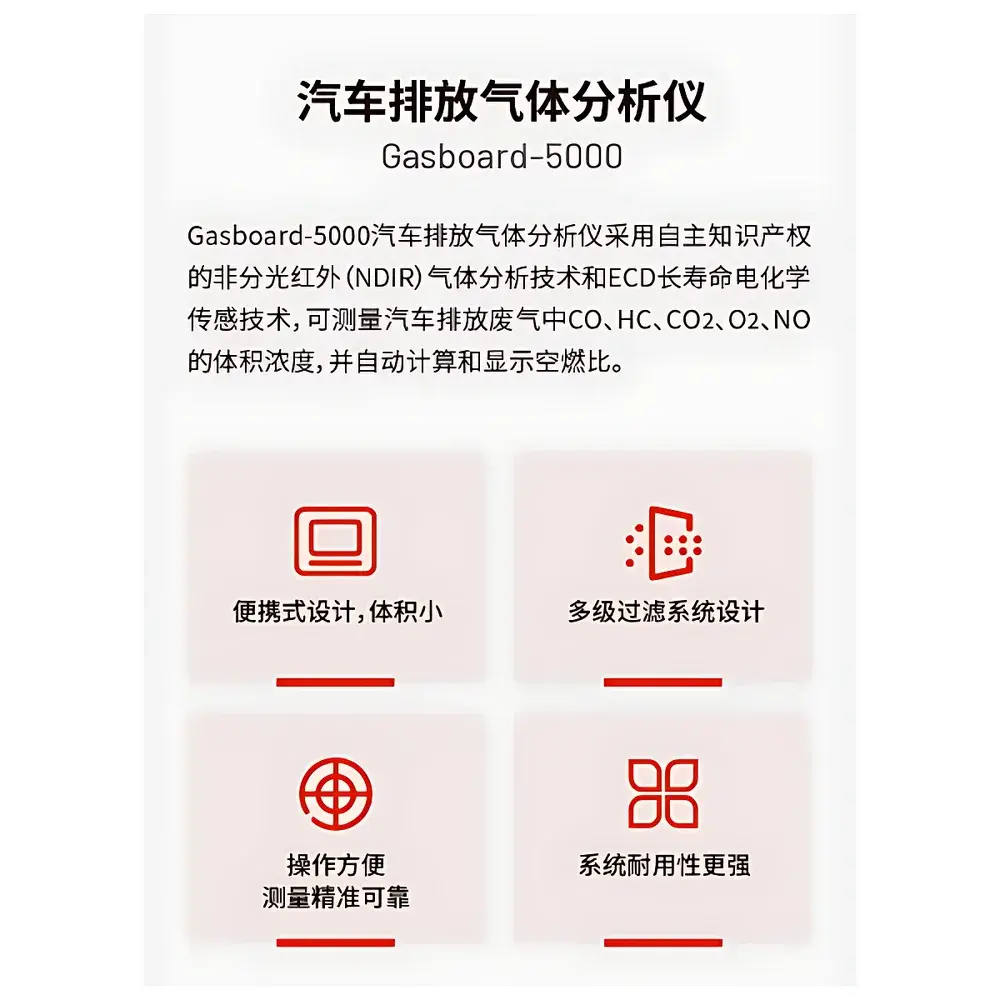
The CUBIC INSTRUMENTS Gasboard-5000 is a dedicated online automotive exhaust gas analyzer engineered for regulatory compliance testing, vehicle maintenance diagnostics, and R&D validation in controlled laboratory and field-deployed environments. It employs dual-sensor architecture: non-dispersive infrared (NDIR) spectroscopy for quantitative measurement of CO, CO₂, and hydrocarbons (HC), and long-life electrochemical detection (ECD) for precise O₂ and NO quantification. This hybrid optical–electrochemical approach ensures high selectivity, minimal cross-sensitivity, and stable baseline performance across extended operational cycles. The instrument calculates air–fuel ratio (AFR) in real time using stoichiometric algorithms based on measured O₂ and CO/CO₂ ratios—enabling direct evaluation of combustion efficiency without external computation. Designed to meet the functional requirements of ISO 3930, ISO 8764, and SAE J1149 standards for exhaust analysis, the Gasboard-5000 supports both stationary bench testing and mobile inspection workflows.
Key Features
- Integrated NDIR + ECD sensor platform delivering simultaneous, independent quantification of CO, HC, CO₂, O₂, and NO with trace-level resolution and low interferences
- Robust multi-stage filtration system—including particulate trap, water condenser, and chemical scrubbers—to protect optical cells and electrochemical cells from oil mist, moisture, and acidic contaminants common in raw exhaust streams
- Compact, rack-mountable chassis with industrial-grade enclosure (IP54-rated) suitable for workshop integration or mobile test cell deployment
- Dual analog/digital interface: RS-232 and RS-485 ports compliant with Modbus RTU protocol for seamless integration into centralized emission monitoring systems or automated test stands
- Onboard LCD display with intuitive menu navigation; real-time graphical trend logging for up to five gas channels and calculated AFR
- Dedicated engine interface supporting analog inputs for oil temperature and RPM synchronization—enabling load-correlated emission profiling per test cycle protocols (e.g., ASM, IM240)
Sample Compatibility & Compliance
The Gasboard-5000 is validated for direct sampling of cooled, conditioned exhaust gas from gasoline, LPG, and ethanol-blended fuel vehicles operating under transient or steady-state conditions. Its sample inlet accepts standard 6 mm OD PTFE tubing and features heated line compatibility (optional accessory) to prevent condensation during low-flow or cold-start measurements. All gas measurement ranges and accuracy specifications align with national and regional regulatory frameworks, including China’s GB 18285–2018, EU Directive 2007/46/EC Annex XI, and U.S. EPA 40 CFR Part 1065 Appendix D calibration verification criteria. The analyzer supports GLP-compliant operation through user-accessible calibration logs, audit-trail-enabled parameter changes, and password-protected configuration modes.
Software & Data Management
The device operates autonomously but is fully compatible with CUBIC’s Gasboard Control Suite (v3.2+), a Windows-based application enabling remote configuration, real-time data streaming, multi-instrument synchronization, and automated report generation in PDF/CSV formats. All measurement data includes embedded timestamps, sensor health status flags, and environmental compensation metadata (ambient T/P). Firmware updates are delivered via secure USB or serial connection and include cryptographic signature verification. Data integrity meets FDA 21 CFR Part 11 requirements for electronic records and signatures when used with optional audit-log activation and role-based user accounts.
Applications
- Periodic technical inspection (PTI) and I/M (Inspection and Maintenance) programs conducted by government-accredited motor vehicle testing centers
- Pre-delivery emission verification and durability testing at OEM manufacturing facilities and Tier-1 supplier labs
- Aftermarket diagnostic support in certified repair shops—particularly for OBD-II correlation, catalyst efficiency assessment, and misfire root-cause analysis
- Academic and governmental research on alternative fuel combustion behavior, aftertreatment system efficiency, and real-driving emissions (RDE) proxy validation
- Third-party certification laboratories performing type-approval testing per UN ECE Regulation 83, Regulation 49, or GB/T 18352.x series
FAQ
What calibration standards are required for routine verification?
Certified gas mixtures traceable to NIST or BIPM standards must be used: CO (1000 ppm), CO₂ (5%), HC (propane, 1000 ppm), NO (500 ppm), and O₂ (10% in N₂). Calibration intervals follow ISO 17025 guidelines—typically every 72 hours of continuous operation or prior to each test batch.
Is the Gasboard-5000 suitable for diesel exhaust analysis?
No. It is optimized for spark-ignition (gasoline) engine exhaust. Diesel applications require additional NO₂ and PM measurement capability, which falls outside this model’s design scope. For diesel, refer to the Gasboard-5200 series with chemiluminescence NOx detection.
Can raw exhaust be introduced directly into the analyzer?
No. Sample gas must be cooled to ≤40 °C and filtered to remove particulates >1 µm and condensed hydrocarbons. Use of the integrated multi-stage filter unit is mandatory; optional heated sample line recommended for low-temperature start-up tests.
Does the instrument support automatic zero/span correction?
Yes—via programmable auto-zero function using internal reference air and external span gas trigger input. Full auto-calibration requires optional solenoid valve manifold kit (part no. GB-5000-CAL-MK2).
What is the warm-up time to achieve full measurement accuracy?
10 minutes from power-on to meet all stated accuracy specifications, as verified per ISO 12103-1 Annex B thermal stabilization protocol.
Related Products







