
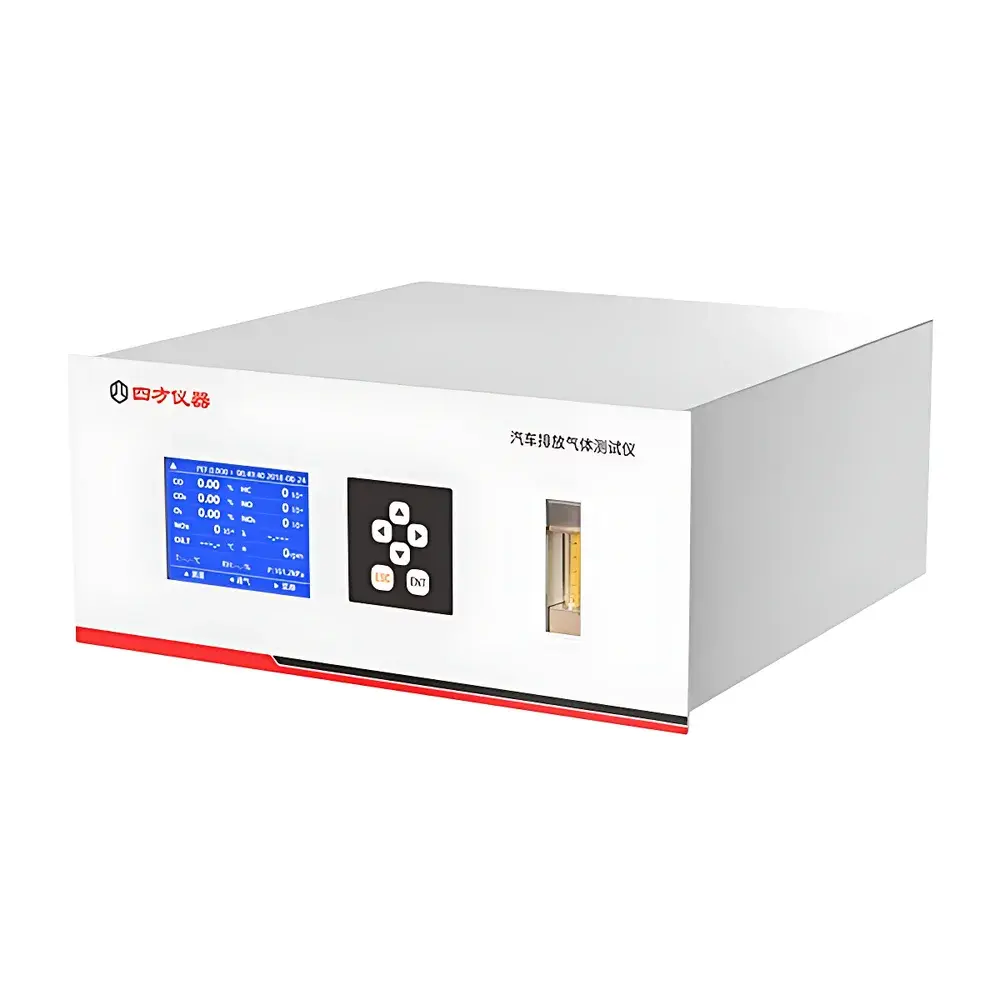
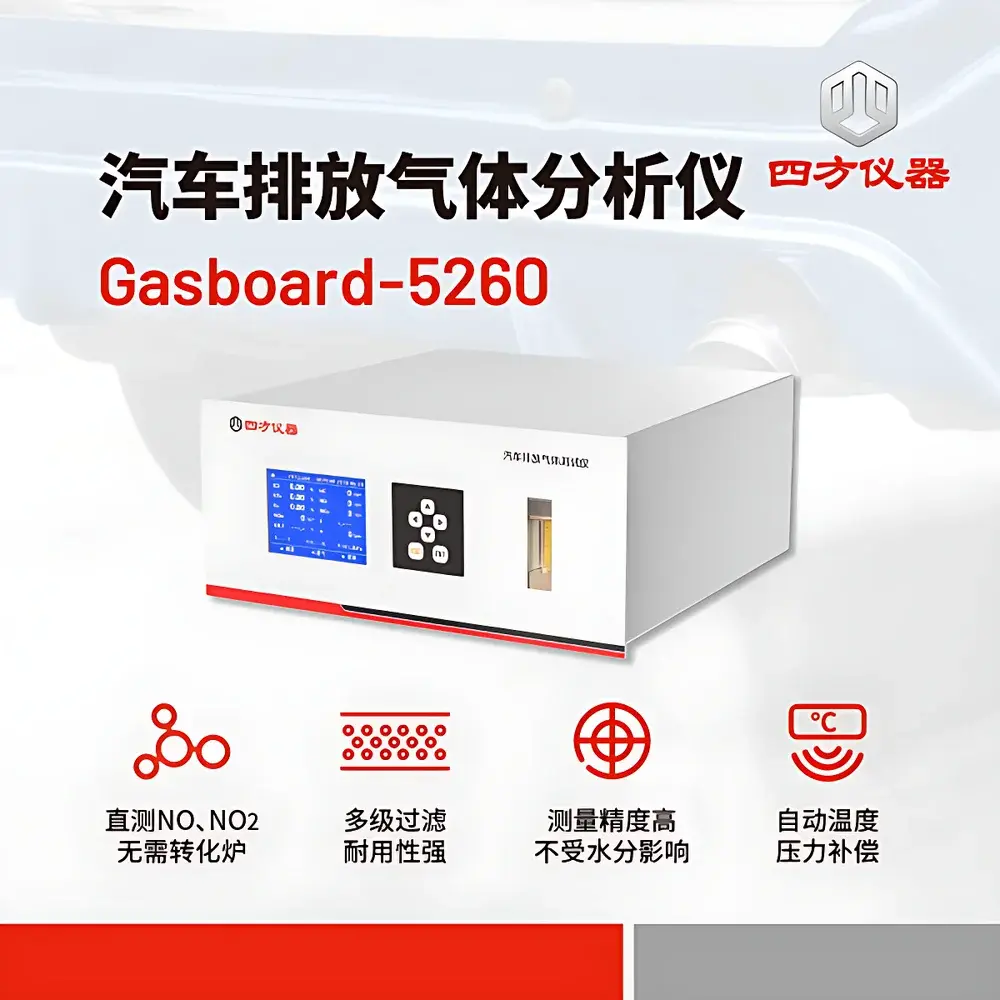
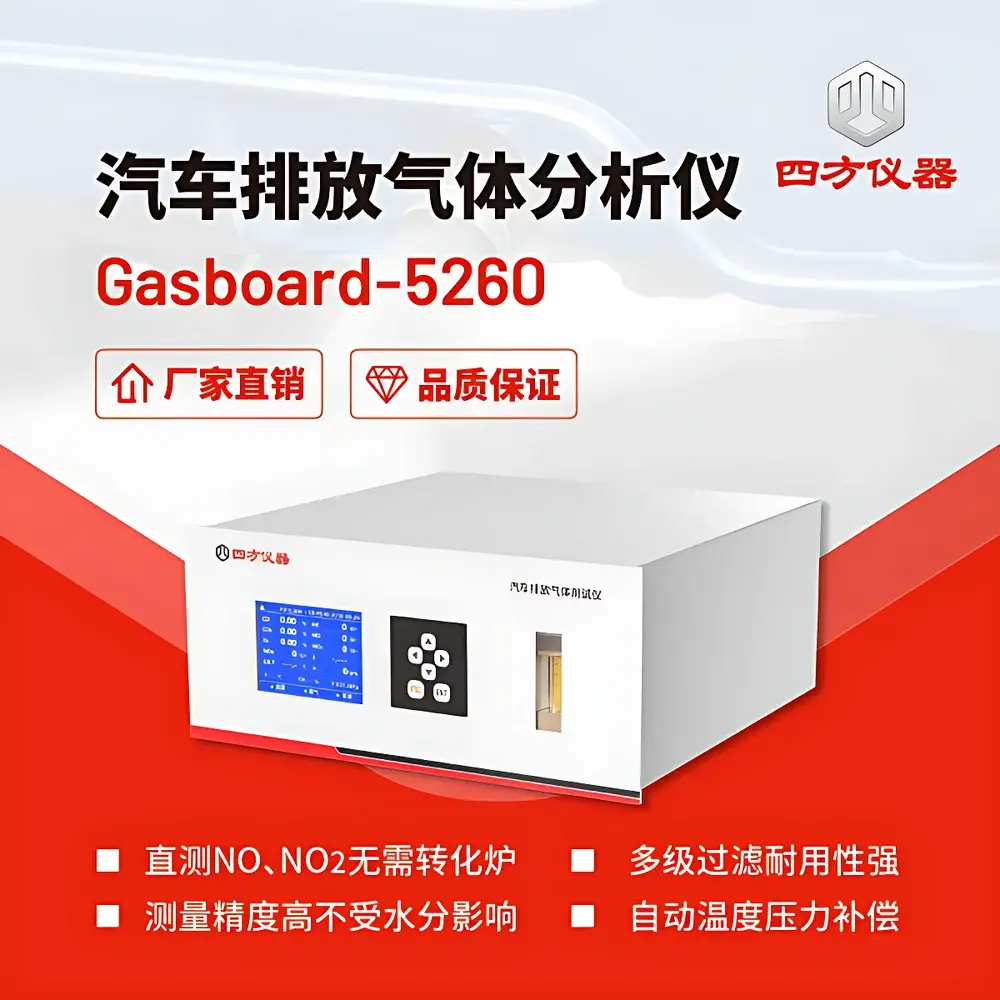
CUBIC INSTRUMENTS Gasboard-5100 Automotive Exhaust Gas Analyzer
| Brand | CUBIC INSTRUMENTS |
|---|---|
| Origin | Hubei, China |
| Model | Gasboard-5100 |
| Instrument Type | Online Analyzer |
| Detection Principles | UV-DOAS (NO, NO₂), NDIR (HC, CO, CO₂), Electrochemical (O₂) |
| Measurement Ranges | HC (0–2000 ppm), CO (0.00–10.00%), CO₂ (0.0–16.0%), NO (0–4000 ppm), NO₂ (0–1000 ppm), O₂ (0.0–25.0%) |
| Accuracy | ±4 ppm or ±3% (HC, 2000 ppm range), ±0.02% or ±3% (CO), ±0.3% or ±3% (CO₂), ±25 ppm or ±4% (NO), ±25 ppm or ±4% (NO₂), ±0.1% or ±5% (O₂) |
| Resolution | HC/NO/NO₂: 1 ppm |
| CO/CO₂/O₂ | 0.01% |
| Response Time (T90) | HC/CO/CO₂ ≤8 s |
| Warm-up Time | 30 min |
| Communication | RS-485 / RS-232 |
| Power Supply | AC 100–240 V, 50 Hz ±2% |
Overview
The CUBIC INSTRUMENTS Gasboard-5100 is an online automotive exhaust gas analyzer engineered for regulatory compliance and high-reliability field deployment in vehicle emissions testing laboratories, inspection stations, and OEM R&D facilities. It implements a multi-principle optical and electrochemical sensing architecture to simultaneously quantify six critical exhaust constituents: hydrocarbons (HC), carbon monoxide (CO), carbon dioxide (CO₂), nitrogen monoxide (NO), nitrogen dioxide (NO₂), and oxygen (O₂). Unlike conventional analyzers relying on catalytic NOx converters, the Gasboard-5100 employs ultraviolet differential optical absorption spectroscopy (UV-DOAS) for direct, interference-free quantification of both NO and NO₂—eliminating conversion inefficiency, thermal drift, and cross-sensitivity artifacts. Complementary non-dispersive infrared (NDIR) detection provides stable, moisture-resilient measurement of CO, CO₂, and HC across wide dynamic ranges, while a long-life electrochemical cell ensures robust O₂ monitoring with minimal calibration drift. The system integrates real-time air-fuel ratio (λ) calculation based on stoichiometric combustion models, supporting both steady-state and acceleration simulation mode (ASM) test protocols defined in GB 18285–2018.
Key Features
- Direct dual-species UV-DOAS detection of NO and NO₂—no NOx converter required, reducing maintenance cycles and operational cost
- Multi-wavelength NDIR optics with temperature- and pressure-compensated signal processing for high repeatability under variable ambient and exhaust humidity conditions
- Modular sensor architecture enabling field-swappable gas modules, minimizing downtime during preventive maintenance or recalibration
- Multi-stage particulate and condensate filtration system—including heated sample line, hydrophobic membrane, and thermoelectric cooler—designed for long-term stability in high-moisture, low-concentration exhaust streams
- Embedded linearization algorithms correcting for spectral interference, baseline offset, and nonlinearity across full measurement spans
- Integrated environmental compensation: automatic correction for ambient temperature (−10 °C to +50 °C) and barometric pressure (70–106 kPa)
- Standardized digital interfaces (RS-232/RS-485) compliant with Gasboard-series ecosystem integration for synchronized data acquisition with opacity meters and engine parameter loggers
Sample Compatibility & Compliance
The Gasboard-5100 is validated for continuous sampling of raw or diluted exhaust gases from gasoline, LPG, and ethanol-fueled light-duty vehicles operating under transient and steady-state conditions. Its optical path design accommodates particulate loadings up to 100 mg/m³ and water vapor concentrations exceeding 20% v/v without signal attenuation or condensation-induced error. All measurement performance parameters meet or exceed the metrological requirements specified in JJG 688–2017 Class 00 verification protocol. The analyzer satisfies functional and accuracy mandates of China’s national standards GB 18285–2018 (emissions testing for light-duty vehicles) and GB 3847–2018 (opacity and gaseous pollutants for heavy-duty diesel vehicles). While not certified to EU type-approval directives (e.g., UNECE R83, R49) or US EPA 40 CFR Part 1065, its traceable calibration methodology and documented uncertainty budgets support GLP-aligned laboratory use and third-party accreditation under ISO/IEC 17025.
Software & Data Management
The embedded firmware supports dual-mode operation: standalone benchtop analysis via front-panel interface or networked control through ASCII-based serial command protocol. Raw sensor outputs are timestamped and logged at 1 Hz resolution, with configurable storage depth (internal flash: ≥72 h at 1 Hz). Export formats include CSV and XML, compatible with LIMS integration and statistical process control (SPC) platforms. Audit trails record all calibration events, zero/span adjustments, and firmware updates—meeting minimum traceability criteria aligned with ISO 17025 Clause 7.7 and FDA 21 CFR Part 11 principles (electronic signature capability available via optional PC software module). Remote diagnostics and firmware upgrades are supported over RS-485 using secure bootloader handshake protocols.
Applications
- Regulatory emissions inspection at authorized motor vehicle testing centers (MTA) and environmental protection bureaus
- In-plant quality assurance for OEM powertrain validation, including cold-start, hot-soak, and durability cycle testing
- Aftermarket catalyst and EGR system performance evaluation in independent repair facilities
- Academic and governmental research on alternative fuel combustion chemistry and aftertreatment efficiency
- Mobile emissions monitoring units (MEMUs) requiring compact, low-power, high-stability analyzers with minimal consumables
- Reference instrumentation for method validation studies supporting national standard revision initiatives
FAQ
Does the Gasboard-5100 require periodic NOx converter replacement?
No—its UV-DOAS subsystem measures NO and NO₂ independently, eliminating dependence on catalytic converters subject to poisoning and thermal degradation.
Can the analyzer operate continuously in high-humidity exhaust environments?
Yes—integrated thermoelectric cooling, hydrophobic filtration, and active dew-point management ensure stable optical transmission even at >95% RH.
Is calibration traceable to national standards?
All factory calibrations are performed using NIST-traceable gas standards (certified by CNAS-accredited laboratories), with full uncertainty budgets provided per JJG 688–2017 Annex B.
What communication protocols does it support for integration with test stands?
RS-232 and RS-485 interfaces implement a documented ASCII command set, enabling synchronization with dynamometer controllers, oil temperature sensors, and engine speed inputs.
How frequently must the system be zeroed or span-checked?
Under routine operation, automated zero checks every 2 hours and manual span verification every 7 days are recommended; extended intervals may be justified under GLP-controlled validation protocols.







