
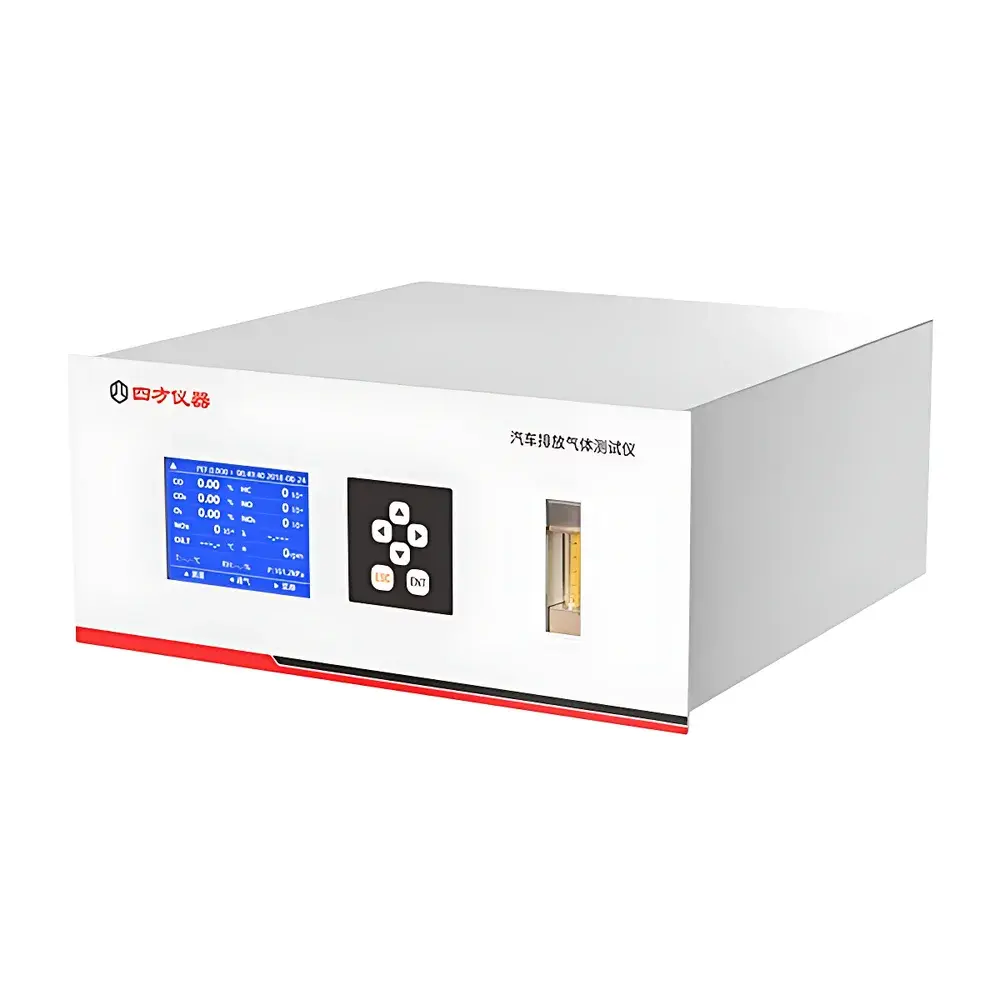
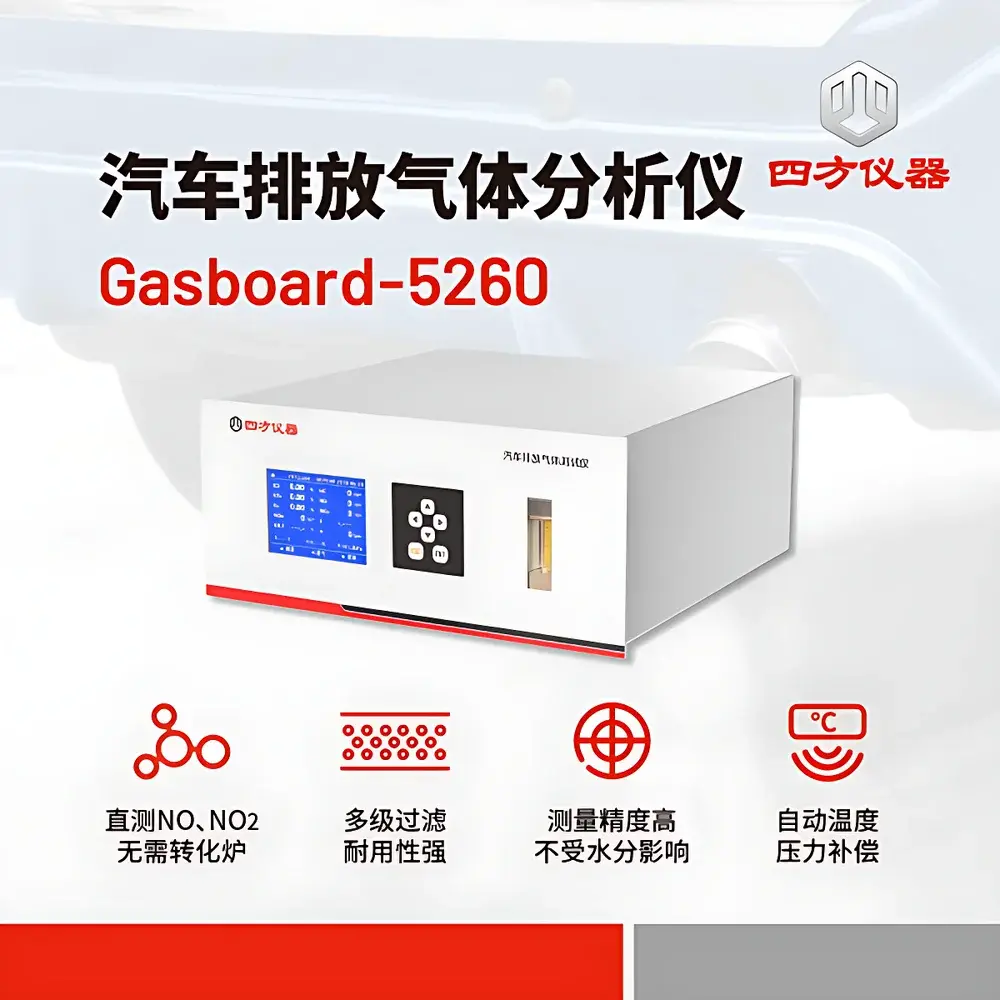
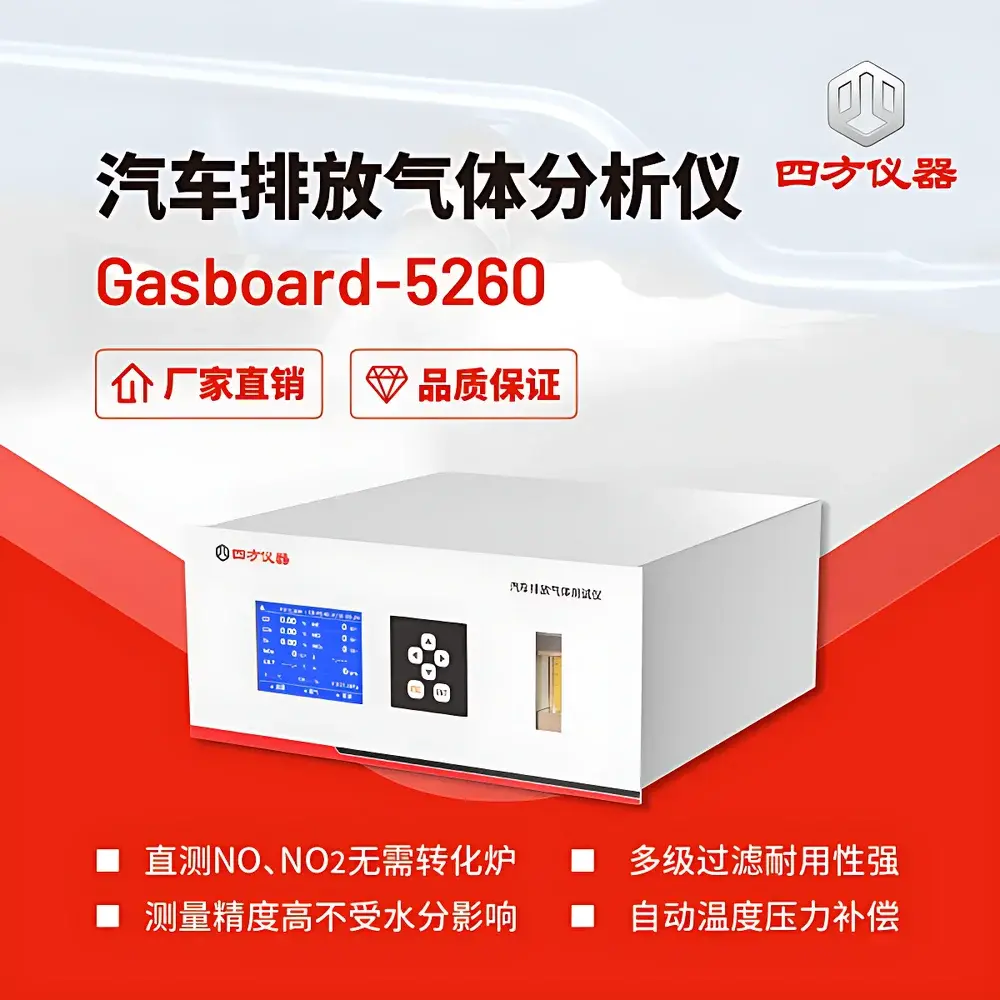
CUBIC INSTRUMENTS Gasboard-5200 Automotive Exhaust Gas Analyzer
| Brand | CUBIC INSTRUMENTS |
|---|---|
| Origin | Hubei, China |
| Model | Gasboard-5200 |
| Instrument Type | Online Analyzer |
| Detection Principles | Microflow Dual-Chamber NDIR (HC, CO, CO₂), PCT-Patented Microflow Infrared for NO, NDUV for NO₂, Long-Life Electrochemical Cell for O₂ |
| Measured Gases | HC, CO, CO₂, NO, NO₂, O₂ |
| Accuracy | HC ±4 ppm (0–2000 ppm), ±3% (2001–5000 ppm), ±5% (5001–9999 ppm) |
| Resolution | HC/NO/NO₂: 1 ppm |
| CO/CO₂/O₂ | 0.01% |
| Response Time (T90) | HC/CO/CO₂ ≤8 s |
| Warm-up Time | 30 min |
| Communication | RS-485 / RS-232 |
| Power Supply | AC 100–240 V, 50 Hz ±2% |
| Compliance | GB 18285-2018, GB 3847-2018, JJG 688-2017 Class 00 |
Overview
The CUBIC INSTRUMENTS Gasboard-5200 is a high-precision, online automotive exhaust gas analyzer engineered for regulatory-grade emissions testing in inspection & maintenance (I/M) programs, vehicle manufacturing QA, and R&D laboratories. It employs a multi-technology sensor architecture to simultaneously quantify six critical combustion byproducts—hydrocarbons (HC), carbon monoxide (CO), carbon dioxide (CO₂), nitric oxide (NO), nitrogen dioxide (NO₂), and oxygen (O₂)—with metrological traceability aligned to Chinese national standards GB 18285-2018 and GB 3847-2018. Unlike conventional analyzers requiring catalytic NOx converters, the Gasboard-5200 directly measures NO and NO₂ using orthogonal optical principles: patented microflow dual-chamber non-dispersive infrared (NDIR) spectroscopy for HC, CO, and CO₂; a PCT-international patent-protected (PCT/CN2018100767) microflow infrared cell with dual reference and measurement chambers for NO—eliminating thermal drift from ambient fluctuations; non-dispersive ultraviolet (NDUV) absorption for selective NO₂ quantification; and a long-life electrochemical oxygen sensor (ECD) for robust O₂ measurement and real-time air-fuel ratio (λ) calculation. All measurements are continuously compensated for temperature and pressure variations, ensuring repeatability across diverse environmental and operational conditions.
Key Features
- Direct, converter-free NO and NO₂ measurement—reducing system complexity, maintenance frequency, and calibration drift over time
- Multi-spectral detection architecture: NDIR (HC/CO/CO₂), microflow IR (NO), NDUV (NO₂), and ECD (O₂)—optimized for cross-interference rejection, especially in humid exhaust streams
- Integrated multi-stage particulate and moisture filtration system—enhancing sensor longevity and minimizing downtime during high-volume testing cycles
- Advanced digital signal processing firmware with adaptive linearization algorithms—correcting nonlinearity inherent to gas absorption profiles across full dynamic ranges
- Real-time ambient temperature and barometric pressure compensation—maintaining accuracy without manual recalibration between test bays or seasonal shifts
- Standardized analog/digital I/O interfaces—including dedicated connectors for engine oil temperature and rotational speed input—enabling synchronized emission evaluation under transient operating modes
Sample Compatibility & Compliance
The Gasboard-5200 is validated for use with raw, diluted, and conditioned exhaust samples from gasoline, LPG, CNG, and hybrid powertrains. Its optical path design and sensor materials resist contamination from unburned hydrocarbons, sulfur compounds, and condensable vapors typical in cold-start or rich-burn exhaust. The analyzer meets JJG 688-2017 Class 00 verification requirements—the highest metrological grade for exhaust gas analyzers in China—ensuring suitability for legal metrology applications, including statutory vehicle inspection certification. While designed primarily for compliance with GB-series standards, its measurement uncertainty profile aligns with internationally recognized performance benchmarks such as ISO 3930 and EN 15085-3 for laboratory-grade gas analysis instrumentation. Data integrity protocols support audit-ready operation under GLP-aligned quality management systems.
Software & Data Management
The embedded firmware supports dual communication protocols—RS-232 and RS-485—with ASCII-based command sets compatible with third-party test stands and centralized fleet management platforms. Raw concentration data, timestamps, temperature/pressure metadata, and diagnostic flags are output at configurable intervals (1–10 Hz). Optional PC-based configuration software enables calibration certificate generation, sensor health monitoring, and trend analysis of zero/span drift over time. All stored calibration events, user actions, and alarm logs include immutable timestamps—facilitating basic audit trail functionality consistent with foundational data governance expectations in regulated environments. The device does not implement FDA 21 CFR Part 11 electronic signature controls but provides exportable CSV logs suitable for integration into validated LIMS or ELN systems.
Applications
- Periodic technical inspection (PTI) stations conducting steady-state (ASM) and transient acceleration simulation mode (ASM5015/ASM2540) tests per GB 18285-2018
- OEM powertrain development labs evaluating aftertreatment efficiency, catalyst light-off behavior, and lambda control strategies
- Aftermarket repair facilities performing diagnostic emission troubleshooting and post-repair verification
- Environmental monitoring agencies deploying mobile test units for roadside enforcement and fleet screening campaigns
- Academic and government research institutions studying combustion chemistry, alternative fuel impacts, and real-driving emissions (RDE) correlation
- Third-party certification bodies conducting type-approval testing and conformity-of-production audits
FAQ
Does the Gasboard-5200 require an external NOx converter for NO measurement?
No. It uses a proprietary microflow dual-chamber infrared sensor with temperature-stabilized optics, enabling direct NO quantification without catalytic conversion.
Is the analyzer suitable for measuring exhaust from diesel engines?
Yes—it supports both gasoline and diesel exhaust streams, though particulate filtration must be maintained per manufacturer guidelines for optimal NO₂ NDUV path stability.
What is the warm-up stabilization period before first-use calibration?
A minimum 30-minute thermal equilibration is required to achieve full specification accuracy across all gas channels.
Can the device interface with existing dynamometer control systems?
Yes—via RS-485 Modbus RTU or ASCII protocol, supporting synchronization of gas readings with torque, speed, and load data.
Are calibration gases traceable to NIM (National Institute of Metrology, China)?
Calibration must be performed using certified reference materials traceable to NIM or equivalent national metrology institutes; the analyzer itself does not include built-in gas standards.







