
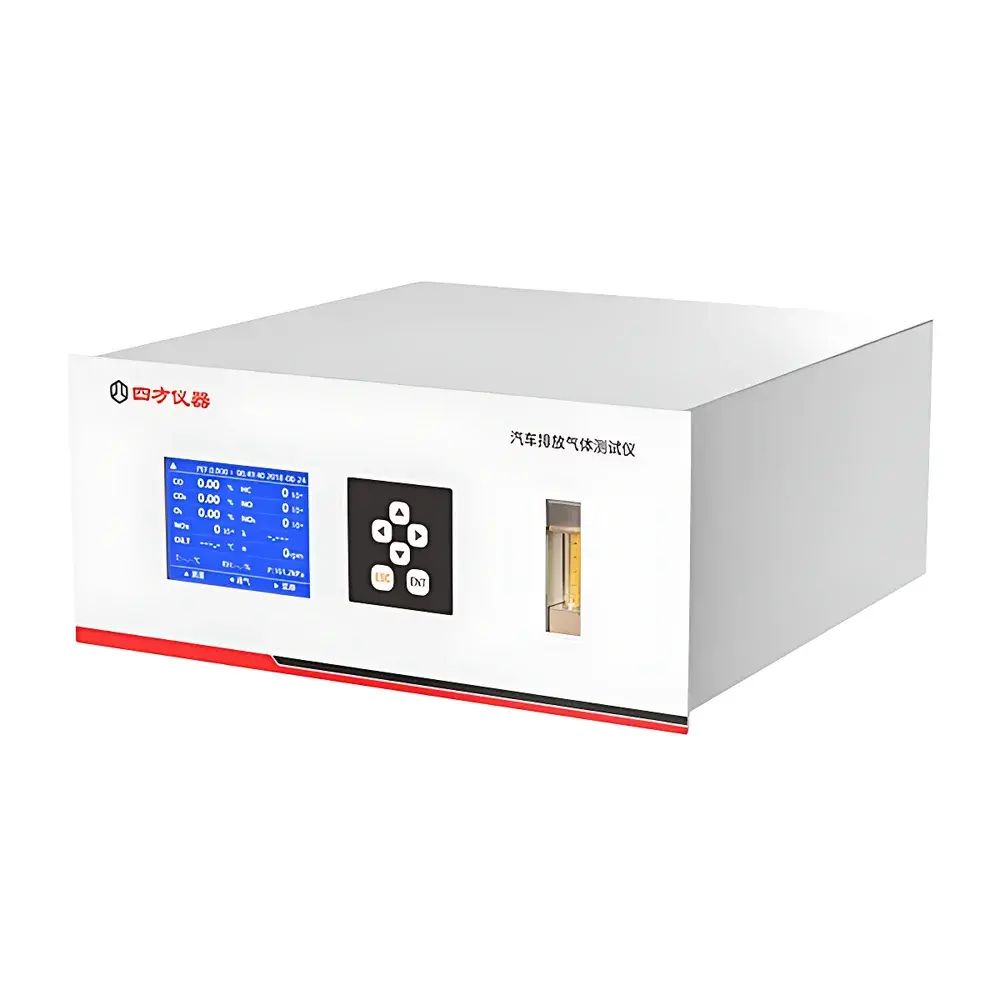
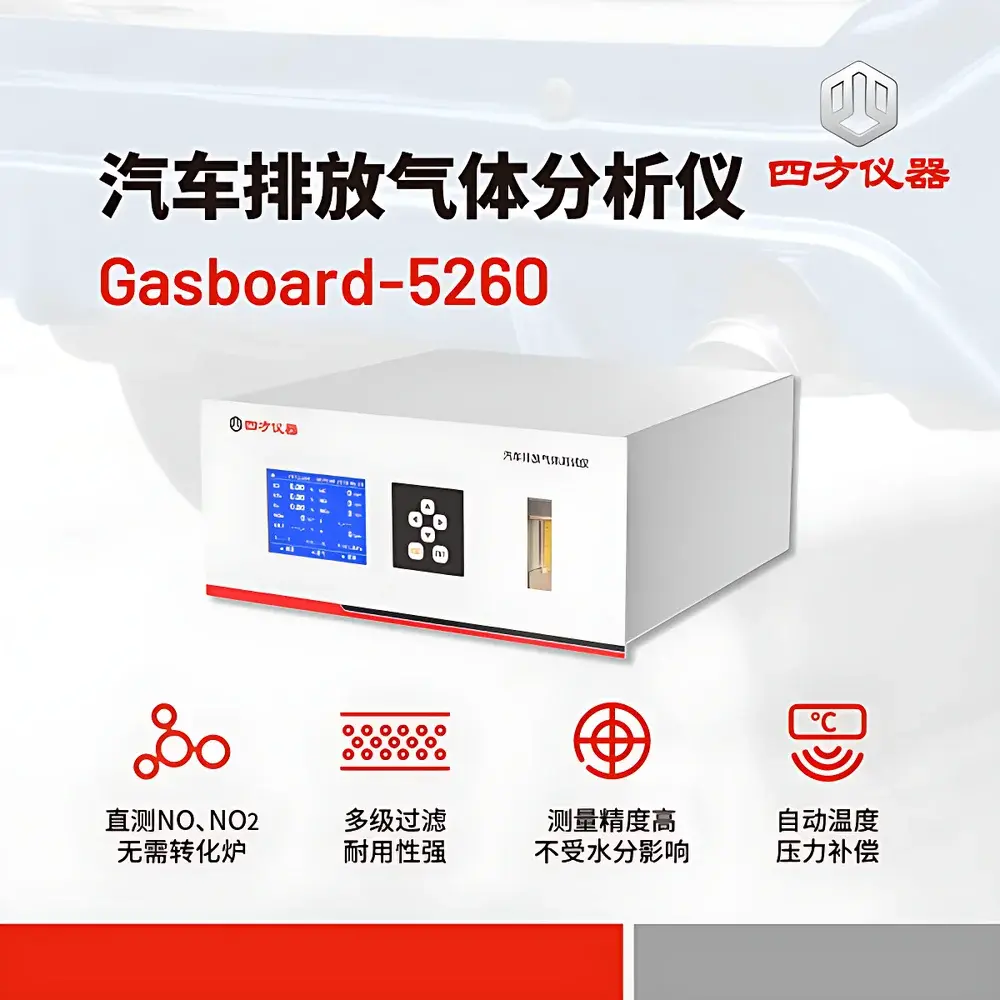
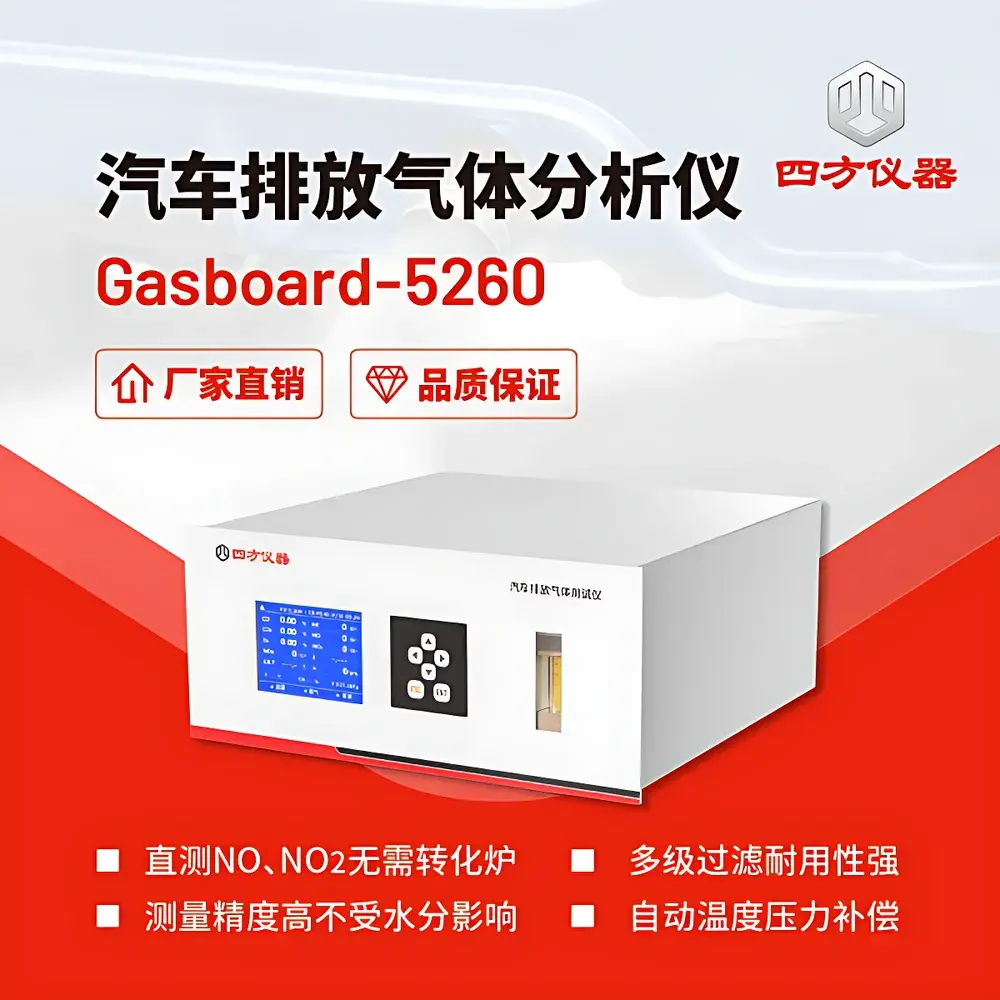
CUBIC INSTRUMENTS Gasboard-5230 Automotive Exhaust Gas Analyzer for Diesel Vehicles
| Brand | CUBIC INSTRUMENTS |
|---|---|
| Origin | Hubei, China |
| Manufacturer Type | Authorized Distributor |
| Country of Origin | China |
| Model | Gasboard-5230 |
| Instrument Type | Online Fixed-Mount Analyzer |
| Detection Principle | Microflow Dual-Chamber NDIR (NO), NDUV (NO₂), NDIR (CO₂) |
| Measured Gases | NO, NO₂, CO₂ |
| Accuracy | ±25 ppm or ±4% (NO/NO₂) |
| Resolution | 1 ppm (NO/NO₂), 0.01% vol (CO₂) |
| Response Time (T₉₀) | ≤10 s (NO/NO₂), ≤8 s (CO₂) |
| Warm-up Time | 30 min |
| Power Supply | 100–240 VAC, 150 W |
| Communication Interface | RS-485 / RS-232 |
Overview
The CUBIC INSTRUMENTS Gasboard-5230 is a certified online automotive exhaust gas analyzer engineered specifically for regulatory compliance testing of diesel-powered vehicles. It implements three distinct, interference-resistant optical absorption methodologies in a single integrated platform: microflow dual-chamber non-dispersive infrared (NDIR) spectroscopy for nitric oxide (NO), non-dispersive ultraviolet (NDUV) absorption for nitrogen dioxide (NO₂), and conventional NDIR for carbon dioxide (CO₂). This multi-technology architecture eliminates the need for catalytic NOx converters—reducing system complexity, long-term drift, and maintenance overhead. The analyzer meets the stringent metrological requirements of China’s national standard GB 3847–2018 (“Limits and Measurement Methods for Pollutants from Diesel-Fueled Vehicles”) and fulfills Class 0 accuracy specifications per JJG 688–2017 (“Verification Regulation for Automotive Exhaust Gas Analyzers”). Its design prioritizes measurement stability under variable ambient conditions, leveraging patented dual-chamber infrared sensor architecture (PCT/CN2018100767) to compensate for thermal drift and electronic aging effects.
Key Features
- Direct, simultaneous quantification of NO, NO₂, and CO₂—no NOx converter required, minimizing cross-sensitivity and calibration dependency
- Proprietary microflow dual-chamber NDIR sensor for NO: enhanced temperature stability and long-term repeatability through differential reference-compensated detection
- NDUV optical path optimized for NO₂ at 400–450 nm, delivering high selectivity without ozone generation or UV lamp degradation concerns
- Multi-stage particulate and moisture filtration system compatible with raw, unconditioned diesel exhaust streams
- Real-time digital signal processing with adaptive linearization algorithms applied to raw absorbance data, correcting for nonlinearity across full dynamic ranges
- Modular interface support for seamless integration with Gasboard-6000 transmittance-type opacity meters (via RS-485), enabling concurrent gaseous and particulate emission assessment per GB 3847–2018 Annex D
Sample Compatibility & Compliance
The Gasboard-5230 is validated for use with undiluted, hot, humid diesel exhaust gases—including transient and steady-state emissions profiles generated during free-acceleration and loaded-mode chassis dynamometer tests. Its optical measurement cells are resistant to condensation and hydrocarbon fouling due to heated sample pathways (standard configuration) and chemically inert internal surfaces. Regulatory alignment includes full traceability to Chinese national verification protocols: JJG 688–2017 (Class 0), GB 3847–2018 (Annexes A–D), and HJ 845–2017 (“Technical Guidelines for Emission Testing of In-Use Diesel Vehicles”). While not certified to EU type-approval standards (e.g., R83, R49) or U.S. EPA 40 CFR Part 1065, its core optical technologies conform to ISO 15057-2:2022 (NDIR/NDUV performance criteria) and ASTM D6522–22 (standard test method for NOx in engine exhaust).
Software & Data Management
Data acquisition and instrument control are managed via embedded firmware supporting Modbus RTU over RS-485/RS-232, enabling integration into centralized lab information management systems (LIMS) or automated test benches. Raw concentration outputs (ppm or % vol), T90 timestamps, sensor diagnostics (lamp intensity, detector gain, chamber temperature), and calibration history are logged with UTC timestamps. The system supports configurable alarm thresholds and automatic zero/span validation triggers. Audit trails include operator ID (via external authentication), calibration event metadata (gas lot numbers, certificate IDs), and firmware versioning—all compliant with GLP documentation requirements. Export formats include CSV and XML, structured for interoperability with national environmental monitoring platforms (e.g., CNEMC’s nationwide I/M network).
Applications
- Periodic inspection and maintenance (I/M) programs operated by third-party vehicle inspection stations accredited under CNAS (China National Accreditation Service)
- Factory-line emissions verification at diesel engine and OEM assembly facilities
- Research and development laboratories evaluating aftertreatment system efficiency (e.g., SCR conversion rates, DPF regeneration profiles)
- Environmental monitoring agencies conducting roadside enforcement and fleet compliance screening
- Calibration laboratories performing verification and inter-laboratory comparison studies per JJG 688–2017
FAQ
Does the Gasboard-5230 require periodic NOx converter replacement?
No. The analyzer measures NO and NO₂ independently using NDIR and NDUV methods; no catalytic converter is used or maintained.
Is the instrument suitable for testing gasoline vehicles?
It is optimized for diesel exhaust per GB 3847–2018. While CO₂ and NO can be measured in gasoline exhaust, NO₂ concentrations are typically below detection limits; dedicated gasoline analyzers (e.g., Gasboard-5220) are recommended for spark-ignition applications.
What is the recommended calibration frequency?
Per JJG 688–2017, zero and span calibration must be performed before each daily test session using certified calibration gases traceable to NIM (National Institute of Metrology, China). Full verification against reference standards is required every 6 months.
Can the device operate continuously in uncontrolled ambient environments?
Yes. The analyzer is rated for operation at 5–40 °C and ≤85% RH (non-condensing). Internal temperature stabilization ensures optical path integrity without external climate control.
Is remote firmware update supported?
Firmware updates require local USB connection and authorized service software; no over-the-air (OTA) capability is provided to maintain metrological integrity and audit readiness.
Related Products







