
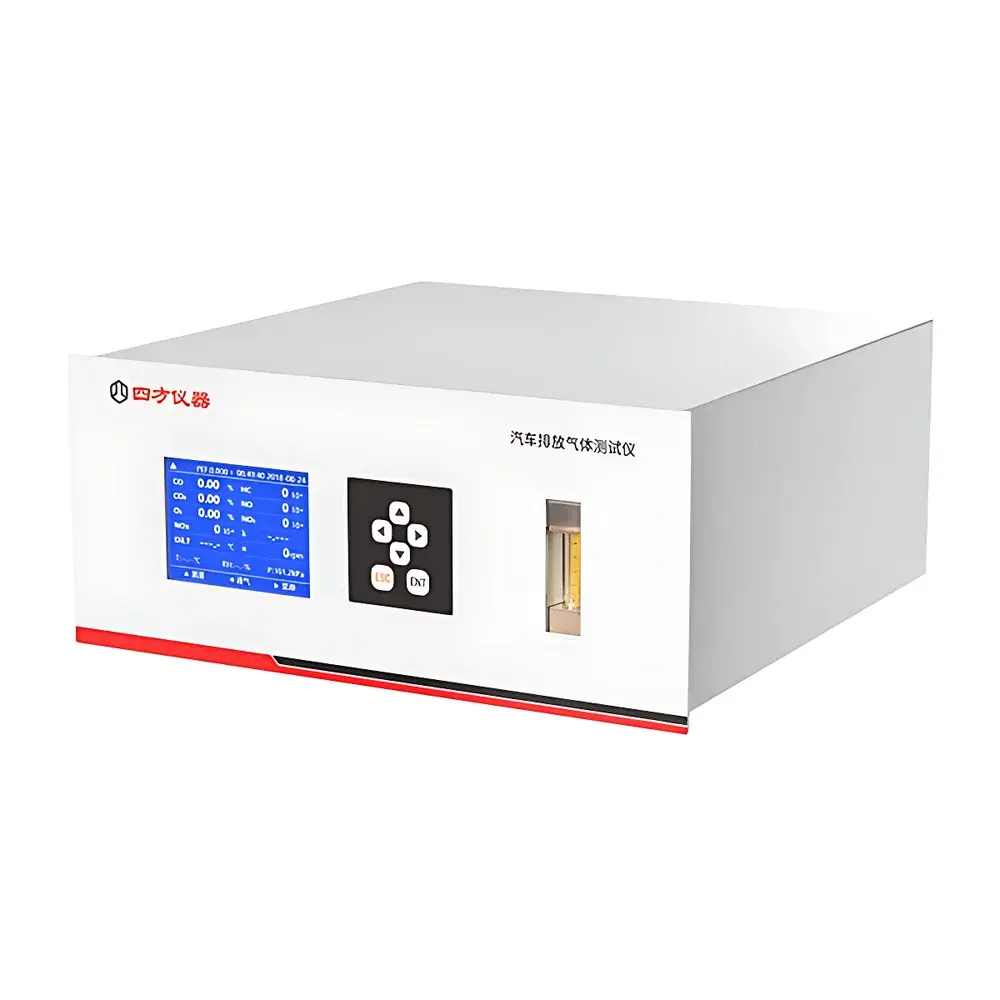
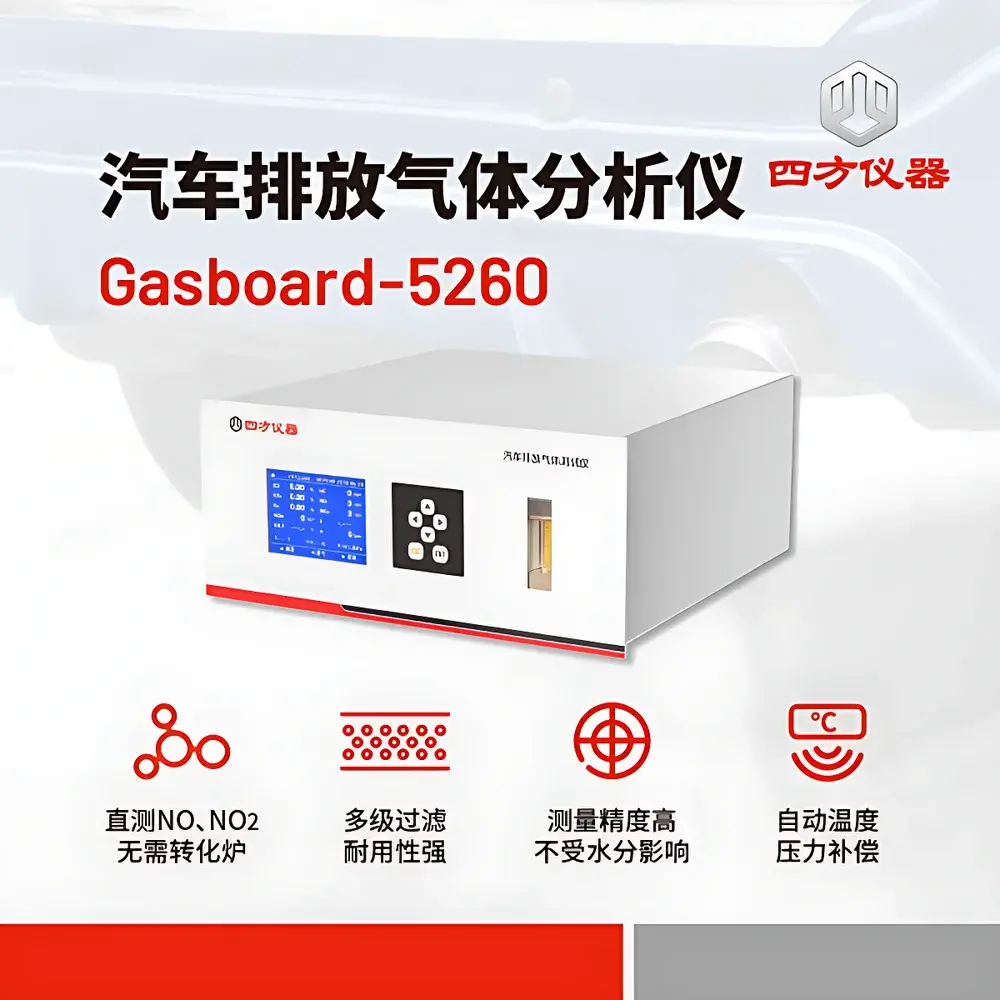
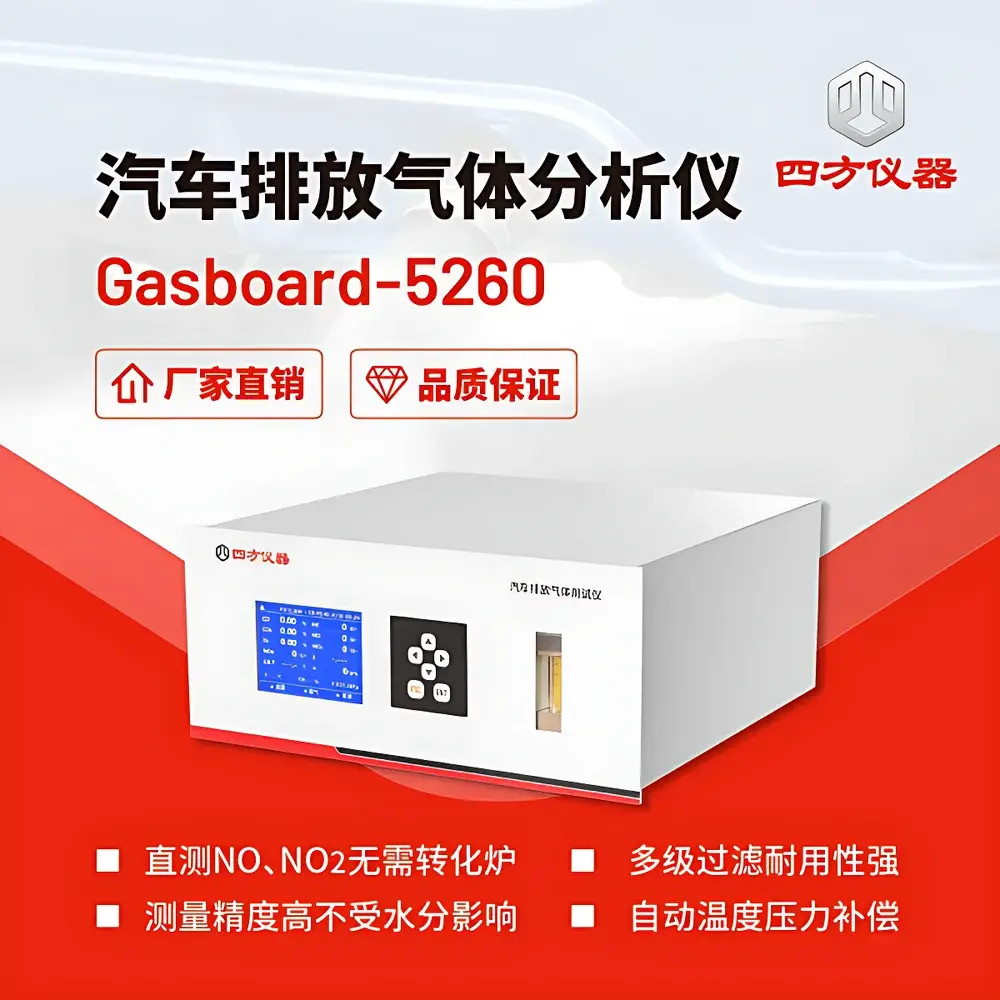
CUBIC INSTRUMENTS Gasboard-5230 Automotive Exhaust Gas Analyzer for Diesel Vehicles
| Brand | CUBIC INSTRUMENTS |
|---|---|
| Origin | Hubei, China |
| Model | Gasboard-5230 |
| Instrument Type | Online Analyzer |
| Measurement Principles | Microflow Dual-Chamber Infrared (NO), Non-Dispersive Ultraviolet (NO₂), Non-Dispersive Infrared (CO₂) |
| Measured Gases | CO₂, NO, NO₂ |
| CO₂ Range | (0.0–16.0) × 10⁻² vol% (±0.3 × 10⁻² vol% or ±3%), (16.01–18.0) × 10⁻² vol% (±5%) |
| NO Range | (0–4000) × 10⁻⁶ vol% (±25 × 10⁻⁶ vol% or ±4%), (4001–5000) × 10⁻⁶ vol% (±8%) |
| NO₂ Range | (0–1000) × 10⁻⁶ vol% (±25 × 10⁻⁶ vol% or ±4%) |
| Resolution | NO/NO₂: 1 ppm |
| CO₂ | 0.01% vol |
| Response Time (T₉₀) | CO₂ ≤ 8 s |
| Warm-up Time | 30 min |
| Communication Interface | RS-485 / RS-232 |
| Power Supply | 100–240 VAC, 150 W |
Overview
The CUBIC INSTRUMENTS Gasboard-5230 is an online automotive exhaust gas analyzer engineered for regulatory-grade measurement of key diesel engine emissions—specifically carbon dioxide (CO₂), nitric oxide (NO), and nitrogen dioxide (NO₂)—in accordance with GB 3847–2018 and JJG 688–2017 Class 0 accuracy requirements. Unlike conventional analyzers relying on catalytic NOx converters or single-chamber infrared detection, the Gasboard-5230 integrates three distinct, physics-based optical absorption techniques within a single compact platform: microflow dual-chamber infrared spectroscopy for NO, non-dispersive ultraviolet (NDUV) absorption for NO₂, and non-dispersive infrared (NDIR) for CO₂. This multi-principle architecture eliminates cross-sensitivity artifacts commonly induced by water vapor, hydrocarbon interference, or thermal drift—critical for stable operation in field-deployed environmental monitoring stations and vehicle inspection lanes. The analyzer’s core sensor design is protected under international PCT patent PCT/CN2018100767, reflecting its innovation in temperature-compensated optical path stability and long-term signal reproducibility without recalibration.
Key Features
- Direct, simultaneous quantification of NO and NO₂ without NOx converter—reducing mechanical complexity, maintenance frequency, and measurement uncertainty associated with catalytic conversion inefficiency.
- Microflow dual-chamber infrared sensor for NO: employs matched reference and measurement chambers with precision interference filters to suppress baseline drift caused by ambient temperature fluctuations and electronic aging.
- NDUV detection for NO₂: operates at characteristic absorption bands (~220–230 nm), avoiding spectral overlap with SO₂ or ozone—enabling selective, interference-free NO₂ measurement in raw exhaust streams.
- NDIR-based CO₂ module with optimized optical path length and thermoelectrically stabilized detector, delivering high linearity across low-to-high concentration ranges (0.0–18.0% vol).
- Multi-stage particulate and moisture filtration system upstream of the optical cell, extending service intervals and ensuring consistent optical transmission over extended operational cycles.
- Embedded real-time signal processing firmware applies proprietary linearization algorithms to raw absorbance data, correcting for non-ideal Beer–Lambert deviations and improving accuracy across full dynamic range.
Sample Compatibility & Compliance
The Gasboard-5230 is validated for continuous sampling of hot, humid, and particulate-laden diesel exhaust gases—conditions typical of free-acceleration and loaded-mode testing per GB 3847–2018. Its inlet conditioning system tolerates dew points up to 90 °C and particulate loading up to 100 mg/m³ without condensation or clogging. All measurement performance specifications meet or exceed JJG 688–2017 Class 0 metrological requirements for automotive exhaust analyzers. While not certified to ISO 17025 or EPA CFR Title 40 Subpart B directly, the instrument’s traceable calibration protocol, documented uncertainty budget, and audit-ready data logging architecture support integration into GLP-compliant laboratory workflows and regulatory inspection programs. It is compatible with external transmissometers (e.g., Gasboard-6000) for concurrent opacity measurement, enabling full compliance with opacity + gaseous pollutant reporting mandates.
Software & Data Management
The Gasboard-5230 supports bidirectional communication via RS-232 and RS-485 interfaces using ASCII-based command protocols, facilitating seamless integration with third-party test stand controllers, fleet management systems, or centralized emission monitoring platforms. Onboard firmware stores ≥30 days of time-stamped concentration data (1 Hz sampling) with automatic timestamping, checksum validation, and cyclic redundancy check (CRC) protection. Exported datasets include raw analog outputs, corrected concentration values, sensor status flags (e.g., filter saturation, lamp intensity decay), and diagnostic logs—all structured in CSV format for traceability. Though native software does not implement FDA 21 CFR Part 11 electronic signature controls, the device’s deterministic data flow, immutable log structure, and hardware-level write-protection mode enable qualification for regulated environments when deployed behind validated middleware.
Applications
- Governmental environmental monitoring stations conducting periodic diesel vehicle inspections under national emission standards.
- Automotive certification laboratories performing type-approval testing per GB 3847–2018 and related technical guidelines.
- Commercial vehicle inspection centers requiring high-throughput, low-downtime exhaust analysis during annual safety and emissions checks.
- OEM R&D facilities evaluating aftertreatment system efficiency (e.g., SCR, DOC, DPF) through real-time NO/NO₂ speciation and CO₂ mass balance calculations.
- Academic and independent research institutes studying combustion chemistry, NOx formation pathways, and alternative fuel impacts on tailpipe composition.
- Third-party verification agencies performing conformity audits for fleet operators subject to local low-emission zone (LEZ) regulations.
FAQ
Does the Gasboard-5230 require periodic calibration with certified gas standards?
Yes—per JJG 688–2017, initial calibration and biannual verification using NIST-traceable span gases are required. Zero calibration may be performed with certified zero air or nitrogen.
Can the analyzer operate continuously for 24/7 monitoring applications?
Yes—the robust thermal management system and hardened optical components support unattended operation for >8,000 hours between major service interventions.
Is the device compatible with European or U.S. regulatory test cycles (e.g., WLTP, FTP-75)?
While designed for GB 3847–2018, its response time (<10 s T₉₀), resolution (1 ppm), and dynamic range meet minimum technical prerequisites for integration into internationally harmonized transient cycle test benches when paired with appropriate data acquisition synchronization.
How is moisture interference mitigated in the NO and NO₂ measurement channels?
The NDUV and dual-chamber IR optical paths are physically isolated from the sample stream’s bulk moisture phase via permeation-resistant membranes and thermally controlled condensation traps—eliminating aqueous absorption artifacts without chemical drying agents.
What documentation is provided for metrological traceability and quality assurance?
Each unit ships with a factory calibration certificate, uncertainty budget report, PCT patent documentation, and a full set of mechanical drawings and firmware revision history—sufficient for internal QA review and external audit preparation.
Related Products







