
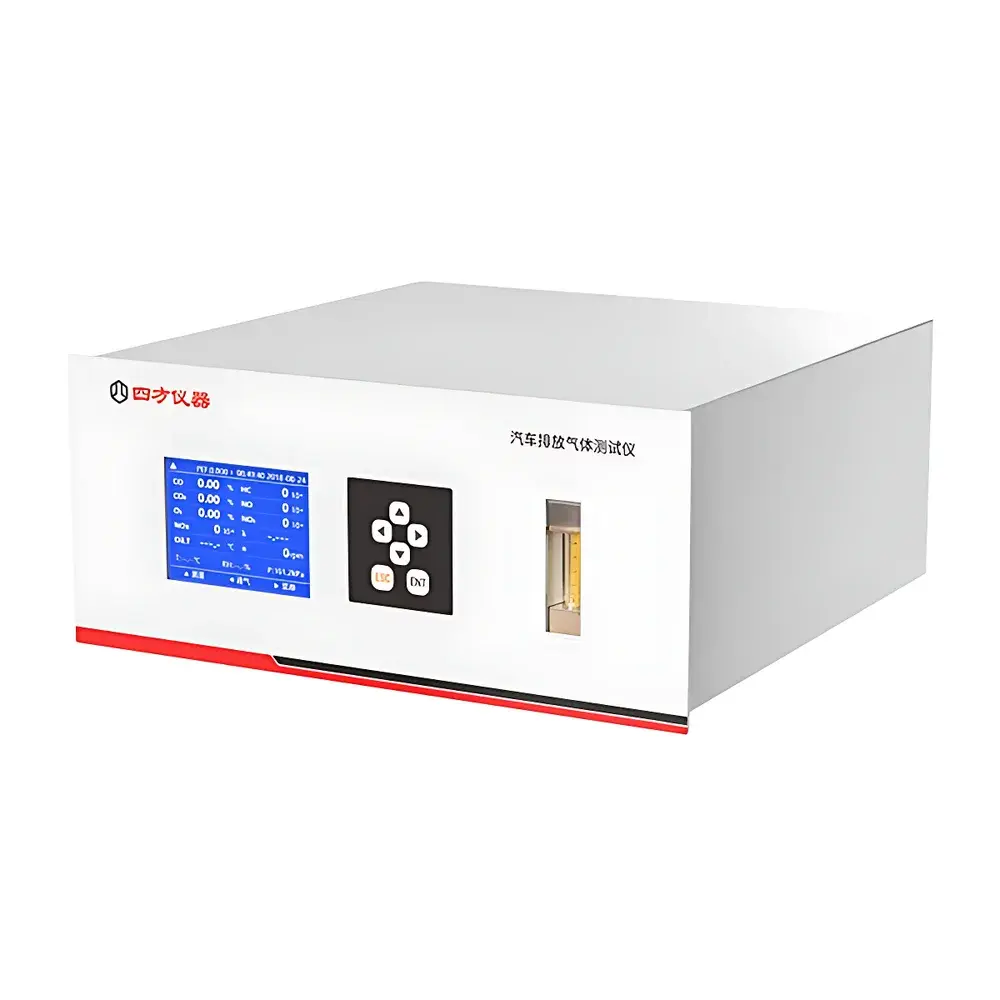
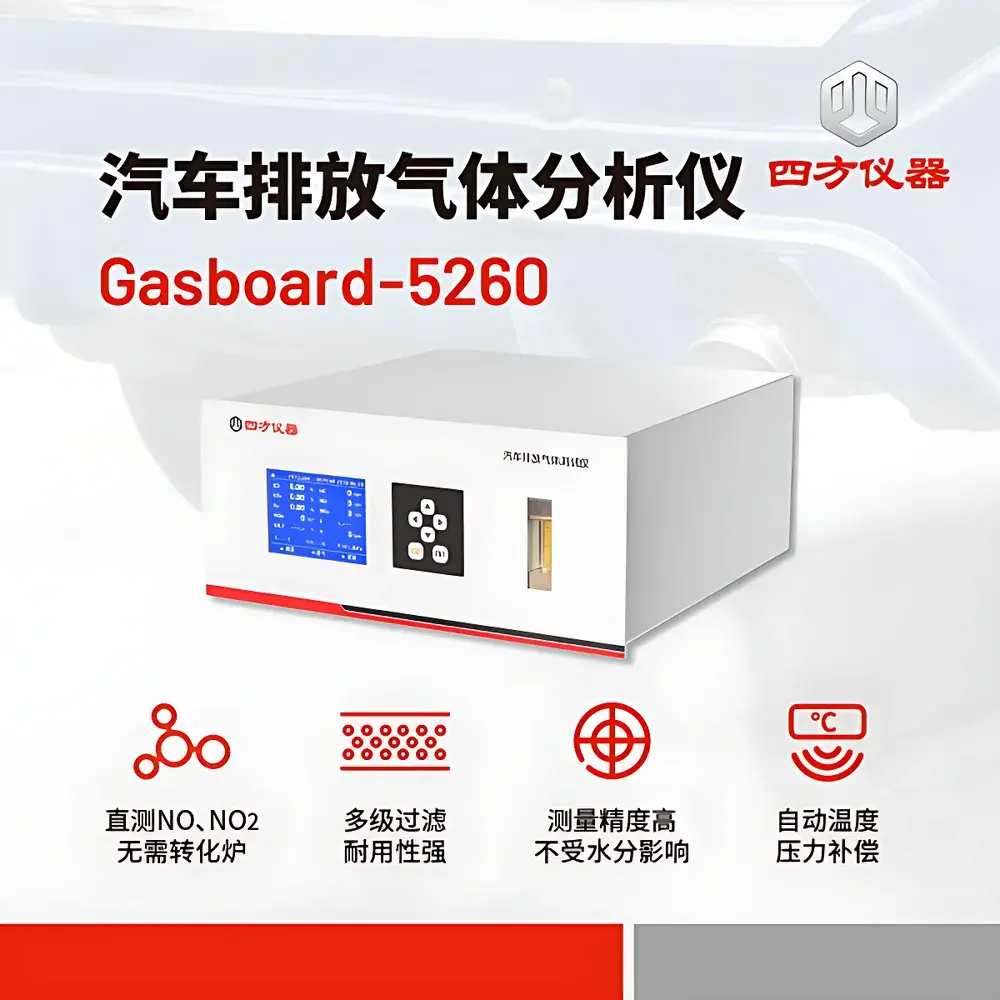
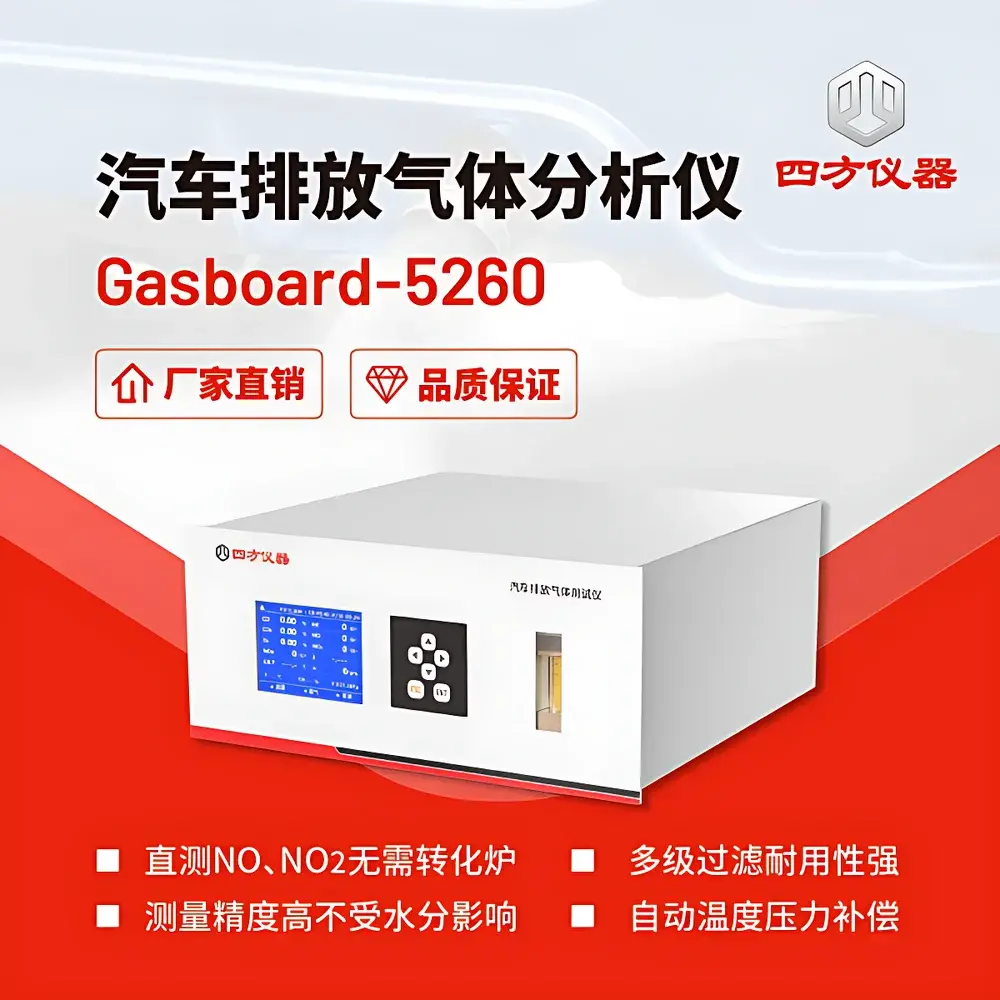
CUBIC INSTRUMENTS Gasboard-5260 Automotive Exhaust Gas Analyzer
| Brand | CUBIC INSTRUMENTS |
|---|---|
| Origin | Hubei, China |
| Model | Gasboard-5260 |
| Instrument Type | Online Analyzer |
| Detection Principles | Micro-flow Dual-chamber NDIR (for HC, CO, CO₂), NDUV (for NO₂), Micro-flow Dual-chamber IR (for NO), Electrochemical (for O₂) |
| Measured Gases | HC, CO, CO₂, NO, NO₂, O₂ |
| Measurement Ranges | HC (0–9999 ppm), CO (0.00–14.00% vol), CO₂ (0.0–18.0% vol), NO (0–5000 ppm), NO₂ (0–1000 ppm), O₂ (0.0–25.0% vol) |
| Accuracy | Compliant with JJG 688-2017 Class 00 and GB 18285-2018 |
| Resolution | NO/NO₂: 1 ppm |
| CO₂ | 0.01% vol |
| Response Time (T90) | HC/CO/CO₂ ≤ 8 s |
| Warm-up Time | 30 min |
| Power Supply | 100–240 VAC, 150 W |
| Communication Interface | RS-485 / RS-232 |
Overview
The CUBIC INSTRUMENTS Gasboard-5260 is a fully integrated, online automotive exhaust gas analyzer engineered for regulatory compliance, field durability, and metrological traceability in emissions testing environments. It employs a multi-physical detection architecture: micro-flow dual-chamber non-dispersive infrared (NDIR) spectroscopy for simultaneous quantification of hydrocarbons (HC), carbon monoxide (CO), and carbon dioxide (CO₂); pulsed non-dispersive ultraviolet (NDUV) absorption for direct nitrogen dioxide (NO₂) measurement—eliminating the need for thermal NOx converters; proprietary micro-flow dual-chamber infrared sensing with temperature-stabilized optical filters for high-precision nitric oxide (NO) detection; and long-life electrochemical cells for oxygen (O₂) analysis. This hybrid optical–electrochemical platform enables real-time, cross-interference-resistant measurement of six key exhaust constituents under dynamic engine operating conditions—including transient idle, acceleration, and deceleration phases. The instrument is designed to meet the stringent performance requirements of China’s national standard GB 18285-2018 (Limits and Measurement Methods for Pollutant Emissions from Gasoline-Fueled Vehicles) and the metrological verification regulation JJG 688-2017 (Verification Regulation for Automotive Exhaust Gas Analyzers), certified to Class 00 accuracy—the highest grade for laboratory-grade exhaust analyzers in China.
Key Features
- Direct, simultaneous measurement of NO and NO₂ without catalytic NOx conversion—reducing system complexity, calibration drift, and maintenance intervals.
- Dual-chamber micro-flow NDIR sensors with thermally compensated optical path design, minimizing zero drift induced by ambient temperature fluctuations and component aging.
- Multi-stage particulate and moisture filtration system (including heated sample line option) ensures long-term operational stability in high-humidity, high-particulate exhaust streams.
- Embedded signal processing algorithms perform real-time linearization, temperature/pressure compensation, and baseline correction—enhancing measurement reproducibility across environmental gradients.
- Integrated air–fuel ratio (λ) calculation engine using stoichiometric combustion models, dynamically updated from concurrent O₂, CO, CO₂, and HC readings.
- Standard RS-485 and RS-232 interfaces support seamless integration into centralized inspection management systems, automated test lanes, and LIMS platforms.
Sample Compatibility & Compliance
The Gasboard-5260 is validated for use with raw, diluted, and conditioned exhaust samples from gasoline-fueled light-duty vehicles, motorcycles, and light commercial vehicles operating under steady-state (dual-idle) and transient (ASM, IM240, or simplified transient cycle) test protocols. Its sensor architecture inherently suppresses water vapor interference—a common source of error in conventional NDIR-based HC and CO measurements—enabling stable operation without frequent desiccant replacement or condensate traps. All measurement uncertainties are defined per JJG 688-2017 Annex B and verified against NIST-traceable gas standards. The analyzer supports GLP-compliant data integrity through time-stamped audit logs, user-access control levels, and electronic signature capability (when paired with compliant host software). It meets mechanical and electromagnetic compatibility requirements per GB/T 18285-2018 Annex D and IEC 61326-1:2012.
Software & Data Management
The analyzer operates with embedded firmware supporting dual-mode operation: standalone mode with local LCD display and keypad navigation, and networked mode via serial communication. Host-side software (available for Windows-based PCs) provides full configuration, calibration management, trend visualization, and report generation aligned with GB 18285-2018 reporting templates. All measurement data include timestamps, ambient T/P values, and sensor diagnostic flags. Raw analog and digital outputs are timestamp-synchronized to enable correlation with external signals such as engine RPM and coolant temperature—via optional analog input channels. Data export complies with CSV and XML formats compatible with national motor vehicle inspection databases. Firmware updates preserve calibration coefficients and historical records, ensuring continuity during periodic metrological revalidation.
Applications
- Regulatory emissions testing at certified motor vehicle inspection stations (MVIS) and environmental protection bureaus.
- In-line quality assurance during engine development and powertrain validation in OEM R&D labs.
- Periodic technical inspection (PTI) and roadside emission screening programs.
- Aftermarket diagnostics and repair verification in certified service centers.
- Academic and governmental research on combustion efficiency, catalyst performance, and alternative fuel impacts on tailpipe chemistry.
- Third-party conformity assessment laboratories accredited to CNAS/ISO/IEC 17025.
FAQ
Does the Gasboard-5260 require an external NOx converter for NO₂ measurement?
No. It uses NDUV absorption at 400–450 nm, enabling direct, selective NO₂ detection without catalytic conversion.
Is the analyzer suitable for use with diesel exhaust?
It is optimized for gasoline engine exhaust per GB 18285-2018. For diesel applications requiring opacity or PM measurement, complementary instrumentation is recommended.
How often does the system require calibration verification?
Per JJG 688-2017, zero and span checks are required before each daily test session; full multi-point calibration is recommended every 30 days or after sensor maintenance.
Can the device output λ (air–fuel ratio) in real time?
Yes. The embedded algorithm computes λ continuously using measured O₂, CO, CO₂, and HC concentrations, applying standard combustion stoichiometry and correction for dilution effects.
What is the maximum allowable ambient operating temperature?
The unit is rated for continuous operation at 5–40 °C ambient, with internal temperature stabilization maintaining sensor performance across this range.
Related Products







