
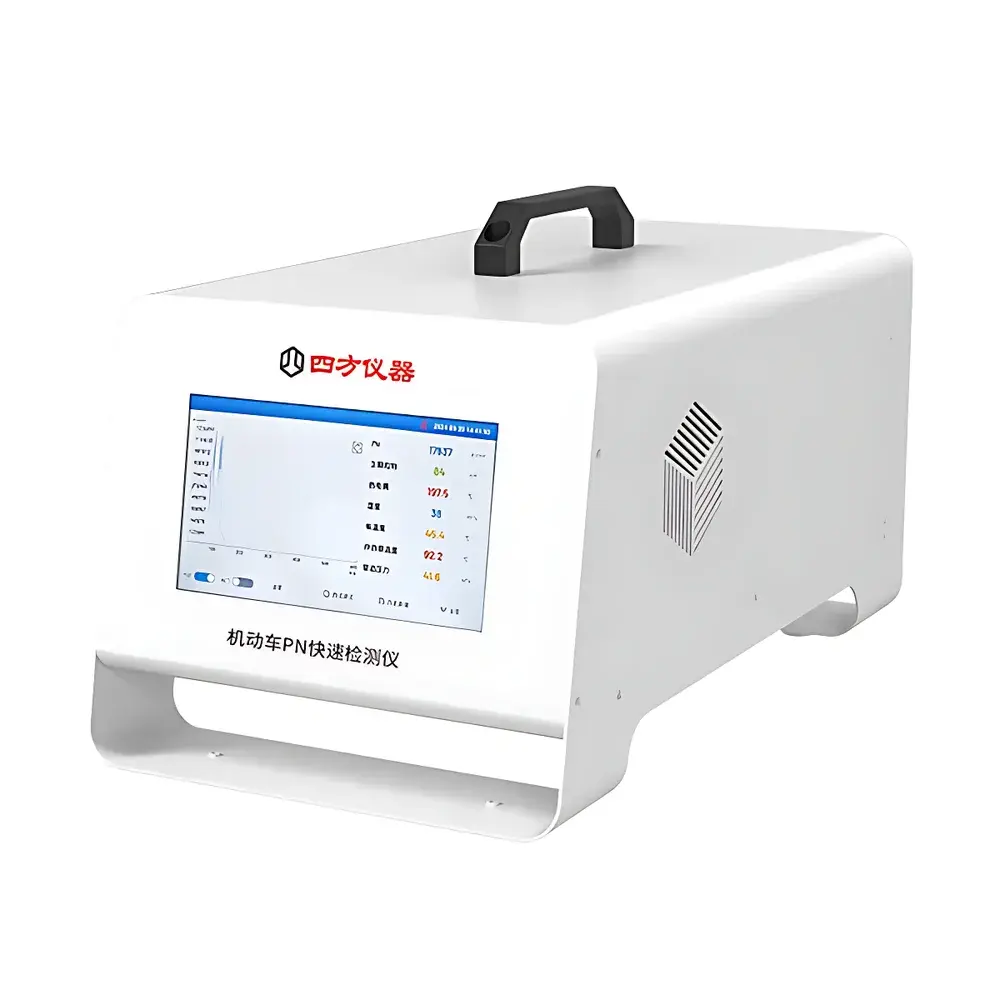
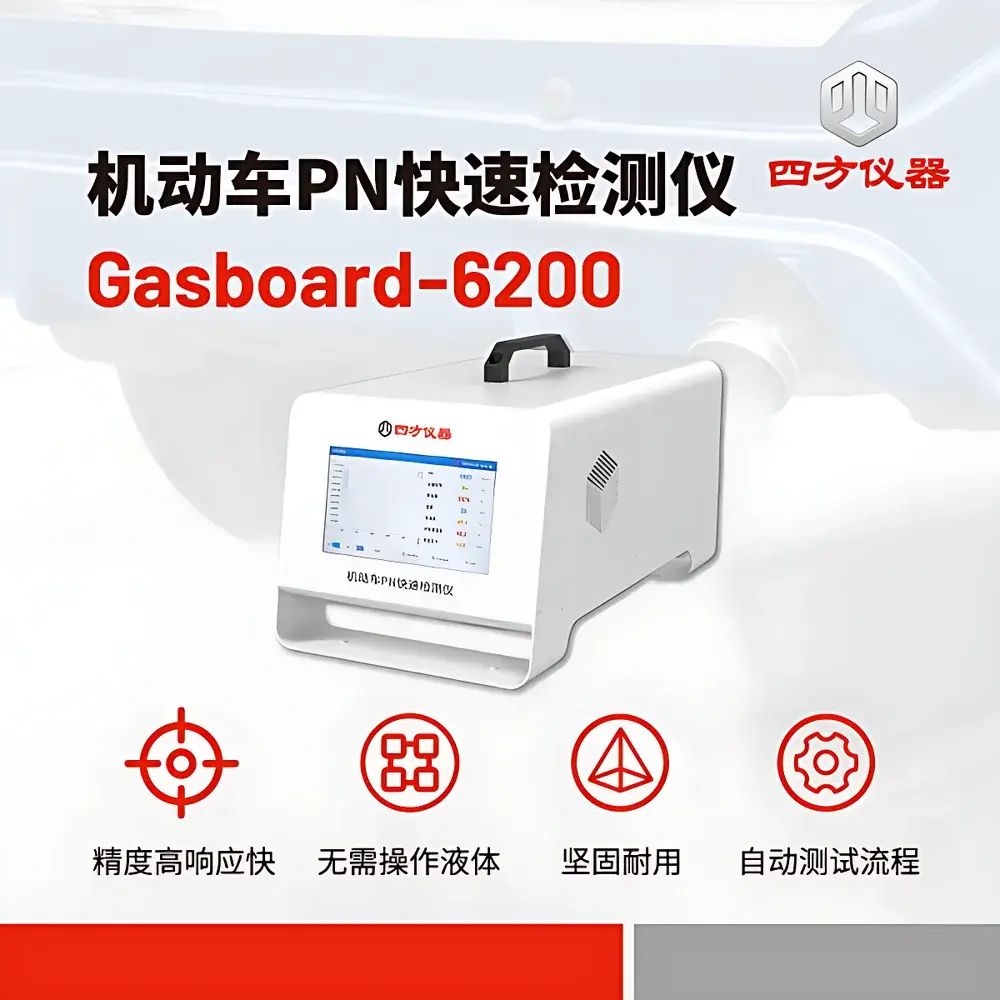
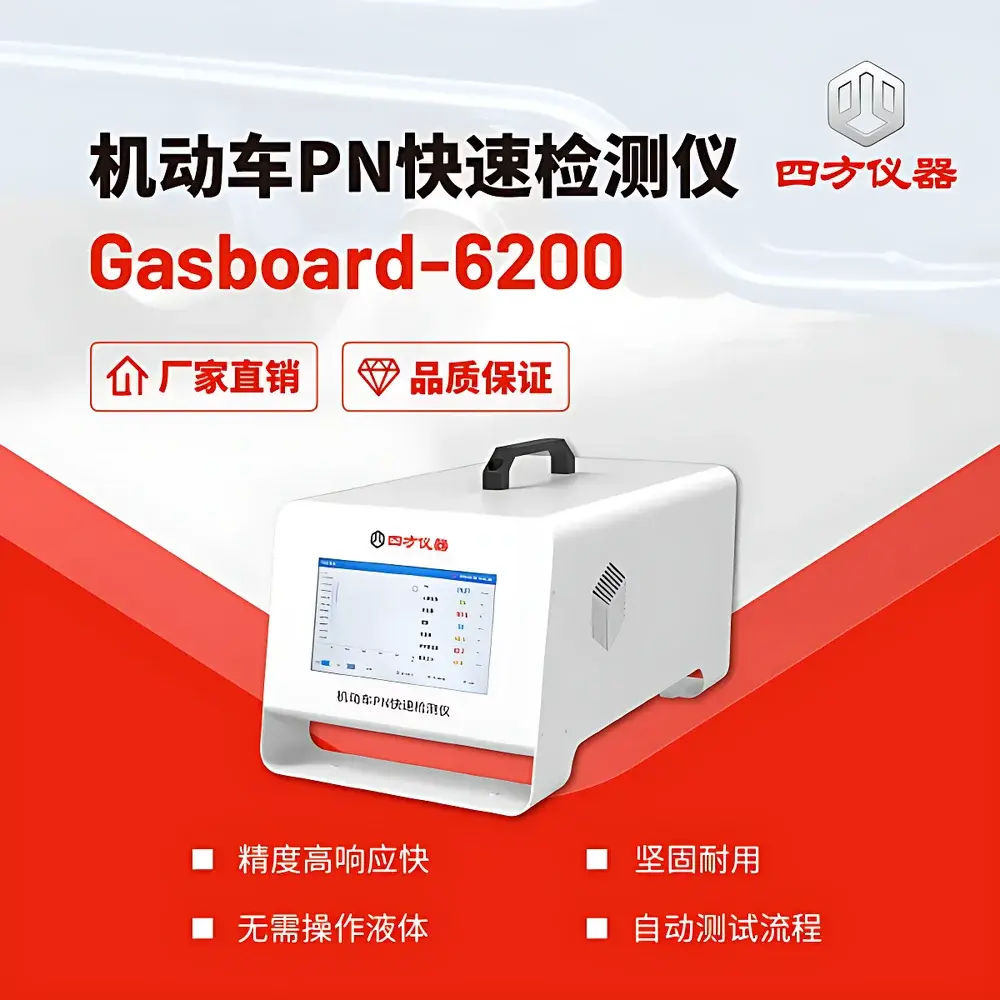
CUBIC INSTRUMENTS Gasboard-6200 Portable Particle Number (PN) Analyzer for Automotive Exhaust
| Brand | CUBIC INSTRUMENTS |
|---|---|
| Origin | Hubei, China |
| Model | Gasboard-6200 |
| Instrument Type | Portable |
| Measurement Principle | Diffusion Charging Counting (DCC) |
| Measured Parameter | Particle Number Concentration in Exhaust Gas |
| Measurement Range | 5×10³–1×10⁷ #/cm³ |
| Particle Size Cut-off | ≥23 nm |
| Maximum Permissible Error | ≤±25% |
| Response Time (T₀–T₉₅) | <10 s |
| Operating Temperature | 0–55 °C |
| Power Supply | AC 100–230 V, 50–60 Hz |
| Startup Power Consumption | 700 W |
| Steady-State Power Consumption | 200 W |
| Heated Sample Line | AC-powered (110/230 V), customizable length |
| Output Interface | RS-232 (optional: RS-485, Bluetooth, 4G, Wi-Fi) |
| Dimensions (L×H×W) | 244×257×419 mm |
| Weight | <10 kg |
Overview
The CUBIC INSTRUMENTS Gasboard-6200 is a portable, real-time particle number (PN) analyzer engineered for regulatory-compliant measurement of solid ultrafine particles (≥23 nm) in automotive exhaust streams. It operates on the diffusion charging counting (DCC) principle — a physically robust and internationally recognized method for PN quantification in transient engine testing environments. Unlike filter-based or condensation particle counter (CPC)-coupled systems, the Gasboard-6200 employs direct diffusion charging of exhaust aerosols followed by electrometric current detection, eliminating the need for sample dilution, filtration, or compressed air supply. This architecture ensures minimal flow path complexity, reduced risk of soot accumulation, and stable performance across high-concentration, high-humidity, and thermally variable exhaust conditions typical of light-duty and heavy-duty vehicle testing cycles (e.g., WLTC, RDE, FTP-75). The instrument is designed to meet the functional requirements of periodic technical inspection (PTI-PN) protocols aligned with European metrological frameworks.
Key Features
- Direct-inlet DCC measurement: No dilution system or external gas supply required — enables rapid deployment and eliminates calibration drift associated with dilution ratio uncertainty.
- Heated sampling line (110/230 V AC): Maintains exhaust gas temperature above dew point throughout the transfer path to prevent condensation-induced particle loss or coagulation artifacts.
- Integrated electrostatic calibration module: On-device zero and span verification using controlled ion generation — traceable to primary standards without external hardware.
- Robust thermal management: Active cooling and insulated housing ensure stable internal sensor environment across ambient temperatures from 0 °C to 55 °C.
- High-speed response: T₀–T₉₅ < 10 seconds supports dynamic PN tracking during aggressive transient driving cycles and enables reliable integration into automated PTI test benches.
- Touchscreen HMI (high-resolution LCD): Intuitive menu navigation, real-time concentration waveform display, and onboard data logging (up to 10,000 records) with time-stamped metadata.
Sample Compatibility & Compliance
The Gasboard-6200 is validated for undiluted sampling of raw gasoline, diesel, and alternative-fueled (e.g., CNG, LPG, ethanol-blend) exhaust under both steady-state and transient operating conditions. Its ≥23 nm lower detection limit satisfies the particle size cut-off requirement specified in UNECE Regulation No. 83 (R83), EU Commission Regulation (EU) 2017/1151, and ISO 29463-3:2017 Annex B for PN analyzers used in type approval and conformity-of-production testing. While not certified to EN 14181 or ISO/IEC 17025 as a standalone measuring instrument, its metrological behavior has been characterized per NMI (Netherlands Metrology Institute) PTI-PN test guidelines and PTB (Physikalisch-Technische Bundesanstalt) PN validation protocols. Device output is compatible with GLP/GMP-aligned data acquisition systems when paired with timestamped RS-232/RS-485 interfaces and audit-trail-enabled software.
Software & Data Management
The analyzer communicates via ASCII-based serial protocol over RS-232 as standard; optional firmware modules support Modbus RTU (RS-485), Bluetooth 5.0 (BLE), or cellular (4G LTE) telemetry for remote monitoring. All firmware versions include configurable data output modes: real-time streaming (1–10 Hz), burst logging, or event-triggered capture synchronized with external CAN bus signals (e.g., engine speed, torque, lambda). Internal memory stores time-series PN concentration, temperature, pressure, and system status flags with UTC timestamps. Export formats include CSV and XML — structured to align with EU RDE reporting templates (e.g., EEA Form 12). Optional PC software provides post-processing tools for background subtraction, moving-average smoothing, and compliance flagging per EU 2017/1151 Annex VIII Section 5.3.
Applications
- Periodic Technical Inspection (PTI-PN) for in-service vehicles in national and municipal inspection programs.
- On-vehicle roadside emissions screening and fleet-level health assessment.
- Engine development labs requiring fast-turnaround PN screening during calibration mapping and aftertreatment optimization.
- Research on non-exhaust particulate emissions (e.g., brake, tire wear) where low-flow, direct-sampling capability is advantageous.
- Emissions verification for retrofitting and aftermarket DPF/CNT filter evaluation under real-world driving conditions.
FAQ
What particle size range does the Gasboard-6200 detect?
It measures solid particle number concentration for particles ≥23 nm in aerodynamic diameter, compliant with the lower detection threshold defined in UNECE R83 and EU 2017/1151.
Does the analyzer require dilution or compressed air?
No — it uses diffusion charging counting with direct exhaust sampling and requires no dilution tunnel, critical orifices, or auxiliary gas sources.
How is calibration verified in the field?
An integrated electrostatic calibrator generates known charge currents for zero and span checks; no radioactive or aerosol-based reference materials are needed.
Can the device operate continuously during RDE testing?
Yes — with its heated sample line, thermal stabilization, and <10 s response time, it meets the temporal resolution and robustness requirements for real-driving emissions monitoring.
Is the data output compatible with EU-type approval reporting systems?
Raw and processed data export formats (CSV/XML) conform to EEA and JRC-defined schemas for PN submission in type approval dossiers and surveillance reports.
Related Products







