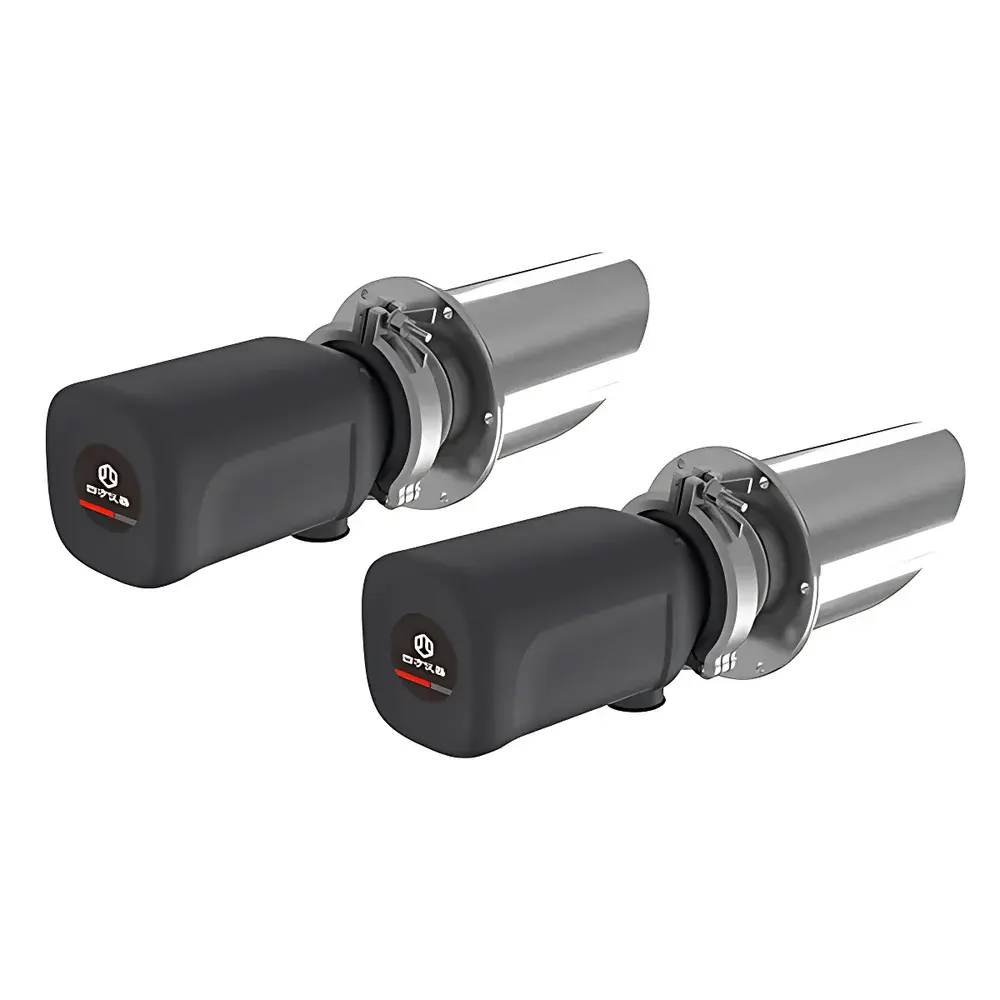
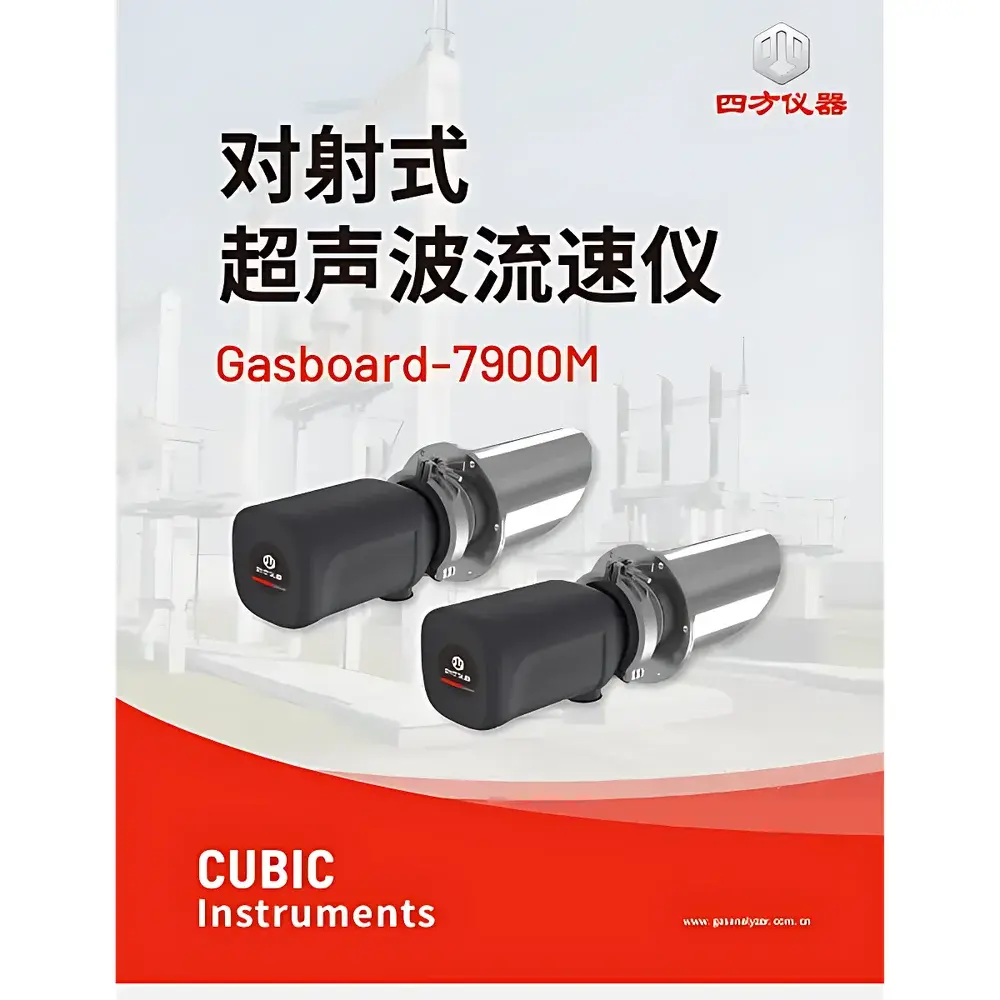
CUBIC INSTRUMENTS Gasboard-7900M Ultrasonic Flow Velocity Monitor
| Brand | CUBIC INSTRUMENTS |
|---|---|
| Origin | Hubei, China |
| Model | Gasboard-7900M |
| Measurement Principle | Transit-time ultrasonic velocity sensing |
| Accuracy | ≤ ±1.5% F.S. |
| Pipe Diameter Range | ≥ 0.3 m |
| Velocity Range | 0–40 m/s |
| Temperature Range (Flue Gas) | −20 to 480 °C |
| Pressure Range (Flue Gas) | −10 to +10 kPa |
| Output Signals | 4–20 mA, RS-485 |
| Enclosure Rating | IP65 |
| Power Supply (Main Unit) | AC 220 V ±10%, 50/60 Hz |
| Blower Power | AC 220 V ±10%, 50/60 Hz, 280 W |
| Weight | 28 kg |
| Channel Configuration | Single-channel (optional dual- or quad-channel) |
| Media Compatibility | Non-flammable gases (e.g., flue gas, air) |
| Minimum Detectable Velocity | 0.1 m/s |
| Materials | Corrosion-resistant alloys for wetted components |
Overview
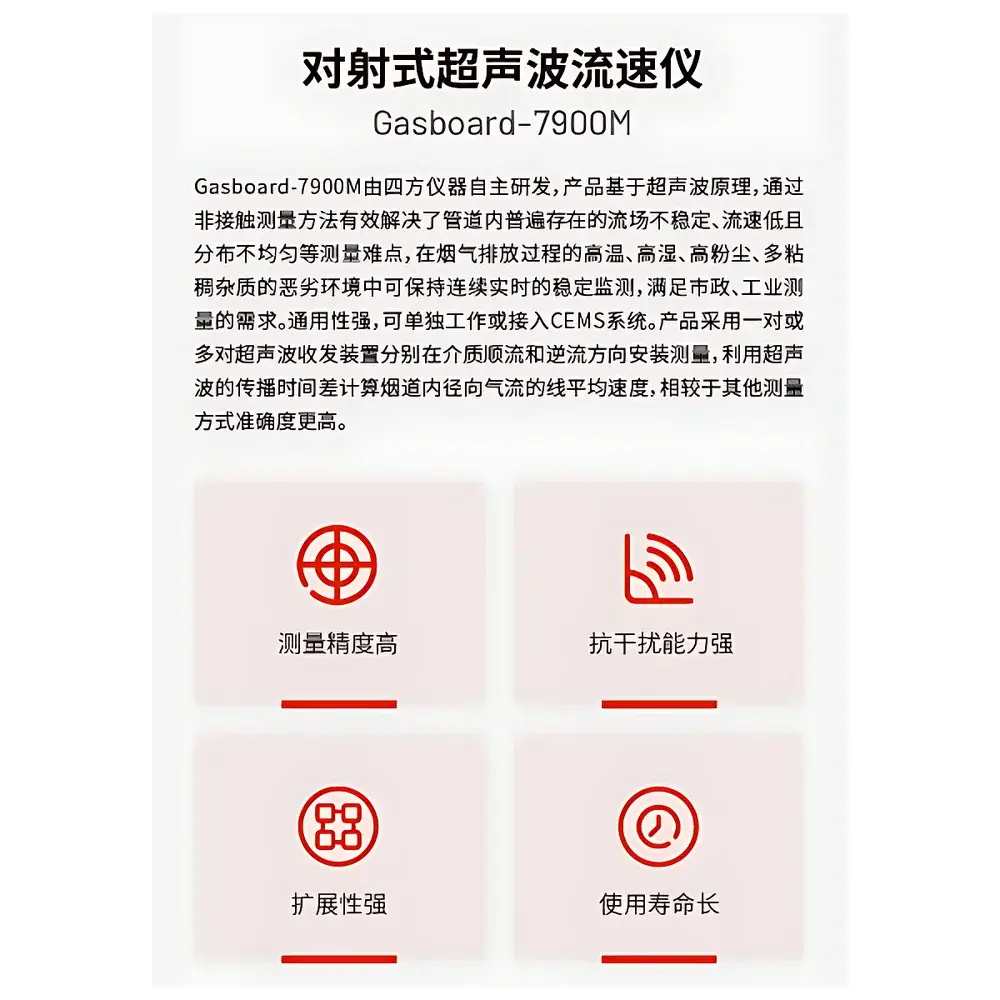
The CUBIC INSTRUMENTS Gasboard-7900M is an industrial-grade, transit-time ultrasonic flow velocity monitor engineered for continuous, real-time measurement of gas velocity in harsh flue gas environments. Unlike intrusive thermal or differential pressure-based sensors, the Gasboard-7900M employs a non-contact, bi-directional ultrasonic transmission method—measuring the time-of-flight difference between upstream and downstream acoustic pulses across the duct cross-section. This principle yields a line-averaged axial velocity value that is inherently robust against turbulent, asymmetric, or low-velocity flow profiles commonly encountered in stack monitoring applications. Designed specifically for compliance-critical emissions monitoring, the instrument operates reliably under extreme conditions: high temperature (up to 480 °C), high humidity, elevated particulate loading, and corrosive acidic gas mixtures—including SO2, NOx, and condensable vapors. Its architecture supports integration into Continuous Emissions Monitoring Systems (CEMS) while maintaining standalone functionality for process optimization and diagnostic use.
Key Features
- Transit-time ultrasonic velocity measurement with line-averaged output, delivering ≤ ±1.5% full-scale accuracy per ASTM D5744 and ISO 17089-2 reference methodologies
- Corrosion-resistant wetted materials—including Hastelloy C-276 and ceramic-coated transducer housings—ensuring long-term stability in acidic, humid flue gas streams
- Configurable channel architecture: standard single-path design; optional dual- or quad-path configurations for large-diameter ducts (>1.5 m) or highly swirling flow fields
- Integrated temperature and static pressure sensing, enabling real-time compensation of sonic velocity and volumetric flow calculation
- Low-velocity detection capability down to 0.1 m/s—critical for post-SCR, low-load, or bypass duct applications where conventional anemometers fail
- Self-correlation signal processing engine mitigates interference from mechanical vibration, fan noise, and broadband acoustic background typical in power plant and cement kiln settings
- Onboard high-speed DSP with embedded diagnostics, zero/span calibration routines, configuration logging, and firmware-upgradable parameter sets
- IP65-rated enclosure with integrated purge blower (280 W, AC 220 V) to maintain optical path clarity and prevent fouling in high-dust environments
Sample Compatibility & Compliance
The Gasboard-7900M is validated for non-flammable, electrically non-conductive gaseous media including ambient air, combustion flue gas, boiler exhaust, and waste incineration off-gas. It is not rated for explosive atmospheres (ATEX/IECEx) or hydrogen-rich streams. The instrument complies with electromagnetic compatibility requirements per EN 61326-1 and environmental stress testing per IEC 60068-2 series. While not certified to EPA Performance Specification 3 (PS-3) out-of-the-box, its measurement uncertainty profile aligns with PS-3 Tier 2 acceptance criteria when installed per EPA Method 2 (velocity traverse guidelines) and maintained under GLP-aligned procedures. Data integrity features—including timestamped event logs and tamper-evident configuration history—support audit readiness for ISO 14064-3 and EU MRV verification frameworks.
Software & Data Management
The device supports Modbus RTU over RS-485 and analog 4–20 mA output with HART-compatible signal modulation. Optional Ethernet or cellular telemetry modules enable remote configuration via secure HTTPS interface. Firmware includes configurable alarm thresholds (velocity deviation, signal-to-noise ratio drop, temperature excursion), automatic drift compensation triggers, and diagnostic self-tests executed at user-defined intervals. All operational parameters—including calibration coefficients, installation geometry, and gas composition assumptions—are stored in non-volatile memory with write-protection and CRC validation. Audit trails meet FDA 21 CFR Part 11 requirements when deployed with validated third-party SCADA platforms supporting electronic signatures and role-based access control.
Applications
- Continuous velocity monitoring in CEMS stacks for mass flow rate derivation (when paired with analyzers for CO2, O2, or total hydrocarbons)
- Boiler efficiency optimization through real-time flue gas velocity feedback to damper and fan control logic
- Waste-to-energy plant duct balancing and leak detection via comparative velocity profiling across parallel paths
- Post-desulfurization (FGD) and selective catalytic reduction (SCR) system performance validation
- Research-grade flue gas dynamics studies requiring high temporal resolution (10 Hz sampling) and minimal flow disturbance
- Regulatory reporting support for national carbon trading schemes requiring traceable, uncertainty-quantified velocity inputs
FAQ
Does the Gasboard-7900M require periodic recalibration? Why?
Yes—annual field verification against a traceable pitot tube traverse or calibrated hot-wire anemometer is recommended per ISO 17025-accredited maintenance protocols. While the ultrasonic transducers exhibit negligible drift, installation-induced alignment errors and refractive index shifts due to changing gas composition necessitate scheduled validation.
Can it be installed in rectangular ducts?
Yes, provided the aspect ratio does not exceed 4:1 and the transducer mounting locations satisfy minimum straight-run requirements (≥ 5× hydraulic diameter upstream, ≥ 2× downstream). Custom bracketing and path-angle optimization are available upon request.
Is the instrument compatible with hazardous area zoning?
No—the Gasboard-7900M is rated for Zone 2 / Class I Division 2 only when used with intrinsically safe barrier systems. It is not certified for Zone 0/1 or Class I Division 1 environments without external explosion-proof enclosures.
How does it handle water droplet interference in saturated flue gas?
The 1 MHz transducer frequency and adaptive gain control minimize attenuation from sub-50 µm mist droplets. For sustained condensation, optional heated transducer housings (−20 to +120 °C) and compressed-air purge nozzles are available as factory-installed accessories.
What documentation is supplied for regulatory audits?
Each unit ships with a Factory Calibration Certificate (traceable to NIST standards), Installation Qualification (IQ) checklist, and a Firmware Version Log. Optional IQ/OQ/PQ validation packages—including protocol templates and raw test data files—are available under separate service agreement.