
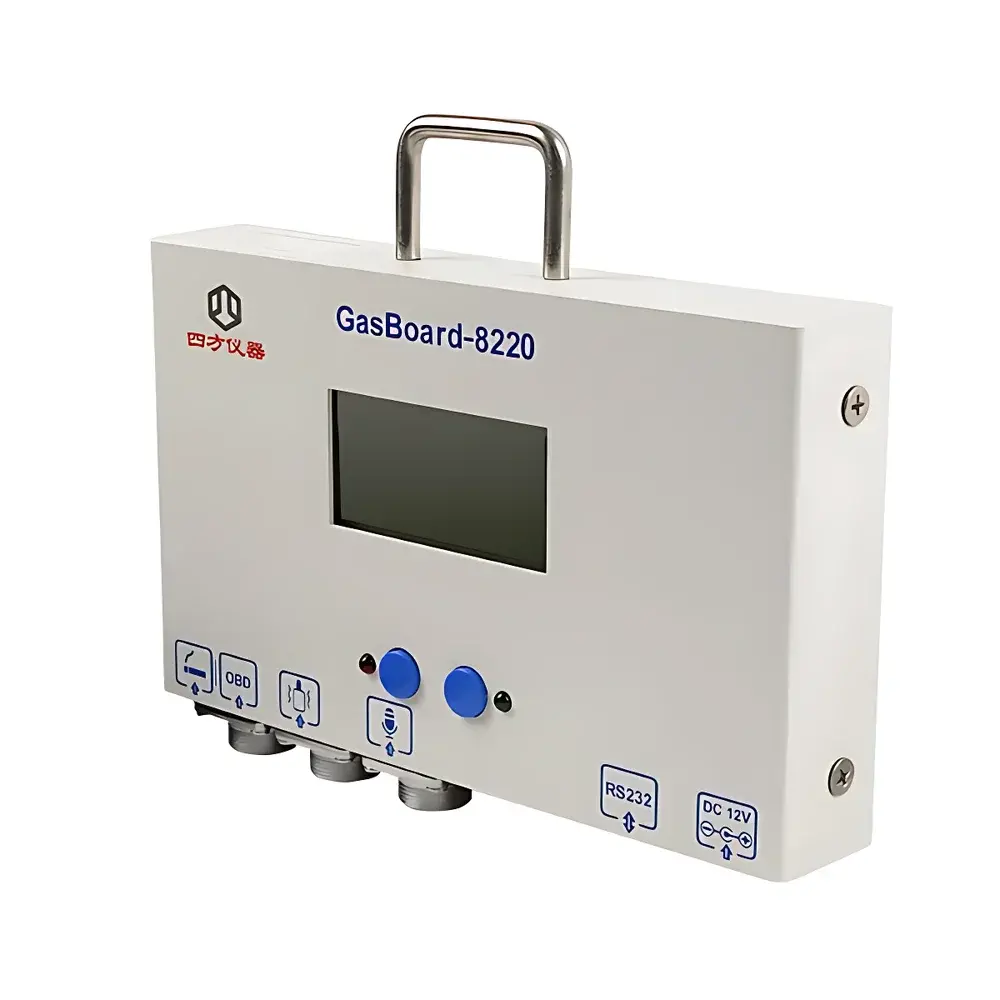
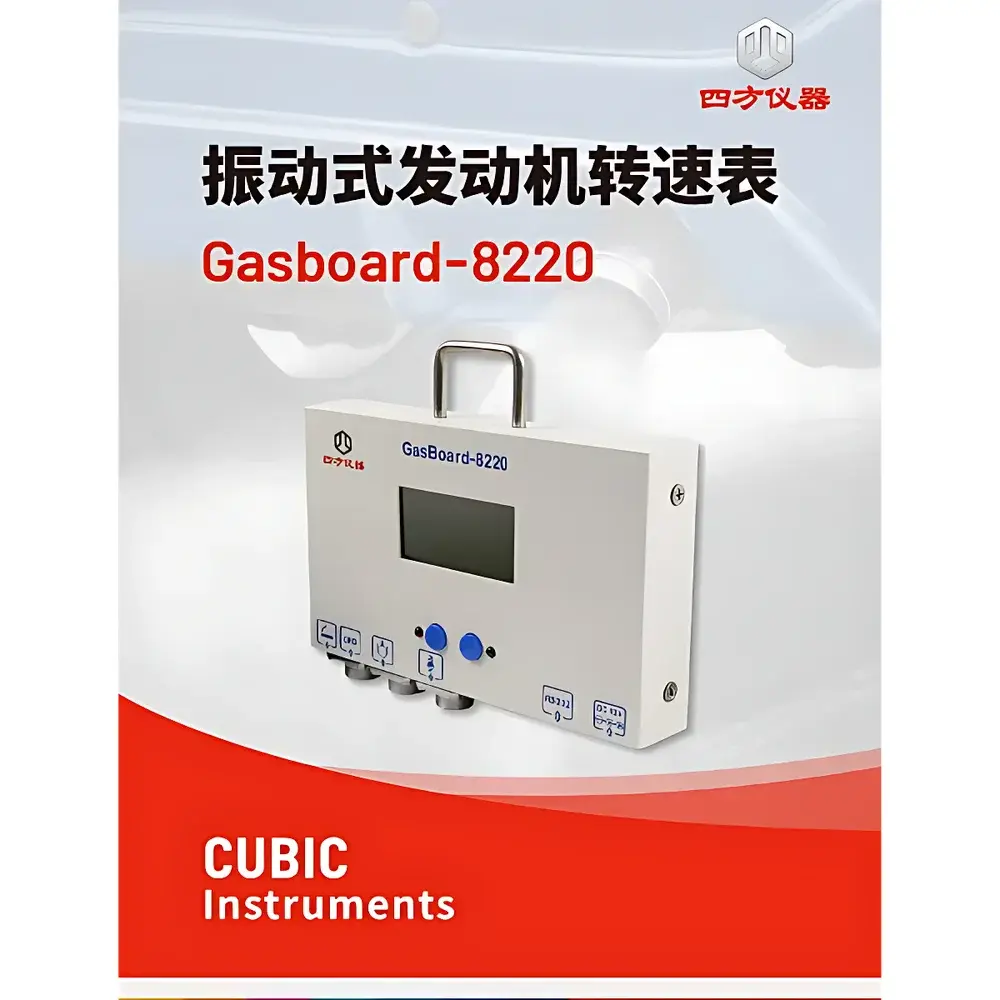
CUBIC INSTRUMENTS Gasboard-8220 Portable Vibration-Based Engine Tachometer
| Brand | CUBIC INSTRUMENTS |
|---|---|
| Origin | Hubei, China |
| Manufacturer Type | Authorized Distributor |
| Origin Category | Domestic (China) |
| Model | Gasboard-8220 |
| Instrument Type | Portable |
| Measurement Principle | Vibration & Ignition Pulse Spectrum Analysis |
| Measured Parameter | Engine Speed (RPM) |
| Measurement Range | Gasoline Engines: 400–8000 rpm |
| Diesel Engines | 400–6000 rpm |
| Operating Temperature | 5–45 °C |
| Operating Humidity | 30–90 % RH |
| Power Supply | 12 VDC, 350 mA |
| Communication Interfaces | RS-232, TTL-level pulse output, analog ignition signal input |
| Display | LCD |
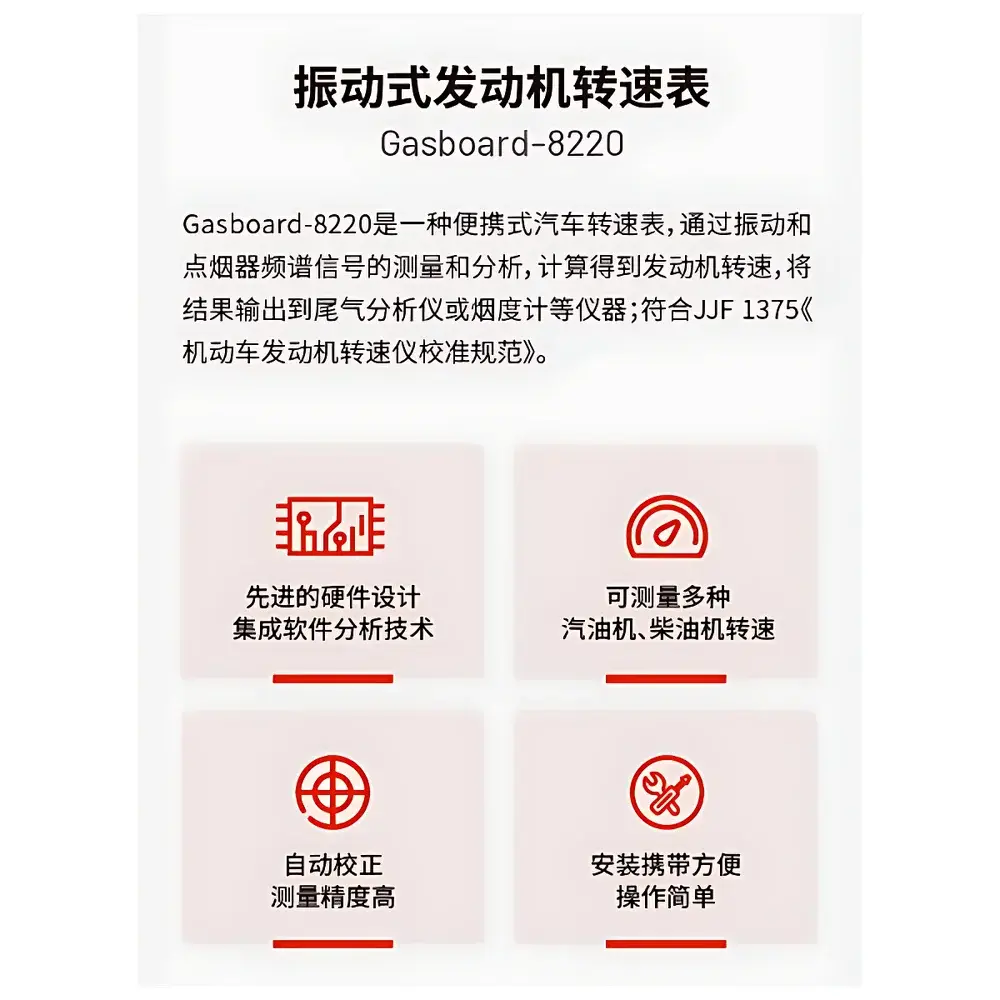
| Compliance | JJF 1375–2012 “Calibration Specification for Motor Vehicle Engine Tachometers” |
Overview
The CUBIC INSTRUMENTS Gasboard-8220 is a portable, non-contact engine tachometer engineered for precise rotational speed measurement of internal combustion engines in field and workshop environments. Unlike optical or magnetic pickup-based tachometers, the Gasboard-8220 employs dual-signal acquisition—simultaneous vibration signature analysis from engine block surface and spectral decomposition of ignition system electrical pulses (e.g., cigarette lighter socket-derived spark timing harmonics). This hybrid sensing methodology enables robust RPM estimation independent of reflective tape, crankshaft position sensors, or direct wiring to ignition coils—making it especially suitable for rapid deployment during vehicle emissions testing, roadside inspection, and mobile maintenance diagnostics. The instrument is designed and validated in accordance with JJF 1375–2012, China’s national metrological calibration specification for motor vehicle engine tachometers, ensuring traceable performance under defined environmental and operational conditions.
Key Features
- Vibration + ignition pulse fusion algorithm: Combines mechanical resonance patterns and time-domain spark event detection to minimize miscounting in high-noise or low-RPM transient conditions.
- Dual-engine compatibility: Configurable calibration profiles for both four-stroke gasoline engines (400–8000 rpm) and diesel engines (400–6000 rpm), supporting common passenger, light-duty, and medium-duty powertrains.
- Integrated signal conditioning: Onboard analog front-end filters ignition noise and isolates fundamental firing frequency components prior to digital FFT-based analysis.
- Low-power 12 VDC operation: Draws ≤350 mA, enabling sustained use via vehicle battery or portable power bank—no external AC adapter required.
- Multi-interface output: Provides real-time RPM data via RS-232 serial protocol (ASCII format), TTL-compatible pulse train (1 pulse per revolution), and analog voltage output proportional to speed (0–5 V DC).
- Embedded auto-calibration routine: Compensates for sensor mounting variability and thermal drift using reference pulse timing from verified ignition events during startup sequence.
Sample Compatibility & Compliance
The Gasboard-8220 is compatible with all standard four-stroke spark-ignition (gasoline) and compression-ignition (diesel) engines equipped with conventional distributor-based or electronic ignition systems. It does not require engine disassembly, ECU access, or OBD-II interface. Mounting is achieved via adhesive-backed piezoelectric vibration transducer placed on accessible engine block surfaces (e.g., cylinder head, intake manifold, or valve cover). Calibration verification follows JJF 1375–2012 procedures, including linearity assessment across full range, repeatability testing (n ≥ 5 at three representative speeds), and ambient temperature/humidity influence evaluation. While not certified to ISO/IEC 17025 or accredited by CNAS, its metrological behavior aligns with functional requirements for auxiliary instrumentation in automotive exhaust testing workflows governed by GB 18285–2018 (Chinese emission standards) and equivalent regulatory frameworks requiring synchronized engine speed input for dilution tunnel or NDIR-based analyzers.
Software & Data Management
The device operates as a standalone embedded system with no proprietary PC software dependency. All configuration—including engine type selection, unit preference (rpm or Hz), and output mode—is managed via front-panel keypad and LCD menu navigation. RS-232 output supports ASCII-formatted strings (e.g., “RPM=5240”) at configurable baud rates (9600–115200 bps), facilitating seamless integration into third-party data acquisition platforms such as LabVIEW, MATLAB, or OEM-built emission analyzer firmware. TTL pulse output meets industrial logic level standards (0 V / 5 V, rise/fall time < 100 ns), enabling direct connection to counter/timer modules in programmable logic controllers (PLCs) or test benches. No audit trail, user authentication, or 21 CFR Part 11 compliance features are implemented—consistent with its role as a Class II auxiliary sensor rather than a primary regulated measurement device.
Applications
- On-vehicle calibration and verification of exhaust gas analyzers (e.g., NDIR CO/CO₂/HC/NOₓ systems) requiring synchronized engine speed input for flow-weighted concentration calculations.
- Field validation of opacity meters and filter smoke number (FSN) testers during periodic technical inspections (PTI) or roadside enforcement campaigns.
- Engine dynamometer pre-test setup where rapid RPM verification is needed without installing permanent tachometer pickups.
- Technical training labs for automotive engineering programs, demonstrating non-intrusive speed sensing principles and signal processing fundamentals.
- Aftermarket diagnostic support for garages lacking OEM scan tools but needing baseline engine speed correlation during misfire or fuel trim analysis.
FAQ
Does the Gasboard-8220 require physical contact with rotating engine components?
No. It uses a surface-mounted piezoelectric vibration sensor and ignition pulse coupling—neither component contacts belts, pulleys, or flywheels.
Can it measure two-stroke engines or rotary (Wankel) engines?
Not validated per manufacturer specifications. Its algorithms and calibration curves are optimized exclusively for four-stroke reciprocating piston engines.
Is the RS-232 output compatible with standard terminal emulators?
Yes. Output is plain ASCII text at default 9600 bps, 8-N-1 framing, with carriage return/line feed termination.
What is the recommended mounting location for optimal vibration signal capture?
Flat, rigid, unpainted metal surface near the cylinder head or intake manifold—avoid rubber mounts, plastic covers, or areas with excessive thermal insulation.
Does it support automatic engine type detection?
No. Engine type (gasoline/diesel) must be manually selected prior to measurement to load appropriate filtering and scaling parameters.







