
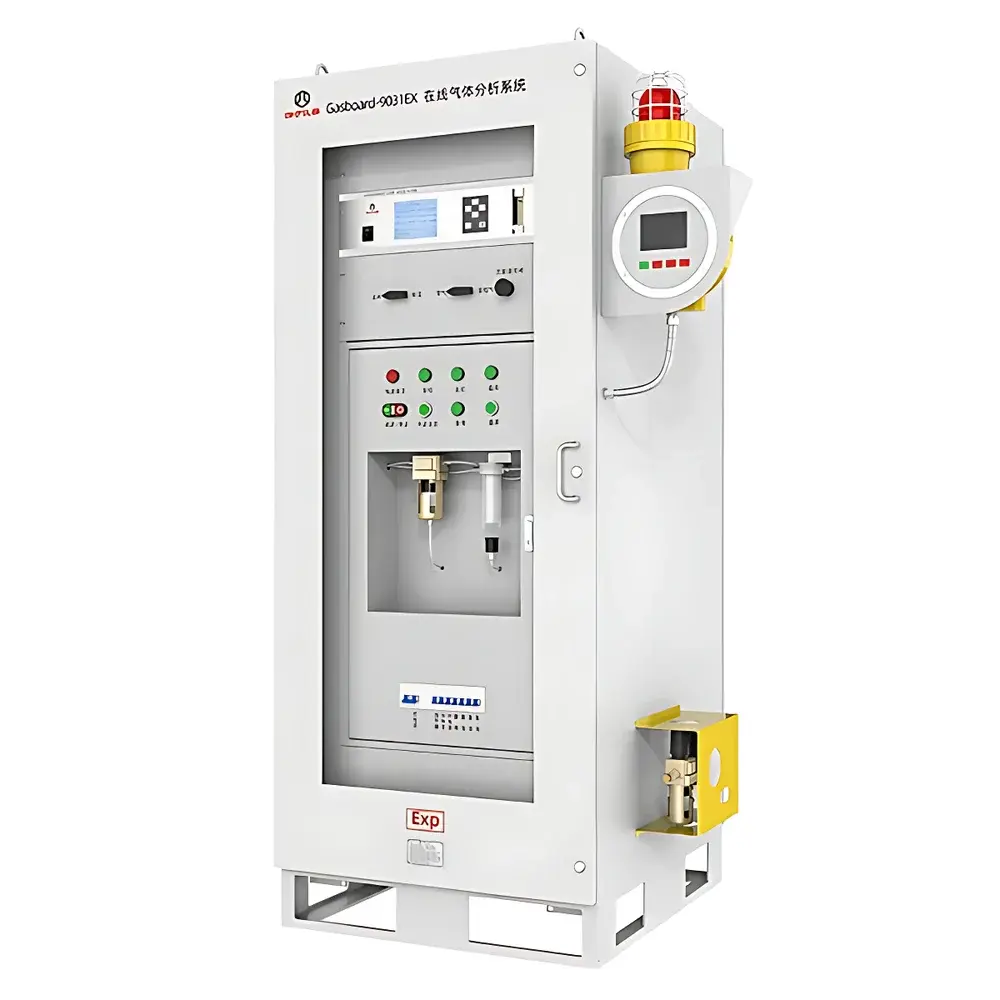
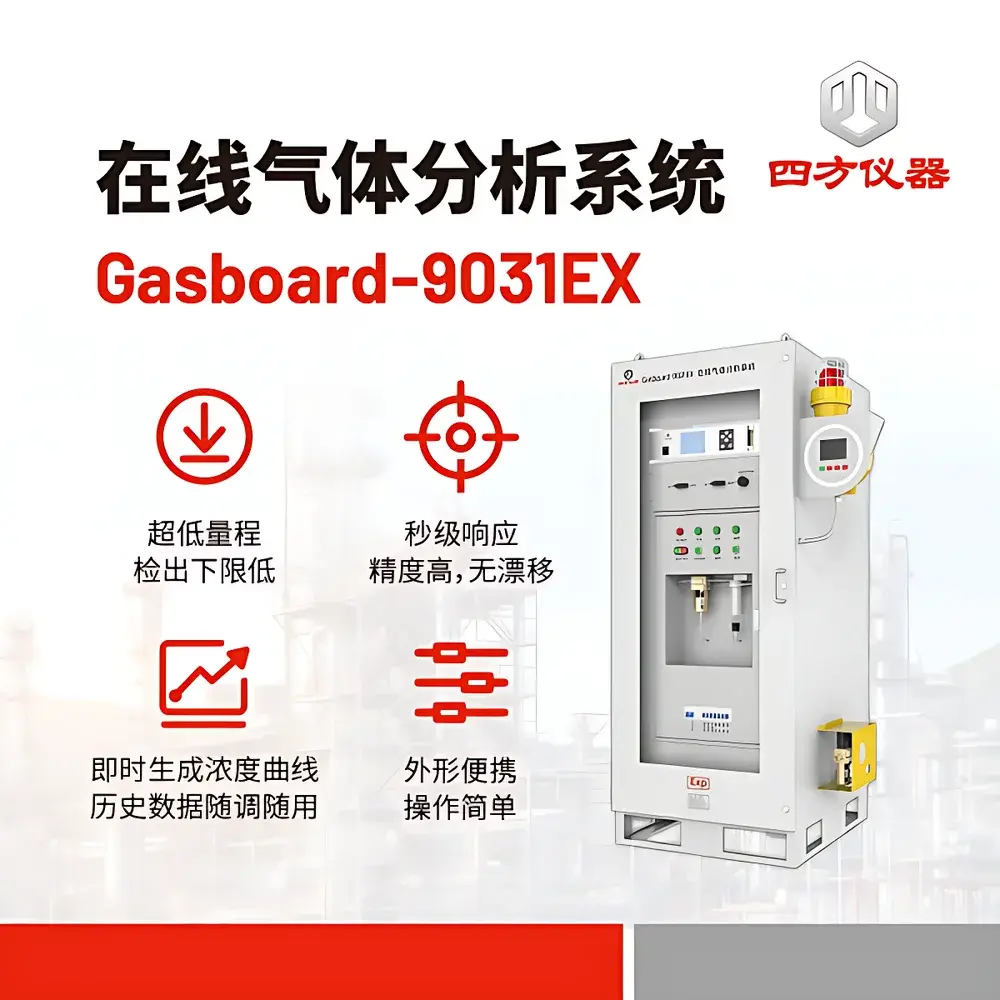
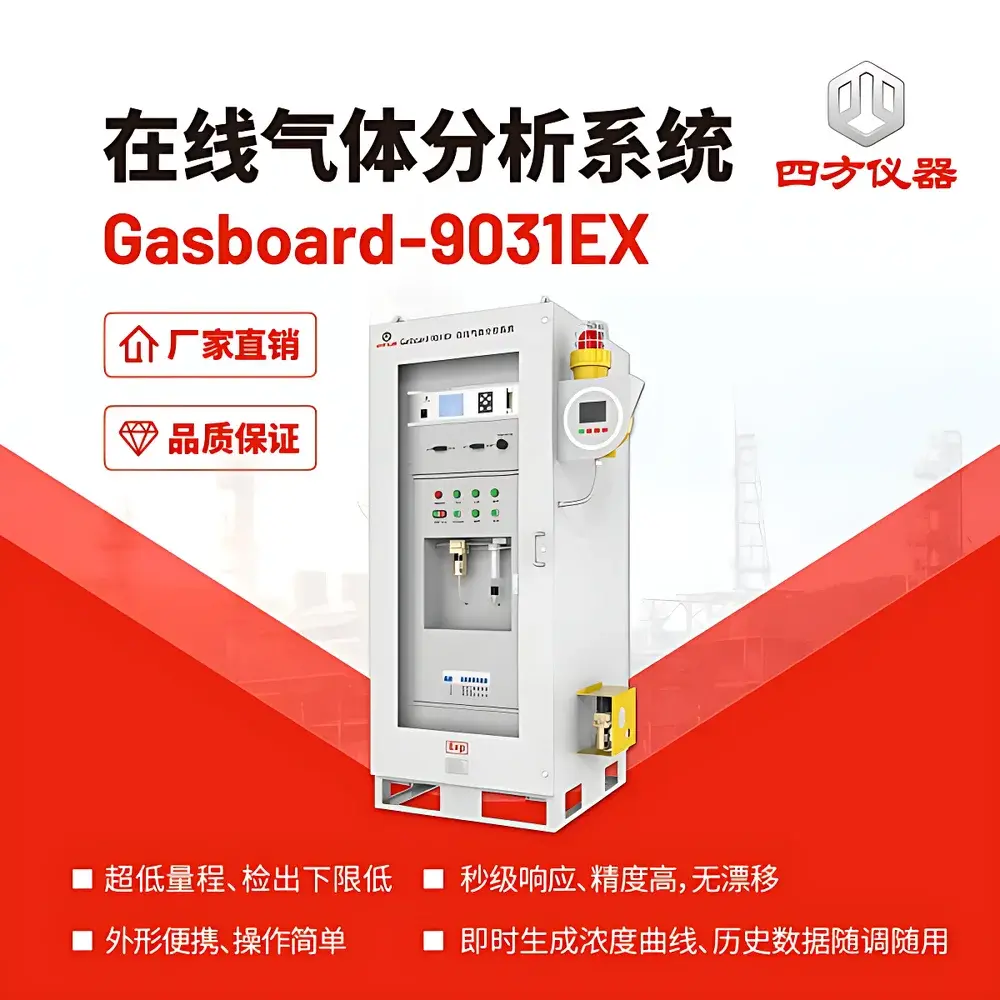
CUBIC INSTRUMENTS Gasboard-9031EX Multicomponent In-Situ Gas Analyzer
| Brand | CUBIC INSTRUMENTS |
|---|---|
| Origin | Hubei, China |
| Model | Gasboard-9031EX |
| Measurement Principle | NDIR (CO, CO₂, CH₄, C₂H₂, C₂H₄, CₙHₘ), TCD (H₂), ECD (O₂) |
| Detection Range | CO/CO₂/CH₄/H₂: (0–100)% vol |
| O₂ | (0–25)% vol |
| C₂H₂/C₂H₄/CₙHₘ | (0–10)% vol (optional) |
| Accuracy | ±1% FS (NDIR channels), ±2% FS (TCD & ECD channels) |
| Repeatability | ≤±0.5% FS |
| Explosion Protection Rating | Ex d IIC T4 Gb |
| Output Interfaces | RS-232, RS-485, (4–20) mA, Ethernet |
| Display | LCD |
| Auto-Calibration | Built-in zero-air pump with automatic air zeroing |
| Diagnostic Function | Real-time sensor health monitoring |
| Sample Handling | Heated stainless steel probe, dual-stage filtration, single-stage refrigerative dryer, pulsed back-purge |
Overview
The CUBIC INSTRUMENTS Gasboard-9031EX is an intrinsically robust, in-situ multicomponent gas analyzer engineered for continuous, real-time monitoring of industrial process gases under low-dust conditions. It integrates three core subsystems—sample conditioning, control logic, and multi-sensor gas analysis—into a unified, explosion-proof platform compliant with IEC 60079-0 and EN 60079-1 standards. The analyzer employs a hybrid detection architecture: non-dispersive infrared (NDIR) spectroscopy for CO, CO₂, CH₄, C₂H₂, C₂H₄, and total hydrocarbons (CₙHₘ); thermal conductivity detection (TCD) for H₂; and electrochemical detection (ECD) for O₂. This configuration enables simultaneous quantification of volumetric concentrations and derived calorific value (CV) of fuel gases—eliminating the need for standalone combustion-based calorimeters. Designed for deployment at critical process nodes—including blast furnace top gas, coke oven gas, dry quenching circulation gas, and electric heating furnace off-gas—the Gasboard-9031EX supports energy optimization, emissions compliance verification, and operational safety assurance in high-temperature, high-humidity industrial environments.
Key Features
- Integrated Sample Conditioning System: Features a heated stainless-steel probe (maintained at >180 °C) with pulsed back-purge functionality to prevent particulate accumulation and ensure long-term sampling integrity; includes a single-stage thermoelectric cooler and dual-stage mechanical filtration (coalescing + sintered metal) for effective water vapor removal without chemical desiccants.
- Automated Control Architecture: PLC-based control logic autonomously manages sample acquisition, condensate drainage, periodic probe purging, and calibration sequences—reducing operator dependency and enabling unattended 24/7 operation.
- Multi-Parameter Output Capability: Delivers concurrent, time-synchronized measurements of eight gas species (CO, CO₂, CH₄, H₂, O₂, C₂H₂, C₂H₄, CₙHₘ) and dynamically calculated higher heating value (HHV) or lower heating value (LHV) based on ASTM D3588-17 and ISO 6976:2016 algorithms.
- Intrinsic Safety & Certification Compliance: Certified to Ex d IIC T4 Gb per EN 60079-1:2014, suitable for Zone 1 hazardous areas; meets EMC requirements per EN 61326-1:2021 and environmental robustness per EN 60721-3-3 Class 3K4.
- Low-Cost-of-Ownership Design: Zero-consumable operation (no carrier gases, reagents, or catalytic converters); field-replaceable sensor modules with plug-and-play calibration; mean time between failures (MTBF) >12,000 hours.
Sample Compatibility & Compliance
The Gasboard-9031EX is validated for use with hot, humid, and mildly corrosive process streams containing up to 5 mg/m³ total suspended particulates. It complies with key regulatory and quality frameworks relevant to industrial emissions and energy management: EPA Method 3A (for O₂), EPA Method 10 (for CO), ISO 14687-2:2019 (hydrogen purity), and EN 15403:2006 (biogas quality). Its measurement traceability aligns with ISO/IEC 17025:2017 laboratory accreditation requirements when operated within defined environmental envelopes (5–45 °C ambient, <90% RH non-condensing). Data integrity conforms to FDA 21 CFR Part 11 principles through audit-trail-enabled firmware logging and user-access-controlled calibration records.
Software & Data Management
The embedded firmware supports Modbus RTU/TCP, TCP/IP, and analog (4–20 mA) output protocols for seamless integration into DCS, SCADA, or MES platforms. Local data storage retains ≥30 days of 1-minute averaged readings with timestamped metadata (sensor status, temperature, pressure, diagnostic flags). Remote access is enabled via secure Ethernet connection using TLS 1.2 encryption; configuration changes require multi-level password authentication. Optional cloud gateway modules support MQTT publishing to AWS IoT Core or Azure IoT Hub, enabling predictive maintenance analytics and cross-site performance benchmarking. All data exports comply with CSV and XML schema standards defined in ISA-95 Part 2.
Applications
- Blast furnace gas (BFG), basic oxygen furnace gas (BOFG), and coke oven gas (COG) monitoring in integrated steelworks
- Biogas upgrading and landfill gas quality control in anaerobic digestion facilities
- Process gas analysis in ammonia synthesis loops, methanol reformers, and syngas purification units
- Combustion efficiency optimization in cement kilns, glass melting furnaces, and ceramic tunnel ovens
- Safety-critical monitoring of acetylene (C₂H₂) and ethylene (C₂H₄) in petrochemical cracking units and polymerization reactors
- Regulatory reporting for NOₓ precursor tracking (via CO/H₂ ratio trends) and carbon intensity calculation in energy-intensive industries
FAQ
What gas species does the Gasboard-9031EX measure by default, and which are optional?
The standard configuration measures CO, CO₂, CH₄, H₂, O₂, and CₙHₘ (total non-methane hydrocarbons). C₂H₂ and C₂H₄ are factory-configurable options requiring dedicated NDIR channels and optical filters.
Can the analyzer operate continuously in high-humidity sample streams?
Yes—its heated probe (≥180 °C), refrigerative dryer, and hydrophobic filtration system maintain stable baseline performance in dew points up to 80 °C, provided condensate is actively drained.
How is calibration performed, and what reference standards are required?
Zero calibration uses ambient air via the built-in zero-air pump; span calibration requires certified gas mixtures traceable to NIST or equivalent national metrology institutes. Automated calibration scheduling and drift compensation are supported.
Is the system compatible with Industry 4.0 infrastructure?
Yes—it provides native OPC UA server capability (via optional firmware upgrade), supports time-series database ingestion (InfluxDB, TimescaleDB), and exposes RESTful APIs for integration with digital twin platforms.
What maintenance intervals are recommended for long-term reliability?
Filter elements require replacement every 6 months under typical industrial conditions; NDIR optical windows should be inspected annually; full system verification (including TCD/ECD zero/span) is advised every 3 months per ISO 13571:2021 guidelines.







