
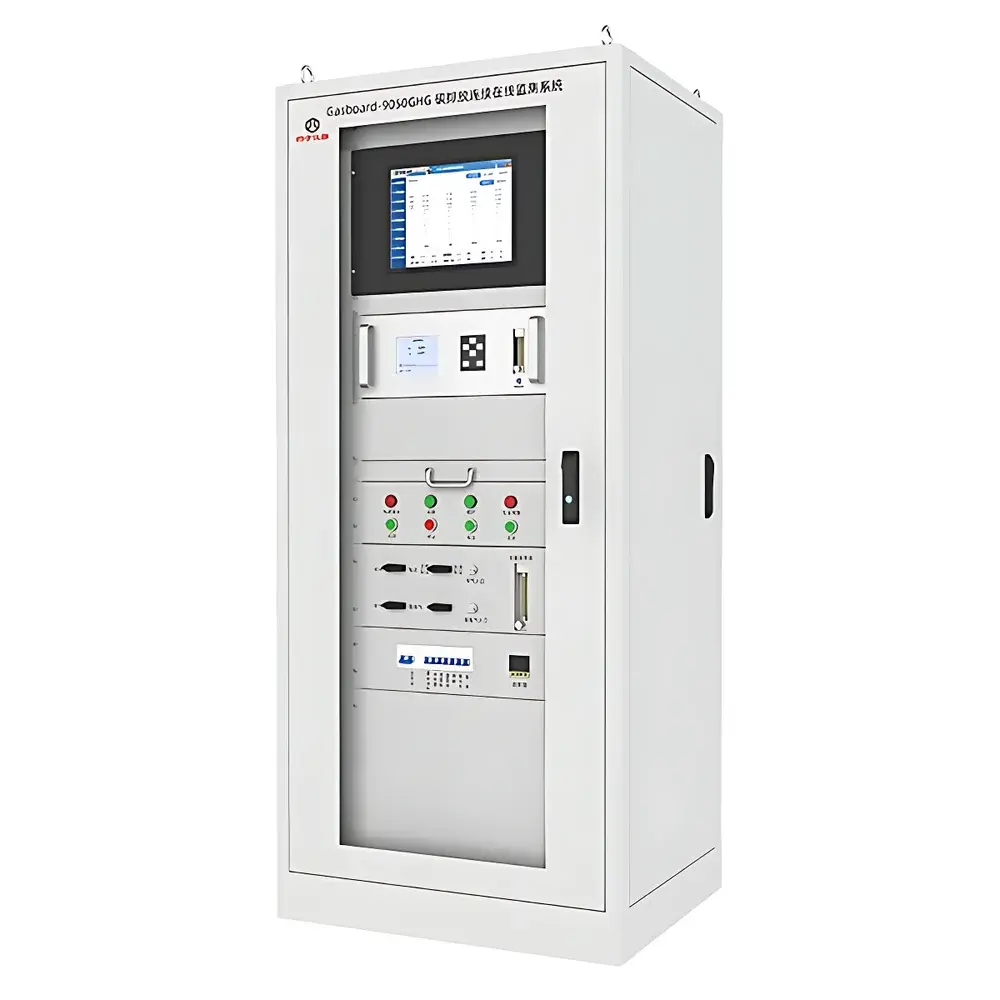
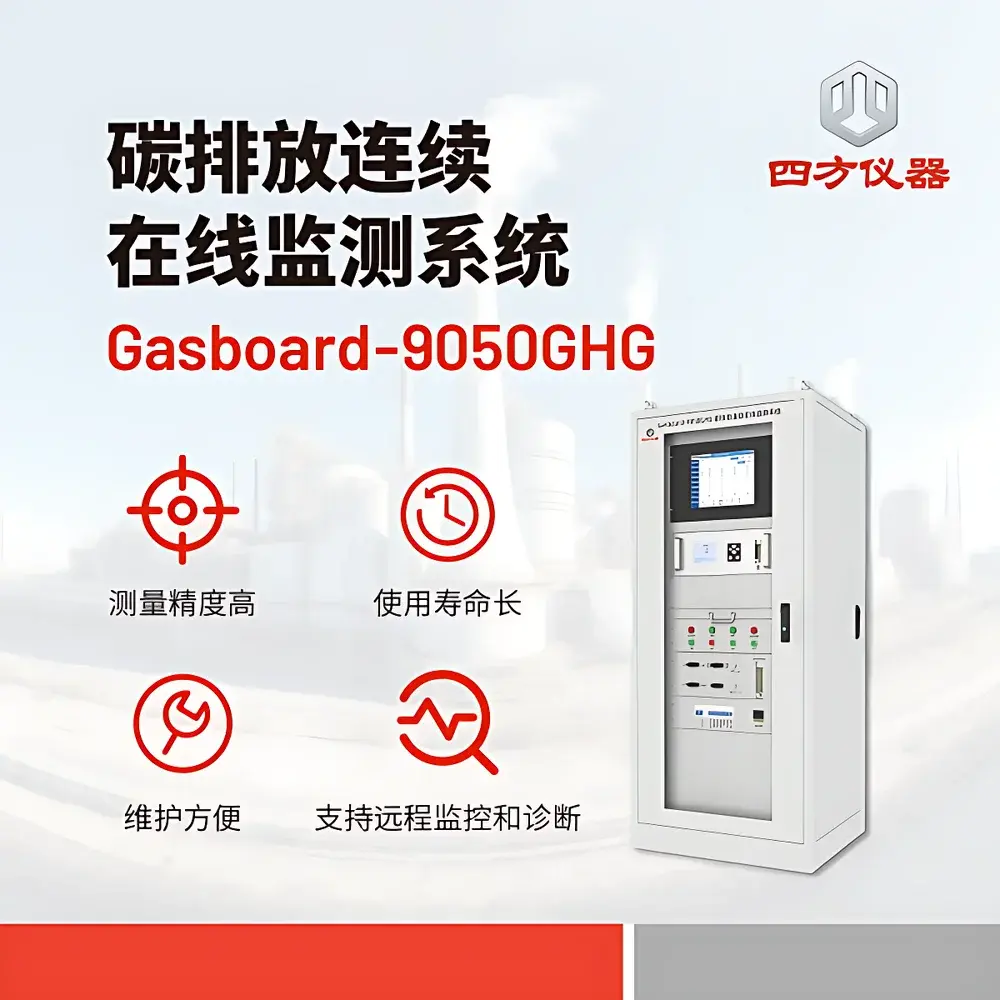
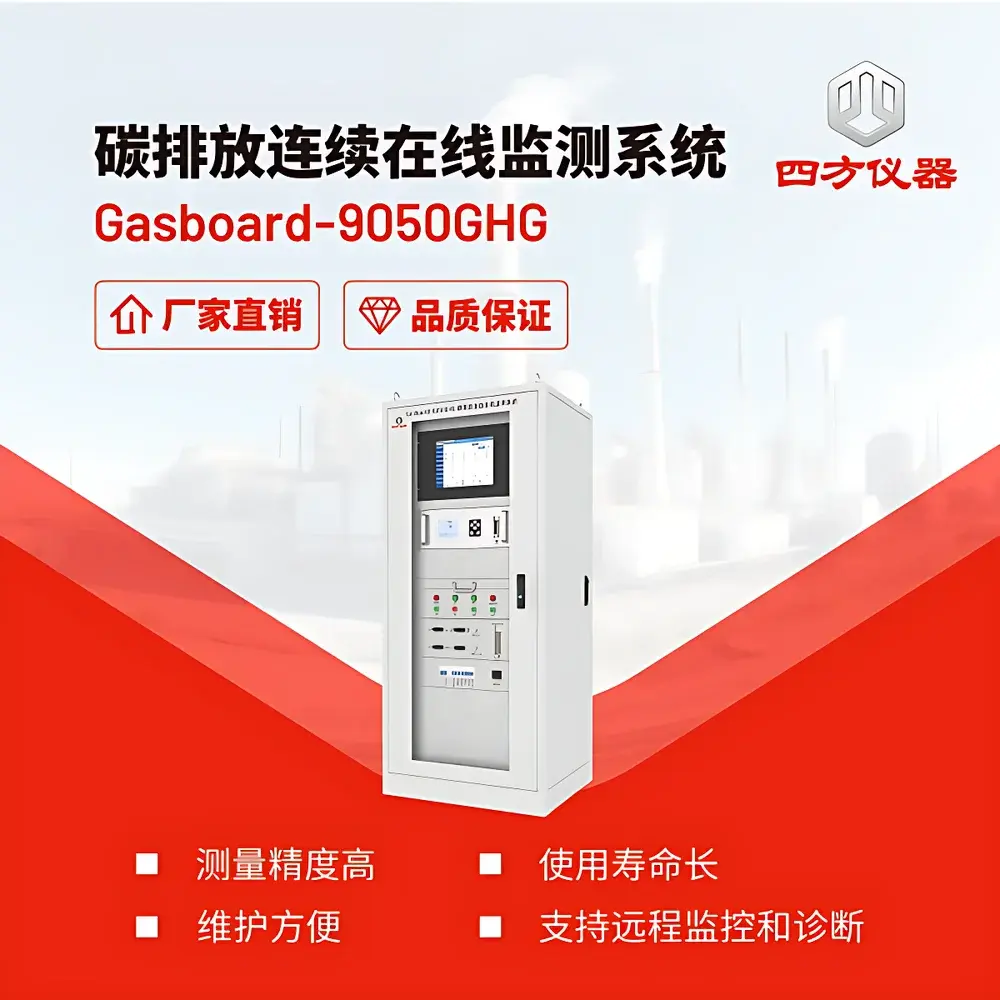
CUBIC INSTRUMENTS Gasboard-9050GHG Continuous Emissions Monitoring System (CEMS) for Greenhouse Gases
| Brand | CUBIC INSTRUMENTS |
|---|---|
| Origin | Hubei, China |
| Model | Gasboard-9050GHG |
| Instrument Type | Online CEMS |
| Measured Gases | CH₄, CO₂, CO, N₂O, O₂ |
| Detection Principle | NDIR (CH₄/CO₂/CO/N₂O), Electrochemical (O₂) |
| Range | CH₄/CO/N₂O: 0–1000 ppm |
| CO₂/O₂ | 0–25% vol |
| Accuracy | CH₄/CO₂/CO/N₂O ≤ ±1% F.S. |
| Repeatability | ≤ ±1% F.S. |
| Resolution | CH₄/CO/N₂O: 1 ppm |
| CO₂/O₂ | 0.01% vol |
| Response Time (T₉₀) | < 25 s |
| Linearity Error | CH₄/CO₂/CO/N₂O ≤ ±1% F.S. |
| Operating Flue Gas Temp. | 0–300 °C |
| Heated Line & Probe Temp. | 120–180 °C |
| Protection Rating | IP54 |
| Dimensions (L×W×H) | 800 × 760 × 1800 mm |
| Ambient Temp. | −20 to +50 °C |
| Ambient Humidity | < 95% RH (non-condensing) |
| Power Supply | 220 V AC ±10%, >3000 W |
| Compressed Air Requirement | 0.4–0.8 MPa, oil-free, dust-free, moisture-free |
| Max. Air Consumption | 2.2 m³/h |
| Avg. | 0.45 m³/h |
| Sample Flow Rate | Max. 2 L/min |
| Communication Interfaces | RS-485, RS-232, 4–20 mA, Ethernet |
Overview
The CUBIC INSTRUMENTS Gasboard-9050GHG is a certified online Continuous Emissions Monitoring System (CEMS) engineered for regulatory-grade, real-time quantification of greenhouse gas (GHG) and auxiliary flue gas parameters from stationary industrial sources. It implements a hybrid detection architecture integrating non-dispersive infrared (NDIR) spectroscopy for CH₄, CO₂, CO, and N₂O; electrochemical detection (ECD) for O₂; and complementary physical sensors for temperature, pressure, flow velocity, and humidity. Designed in accordance with ISO 14064-1 and aligned with EU IED (Industrial Emissions Directive) and EPA Method 3A/7E/10 requirements, the system supports mandatory GHG reporting frameworks—including China’s National Carbon Market (NCM), EU ETS, and voluntary corporate Scope 1 emissions verification—by delivering metrologically traceable, auditable concentration data at sub-minute temporal resolution.
Key Features
- Multi-gas NDIR core module with proprietary optical filtering and thermal stabilization, minimizing cross-sensitivity among CO₂, CH₄, CO, and N₂O—even in high-moisture, high-dust flue streams
- High-temperature heated probe and sample line (120–180 °C) with integrated ceramic zirconia-based humidity compensation, eliminating condensation-induced measurement drift
- Robust particulate management: sintered metal filter at probe inlet with programmable pulsed air back-blow (0.4–0.8 MPa), extending maintenance intervals to ≥6 months under typical coal-fired boiler conditions
- Auto-calibration capability via built-in zero-air pump and dual-point span validation support (external standard gas required), compliant with EN 15267-3 QA/QC protocols
- Self-diagnostic firmware with real-time sensor health logging, fault code mapping, and event-triggered alarm outputs (relay + digital signal)
- Modular hardware architecture enabling field-upgradable gas channels and firmware updates without system shutdown
Sample Compatibility & Compliance
The Gasboard-9050GHG is validated for continuous operation in flue gas streams with temperatures up to 300 °C, particulate loadings ≤50 g/Nm³, and SO₂ concentrations ≤2000 ppm. Its corrosion-resistant wet-end components—including Hastelloy C-276 probe tip, PTFE-lined sampling lines, and alumina-ceramic NDIR cells—meet ASTM D6784-22 requirements for acid gas resistance. The system satisfies data integrity prerequisites for regulatory reporting under China’s HJ 75-2017 and HJ 76-2017 standards, as well as international GLP/GMP-aligned audit trails (time-stamped raw data, calibration logs, alarm history). Optional integration with secure TLS 1.2 Ethernet communication enables compliance with FDA 21 CFR Part 11 electronic record controls when deployed in pharma or biotech manufacturing exhaust stacks.
Software & Data Management
Embedded Linux-based data acquisition unit provides local storage of 12+ months of second-level raw sensor outputs, diagnostic events, and calibration metadata. The system exports time-synchronized, timestamped data streams via Modbus TCP, OPC UA, or custom JSON over Ethernet—fully compatible with industry SCADA platforms (e.g., Siemens Desigo, Honeywell Experion, ABB Ability). Optional CEMS Manager™ desktop software (Windows/Linux) enables remote configuration, spectral diagnostics, drift trending analysis, and automated report generation per ISO 14064-3 Annex A templates. All data transfers include SHA-256 checksums and configurable audit log retention policies.
Applications
- Coal-, biomass-, and waste-to-energy power plants for Tier 2 GHG inventory reporting
- Cement kilns and lime calciners requiring simultaneous CO₂ and NOₓ co-monitoring
- Steel sintering plants and coke ovens where CO and CO₂ ratio monitoring informs combustion efficiency optimization
- Landfill gas recovery facilities tracking CH₄ destruction efficiency and flare compliance
- Food processing and ethanol fermentation exhaust streams subject to VOC + GHG dual-reporting mandates
- Research and development test benches evaluating low-carbon fuel blends (e.g., ammonia-hydrogen co-firing)
FAQ
What regulatory standards does the Gasboard-9050GHG comply with for emissions reporting?
It meets China’s HJ 75-2017 (performance acceptance) and HJ 76-2017 (data validity), and its measurement uncertainty profile aligns with ISO 14064-3 verification criteria for facility-level GHG inventories.
Can the system operate without external calibration gases?
Zero calibration is fully automated using ambient air via the internal zero-air pump; however, span calibration requires certified reference gases traceable to NIST or NIM standards for regulatory compliance.
Is the system suitable for high-moisture flue gas (e.g., from wet scrubbers)?
Yes—the heated sampling train (120–180 °C), combined with NDIR water vapor interference correction algorithms and optional chilled mirror dew point monitoring, ensures stable performance at relative humidity >90% RH.
How is data security ensured during remote transmission?
All Ethernet communications support TLS 1.2 encryption and user-authenticated API access; local database encryption (AES-256) is enabled by default.
What is the recommended maintenance schedule for the heated probe and filters?
Under typical industrial conditions, sintered metal probe filters require cleaning every 6 months; ceramic NDIR cells are rated for >5 years of continuous operation without recalibration if operated within specified temperature and contamination limits.
Related Products







