
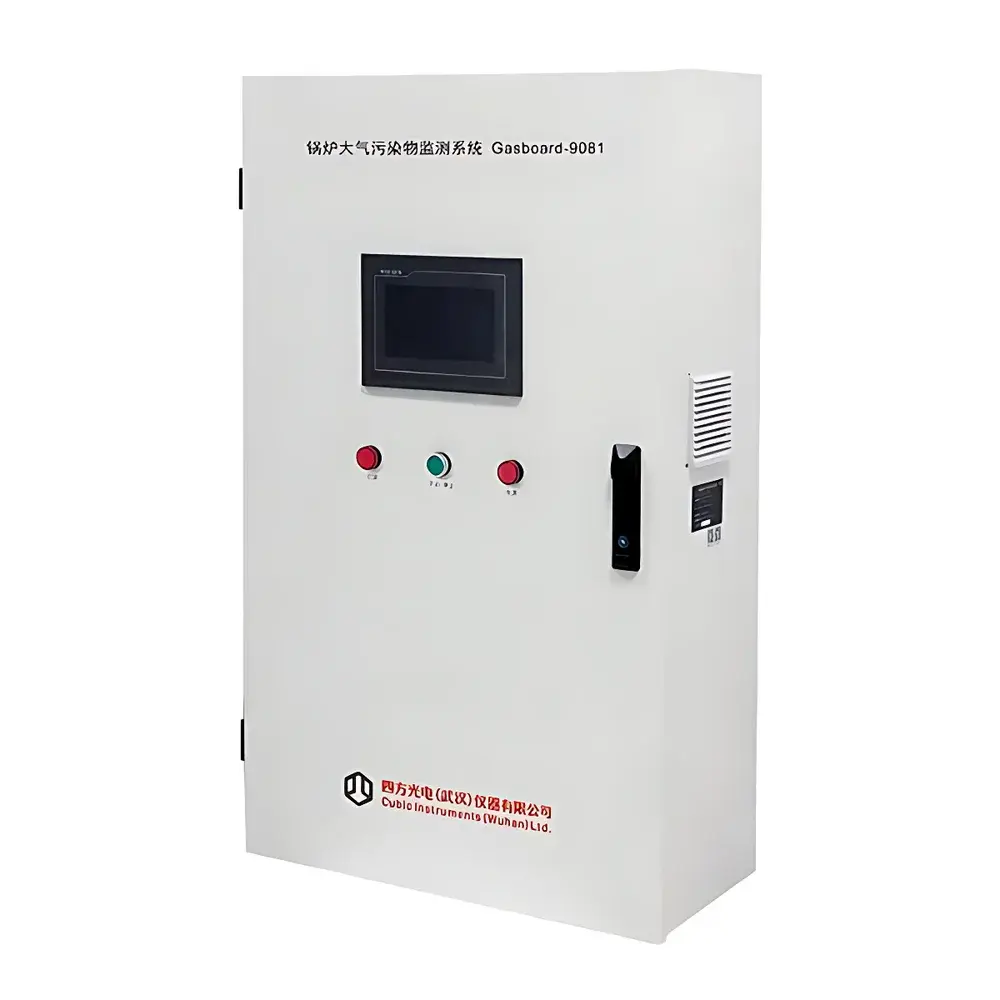
CUBIC INSTRUMENTS Gasboard-9081 High-Configuration Online Boiler Flue Gas Emission Monitoring System
| Brand | CUBIC INSTRUMENTS |
|---|---|
| Origin | Hubei, China |
| Model | Gasboard-9081 |
| Measurement Principle | UV-DOAS (NOx, SO₂), NDIR (CO, CO₂), Electrochemical (O₂) |
| Configuration | Online Multicomponent Gas Analyzer |
| Detection Range | NOx/SO₂: 0–100 mg/m³ |
| O₂/CO₂ | 0–25% vol |
| CO | 0–5% vol |
| Response Time | ≤30 s |
| Repeatability | ±1% FS (NO, SO₂, O₂) |
| Resolution | NOx/SO₂/CO: 1 mg/m³ |
| O₂/CO₂/CO | 0.01% vol |
| Zero Drift | NOx/SO₂: ≤1% FS/24 h |
| CO/CO₂/O₂ | ≤2% FS/24 h |
| Accuracy | ±2% FS (all measured components) |
| Power Supply | 220 V AC ±20%, 50 Hz ±1 Hz |
| Display | 7-inch capacitive touchscreen |
| Communication Interfaces | RS232, RS485, 4–20 mA analog output, audible/visual alarm relay |
| Data Storage | Internal non-volatile memory supporting ≥3 years of 1-minute interval data |
Overview
The CUBIC INSTRUMENTS Gasboard-9081 High-Configuration Online Boiler Flue Gas Emission Monitoring System is an industrial-grade, continuous emissions monitoring system (CEMS) engineered for real-time, multi-parameter analysis of combustion exhaust from small- to medium-capacity gas-fired boilers. It integrates three complementary analytical technologies—Ultraviolet Differential Optical Absorption Spectroscopy (UV-DOAS) for NO and SO₂, Non-Dispersive Infrared (NDIR) spectroscopy for CO and CO₂, and long-life electrochemical detection for O₂—within a single, compact chassis. This hybrid architecture ensures high selectivity, minimal cross-sensitivity, and stable operation under variable flue gas temperature, humidity, and particulate load conditions. Designed to comply with China’s GB 13271–2014 (Emission Standards for Air Pollutants from Boiler) and aligned with international performance benchmarks for regulatory CEMS (e.g., EN 15267, EPA Method 6C/7E/10), the Gasboard-9081 delivers trace-level quantification of key combustion byproducts while supporting energy efficiency optimization through stoichiometric ratio analysis.
Key Features
- UV-DOAS-based NOx and SO₂ measurement with sub-1 mg/m³ resolution and ultra-low-range calibration (0–100 mg/m³), optimized for post-low-NOx burner and SCR/SNCR retrofit applications.
- Dual-wavelength NDIR channels for simultaneous, drift-compensated CO and CO₂ quantification—enabling real-time combustion efficiency calculation (e.g., excess air ratio λ, thermal efficiency η).
- High-stability electrochemical O₂ sensor with integrated temperature and pressure compensation, certified for continuous operation >24 months without recalibration under typical boiler stack conditions.
- Integrated sample conditioning unit featuring heated sampling probe (180 °C), PTFE-lined extractive line, condensate trap, and particle filter—designed to maintain sample integrity and prevent optical window fouling.
- Automated self-diagnostic routines including zero/span validation, lamp intensity monitoring, optical path alignment verification, and sensor health logging—reducing manual maintenance intervals by ≥40% versus conventional CEMS.
- Industrial-grade 7-inch resistive-capacitive touchscreen HMI with intuitive configuration wizard, multilingual UI (English/Chinese), and embedded event log viewer for immediate root-cause analysis.
Sample Compatibility & Compliance
The Gasboard-9081 is validated for use with dry or wet flue gas streams from natural gas, LPG, and biogas-fired boilers operating at stack temperatures between 60–200 °C and moisture content up to 15% v/v. Its UV-DOAS optical path employs quartz cuvettes and thermally stabilized light sources to maintain spectral fidelity in high-humidity environments. All measurement modules meet IP65 enclosure rating and operate within ambient temperatures of –10 to +50 °C. The system supports compliance with national emission reporting requirements (e.g., China’s MEP Order No. 19, “Technical Specifications for CEMS Data Acquisition and Transmission”) and provides audit-ready data logs with time-stamped metadata—including calibration events, fault codes, and environmental compensation parameters. Optional 21 CFR Part 11-compliant software add-on enables electronic signature, role-based access control, and immutable audit trail generation for GLP/GMP-aligned facilities.
Software & Data Management
Embedded firmware runs on a real-time Linux OS with deterministic I/O scheduling, ensuring consistent 1-second measurement cycles and ≤30 s end-to-end system response. Data are stored locally in SQLite3 format with cyclic overwrite protection and automatic timestamping (UTC synchronized via NTP or GPS optional). Historical records include raw spectra (UV-DOAS), detector voltages (NDIR/ECD), temperature/pressure compensation values, and diagnostic flags—accessible via USB 2.0 host interface or Modbus TCP over Ethernet (optional module). The standard PC software package supports automated report generation (PDF/CSV), trend visualization (hourly/daily/monthly), limit violation alerts (configurable thresholds), and seamless integration with SCADA platforms via OPC UA or MQTT protocols. Firmware updates are delivered via signed binary packages with SHA-256 verification to ensure integrity.
Applications
- Continuous regulatory compliance monitoring for gas-fired steam/hot-water boilers in commercial buildings, hospitals, and district heating plants.
- Performance validation of low-NOx burners, flue gas recirculation (FGR) systems, and selective catalytic reduction (SCR) installations.
- Combustion optimization studies—correlating O₂, CO, and CO₂ profiles with fuel consumption, stack loss, and thermal efficiency metrics.
- Post-combustion VOC abatement verification—quantifying NOx formation during thermal oxidation of hydrocarbon-laden exhaust streams.
- Pre-commissioning and periodic QA/QC testing of boiler control systems under varying load conditions (10–100% capacity).
FAQ
What regulatory standards does the Gasboard-9081 meet for emissions reporting?
It conforms to GB 13271–2014, HJ 75–2017 (China’s CEMS Technical Specification), and provides measurement uncertainty profiles compatible with EN 14181 QAL1/QAL2 requirements.
Can the system be integrated into existing plant DCS or cloud-based EMS platforms?
Yes—via native Modbus RTU/TCP, 4–20 mA analog outputs, or optional OPC UA/MQTT gateway modules.
Is field calibration required after installation?
Zero and span checks are recommended every 7 days per GB/T 32200–2015; full QAL2 verification is advised annually using certified reference gases traceable to NIM.
How is moisture interference mitigated in UV-DOAS measurements?
The system applies real-time water vapor spectral subtraction using pre-characterized H₂O absorption cross-sections and dynamically adjusts baseline correction based on inline humidity sensor feedback.
What is the expected service life of the electrochemical O₂ sensor?
Rated for ≥24 months continuous operation under typical flue gas conditions (T < 120 °C, dew point < 4 °C); replacement interval extends to 36 months with optional heated sampling line.







