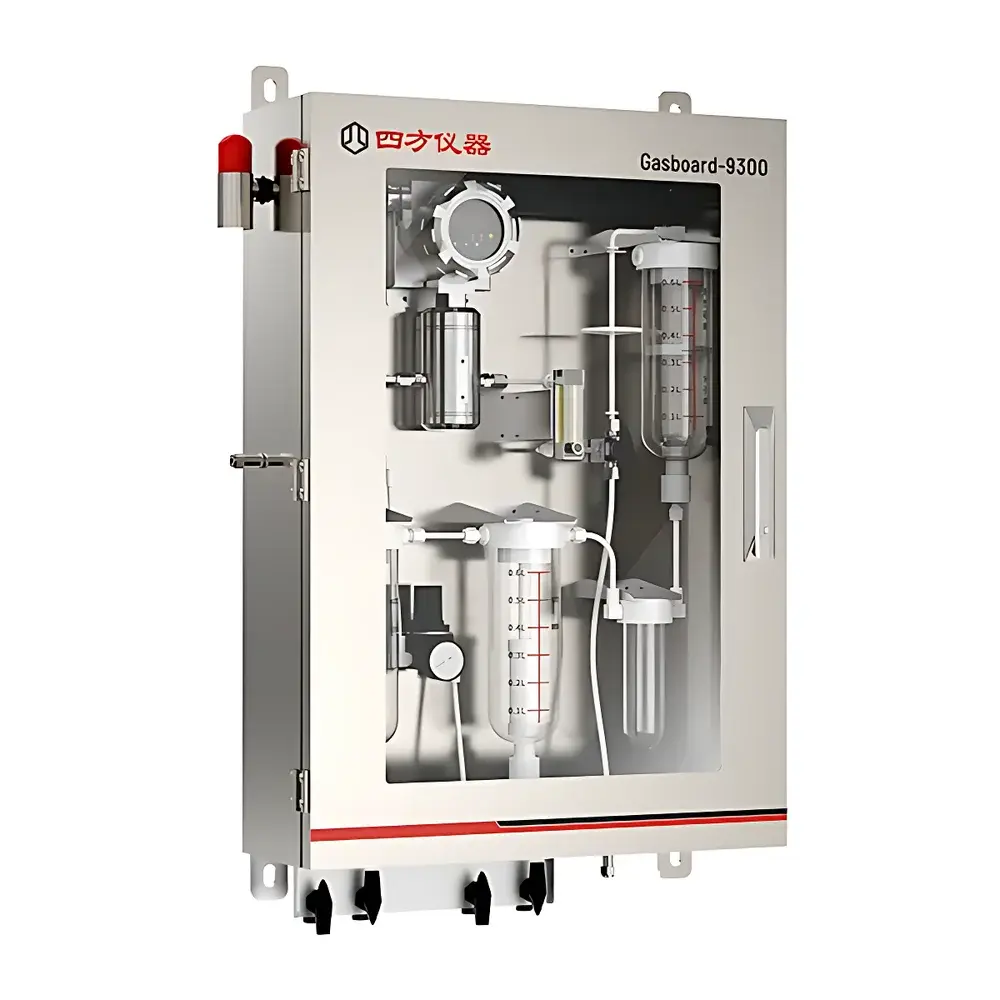
CUBIC INSTRUMENTS Gasboard-9300 Tunable Diode Laser Absorption Spectroscopy (TDLAS) Oxygen Analyzer
| Brand | CUBIC INSTRUMENTS |
|---|---|
| Origin | Hubei, China |
| Model | Gasboard-9300 |
| Sensor Type | Tunable Diode Laser (TDLAS) |
| Measurement Ranges | 0–1%, 0–5%, 0–25% O₂ (selectable) |
| Accuracy | ≤ ±1% FS |
| Repeatability | ≤ ±1% FS |
| Linearity Error | ≤ ±1% FS |
| Resolution | 0.1% (for 0–25% range) or 0.01% (for 0–1% range) |
| Response Time (T90) | < 10 s |
| Explosion Protection Rating | Ex db IIC T6 Gb |
| Operating Temperature | −20 to +60 °C |
| Operating Humidity | 0–98% RH (non-condensing) |
| Output Signal | RS485 (standard), RS232 (optional) |
| Communication Protocol | Modbus RTU |
| Power Supply | 24 VDC or 220 VAC |
Overview
The CUBIC INSTRUMENTS Gasboard-9300 is a high-integrity, in-situ oxygen analyzer engineered for continuous, real-time monitoring in demanding industrial process environments. It employs Tunable Diode Laser Absorption Spectroscopy (TDLAS), a physics-based, non-contact optical measurement principle that exploits the unique near-infrared absorption line of molecular oxygen (O₂) at ~760 nm. Unlike electrochemical or zirconia-based sensors—whose performance degrades under thermal cycling, moisture exposure, or corrosive gas matrices—the Gasboard-9300 delivers stable, drift-free measurements without consumables, calibration gases, or frequent sensor replacement. Its optical path is intrinsically immune to poisoning by acid vapors, alkaline mists, or organic solvents, making it suitable for installation directly in sample streams from reactors, centrifuges, dryers, and inertization systems where conventional analyzers fail.
Key Features
- TDLAS-based optical detection ensures zero cross-sensitivity to CO₂, CO, H₂O, N₂, or hydrocarbons—critical for accurate O₂ quantification in complex process gas mixtures.
- Explosion-proof enclosure rated Ex db IIC T6 Gb, certified for Zone 1/21 hazardous locations per IEC 60079-0 and IEC 60079-1, enabling safe deployment in pharmaceutical synthesis, agrochemical production, and fine chemical manufacturing.
- Integrated sample conditioning system includes heated sampling probe, particulate filter, and corrosion-resistant flow path constructed from 316L stainless steel and PTFE-lined components—capable of withstanding ambient HCl, NH₃, methanol vapor, and acetone-laden exhaust streams.
- Fast dynamic response (T90 < 10 s) supports closed-loop nitrogen purge control, enabling automated O₂ suppression during reactor blanketing and ensuring compliance with OSHA-defined inerting thresholds (< 8% O₂ for many flammable solvents).
- Self-diagnostic firmware continuously monitors laser wavelength stability, photodetector gain, and optical alignment integrity; alerts are logged via Modbus RTU for integration into DCS or SIS platforms.
Sample Compatibility & Compliance
The Gasboard-9300 is validated for use with wet, hot, and chemically aggressive process streams typical of batch pharmaceutical manufacturing (e.g., hydrogenation reactors, crystallization vessels) and food-grade nitrogen blanketing applications. It meets the mechanical and environmental requirements of IEC 61508 (SIL2-capable architecture), and its digital output architecture supports audit-trail-ready data logging when interfaced with compliant SCADA or MES systems. While not inherently FDA 21 CFR Part 11-compliant as a standalone device, its RS485/Modbus RTU interface enables traceable data acquisition when deployed within validated instrumented systems adhering to GMP Annex 11 and EU GMP Chapter 4 requirements. Calibration verification procedures align with ISO 14644-3 for cleanroom process gas monitoring and ASTM D6245 for oxygen concentration validation in inert atmospheres.
Software & Data Management
The analyzer operates autonomously without external PC dependency. Configuration, alarm thresholds, range selection, and diagnostic history are managed via embedded web interface (accessible over local Ethernet) or terminal-based CLI via RS232/RS485. All operational parameters—including laser drive current, detector signal-to-noise ratio, and internal temperature compensation coefficients—are stored with time-stamped logs. Data export supports CSV format for offline trend analysis in MATLAB, Python (Pandas), or LIMS environments. For enterprise integration, optional OPC UA gateway modules enable seamless mapping of O₂ concentration, status flags, and fault codes into PI System, Ignition, or Siemens Desigo CC platforms.
Applications
- Real-time O₂ monitoring inside jacketed glass-lined reactors during exothermic nitration or oxidation steps—preventing runaway reactions through automatic N₂ injection when O₂ exceeds user-defined setpoints.
- Inert atmosphere verification in lyophilizer chambers and vial-filling isolators, ensuring residual O₂ remains below 0.5% for oxygen-sensitive biologics and sterile APIs.
- Continuous verification of nitrogen purity in solvent recovery systems handling ethanol, ethyl acetate, or dichloromethane—supporting ATEX-compliant vent-gas management.
- On-line monitoring of headspace O₂ in modified-atmosphere packaging (MAP) lines for dairy, meat, and nutraceutical products, supporting HACCP critical control point documentation.
FAQ
Does the Gasboard-9300 require periodic zero/span calibration?
No—TDLAS is an absolute measurement technique referenced to fundamental spectroscopic constants. Routine calibration is not required; however, annual verification using certified N₂/O₂ standard gas blends is recommended for regulatory audit readiness.
Can it be installed in a pressurized reactor vessel?
Yes—the standard configuration supports direct in-line mounting on ANSI/ISO flanged ports up to 10 bar(g); custom high-pressure variants (up to 40 bar) are available upon request.
Is the analyzer compatible with SIL2 safety instrumented functions?
Yes—the hardware architecture, diagnostic coverage (>90%), and failure mode analysis comply with IEC 61508 Ed.2 requirements for SIL2 applications when integrated into a certified SIS loop.
What maintenance intervals are recommended?
Optical windows require cleaning every 6–12 months depending on particulate loading; no routine sensor replacement or electrolyte refills are needed—typical MTBF exceeds 60,000 hours.
How is temperature compensation handled during rapid ambient fluctuations?
An embedded Pt100 sensor monitors optical bench temperature in real time; all spectral fitting algorithms apply dynamic thermal drift correction based on multi-point factory characterization across −20 to +60 °C.