
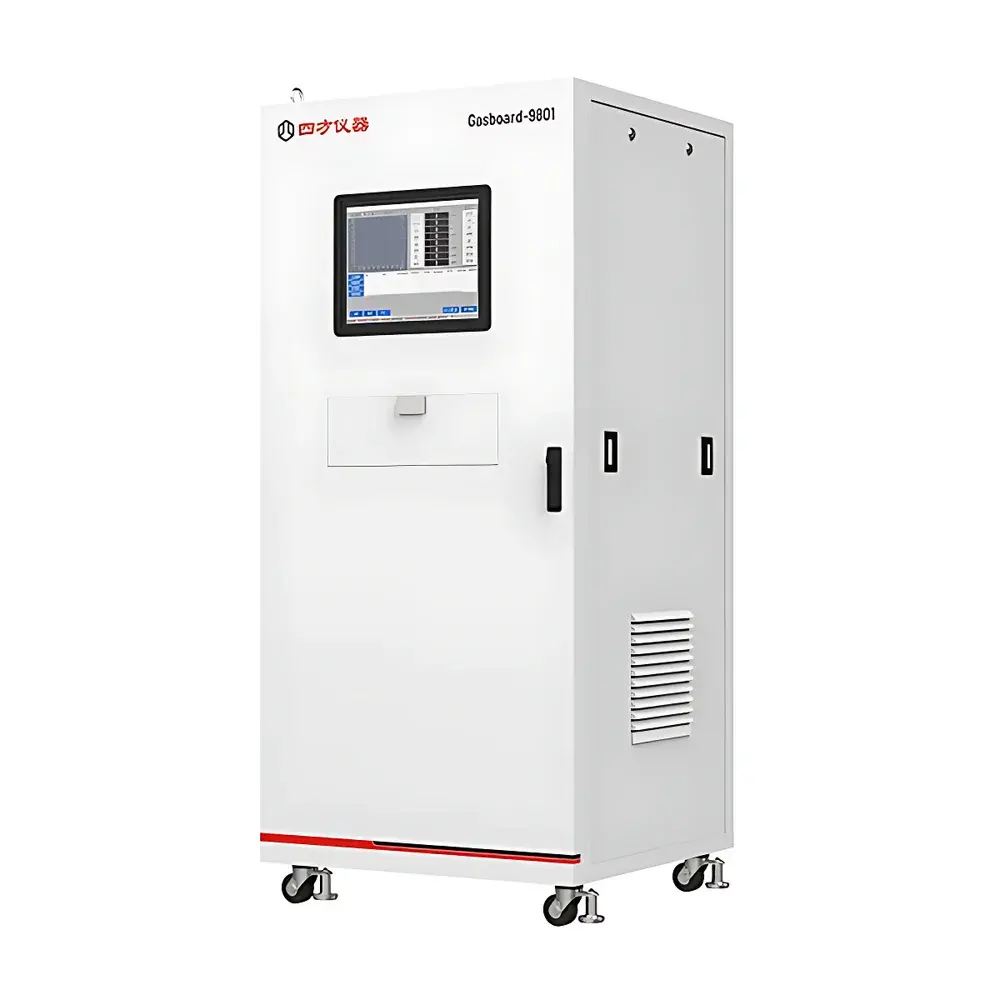
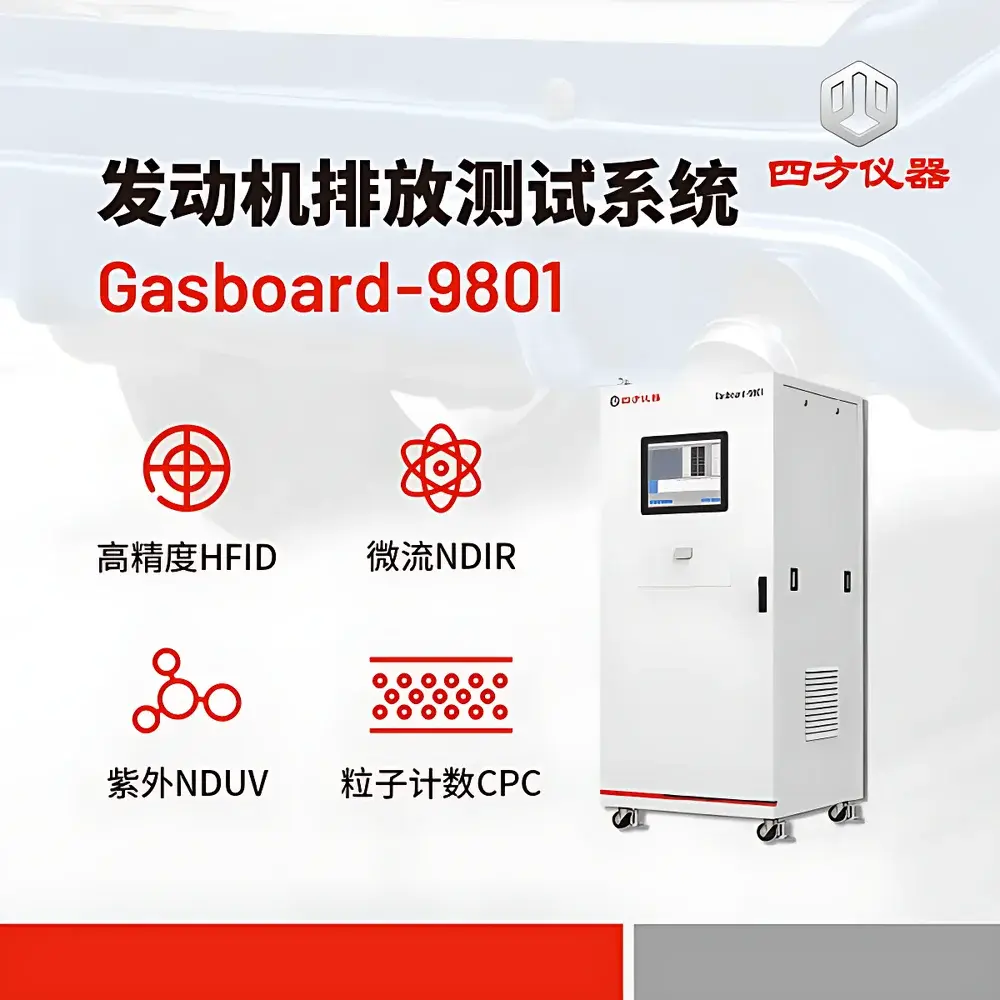
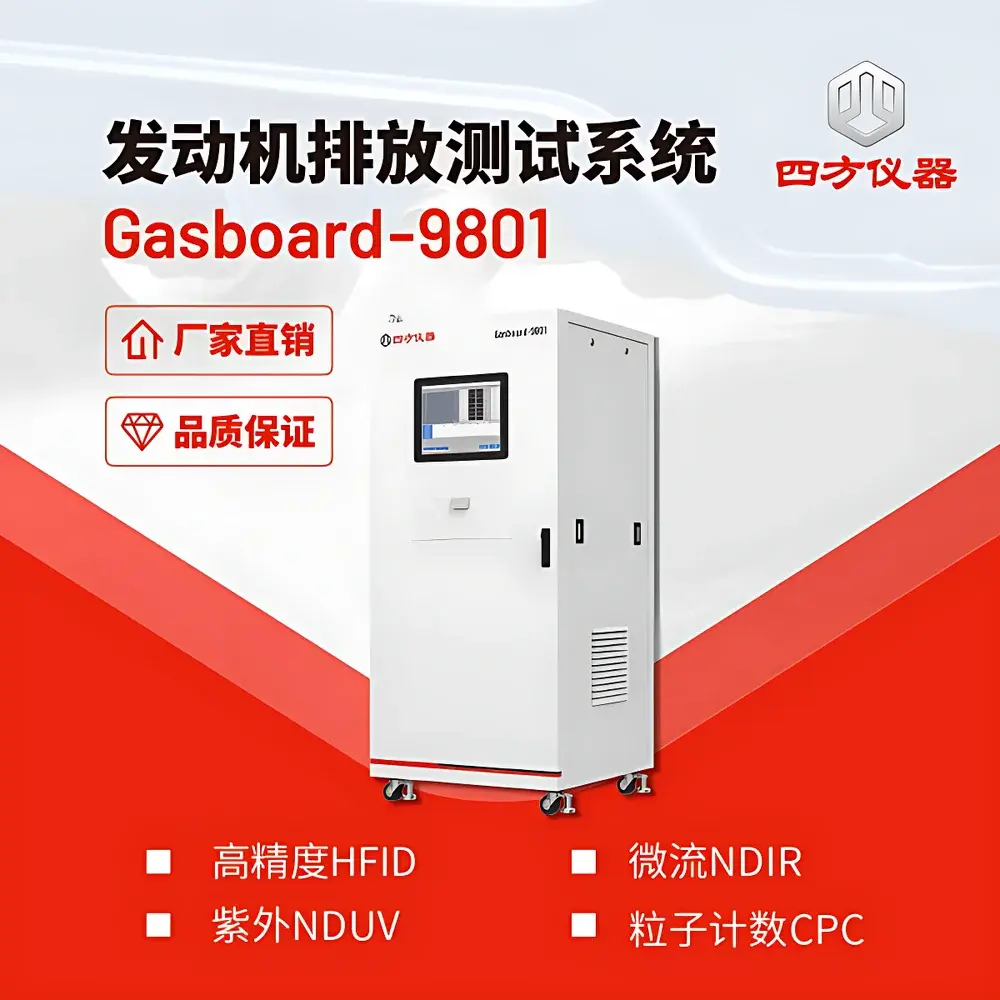
CUBIC INSTRUMENTS Gasboard-9801 Automotive Exhaust Emission Monitoring System
| Brand | CUBIC INSTRUMENTS |
|---|---|
| Origin | Hubei, China |
| Model | Gasboard-9801 |
| Instrument Type | Online Continuous Emission Monitoring System (CEMS) |
| Detection Principle | Non-Dispersive Infrared (NDIR), Non-Dispersive Ultraviolet (NDUV), Chemiluminescence Detection (CLD), and Flame Ionization Detection (HFID) |
| Measured Gases | THC, CH₄, NOₓ, CO, CO₂, O₂ |
| Maximum Permissible Error | ≤±2.0% of Reading Standard (RS) or ≤±0.3% of Full Scale (FS) |
| Zero Drift | ≤±1% FS / 8 h |
| Span Drift | ≤±1% FS / 8 h |
| Repeatability | ≤±0.5% FS |
| Response Time (T₁₀–₉₀) | <2.5 s |
| Linearity | R² ≥ 0.998 |
| Slope | 0.99–1.01 |
| Operating Environment | 5–40 °C, ≤80% RH |
Overview
The CUBIC INSTRUMENTS Gasboard-9801 is an integrated online automotive exhaust emission monitoring system engineered for high-fidelity, continuous measurement of regulated gaseous pollutants in laboratory-based engine testing environments. It is specifically designed to support full-flow dilution tunnel testing and raw exhaust analysis per international regulatory frameworks—including EU Regulation (EU) 2017/1151 (RDE), UNECE Regulation No. 83 and No. 49, China’s GB 18352.6–2016 (China 6), and ISO 8178 for non-road engines. The system employs a modular architecture comprising sampling probes, heated sample transfer lines, conditioning units (including water removal, particulate filtration, and pressure/temperature stabilization), and six parallel gas analyzers operating on complementary physical principles: NDIR for CO, CO₂, and CH₄; NDUV and CLD for NOₓ speciation (NO, NO₂); HFID for total hydrocarbons (THC); and paramagnetic or electrochemical detection for O₂. This multi-principle configuration ensures trace-level sensitivity, cross-interference suppression, and metrological robustness across wide dynamic ranges—from sub-ppm background levels to high-concentration transient peaks during aggressive engine transients.
Key Features
- Multi-technology gas analysis platform: Simultaneous quantification of THC, CH₄, NOₓ, CO, CO₂, and O₂ using industry-validated NDIR, NDUV, CLD, and HFID sensing modules—each independently calibrated and temperature-compensated.
- Full-scale dynamic range coverage: Configurable measurement spans from 0–10 ppmC (THC/CH₄) to 0–25% (O₂), enabling compliance with both ultra-low emission vehicle certification (e.g., Euro 7 PEMS limits) and legacy engine benchmarking protocols.
- Sub-second response fidelity: T10–90 < 2.5 s across all channels, preserving temporal resolution critical for cycle-resolved emissions analysis (e.g., WLTC, FTP-75, or RDE trip segmentation).
- Modular sampling interface: Supports up to 8-channel heated probe integration for spatially resolved exhaust sampling, EGR ratio derivation via dual-point O₂/CO₂ differential analysis, and bypass-compatible calibration gas injection.
- Automated drift compensation: Real-time zero/span verification routines aligned with EN 14181 QAL1/QAL2 requirements; drift stability maintained at ≤±1% FS over 8-hour operational windows without manual intervention.
- Ruggedized laboratory deployment: All wetted components constructed from 316L stainless steel and PTFE-lined tubing; conditioned sample path maintained at >180 °C to prevent condensation and adsorption losses of semi-volatile organics.
Sample Compatibility & Compliance
The Gasboard-9801 is validated for use with spark-ignition (SI), compression-ignition (CI), and alternative-fuel engines—including CNG, LNG, hydrogen-fueled, and hybrid powertrains. Its analytical performance meets the metrological criteria defined in ISO 20023:2020 (performance verification of exhaust gas analyzers), EPA 40 CFR Part 1065 Subpart J (calibration and verification procedures), and EU Commission Regulation (EU) 2017/1151 Annex IIIA. The system supports full traceability under GLP-compliant audit trails and is compatible with 21 CFR Part 11–enabled data acquisition platforms when interfaced via RS-232/485 or Ethernet TCP/IP. Certificates of conformity include CE marking per Directive 2014/30/EU (EMC) and 2014/35/EU (LVD), as well as RoHS 2011/65/EU compliance.
Software & Data Management
Control and data acquisition are managed through CUBIC’s proprietary EmissionSuite™ v4.2 software, a Windows-based application compliant with ISO/IEC 17025 documentation requirements. The software provides synchronized time-stamped logging at user-selectable intervals (10 ms to 1 s), real-time stoichiometric air–fuel ratio (λ) calculation, and automatic generation of regulatory report templates (e.g., EU type-approval Annex XXI, China 6 certification forms). Raw analog/digital inputs support third-party DAQ integration (NI PXI, Dewetron), while encrypted SQLite databases ensure data integrity and revision-controlled archiving. Audit logs record all calibration events, parameter changes, and user logins—fully satisfying FDA 21 CFR Part 11 electronic record and signature requirements when deployed in certified test laboratories.
Applications
- Regulatory type-approval testing for light-duty and heavy-duty vehicles (Euro 6d, China 6b, US Tier 3, Japan Post-New Long-Term).
- Production conformity assessment (PCA) and in-service conformity (ISC) monitoring per UN GTR 15 and GB 18352.6–2016.
- Non-road mobile machinery (NRMM) certification under EU Stage V (Regulation (EU) 2016/1628) and China’s GB 20891–2014 (Stage IV).
- R&D emissions mapping for aftertreatment system development (e.g., DOC, DPF, SCR, GPF), including ammonia slip and N₂O quantification via extended NOₓ channel configuration.
- Marine engine testing per IMO MARPOL Annex VI and ISO 8178–4, supporting Tier III NOₓ control validation.
- Real-driving emissions (RDE) data post-processing with GPS-synchronized pollutant mass emission rate computation (g/km, g/kWh).
FAQ
Does the Gasboard-9801 support simultaneous measurement of NO and NO₂ separately?
Yes—via dual-channel NDUV and CLD modules configured for independent NO and NO₂ detection, enabling accurate NOₓ speciation and conversion efficiency calculations for SCR systems.
Can the system be integrated into existing chassis dynamometer test cells?
Yes—the Gasboard-9801 features standardized analog (0–10 V, 4–20 mA) and digital (CAN 2.0B, Modbus TCP) I/O interfaces, with DIN-rail mounting and IP54-rated enclosures for seamless integration into ISO 16183-compliant test cell architectures.
What calibration standards are required for periodic verification?
Certified reference gases traceable to NIST or BAM, including multi-component blends (e.g., NO/CO/CO₂/N₂ balance) and hydrocarbon standards (propane for THC, methane for CH₄), must be used per ISO 12039 and EN 14181 QAL2 schedules.
Is remote diagnostics and firmware update capability available?
Yes—through secure HTTPS-based web interface and optional VPN-enabled remote maintenance port, supporting over-the-air updates and real-time health monitoring of analyzer status, flow rates, and temperature setpoints.
How is moisture interference mitigated in raw exhaust measurements?
Via integrated Nafion™-based permeation dryers and thermoelectrically cooled condensate traps, maintaining sample dew point below −5 °C prior to NDIR/NDUV optical cells—validated per ISO 8178–10 Annex B moisture rejection specifications.







