
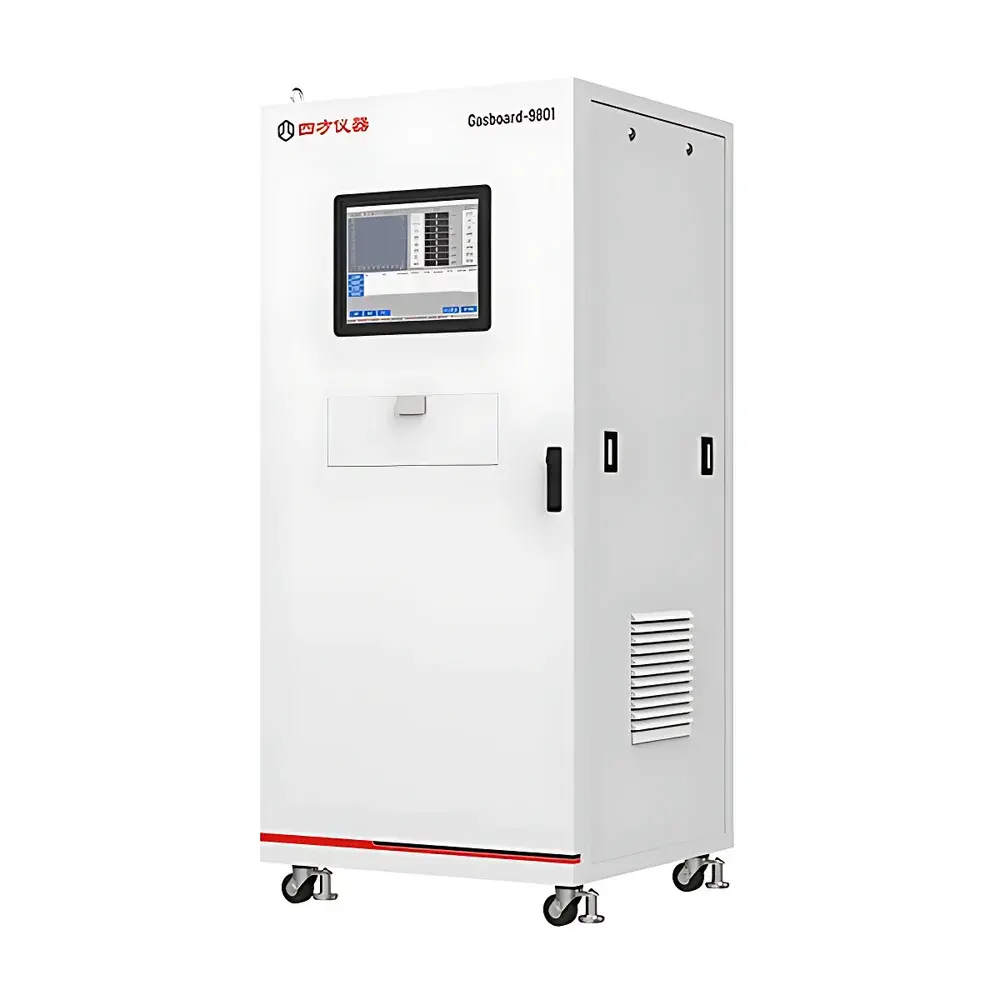
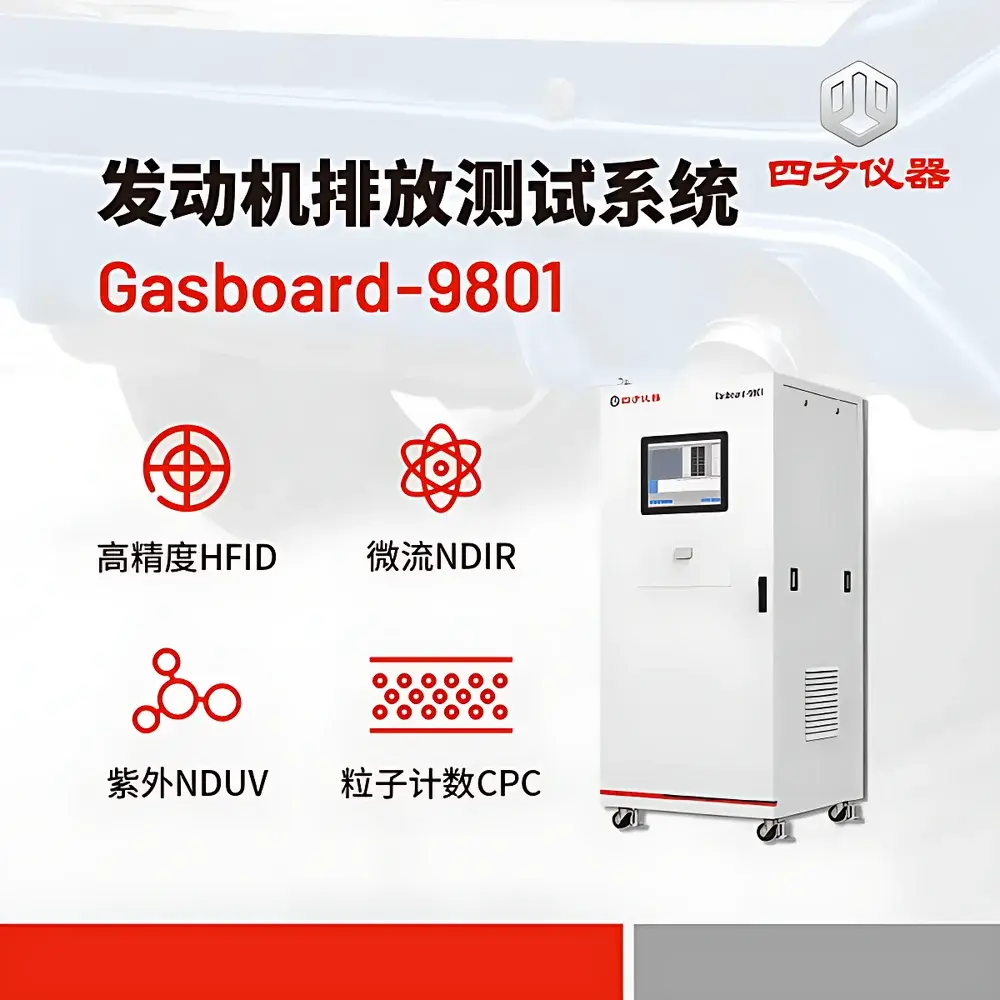
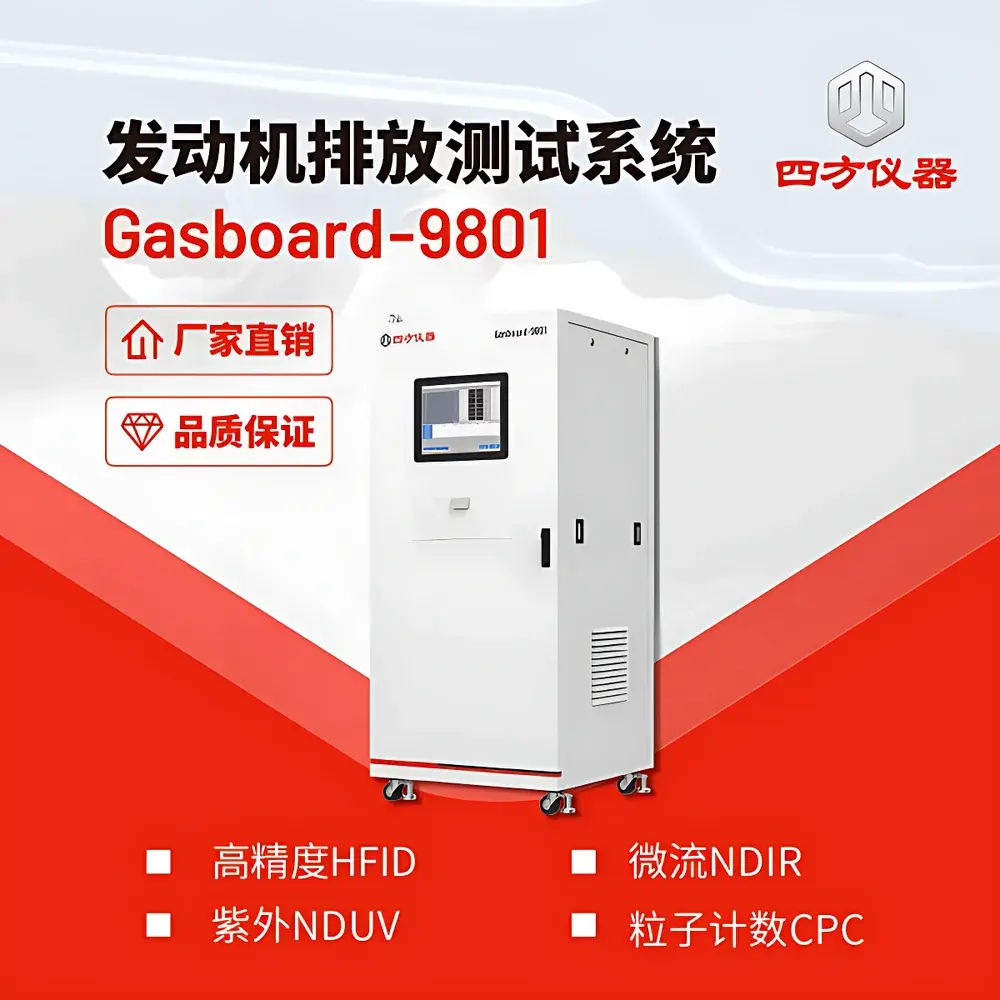
CUBIC INSTRUMENTS Gasboard-9801 Engine Type Approval and Production Conformity Emission Testing System
| Brand | CUBIC INSTRUMENTS |
|---|---|
| Origin | Hubei, China |
| Model | Gasboard-9801 |
| Instrument Type | Online Emission Analyzer |
| Detection Principle | Non-Dispersive Infrared (NDIR), Non-Dispersive Ultraviolet (NDUV), Chemiluminescence Detection (CLD), Flame Ionization Detection (FID) |
| Measured Gases | THC, CH₄, NOₓ, CO, CO₂, O₂ |
| Max. Permissible Error | ≤±2.0% of Reading Span (RS) or ≤±0.3% of Full Scale (FS) |
| Zero Drift | ≤±1% FS / 8 h |
| Span Drift | ≤±1% FS / 8 h |
| Repeatability | ≤±0.5% FS |
| Response Time (T₁₀–₉₀) | <2.5 s |
| Operating Temperature | 5–40 °C |
| Relative Humidity | ≤80% RH |
Overview
The CUBIC INSTRUMENTS Gasboard-9801 is a fully integrated, online-capable engine emission testing system engineered for regulatory compliance validation in laboratory environments. It is designed to perform high-fidelity, real-time measurement of gaseous pollutants—including total hydrocarbons (THC), methane (CH₄), nitrogen oxides (NOₓ), carbon monoxide (CO), carbon dioxide (CO₂), and oxygen (O₂)—in both raw exhaust and full-flow dilution tunnel configurations. The system implements a multi-principle analytical architecture: NDIR for CO, CO₂, and CH₄; NDUV and CLD for NOₓ speciation (NO, NO₂); HFID for THC quantification; and MPD (magnetic paramagnetic detection) for O₂. This hybrid sensor strategy ensures trace-level sensitivity, robust cross-interference rejection, and metrological stability across the full dynamic range required by global emissions legislation.
Key Features
- Modular architecture with independent sampling, conditioning, and analysis units—enabling flexible integration into existing test benches or dilution tunnels.
- Patented gas sensing technologies: HFID with catalytic methanizer for speciated THC/CH₄ differentiation; dual-wavelength NDUV + CLD for NO/NO₂ resolution; temperature-stabilized NDIR cells with pressure-compensated optical path for CO/CO₂ accuracy under variable flow conditions.
- Multi-point sampling capability via configurable probe manifolds—supporting simultaneous tailpipe sampling, EGR ratio determination, and spatial profiling per ISO 8178-4 and UN GTR No. 15.
- Real-time data acquisition at ≥10 Hz sampling rate, synchronized with engine dynamometer signals and environmental monitoring parameters (temperature, pressure, humidity).
- Ruggedized industrial design compliant with IP54 enclosure rating, optimized for continuous operation in engine test cell environments with vibration, thermal cycling, and condensate exposure.
Sample Compatibility & Compliance
The Gasboard-9801 meets the instrumental performance requirements specified in key international regulatory frameworks governing engine certification and production conformity. It supports testing protocols for light-duty vehicles (EU Regulation (EU) 2017/1151, GB 18352.6–2016, UNECE R83/R49), heavy-duty engines (EU Regulation (EU) 2016/1628, GB 17691–2018), non-road mobile machinery (EU Regulation (EU) 2016/1628 Annex II Stage V, GB 20891–2014), and marine propulsion systems (IMO MARPOL Annex VI Tier III). All analyzers are calibrated and verified per ISO 16183 (gaseous emissions measurement), ISO 20029 (HFID performance), and ISO 11470 (NDIR linearity verification). System-level uncertainty budgets comply with ISO 17025:2017 for accredited laboratories conducting type approval testing.
Software & Data Management
The embedded control and analysis software provides ISO/IEC 17025-compliant data handling, including audit-trail-enabled calibration logging, automated zero/span verification sequences, and drift compensation algorithms per ISO 16183 Annex D. Raw analog and digital outputs (4–20 mA, RS-485, Ethernet TCP/IP) interface seamlessly with third-party test bed management systems (e.g., AVL PUMA, Horiba MEXA, ETAS INCA). Data export formats include CSV, XML, and ASAM MDF 4.1.0 for traceability in GLP/GMP-regulated environments. Optional FDA 21 CFR Part 11-compliant software package available with electronic signatures, role-based access control, and immutable record retention.
Applications
- Regulatory type approval testing for internal combustion engines across automotive, off-highway, marine, and stationary power generation sectors.
- Production conformity assessment (PCA) per EU Regulation (EU) 2016/427 and GB/T 17692–2022, including batch sampling, statistical process control (SPC), and outlier detection workflows.
- R&D emissions mapping—supporting transient cycle analysis (NEDC, WLTC, FTP-75, SET, NRSC), cold-start characterization, and aftertreatment system development (SCR, DOC, DPF).
- Verification of on-board diagnostic (OBD) monitor readiness and fault threshold validation under controlled bench conditions.
- Support for alternative fuel engine certification (LNG, LPG, hydrogen blends, biofuels) where extended dynamic range and low-level hydrocarbon detection are critical.
FAQ
What emission standards does the Gasboard-9801 support out-of-the-box?
The system is pre-configured to meet measurement performance criteria defined in EU 6/7, China 6, U.S. EPA 40 CFR Part 1065, and ISO 8178 for all applicable engine categories.
Can it measure both raw and diluted exhaust simultaneously?
Yes—the modular design allows parallel sampling paths: one dedicated to raw exhaust (for O₂, NOₓ, THC), and another routed through a constant-volume sampler (CVS) for dilute-phase analysis per ISO 8178-1.
Is the system suitable for accreditation under ISO/IEC 17025?
All analyzer modules include factory calibration certificates traceable to NIST and PTB standards; full system validation documentation and uncertainty analysis templates are provided for laboratory accreditation submissions.
How is cross-sensitivity managed between NOₓ and CO₂ in high-CO₂ exhaust streams?
NDUV optics employ spectral deconvolution algorithms, while CLD reaction chamber temperature and ozone generator output are dynamically adjusted to suppress quenching effects—validated per ISO 16183 Clause 7.3.2.
What maintenance intervals are recommended for long-term operational reliability?
HFID burner cleaning every 250 hours; NDIR optical windows inspected quarterly; full system verification (zero/span, linearity, response time) performed semi-annually or per test campaign, as required by ISO/IEC 17025 Clause 7.7.
Related Products







