
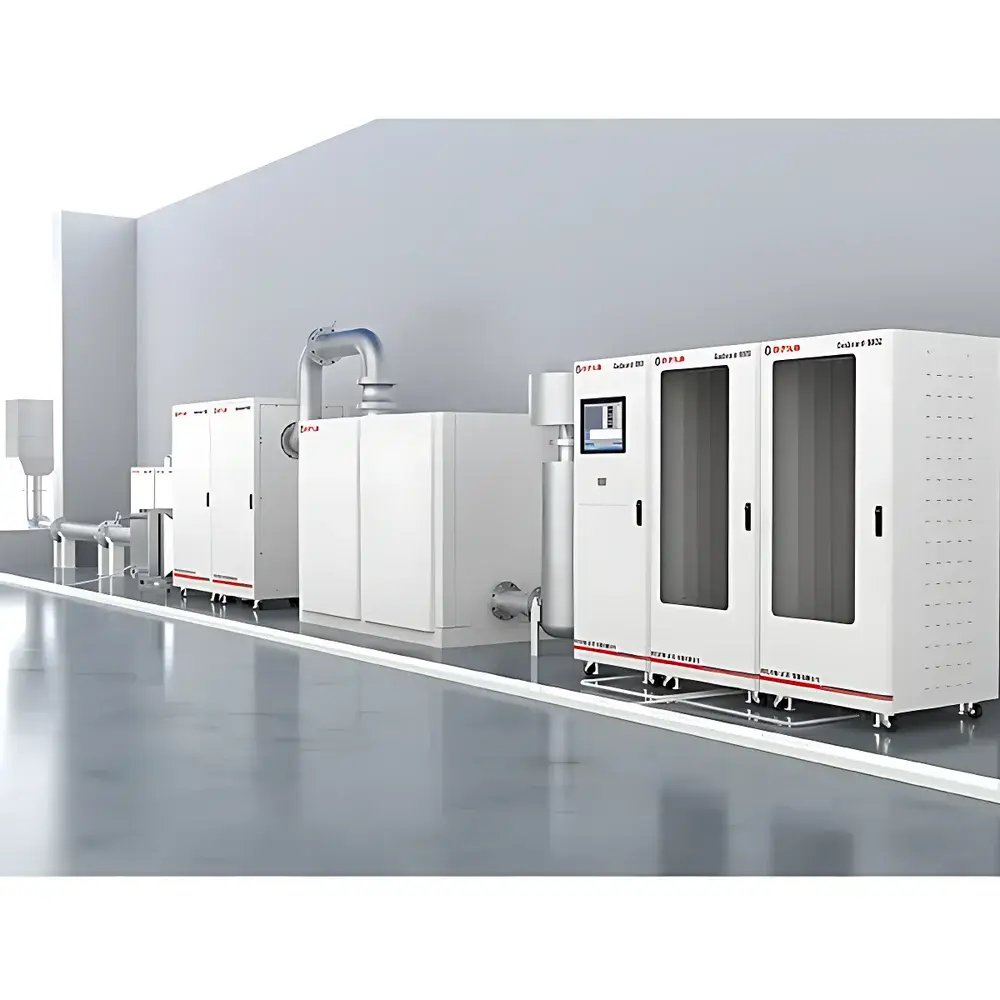
CUBIC INSTRUMENTS Gasboard-9802 Full-Flow Dilution Constant Volume Sampling (CVS) System for Automotive OEM Emission Testing
| Brand | CUBIC INSTRUMENTS |
|---|---|
| Origin | Hubei, China |
| Manufacturer Type | Authorized Distributor |
| Country of Origin | China |
| Model | Gasboard-9802 |
| Instrument Type | Online Fixed Installation |
| Measurement Principle | Constant Volume Sampling with Dilution Air Conditioning and Thermal Regulation |
| Max. Permissible Error | ±2% (Propane Spike Verification) |
| Measured Species | Diluted Exhaust Emissions from Vehicles and Engines |
| Dilution Exhaust Flow Ranges | 1–12 m³/min |
| Dilution Exhaust Temperature Control | 40 ± 5 °C |
| Bag Sampling Flow Rates | 3 / 6 / 9 L/min |
| Sample Bag Configuration | 3 Dilution Air Bags + 3 Diluted Exhaust Bags |
| Bag Chamber Temperature Control | 35 ± 5 °C |
| Particulate Sampling Flow | 35–65 L/min |
| Particulate Sampling Channels | 3 Diluted Exhaust + 1 Dilution Air |
| Particulate Sampling Box Temperature | 47 ± 5 °C |
| Dilution Air Filtration | Activated Carbon Filter + Pre-filter + H13 HEPA Filter |
| Operating Environment | 5–35 °C Ambient Temperature |
Overview
The CUBIC INSTRUMENTS Gasboard-9802 Full-Flow Dilution Constant Volume Sampling (CVS) System is an engineered solution for regulatory-grade emission testing of light-duty and heavy-duty vehicles, engines, and hybrid powertrains in OEM validation laboratories and certified test facilities. Based on the fundamental principle of constant-volume sampling—where diluted exhaust is drawn through calibrated critical-flow venturis to maintain volumetric flow rate independence from backpressure—the system ensures metrologically traceable mass-based emission quantification per ISO 8714, ISO 20816, SAE J1094, and EU Regulation (EU) 2017/1151 Annex IIIA. Designed to interface seamlessly with high-accuracy online analyzers (e.g., NDIR for CO/CO₂, CLD for NOₓ, FID for THC, and condensation particle counters for PN), the Gasboard-9802 meets technical requirements for Type I (cold-start) emissions testing under current Euro 6d and upcoming Euro 7 legislation, including PEMS-correlated laboratory validation protocols.
Key Features
- Multi-range dilution exhaust flow capability (1–12, 3–24, 9–60, or 30–150 m³/min) accommodates testing across engine displacement classes—from 1.0L gasoline units to >16L diesel powerplants—without hardware reconfiguration.
- Integrated thermal management architecture comprising high-efficiency heat exchangers and temperature-stabilized venturi assemblies ensures long-term flow accuracy stability (±0.5% drift over 8 h) under dynamic duty cycles.
- Dual-stage dilution air conditioning: activated carbon adsorption removes hydrocarbon background; pre-filters capture coarse particulates; H13-class HEPA filtration achieves ≤0.01 mg/m³ total particulate loading—critical for ultra-low NOₓ and PN measurement compliance.
- Active temperature control of dilution exhaust (40 ± 5 °C), sample bag chamber (35 ± 5 °C), and particulate sampling box (47 ± 5 °C) prevents water condensation and volatile organic compound (VOC) losses during transient testing.
- Modular bag sampling subsystem supports simultaneous collection of three dilution air and three diluted exhaust samples at user-selectable flow rates (3/6/9 L/min), enabling parallel analysis for repeatability verification and method validation.
Sample Compatibility & Compliance
The Gasboard-9802 is validated for use with gasoline, diesel, LPG, CNG, ethanol blends (E85), and hydrogen-fueled powertrains. Its dilution ratio control and thermal conditioning meet the stringent background cleanliness criteria specified in ISO 16183 (particulate sampling), ISO 20816-3 (engine vibration and exhaust conditioning), and UN/ECE R83-07 (type approval). All temperature-controlled zones are equipped with NIST-traceable PT100 sensors and PID feedback loops, satisfying GLP audit requirements for data integrity. The system’s ±2% maximum permissible error—verified via propane spike calibration per ISO 16183 Annex B—is documented in a full metrological uncertainty budget compliant with ISO/IEC 17025:2017.
Software & Data Management
The embedded control software provides real-time monitoring of 42+ process variables—including venturi differential pressure, thermal sensor outputs, filter differential pressure, and bag fill status—with configurable alarm thresholds and automatic log archiving. Data export complies with ASAM MCD-2 MC and ASAM ODS standards for integration into AVL PUMA, Horiba MEXA, or ETAS INCA environments. Audit trails record all operator actions, parameter changes, and calibration events with time stamps and user IDs, fulfilling FDA 21 CFR Part 11 electronic record requirements when deployed in GMP-aligned validation labs.
Applications
- Regulatory certification testing per Euro 6d, US EPA Tier 3, and China GB 18352.6-2016.
- Development testing of aftertreatment systems (SCR, DPF, GPF) under WLTC, RDE, and custom drive cycles.
- Correlation studies between laboratory CVS and portable emissions measurement systems (PEMS).
- Engine mapping for emission-sensitive operating points (e.g., low-load NOₓ spikes, cold-start HC slip).
- Particulate number (PN) and solid particle number (SPN) measurement per UNECE R155 and ISO 29463-3.
FAQ
Does the Gasboard-9802 support RDE correlation testing?
Yes—it provides synchronized dilution flow, temperature, and bag sampling triggers compatible with PEMS synchronization protocols defined in EU 2016/427 Annex III.
Can the system be upgraded for Euro 7 PN measurement requirements?
Yes—the H13 filtration, 47 °C heated sampling box, and optional 23 nm CPC interface meet the latest PN detection sensitivity and volatility robustness mandates.
Is third-party calibration documentation provided?
Each unit ships with a factory calibration certificate traceable to NIM (China National Institute of Metrology), including venturi discharge coefficients, thermal sensor linearity curves, and filter efficiency test reports.
What maintenance intervals are recommended for the dilution air filtration system?
Activated carbon filters require replacement every 500 operational hours; H13 HEPA filters every 2,000 hours or upon ≥250 Pa differential pressure rise—both tracked automatically by the onboard maintenance scheduler.
Is remote diagnostics supported?
Yes—via secure TLS 1.2-enabled Ethernet connection with role-based access control, supporting predictive fault analysis using historical sensor trend logs.
Related Products







