
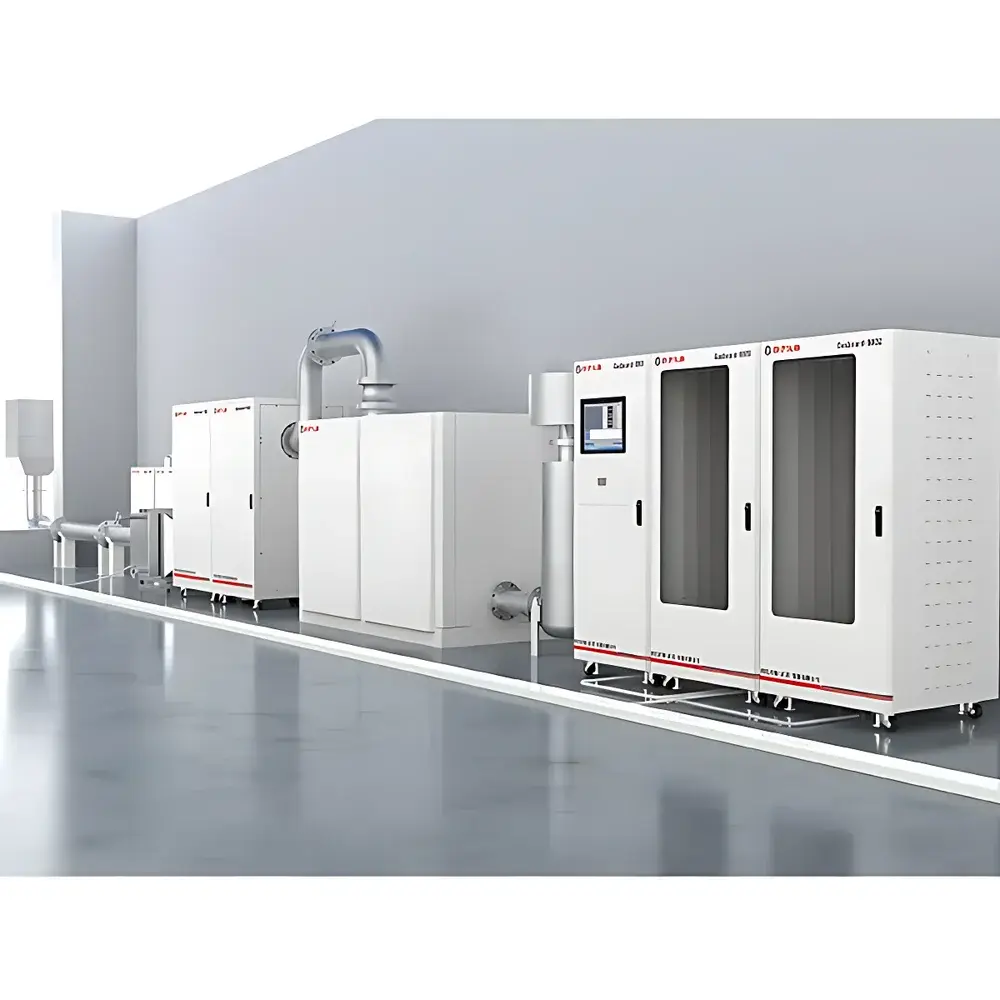
CUBIC INSTRUMENTS Gasboard-9802 Full-Flow Dilution Constant Volume Sampling (CVS) System for Engine Emission Testing
| Brand | CUBIC INSTRUMENTS |
|---|---|
| Origin | Hubei, China |
| Model | Gasboard-9802 |
| Instrument Type | Online |
| Measurement Principle | Dilution-based gravimetric/volumetric sampling per ISO 8178 & UNECE R49 |
| Max. Permissible Error | ±2% (propane spike verification) |
| Measured Species | Diluted exhaust emissions from engines and vehicles |
| Dilution Exhaust Flow Range | 1–12, 3–24, 9–60, or 30–150 m³/min (configurable) |
| Diluted Exhaust Temperature Control | 40 ± 5 °C |
| Bag Sampling Flow Rates | 3, 6, or 9 L/min |
| Sample Bag Configuration | 3 dilution air bags + 3 diluted exhaust bags |
| Bag Chamber Temperature Control | 35 ± 5 °C |
| Particulate Sampling Flow | 35–65 L/min |
| Particulate Sampling Channels | 3 diluted exhaust + 1 dilution air |
| Particulate Chamber Temperature Control | 47 ± 5 °C |
| Dilution Air Filtration | Activated carbon + pre-filter + H13 HEPA |
| Operating Environment | 5–35 °C, ≤80% RH, 80–102 kPa |
Overview
The CUBIC INSTRUMENTS Gasboard-9802 Full-Flow Dilution Constant Volume Sampling (CVS) System is an engineered solution for regulatory-grade engine emission testing in powertrain development laboratories and certification facilities. Designed in accordance with ISO 8178 (Reciprocating internal combustion engines — Exhaust emission measurement), UNECE Regulation No. 49 (Emission of pollutants from compression ignition engines), and aligned with the technical requirements of EU Stage V and upcoming Euro 7 type-approval protocols, the system implements a gravimetrically traceable, full-flow dilution methodology. It maintains a constant volumetric flow of diluted exhaust through calibrated critical-flow venturis while thermally conditioning both dilution air and exhaust streams to prevent condensation and ensure analyte stability. The CVS architecture integrates seamlessly with high-accuracy online gas analyzers (e.g., NDIR for CO/CO₂, chemiluminescence for NOₓ, FID for THC) and gravimetric particulate mass measurement systems (e.g., TEOM or filter-based PM samplers), enabling simultaneous gaseous and particulate emission quantification under transient and steady-state engine operating conditions.
Key Features
- Modular dilution exhaust flow configuration supporting four scalable ranges (1–12, 3–24, 9–60, and 30–150 m³/min) to accommodate single-cylinder generators up to heavy-duty diesel engines and hybrid powertrains.
- High-stability thermal management system comprising a high-efficiency heat exchanger and precision-controlled venturi assembly, ensuring dilution exhaust flow accuracy within ±2% as verified by propane spike calibration per ISO 16183.
- Dual-stage temperature regulation: dilution exhaust maintained at 40 ± 5 °C and dilution air bags held at 35 ± 5 °C to suppress water vapor condensation and preserve volatile organic compound integrity during bag sampling.
- Particulate sampling subsystem with three parallel diluted exhaust channels and one dedicated dilution air channel, each operating at 35–65 L/min with independent thermal control (47 ± 5 °C) to meet PN (particle number) and PM mass measurement requirements per ISO 8573-1 and UNECE R83.
- Multi-stage dilution air purification train featuring activated carbon adsorption, G3-class pre-filtration, and H13-rated HEPA filtration (≥99.95% efficiency at 0.3 µm), achieving ultra-low background contamination essential for sub-10 mg/kWh PM testing.
Sample Compatibility & Compliance
The Gasboard-9802 is validated for use with gasoline, diesel, natural gas (CNG/LNG), biodiesel, and hydrogen-fueled internal combustion engines. Its hardware architecture and operational protocols support compliance with international test cycles including WHSC, WHTC, ESC, ETC, and FTP-75. All temperature, pressure, and flow control subsystems are traceably calibrated against NIST-traceable standards. The system meets mechanical and data integrity requirements for GLP-compliant laboratories and supports audit-ready documentation for EPA Certification (40 CFR Part 1065), EU Type Approval (Regulation (EU) 2016/646), and China’s GB 17691–2018 Stage VI certification testing. Optional integration with 21 CFR Part 11–compliant software modules enables electronic signatures and audit trails for regulated environments.
Software & Data Management
The embedded control interface provides real-time monitoring of 42+ process variables—including differential pressures across venturis, thermal sensor arrays, bag fill status, and filter differential pressure—with configurable alarm thresholds and automatic fault logging. Raw data streams are timestamped and exported in ASCII CSV format compatible with MATLAB, LabVIEW, and commercial emission analysis suites (e.g., AVL PUMA, Horiba MEXA). Optional Ethernet/IP and Modbus TCP gateways enable centralized SCADA integration. All calibration records, maintenance logs, and test reports are stored with SHA-256 hash integrity verification and user-access controls aligned with ISO/IEC 17025:2017 clause 7.5.
Applications
- Engine development labs conducting R&D on aftertreatment systems (DOC, DPF, SCR) under realistic duty cycles.
- Third-party certification bodies performing official type-approval testing per UN GTR 15 and EU Commission Delegated Regulation (EU) 2022/171.
- Government metrology institutes validating reference CVS systems against primary standards.
- University research centers studying low-temperature combustion, alternative fuels, and nanoparticle formation mechanisms in diluted exhaust plumes.
- OEM validation facilities executing durability testing and conformity-of-production (COP) audits under ISO 9001 and IATF 16949 frameworks.
FAQ
What emission standards does the Gasboard-9802 support?
It is configured to meet ISO 8178, UNECE R49/R83/R101, EU Regulation (EU) 2016/646 and (EU) 2022/171, EPA 40 CFR Part 1065, and China GB 17691–2018 Stage VI requirements.
Can the system be upgraded for Euro 7 compliance?
Yes—its modular venturi and thermal control architecture allows field retrofitting of enhanced PM/PN sampling modules and expanded VOC trapping capacity to address Euro 7’s tightened NMHC and particle number limits.
Is remote diagnostics supported?
Standard Ethernet connectivity enables secure remote access via TLS 1.2–encrypted VPN tunnels for firmware updates, parameter tuning, and diagnostic log retrieval.
What is the calibration interval recommendation?
Venturi flow elements require annual recalibration against certified sonic nozzles; temperature sensors and pressure transducers are recommended for biannual verification per ISO/IEC 17025 Annex A.
Does the system include particulate mass measurement capability?
No—the Gasboard-9802 is a sampling and conditioning platform only; it interfaces with external gravimetric (filter-based) or continuous (TEOM/FDMS) PM analyzers via standardized 1/4″ Swagelok ports and thermal sleeves.







