
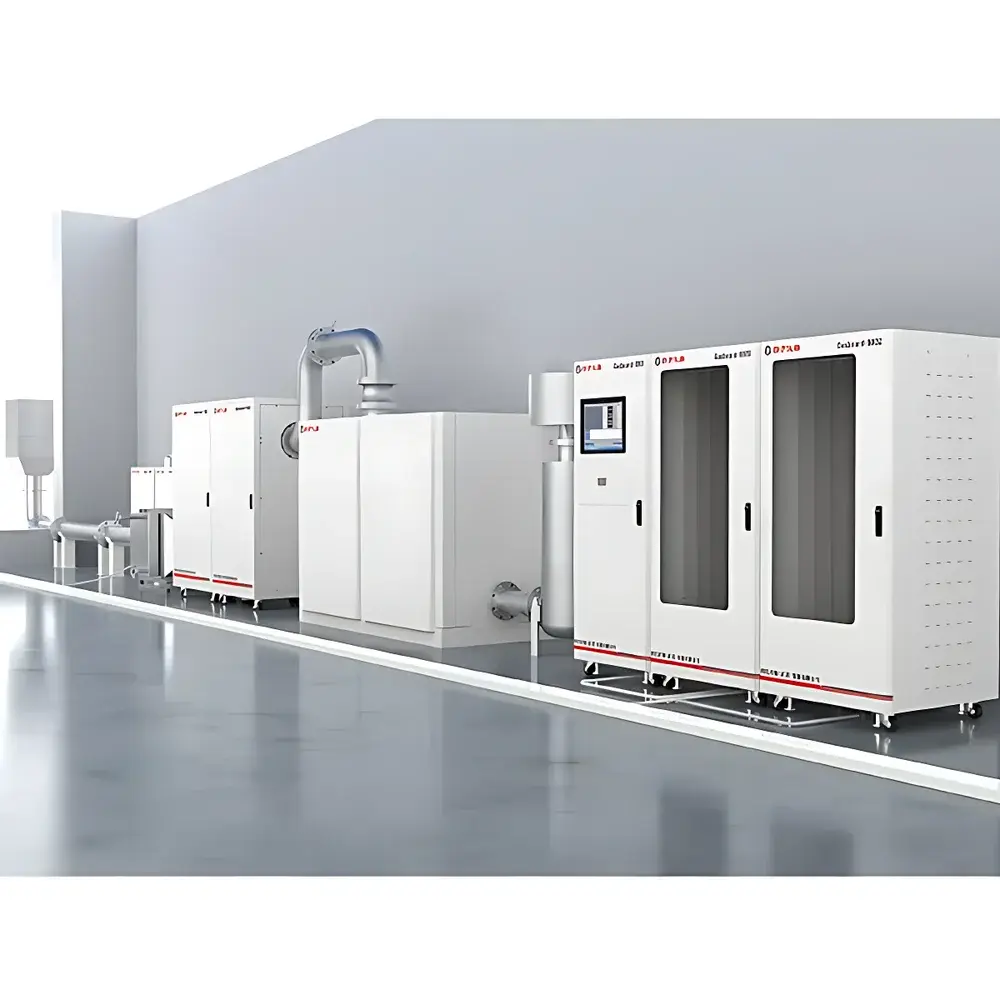
CUBIC INSTRUMENTS Gasboard-9802 Full-Flow Dilution Constant Volume Sampling (CVS) System for Engine and Vehicle Emission Testing
| Brand | CUBIC INSTRUMENTS |
|---|---|
| Origin | Hubei, China |
| Manufacturer Type | Authorized Distributor |
| Product Origin | Domestic (China) |
| Model | Gasboard-9802 |
| Instrument Type | Online Fixed Installation |
| Measurement Principle | Constant Volume Sampling with Dilution Air Conditioning & Flow Control |
| Max. Permissible Error | ±2% (Propane Spike Verification) |
| Measured Species | Diluted exhaust emissions from engines and vehicles |
| Dilution Exhaust Flow Ranges | 1–12, 3–24, 9–60, or 30–150 m³/min |
| Diluted Exhaust Temperature Control | 40 ± 5 °C |
| Bag Sampling Flow Rates | 3 / 6 / 9 L/min |
| Sample Bag Configuration | 3 dilution air bags + 3 diluted exhaust bags |
| Bag Chamber Temperature Control | 35 ± 5 °C |
| Particulate Sampling Flow | 35–65 L/min |
| Particulate Sampling Channels | 3 diluted exhaust + 1 dilution air |
| Particulate Sampling Box Temp. | 47 ± 5 °C |
| Dilution Air Filtration | Activated Carbon + Pre-filter + H13 HEPA |
| Operating Environment | 5–35 °C ambient temperature, ≤80% RH, 80–102 kPa atmospheric pressure |
Overview
The CUBIC INSTRUMENTS Gasboard-9802 Full-Flow Dilution Constant Volume Sampling (CVS) system is an engineered solution for regulatory-grade measurement of gaseous and particulate emissions from internal combustion engines and light- to heavy-duty vehicles under laboratory-based Type I certification testing conditions. Based on the principle of constant-volume sampling—where total diluted exhaust flow is metered continuously via calibrated critical-flow venturis (CFVs) or sonic nozzles—the system maintains stoichiometrically representative sample proportions across dynamic engine operating cycles. It integrates thermally stabilized dilution air conditioning, precision flow control, and temperature-regulated sampling pathways to ensure metrological traceability per ISO 8714, ISO 20816-3, and UN/ECE Regulation No. 83 (as amended), while supporting compliance verification against Euro 7, China 6b, and U.S. EPA Tier 3 requirements. Designed for third-party accredited laboratories, the Gasboard-9802 meets GLP-aligned infrastructure expectations for audit-ready test execution.
Key Features
- Modular dilution exhaust flow configuration with four selectable ranges (1–12, 3–24, 9–60, and 30–150 m³/min), enabling scalable application across spark-ignition, compression-ignition, hybrid, and alternative-fuel powertrains.
- High-stability thermal management architecture: dual-stage heat exchangers coupled with venturi-based flow regulation ensure dilution exhaust temperature control within 40 ± 5 °C—critical for minimizing hydrocarbon condensation and preserving volatile organic compound (VOC) integrity.
- Dual-temperature-controlled bag storage cabinet (35 ± 5 °C) accommodates six standardized Tedlar® or fluorinated ethylene propylene (FEP) sample bags—three for dilution air blanks and three for time-integrated diluted exhaust—ensuring consistent storage conditions prior to downstream gas chromatographic or FTIR analysis.
- Multi-path particulate sampling subsystem with three parallel diluted exhaust inlets and one dedicated dilution air channel, each equipped with isokinetic probes and maintained at 47 ± 5 °C to prevent thermophoretic losses during PM mass and number concentration measurement.
- Triple-stage dilution air purification train comprising activated carbon (for VOC removal), G3-class pre-filters (EN 779), and H13 HEPA filters (EN 1822)—validated to deliver <0.1 µg/m³ background particulate mass and <10 ppb total hydrocarbon residual—essential for ultra-low emission vehicle (ULEV) and zero-emission vehicle (ZEV) support testing.
Sample Compatibility & Compliance
The Gasboard-9802 supports full-cycle transient testing (e.g., WLTC, FTP-75, RDE simulation) and steady-state mode validation across gasoline, diesel, natural gas (CNG/LNG), and hydrogen-fueled powertrains. Its hardware and control firmware are designed to interface seamlessly with certified analyzers—including CLD, NDUV, FID, paramagnetic O₂, and SMPS systems—while maintaining synchronization with engine dynamometer control signals (CAN 2.0B, analog I/O). The system conforms to ISO 16183:2021 (dilution tunnel performance criteria), SAE J1094 (CVS calibration procedures), and ASTM D6673 (particulate sampling guidelines). All temperature and flow sensors are NIST-traceable; calibration records comply with ISO/IEC 17025 documentation requirements for accredited laboratories.
Software & Data Management
The embedded control software provides real-time monitoring of 60+ process variables—including primary and secondary CFV differential pressures, heat exchanger inlet/outlet temperatures, bag fill status, and filter pressure drops—with automatic alarm thresholds and event logging. Raw data streams are timestamped and exported in CSV/ASCII format compatible with MATLAB, LabVIEW, and commercial emission data platforms (e.g., AVL PUMA, Horiba MEXA). Audit trails record operator login, parameter changes, calibration events, and system faults—fully compliant with FDA 21 CFR Part 11 electronic record requirements when deployed in GxP-regulated environments. Optional OPC UA integration enables centralized SCADA-level supervision across multi-bay test facilities.
Applications
- Type I cold-start emission certification testing per EU Regulation (EU) 2017/1151 and GB 18352.6–2016.
- Real-driving emissions (RDE) lab simulation with portable emission measurement system (PEMS) correlation studies.
- Engine development validation for aftertreatment system efficiency (e.g., DOC, DPF, SCR) under controlled dilution conditions.
- Regulatory reference testing for national type-approval agencies and independent conformity assessment bodies.
- Research applications in aerosol science, including nucleation-mode particle characterization and semi-volatile organic compound (SVOC) partitioning behavior.
FAQ
What standards does the Gasboard-9802 meet for regulatory testing?
It satisfies ISO 8714, ISO 20816-3, UN/ECE R83, SAE J1094, and ASTM D6673—supporting full compliance with Euro 6d, Euro 7 draft specifications, China 6b, and U.S. EPA Tier 3 certification protocols.
Can the system be integrated with existing dynamometer and analyzer infrastructure?
Yes—standardized analog (0–10 V, 4–20 mA) and digital (CAN 2.0B, RS-485 Modbus RTU) interfaces enable plug-and-play integration with major OEM dynamometers (AVL, Horiba, Schenck) and gas analyzers.
How is calibration traceability ensured?
All flow meters are calibrated using NIST-traceable primary standards; temperature sensors are verified against PT100 reference probes with ±0.1 °C uncertainty; annual recalibration certificates follow ISO/IEC 17025 requirements.
Is remote diagnostics and software update capability available?
Remote maintenance is supported via secure SSH/TLS-enabled Ethernet connection; firmware updates are delivered as digitally signed packages with version-controlled rollback functionality.
What maintenance intervals are recommended for the dilution air filtration system?
Activated carbon cartridges require replacement every 500 operational hours; H13 HEPA filters every 2,000 hours or upon ΔP > 250 Pa; pre-filters are inspected and cleaned weekly per preventive maintenance log.







