
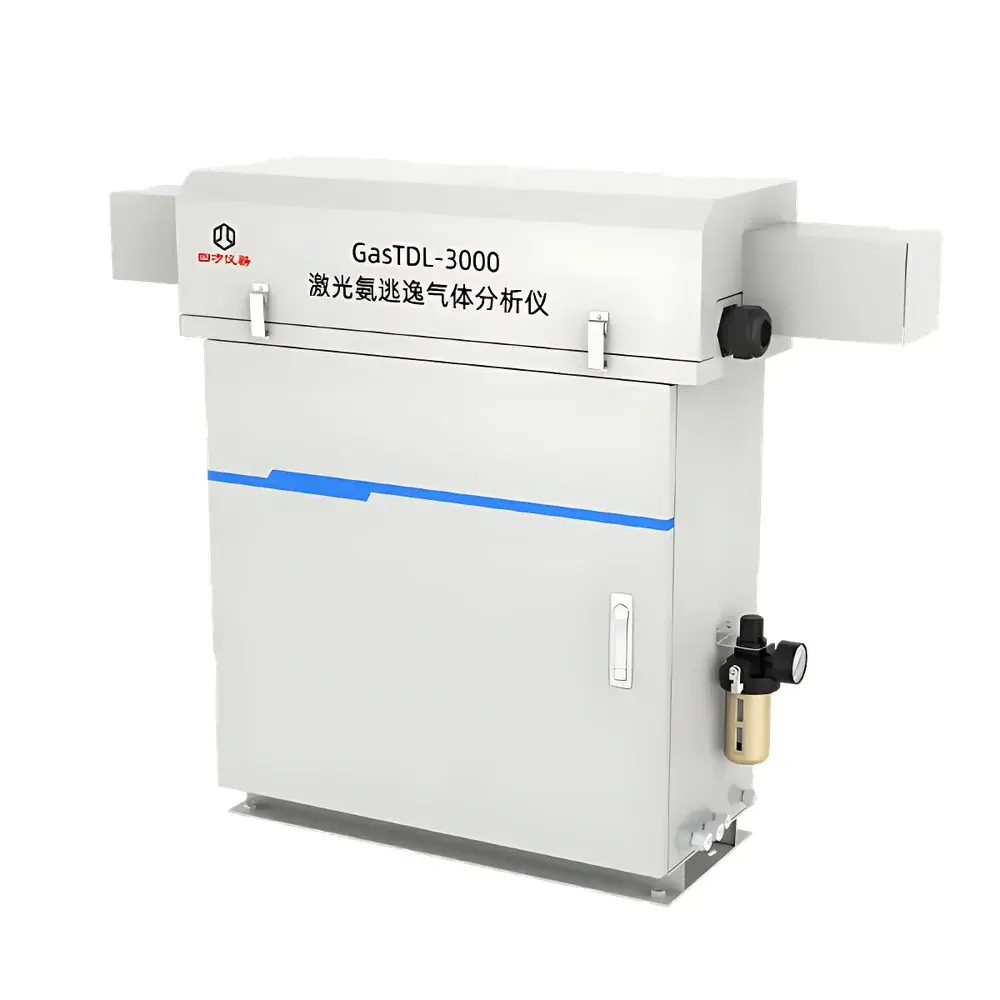
CUBIC INSTRUMENTS GasTDL-3000 In-Situ Ammonia Slip Analyzer
| Brand | CUBIC INSTRUMENTS |
|---|---|
| Origin | Hubei, China |
| Model | GasTDL-3000 |
| Detection Principle | Tunable Diode Laser Absorption Spectroscopy (TDLAS) |
| Sampling Method | In-situ extraction |
| Measurement Range | 0–10 ppm NH₃ |
| Accuracy | ±1% of Full Scale |
| Response Time | <30 s |
| Repeatability | ±1% of Full Scale |
| Operating Ambient Temperature | −30 °C to +70 °C |
| Resolution | 0.01 ppm |
| Power Supply | DC 24 V (heating: AC 220 V) |
| Communication Interfaces | RS-232, RS-485 |
| Storage Conditions | −40 °C to +85 °C |
| Enclosure Rating | IP65 |
Overview
The CUBIC INSTRUMENTS GasTDL-3000 is an in-situ ammonia slip analyzer engineered for continuous, real-time monitoring of trace NH₃ concentrations downstream of selective catalytic reduction (SCR) and selective non-catalytic reduction (SNCR) systems. It employs tunable diode laser absorption spectroscopy (TDLAS), a highly selective and interference-resistant optical technique based on the fundamental vibrational-rotational absorption lines of NH₃ in the near-infrared spectrum. Unlike extractive systems requiring complex heated sample lines, the GasTDL-3000 implements an in-situ extraction architecture: the probe is mounted directly on the flue duct wall, and gas is drawn into a high-temperature measurement cell without transit through external tubing. This design eliminates adsorption losses, condensation artifacts, and transport delays—critical factors in maintaining fidelity for sub-ppm NH₃ quantification. The analyzer operates under harsh industrial conditions, delivering stable performance across ambient temperatures from −30 °C to +70 °C and meeting the demanding requirements of continuous emission monitoring systems (CEMS) in thermal power generation and heavy industry.
Key Features
- In-situ extraction with integrated high-temperature measurement cell (≥180 °C), ensuring minimal NH₃ loss due to surface adsorption or thermodynamic condensation
- Optimized multi-pass absorption cell achieving effective path lengths >10 m, enabling detection limits down to 0.01 ppm with high signal-to-noise ratio
- Onboard reference gas module with dynamic wavelength calibration, compensating for thermal drift, pressure fluctuations, and laser aging in real time
- Background gas immunity: TDLAS spectral selectivity prevents cross-sensitivity from CO₂, H₂O, SO₂, NOₓ, and particulate-laden flue gas matrices
- Full-system automated calibration capability—including zero, span, and linearity verification—traceable to NIST-certified NH₃ standards
- Ruggedized IP65-rated enclosure suitable for outdoor installation on boiler ducts, stack penetrations, and process headers
Sample Compatibility & Compliance
The GasTDL-3000 is validated for direct measurement in flue gases containing up to 20% vol. H₂O, ≤1000 mg/m³ dust loading, and operating pressures ranging from −5 kPa to +5 kPa gauge. Its high-temperature flow path and low-adsorption internal surfaces (electropolished stainless steel, ceramic-coated optics) ensure representative sampling across varying load conditions in coal-fired, biomass, waste-to-energy, cement kiln, and metallurgical furnaces. The analyzer complies with Chinese Environmental Protection Product Certification (CCEP) requirements and aligns with international technical frameworks including EPA Method 320, ISO 14956:1998 (ambient air quality—determination of ammonia), and EN 15267-3 for automated measuring systems. Data integrity meets GLP/GMP-aligned audit trail requirements via timestamped calibration logs and configuration change records.
Software & Data Management
The embedded firmware supports Modbus RTU (RS-485) and ASCII protocol (RS-232) for integration into DCS, SCADA, and CEMS platforms. Local display provides real-time concentration, status flags (e.g., “Cell Temp OK”, “Laser Lock Active”, “Calibration Due”), and diagnostic codes per IEC 61508 SIL1 guidelines. Optional cloud-ready edge gateway enables secure MQTT transmission of time-stamped NH₃ values, system health metrics, and alarm events to centralized environmental data management systems. All operational parameters—including laser current, detector voltage, temperature setpoints, and calibration history—are stored internally for ≥30 days and exportable via USB or serial interface. Firmware updates are performed via signed binary packages to maintain cryptographic integrity.
Applications
The GasTDL-3000 serves as a primary monitoring solution for regulatory compliance and process optimization in facilities deploying SCR/SNCR de-NOₓ technologies. Typical installations include: coal- and gas-fired power plants (post-air preheater, pre-ESP/Fabric Filter); aluminum smelters (anode baking furnace exhaust); integrated steel mills (sintering machine and blast furnace gas cleaning); municipal solid waste incinerators (post-SCR ducts); cement clinker coolers and precalciner stacks; and chemical synthesis units where NH₃ is used as a reducing agent or byproduct. Its robustness supports long-term unattended operation in environments with vibration, electromagnetic noise, and wide thermal cycling—enabling reliable ammonia slip control to meet EU IED BREF LCP emission ceilings (<2 ppm NH₃) and China’s GB 13223–2011 limits.
FAQ
How does the GasTDL-3000 eliminate ammonia adsorption errors common in conventional extractive analyzers?
It uses an in-situ extraction probe with a fully heated (>180 °C), short-path measurement cell mounted directly on the duct wall—eliminating cooled transfer lines where NH₃ would adsorb onto metal or polymer surfaces.
Is the analyzer suitable for high-dust flue gas applications?
Yes. The probe incorporates a self-cleaning purge port and particulate filter upstream of the cell inlet, validated for continuous operation at dust loadings up to 1000 mg/m³ without performance degradation.
Does it support regulatory reporting under EPA or EU directives?
While not EPA-certified as a standalone CEMS, its measurement methodology, calibration traceability, and data logging architecture comply with QA/QC provisions of EPA Performance Specification 18 (PS-18) and EN 14181 for automated monitoring systems.
Can the GasTDL-3000 be integrated with existing plant DCS networks?
Yes. Native RS-485 Modbus RTU output enables seamless integration with major DCS vendors (e.g., Siemens Desigo, Honeywell Experion, Yokogawa CENTUM VP) without protocol converters.
What maintenance intervals are recommended for long-term reliability?
Optical alignment and cell cleaning are recommended every 6 months; laser diode lifetime exceeds 25,000 operating hours; no consumables or reagents required beyond periodic zero/span gas verification.
Related Products







