
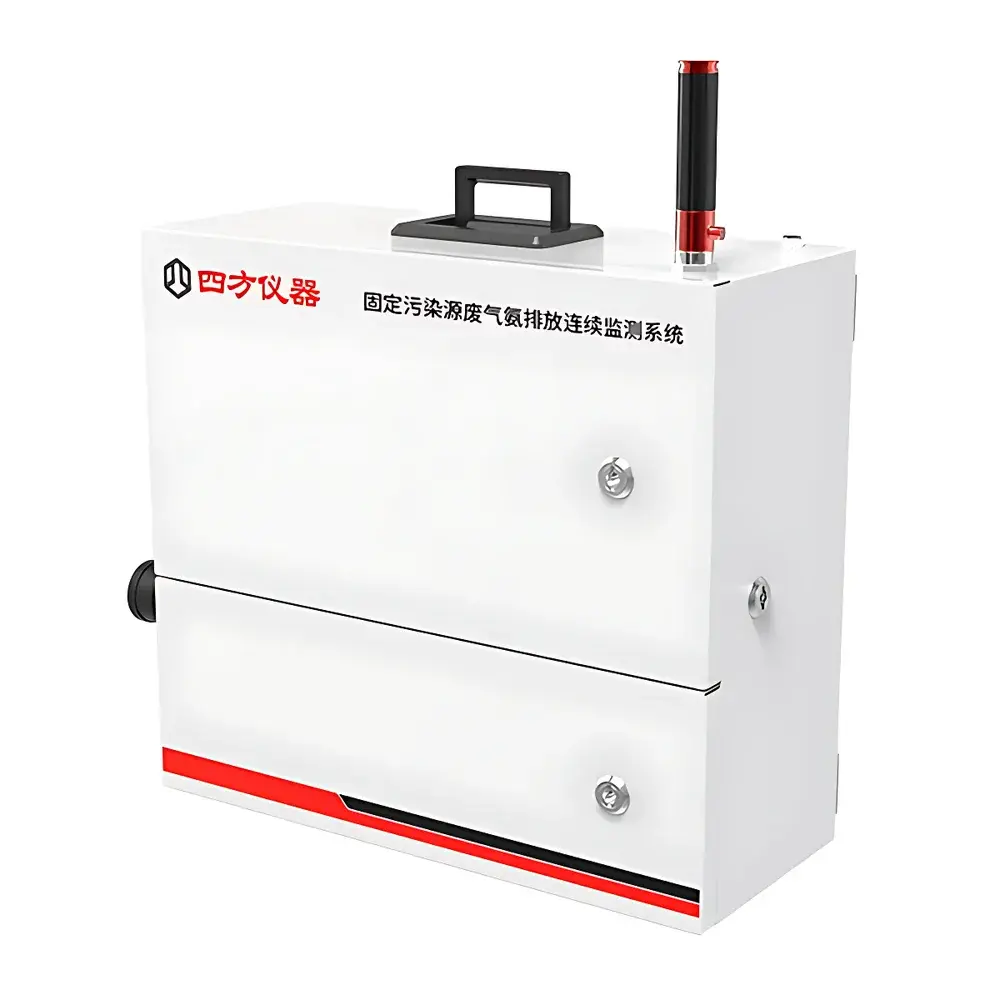
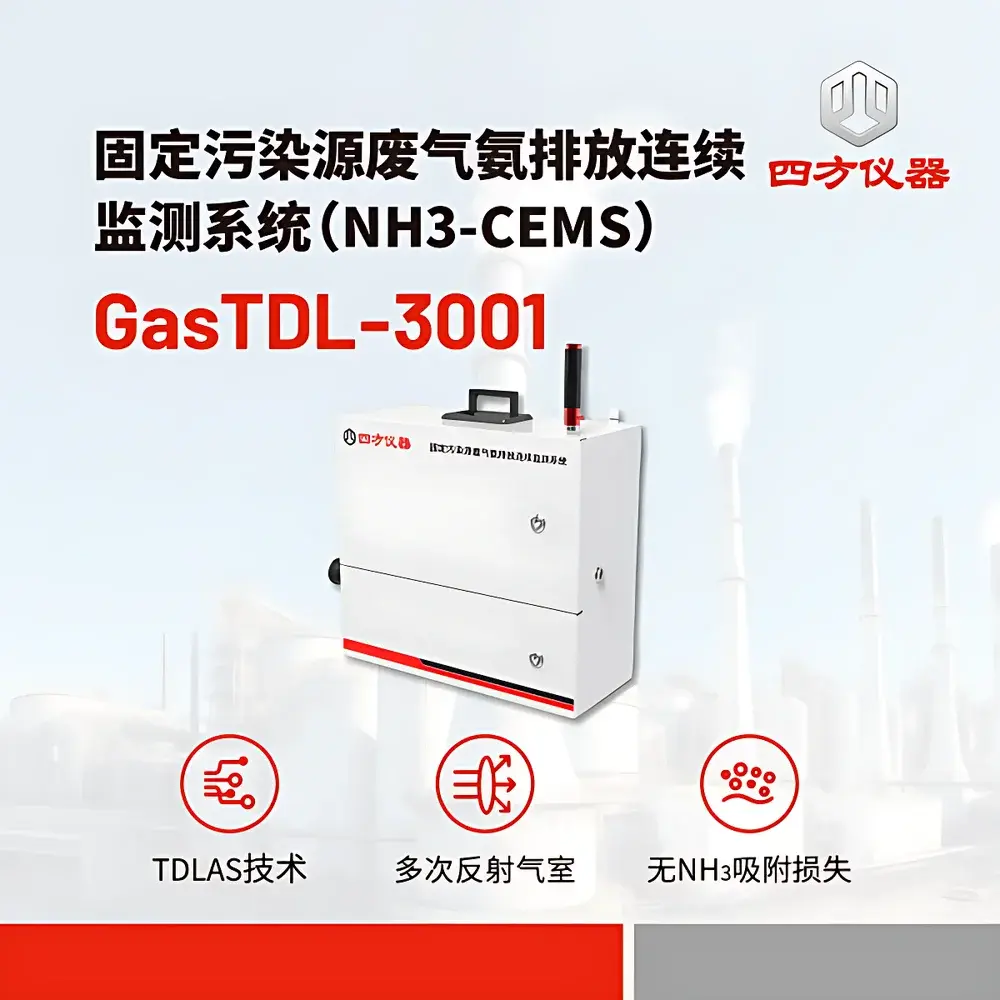
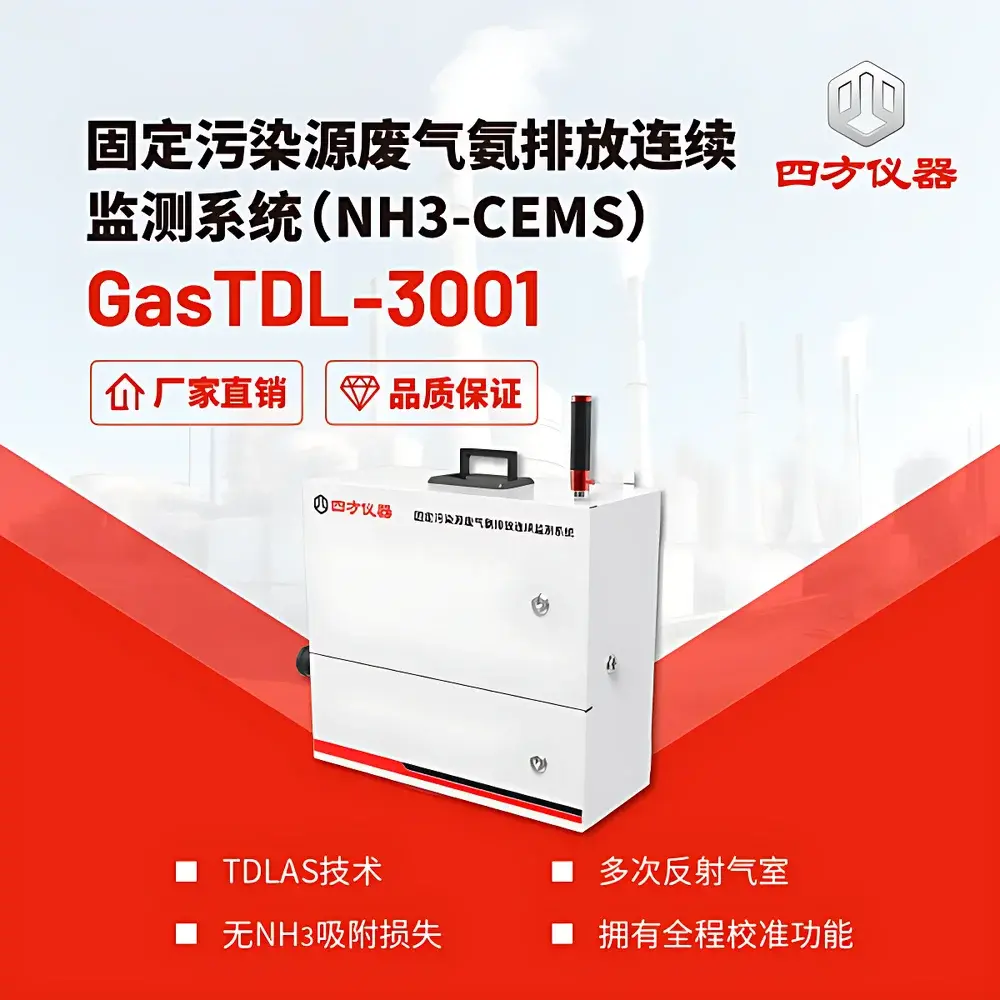
CUBIC INSTRUMENTS GasTDL-3001 Ammonia Slip Online Monitoring System
| Brand | CUBIC INSTRUMENTS |
|---|---|
| Origin | Hubei, China |
| Manufacturer Type | Authorized Distributor |
| Country of Origin | China |
| Model | GasTDL-3001 |
| Detection Principle | Tunable Diode Laser Absorption Spectroscopy (TDLAS) |
| Sampling Method | In-situ |
| Measurement Range | 0–10–100 ppm (field-selectable) |
| Accuracy | ±1% F.S. |
| Response Time (T90) | ≤30 s |
| Repeatability | ±1% |
| Operating Ambient Temperature | −30 to +60 °C |
| Protection Rating | IP65 |
| Resolution | 0.01 ppm |
| LOD | ±1% F.S. |
| Power Supply | 220 VAC, 50 Hz, 800 W |
| Purge Air | 0.4–0.8 MPa compressed air |
| Communication | 1× RS-232, 1× RS-485 |
| Analog Outputs | 4× 4–20 mA |
| Digital Outputs | 8× relay |
Overview
The CUBIC INSTRUMENTS GasTDL-3001 Ammonia Slip Online Monitoring System is an industrial-grade, in-situ continuous emission monitoring solution engineered for precise, real-time quantification of ammonia (NH3) concentration downstream of selective catalytic reduction (SCR) and selective non-catalytic reduction (SNCR) systems. It employs Tunable Diode Laser Absorption Spectroscopy (TDLAS), a physics-based optical technique that exploits the unique near-infrared absorption fingerprint of NH3 molecules at specific wavelengths (e.g., ~1512 nm or ~2200 nm, depending on configuration). Unlike extractive NDIR or electrochemical methods, TDLAS enables direct, interference-free measurement through the process gas stream without physical sample extraction—minimizing transport delay, condensation risk, and chemical adsorption artifacts. The system is designed for integration into fixed-source emission monitoring frameworks compliant with national and regional regulatory requirements for NH3 slip control, including China’s HJ 75–2017 and HJ 76–2017 standards, as well as international benchmarks such as EN 15267 and ISO 14956 for continuous monitoring system performance validation.
Key Features
- In-situ optical path design: Laser transmitter and detector are mounted directly on opposing flanges of the stack or duct, enabling true in-situ measurement with zero sample transport lag and no conditioning-induced bias.
- High-temperature, low-adsorption gas path: All optical windows and internal beam paths are actively heated to >180 °C, while wetted components utilize passivated stainless steel and ceramic-coated surfaces to suppress NH3 adsorption and surface condensation.
- Multi-pass enhanced sensitivity: Integrated Herriott-type multi-reflection cell increases effective optical path length up to 20 m, delivering sub-ppm detection capability (LOD ≤ 0.01 ppm) within the 0–10–100 ppm selectable range.
- Zero-background interference operation: Wavelength modulation spectroscopy (WMS) with second-harmonic detection eliminates spectral overlap from H2O, CO2, NOx, and particulate scattering—ensuring high selectivity under complex flue gas matrices.
- Full-system calibration traceability: Built-in automated zero/span verification using certified NH3 standard gases; optional integrated permeation tube or dynamic dilution source supports daily drift correction per QA/QC protocols.
- Robust environmental adaptation: IP65-rated enclosure with wide ambient operating range (−30 to +60 °C) and integrated purge-air cooling for laser diode thermal stability under field conditions.
Sample Compatibility & Compliance
The GasTDL-3001 is validated for use in coal-fired, biomass, waste-to-energy, and cement kiln exhaust streams with typical flue gas temperatures ranging from 80 °C to 400 °C, dust loadings up to 50 g/Nm³, and moisture content ≤35% v/v. Its in-situ architecture inherently rejects interference from pressure fluctuations (<±10 kPa), temperature gradients (<±50 °C/m), and particulate loading—eliminating need for filtration, dilution, or chiller units. The system conforms to GLP-aligned data integrity requirements, supporting audit-ready event logging, electronic signatures, and secure user access levels. Optional 21 CFR Part 11-compliant software modules enable FDA-regulated environments to meet electronic record and signature mandates for continuous emissions data reporting.
Software & Data Management
Embedded firmware provides local data acquisition at 1 Hz sampling rate, with onboard storage for ≥30 days of raw spectra and processed concentration records. The system interfaces via RS-232/RS-485 to DCS/SCADA platforms or central CEMS servers using Modbus RTU or custom ASCII protocols. Standard analog outputs (4× 4–20 mA) support legacy PLC integration, while relay outputs trigger alarms for high-slip events, calibration faults, or optical path obstruction. CUBIC’s optional GasView Pro software suite offers remote diagnostics, spectral visualization, trend analysis, and automated report generation aligned with HJ 76–2017 reporting templates—including daily zero/span verification logs, 7-day rolling precision statistics, and uptime/downtime summaries for regulatory submission.
Applications
- Real-time NH3 slip monitoring at SCR/SNCR reactor outlets in thermal power plants
- Process optimization of reagent injection rates to minimize unreacted NH3 and reduce air heater fouling
- Compliance verification for national emission standards (e.g., China’s GB 13223–2011, EU IED BREFs)
- Correlation studies between NH3 slip, catalyst aging, and NOx conversion efficiency
- Supporting predictive maintenance strategies through long-term drift trending and spectral health monitoring
FAQ
What is the recommended installation orientation for the optical transmitter and receiver units?
Mount both units on opposite sides of the duct or stack with optical axis centered on the gas flow profile; alignment tolerance ±2° horizontal/vertical is acceptable with built-in auto-alignment assist.
Does the system require periodic replacement of consumables?
No consumables are used—the laser diode has a rated lifetime >20,000 hours; only annual verification of window cleanliness and purge-air filter replacement is required.
Can the GasTDL-3001 be integrated with existing CEMS infrastructure?
Yes—native Modbus RTU support, 4–20 mA analog outputs, and configurable alarm relays ensure seamless integration with third-party data acquisition systems and central CEMS servers.
How is measurement accuracy maintained over time in high-dust environments?
The system continuously monitors optical transmission intensity and applies real-time compensation algorithms for particulate attenuation; optional automatic window cleaning cycles can be scheduled during low-load periods.
Is factory calibration traceable to national metrology institutes?
Yes—each unit ships with NIST-traceable calibration certificate for NH3 at three points (0, 5, and 50 ppm) using certified gas standards accredited to ISO/IEC 17025.







