
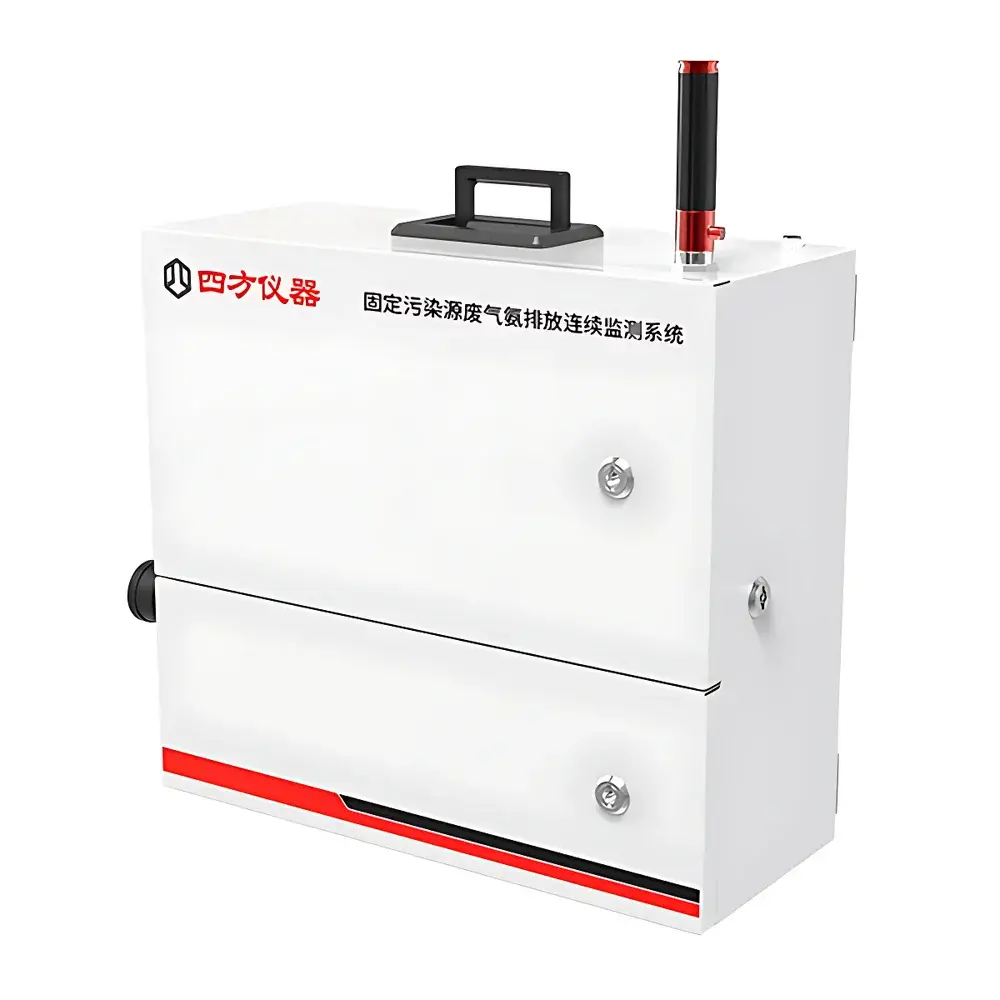
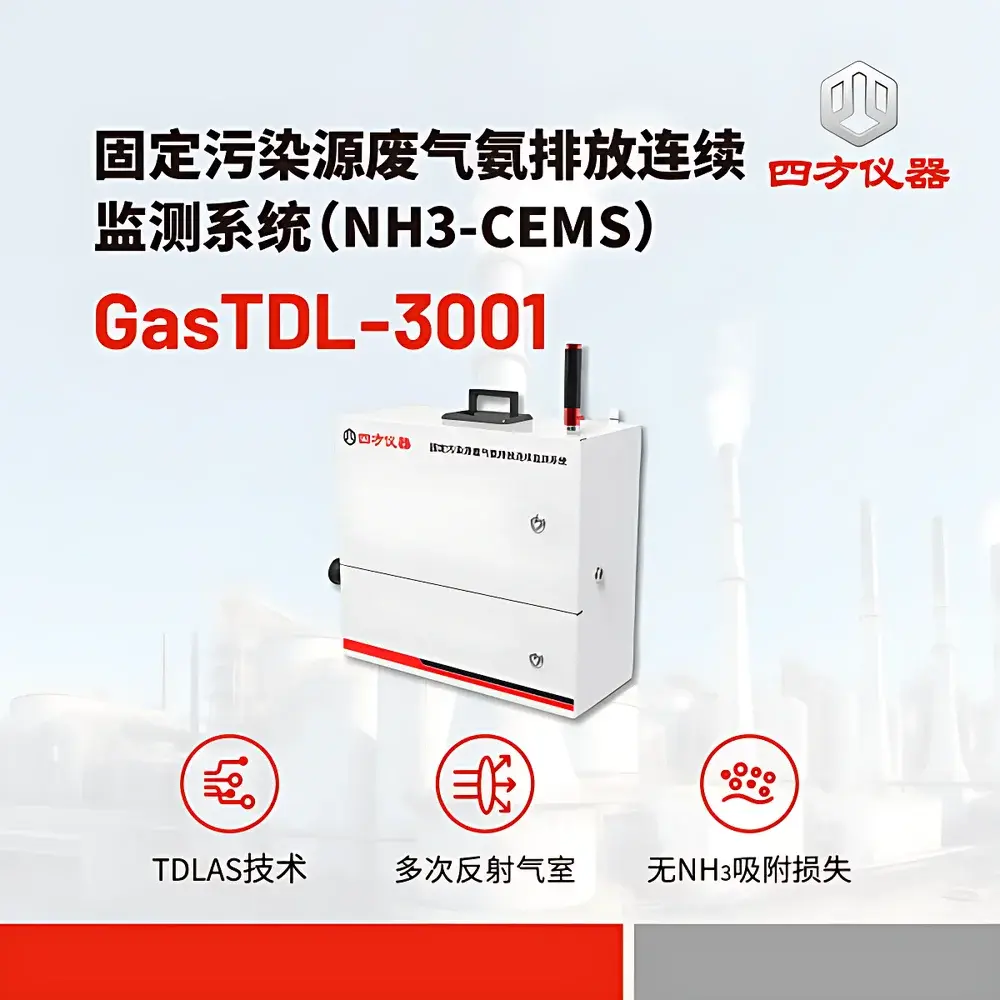
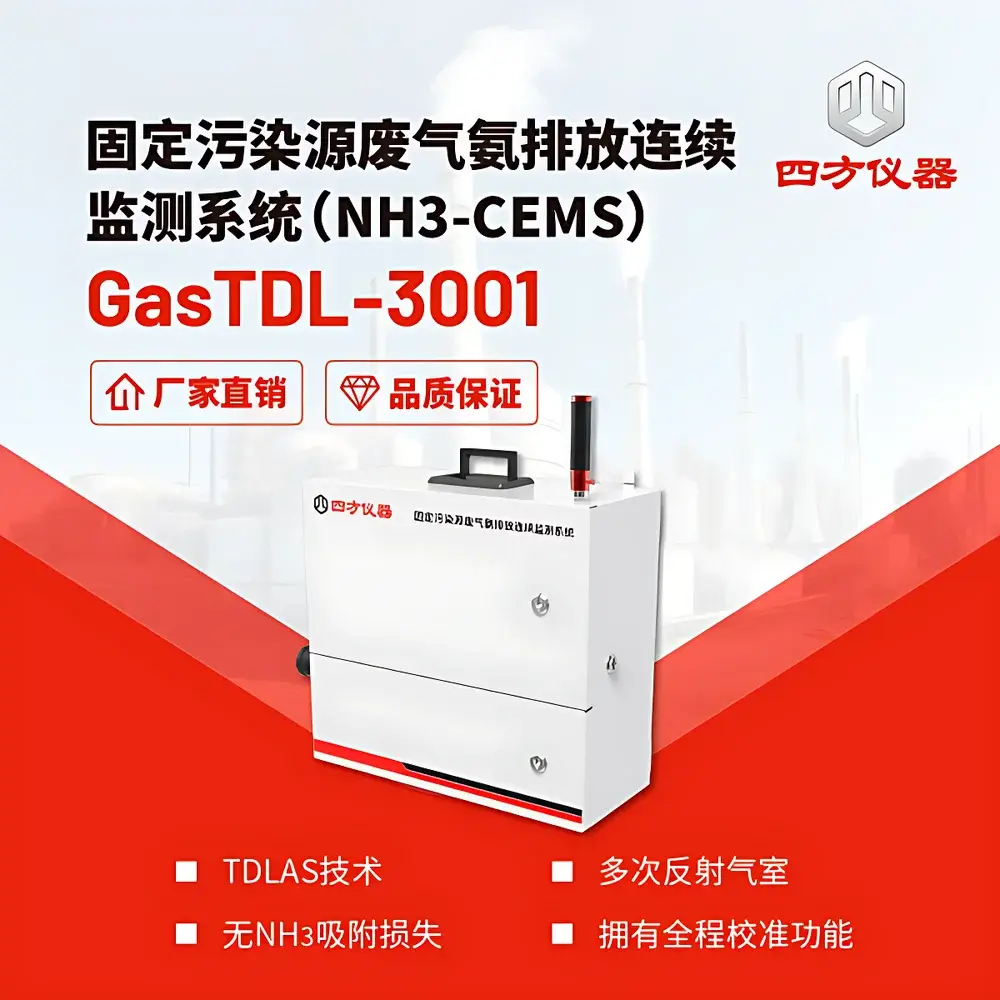
CUBIC INSTRUMENTS GasTDL-3001 Ammonia Slip Online Monitoring System
| Brand | CUBIC INSTRUMENTS |
|---|---|
| Origin | Hubei, China |
| Model | GasTDL-3001 |
| Detection Principle | Tunable Diode Laser Absorption Spectroscopy (TDLAS) |
| Sampling Method | In-situ |
| Measurement Range | 0–10–100 ppm (adjustable) |
| Accuracy | ±1% F.S. |
| Response Time (T90) | ≤30 s |
| Repeatability | ±1% |
| Operating Ambient Temperature | −30 to +60 °C |
| Protection Rating | IP65 |
| Resolution | 0.01 ppm |
| Lower Detection Limit | ±1% F.S. |
| Power Supply | 220 VAC, 50 Hz, 800 W |
| Purge Air | 0.4–0.8 MPa compressed air |
| Communication | 1× RS-232, 1× RS-485 |
| Analog Outputs | 4× 4–20 mA |
| Digital Outputs | 8× relay |
Overview
The CUBIC INSTRUMENTS GasTDL-3001 Ammonia Slip Online Monitoring System is an industrial-grade, in-situ gas analyzer engineered for continuous, real-time quantification of ammonia (NH₃) concentration in flue gas streams downstream of selective catalytic reduction (SCR) and selective non-catalytic reduction (SNCR) systems. It employs Tunable Diode Laser Absorption Spectroscopy (TDLAS), a physics-based optical technique that exploits the unique near-infrared absorption fingerprint of NH₃ molecules at specific wavelengths (e.g., ~1512 nm or ~2200 nm, depending on configuration). Unlike extractive NDIR or electrochemical sensors, TDLAS provides inherent selectivity—eliminating cross-sensitivity to CO₂, H₂O, NOₓ, SO₂, and particulate interference—while enabling high signal-to-noise ratio measurements even at sub-ppm levels. The system is designed for integration into NH₃-CEMS (Ammonia Continuous Emission Monitoring Systems) compliant with national and international regulatory frameworks, including China’s HJ 75-2017 and HJ 101-2018, as well as EU BREF guidelines for large combustion plants and IED (2010/75/EU) monitoring requirements.
Key Features
- In-situ measurement architecture: Optical probe mounted directly on the duct wall eliminates sample transport delay, condensation risk, and adsorption losses common in extractive systems.
- High-temperature heated optical path: Entire gas-contacting flow path—including sampling nozzle, transfer line, and measurement cell—is maintained above 180 °C using integrated trace heating, preventing NH₃ adsorption on stainless steel surfaces and minimizing cold-spot-induced measurement drift.
- Multi-pass absorption cell: Optimized Herriott-type or White-cell design increases effective optical path length up to 20 m, enhancing detection sensitivity and achieving a verified lower limit of quantitation (LLOQ) of 0.01 ppm (±1% F.S.) across the 0–10 ppm range.
- Full-system calibration capability: Built-in zero/span verification using certified NH₃ standard gases enables automated daily or weekly calibration without manual intervention—supporting audit-ready GLP/GMP traceability.
- Robust mechanical construction: IP65-rated enclosure ensures operational integrity in harsh industrial environments, including exposure to vibration, ambient temperature extremes (−30 to +60 °C), and high humidity (5–85% RH).
- Real-time diagnostics: Embedded self-check routines monitor laser wavelength stability, photodetector gain, optical alignment, and purge air pressure—triggering configurable alarms via relay outputs or digital communication interfaces.
Sample Compatibility & Compliance
The GasTDL-3001 is validated for use in flue gas streams containing up to 20% v/v water vapor, <10 g/Nm³ dust loading, and operating pressures from −5 to +5 kPa gauge. Its TDLAS methodology meets ASTM D6348-18 (Standard Test Method for Determination of Gaseous Compounds by Multi-Gas Analyzer) for NH₃ quantification accuracy and repeatability. When deployed as part of a full NH₃-CEMS, the system supports compliance with China’s Ministry of Ecology and Environment (MEE) Technical Specifications for Continuous Emission Monitoring of Fixed Pollution Sources (HJ 75-2017, HJ 101-2018), and aligns with EN 15267-3:2017 for automated measuring systems (AMS) performance evaluation. Optional data acquisition modules can be configured to satisfy 21 CFR Part 11 audit trail and electronic signature requirements for regulated facilities.
Software & Data Management
The embedded firmware supports dual-mode operation: standalone local control via 5.7″ resistive touchscreen HMI, or remote supervision through Modbus RTU (RS-485) or ASCII protocol over RS-232. All analog outputs (4× 4–20 mA) are individually scalable and linearized per user-defined range. Data logging is performed internally at 1-second intervals with 30-day circular buffer storage; historical records are exportable via USB or Ethernet (optional). The system generates timestamped calibration logs, fault event reports, and raw absorbance spectra—enabling root-cause analysis during QA/QC review. For enterprise-level integration, optional OPC UA or MQTT gateways facilitate secure transmission to DCS, SCADA, or cloud-based environmental data platforms.
Applications
- Continuous monitoring of NH₃ slip at SCR/SNCR reactor outlets in coal-fired, biomass, and waste-to-energy power plants.
- Optimization of reagent injection dosing in de-NOₓ systems to minimize unreacted NH₃ while maintaining NOₓ removal efficiency >90%.
- Compliance reporting for environmental permits requiring hourly average NH₃ concentration data with documented uncertainty budgets.
- Process troubleshooting during catalyst aging, soot accumulation, or temperature excursions affecting NH₃ conversion kinetics.
- Stack testing support for third-party emission verification under ISO 14064-3 or EPA Method 320 validation protocols.
FAQ
What is the recommended maintenance interval for the GasTDL-3001?
Routine inspection is advised every 3 months; optical window cleaning and purge air filter replacement should be performed quarterly. Annual factory recalibration is recommended to maintain metrological traceability.
Can the system operate reliably in high-dust flue gas without filtration?
Yes—the in-situ probe design avoids particulate-laden sample extraction. However, periodic manual cleaning of the optical viewport is required if visible soiling occurs, typically every 1–3 months depending on dust morphology and concentration.
Does the analyzer support automatic zero/span correction during normal operation?
Yes—integrated solenoid valves allow sequential introduction of zero air and NH₃ span gas without process interruption. Calibration sequences are programmable and logged with full audit trail.
Is the 4–20 mA output intrinsically safe for hazardous area installation?
No—the standard outputs are non-IS. For Zone 1/2 installations, optional ATEX/IECEx-certified isolated signal conditioners must be deployed upstream of field wiring.
How does the system handle water vapor interference in hot, wet flue gas?
TDLAS operates at specific rotational-vibrational absorption lines where H₂O spectral overlap is negligible. Water vapor concentration is simultaneously measured and mathematically compensated in real time using dual-wavelength referencing.
Related Products







