
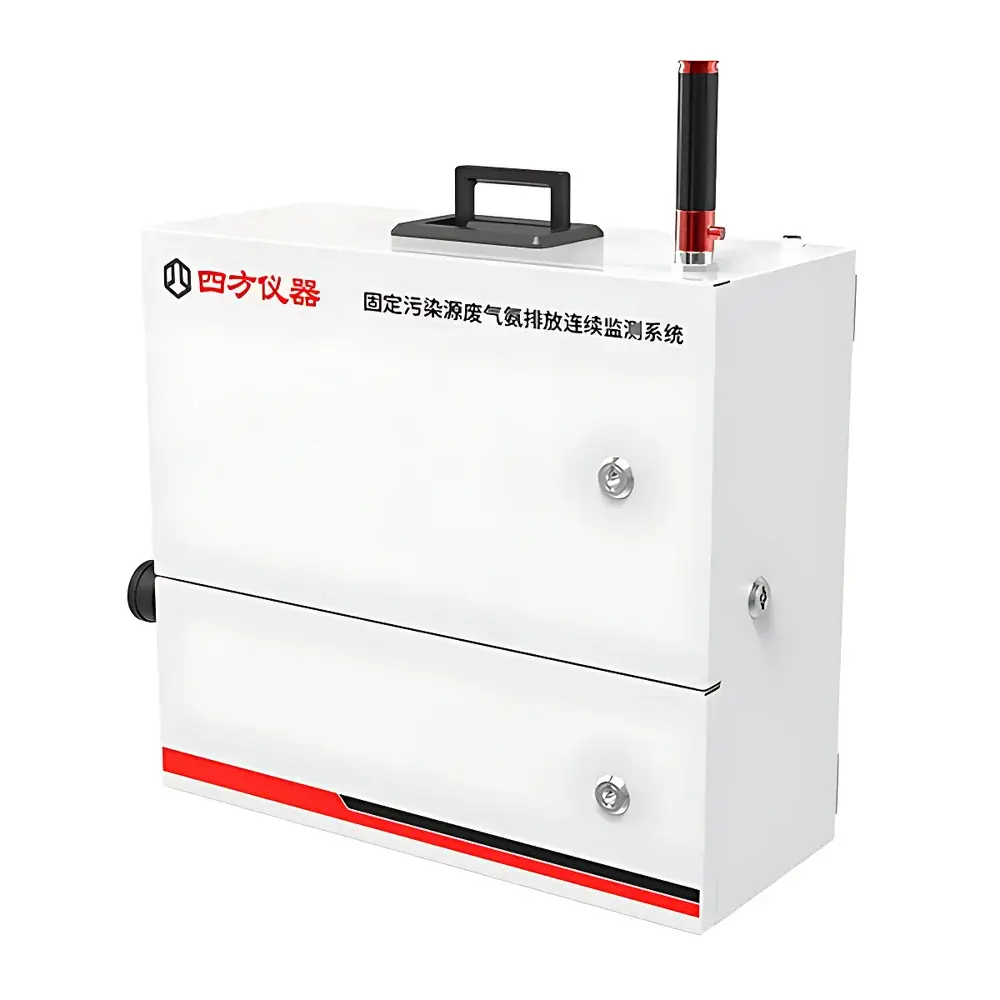
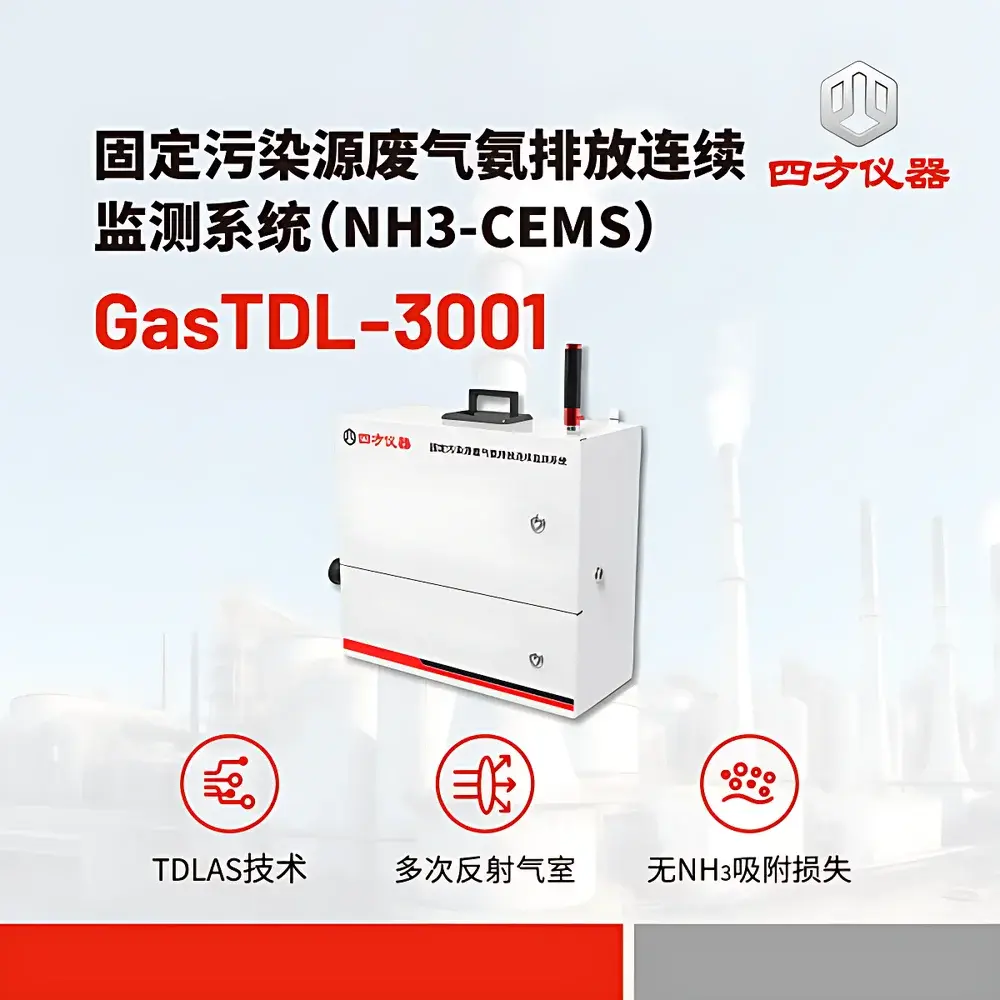
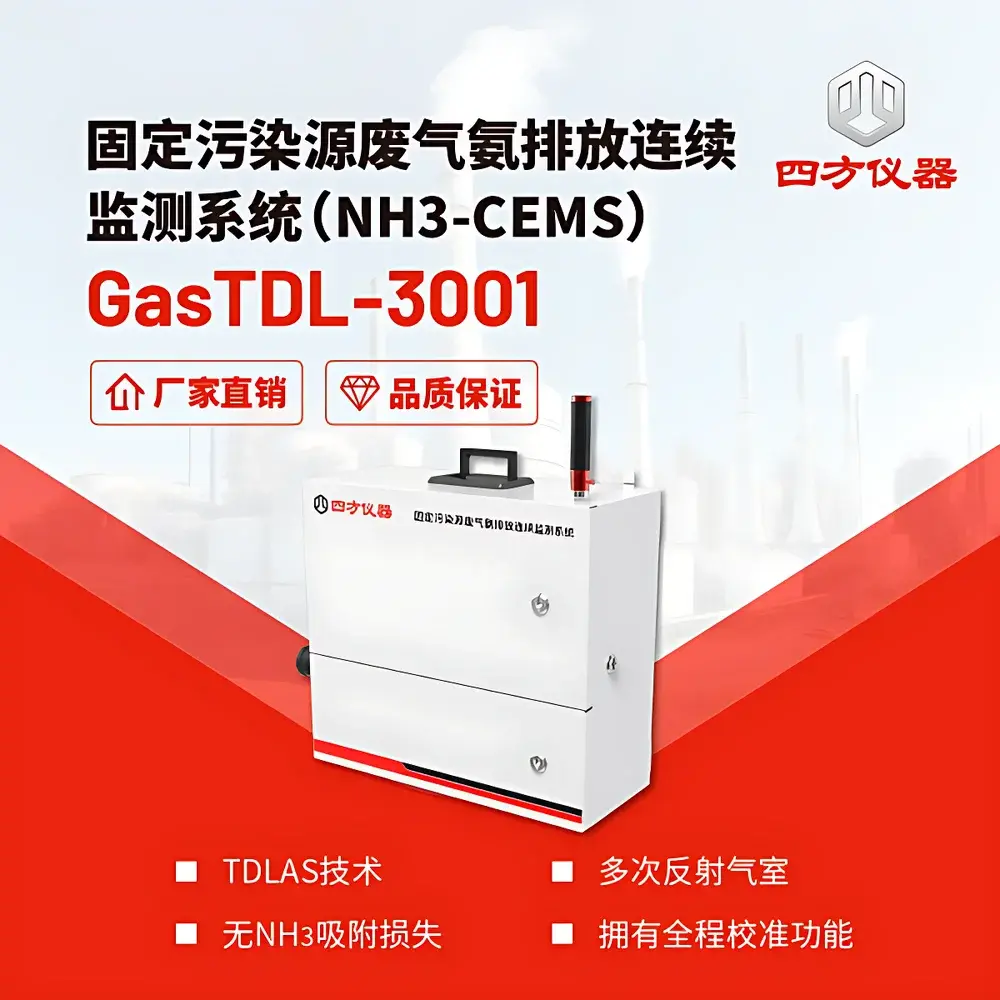
CUBIC INSTRUMENTS GasTDL-3001 Ammonia Slip Online Monitoring System for Waste-to-Energy SCR DeNOₓ Applications
| Brand | CUBIC INSTRUMENTS |
|---|---|
| Origin | Hubei, China |
| Model | GasTDL-3001 |
| Detection Principle | Tunable Diode Laser Absorption Spectroscopy (TDLAS) |
| Sampling Method | In-situ (Hot Extractive) |
| Measurement Range | 0–10–100 ppm (selectable) |
| Accuracy | ±1% of Full Scale (F.S.) |
| Response Time (T90) | ≤30 s |
| Repeatability | ±1% F.S. |
| Operating Ambient Temperature | −30 to +60 °C |
| IP Rating | IP65 or higher |
| Resolution | 0.01 ppm |
| LOD | ±1% F.S. |
| Power Supply | 220 VAC, 50 Hz, 800 W |
| Purge Air | 0.4–0.8 MPa compressed air |
| Communication | 1× RS-232, 1× RS-485 |
| Analog Outputs | 4× 4–20 mA |
| Digital Outputs | 8× relay |
Overview
The CUBIC INSTRUMENTS GasTDL-3001 Ammonia Slip Online Monitoring System is an engineered solution for continuous, real-time quantification of residual ammonia (NH₃) concentration downstream of selective catalytic reduction (SCR) systems in waste-to-energy (WtE) power plants. Designed specifically for high-dust, high-moisture, and thermally variable flue gas environments, the system employs Tunable Diode Laser Absorption Spectroscopy (TDLAS) — a physics-based, line-of-sight optical technique that targets the fundamental rotational-vibrational absorption lines of NH₃ near 1531 nm. Unlike extractive NDIR or electrochemical sensors, TDLAS provides inherent selectivity against spectral interference from CO₂, H₂O, NOₓ, SO₂, and particulate scatter, eliminating cross-sensitivity artifacts common in complex combustion effluents. The GasTDL-3001 utilizes a hot extractive configuration: sample gas is drawn directly from the duct via a heated probe and transported through a fully trace-heated (≥180 °C), low-adsorption stainless-steel flow path to a multi-pass absorption cell. This architecture prevents NH₃ condensation, wall adsorption, and catalytic loss — critical failure modes in conventional cold-extractive systems — thereby preserving molecular integrity and ensuring metrological fidelity from sampling point to measurement.
Key Features
- True TDLAS-based detection with wavelength-scanned single-line absorption, delivering intrinsic gas-species selectivity without chemical filters or compensation algorithms
- Configurable dual-range measurement (0–10 ppm and 0–100 ppm) optimized for both low-level slip monitoring (<2 ppm) and process fault diagnostics
- Multi-reflection Herriott-type absorption cell enabling path lengths >20 m within compact footprint, achieving sub-ppm detection limits (LOD: 0.01 ppm)
- Full-path thermal management: probe, filter, transport line, and cell maintained at constant elevated temperature (>180 °C) using PID-controlled heating jackets and insulated conduits
- Low-adsorption wetted materials: electropolished 316L SS, PFA-lined fittings, and passivated internal surfaces minimize NH₃ surface retention
- Onboard zero/span calibration capability with integrated solenoid valves and certified NH₃/N₂ standard gases; supports automated daily/weekly verification per EN 15267-3 requirements
- Ruggedized enclosure rated IP65 or higher, qualified for outdoor mounting on boiler house structures or SCR skid frames
Sample Compatibility & Compliance
The GasTDL-3001 is validated for operation in flue gas streams containing up to 50 g/Nm³ total suspended particulates, moisture content up to 25 vol%, and operating duct temperatures ranging from 120 °C to 400 °C. It meets the functional and performance criteria outlined in EPA Method 320, ISO 14956:1998 (ambient air), and EN 15267-3:2017 (performance certification of CEMS). While not a certified QAL1 system out-of-the-box, its architecture aligns with EU Industrial Emissions Directive (IED 2010/75/EU) and China’s HJ 75-2017 / HJ 76-2017 standards for NH₃-CEMS validation protocols. All firmware and data handling routines support audit-ready logging compliant with GLP principles, including timestamped calibration events, sensor diagnostics, and raw spectral acquisition metadata.
Software & Data Management
Embedded Linux-based controller hosts a web-accessible interface (HTTPS, TLS 1.2) for remote configuration, real-time trend visualization, and alarm management. Data are stored locally on industrial-grade microSD with 30-day circular buffer and simultaneously transmitted via Modbus RTU (RS-485) or ASCII protocol (RS-232) to DCS/SCADA systems. Four isolated 4–20 mA analog outputs support connection to PLCs or legacy chart recorders, while eight programmable relays trigger maintenance alerts, purge cycles, or safety interlocks. Optional cloud integration enables secure MQTT publishing to AWS IoT Core or Azure IoT Hub, supporting predictive maintenance analytics based on laser drift rate, cell contamination index, and signal-to-noise ratio (SNR) degradation trends.
Applications
- Continuous NH₃ slip monitoring at SCR reactor outlet in municipal solid waste (MSW) incineration plants
- Ammonia dosing optimization and catalyst health assessment in fluidized-bed and grate-fired WtE boilers
- Compliance reporting for national emission standards (e.g., China’s GB 18485-2014, EU IED Annex VI)
- Integration into plant-wide environmental management systems (EMS) for ISO 14001 reporting
- Supporting ammonia injection control loops via closed-loop feedback to upstream reagent dosing pumps
- Research and development of novel SCR catalyst formulations under real-world flue gas conditions
FAQ
What distinguishes hot extractive TDLAS from in-situ TDLAS for NH₃ monitoring?
Hot extractive design isolates the optical measurement cell from harsh duct conditions, enabling precise temperature/pressure control and eliminating beam misalignment risks caused by vibration or thermal expansion — critical for long-term stability in WtE applications.
Can the GasTDL-3001 be validated per EN 15267-3 for regulatory compliance?
Yes — when deployed with certified calibration gases, documented installation procedures, and third-party witnessed QAL2/QAL3 testing, it satisfies the technical prerequisites for EN 15267-3 conformity assessment.
How is zero drift corrected during extended unattended operation?
The system executes automatic zero checks every 24 hours using high-purity nitrogen purge, combined with real-time water vapor and CO₂ spectral baseline correction algorithms embedded in the TDLAS signal processing stack.
Is the 4–20 mA output linear across both range settings?
Yes — each range (0–10 ppm and 0–100 ppm) has independent, factory-calibrated current output scaling with NIST-traceable linearity verification.
What maintenance intervals are recommended for field operation?
Probe filter replacement every 3 months; optical window cleaning every 6 months; full system QAL2 verification annually — all tracked automatically in the maintenance log module.







