
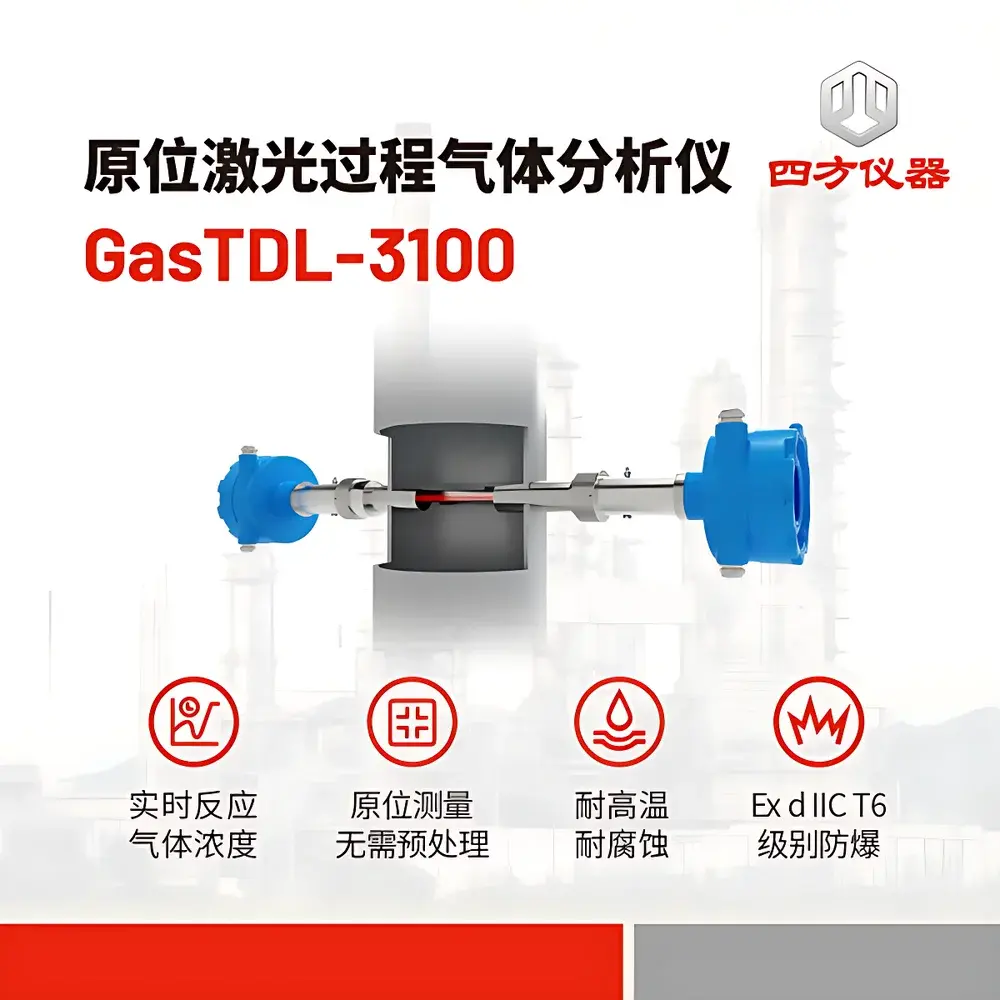
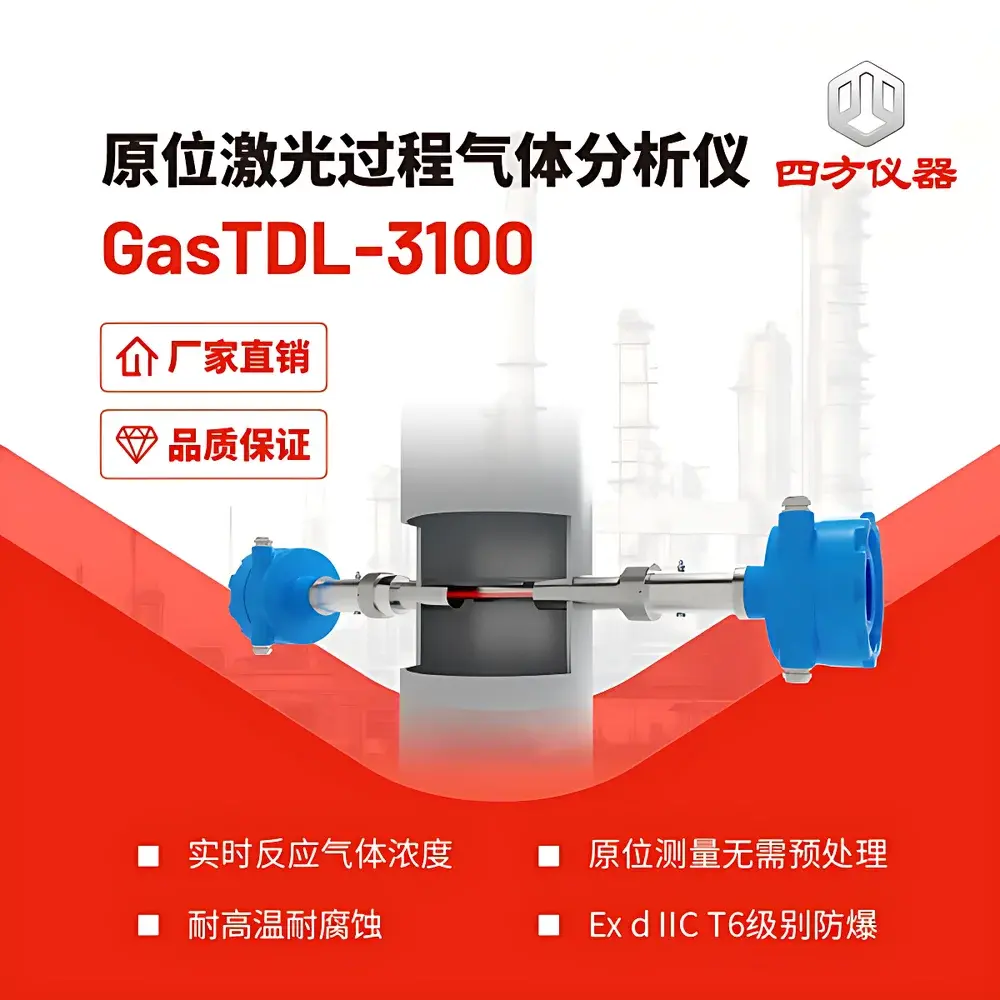
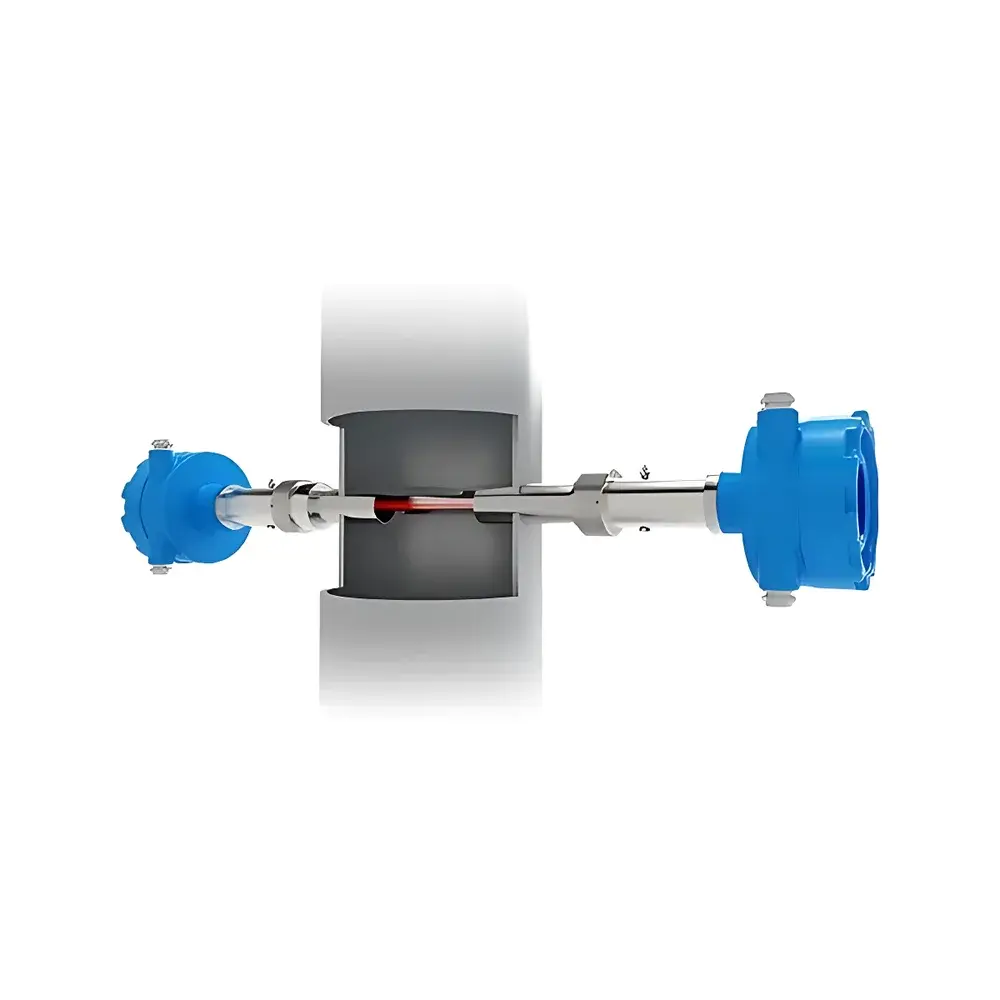
CUBIC INSTRUMENTS GasTDL-3100-CO2 Tunable Diode Laser Absorption Spectroscopy (TDLAS) In-Situ CO₂ Analyzer
| Brand | CUBIC INSTRUMENTS |
|---|---|
| Origin | Hubei, China |
| Model | GasTDL-3100-CO2 |
| Detection Principle | Tunable Diode Laser Absorption Spectroscopy (TDLAS) |
| Configuration | In-situ, dual-beam transmission |
| Measured Gas | CO₂ (single-component mode) |
| O₂ Range | (0–5)% vol (customizable up to 100% vol) |
| CO Range | (0–100)% vol |
| CO₂ Range | (0–100)% vol |
| CH₄ Range | (0–20)% vol |
| Accuracy | ≤±1% FS |
| Repeatability | ≤±1% FS |
| Zero/Full-Scale Drift | ≤±1% FS per 30 days |
| Resolution | 0.01% vol |
| Response Time (T90) | ≤4 s |
| Operating Temperature | −20 to +60 °C |
| Power Supply | 24 V DC, 24 W |
| Explosion Protection | Ex d II CT6 |
| Output Signals | 2 × 4–20 mA analog outputs, 3 × relay outputs |
| Communication | RS485, RS232 |
| Purge Gas | Industrial nitrogen, 0.3–0.8 MPa |
Overview
The CUBIC INSTRUMENTS GasTDL-3100-CO2 is an in-situ, dual-beam tunable diode laser absorption spectroscopy (TDLAS) analyzer engineered for continuous, real-time measurement of carbon dioxide (CO₂) concentration in demanding industrial process streams. Unlike extractive sampling systems that introduce transport delay, pressure drop, and condensation artifacts, the GasTDL-3100-CO2 employs a non-contact, line-of-sight optical path across the process duct or stack—enabling true in-situ quantification without gas conditioning. Its core measurement principle relies on high-resolution absorption spectroscopy at a specific near-infrared wavelength (e.g., ~2.004 µm) where CO₂ exhibits strong, isolated rotational-vibrational transitions. By modulating the laser’s wavelength and applying second-harmonic detection (2f-WMS), the analyzer achieves high selectivity against spectral interference from water vapor, methane, carbon monoxide, and other common combustion gases—eliminating cross-sensitivity without chemical filters or catalytic scrubbers.
Key Features
- In-situ dual-beam TDLAS architecture eliminates sample extraction, conditioning, and associated calibration drift caused by tubing permeation, adsorption, or filter clogging.
- Robust mechanical design with no moving parts, no consumables, and no optical windows exposed to the process stream—ensuring long-term stability in high-dust, high-moisture, and high-temperature environments (up to 60 °C ambient; process-compatible with hot/wet flue gas when installed with appropriate probe cooling or purging).
- Explosion-proof enclosure rated Ex d II CT6, certified for use in Zone 1 hazardous areas containing combustible gases including CO, CH₄, and H₂.
- Fast dynamic response: T90 ≤ 4 seconds enables closed-loop feedback control in combustion optimization, fermentation monitoring, and carbon capture verification applications.
- High optical signal-to-noise ratio (SNR) achieved via balanced photodetection and digital lock-in amplification—delivering repeatability ≤ ±1% FS and resolution of 0.01% vol over full 0–100% CO₂ range.
- Integrated purge gas interface (0.3–0.8 MPa industrial N₂) maintains optical path cleanliness in particulate-laden flows; purge flow rate and timing are configurable via embedded firmware.
Sample Compatibility & Compliance
The GasTDL-3100-CO2 is validated for direct installation in ducts, stacks, and reactors with gas temperatures up to 200 °C (with optional high-temp probe variants) and particulate loadings exceeding 10 g/Nm³. It operates reliably under high relative humidity (up to 100% RH) due to its wavelength-specific targeting and moisture-insensitive detection algorithm. While not intrinsically calibrated to ISO 14064 or EPA Method 3A, its TDLAS methodology aligns with ASTM D6522–22 (Standard Test Method for Determination of Nitrogen Oxides, Carbon Monoxide, and Oxygen in Emissions from Stationary Sources by Continuous Emission Monitoring Systems) for optical gas analyzers. The device supports audit-ready data logging and complies with general requirements for GLP/GMP-aligned environmental monitoring when paired with traceable calibration protocols and documented instrument qualification (IQ/OQ/PQ).
Software & Data Management
The analyzer embeds a Linux-based real-time operating system with local web server interface (HTTPS-enabled) for configuration, diagnostics, and live waveform visualization. All analog outputs (2 × 4–20 mA) and relay states are timestamped with microsecond precision and support HART-compatible digital superimposition. RS485 Modbus RTU and RS232 ASCII protocols enable seamless integration into DCS, SCADA, and MES platforms. Firmware includes built-in zero/span validation routines, automatic baseline correction, and configurable alarm thresholds with latching behavior. Data export supports CSV and XML formats; optional cloud gateway modules provide MQTT/OPC UA connectivity for Industry 4.0 infrastructure. Audit trail functionality records all parameter changes, calibration events, and user logins—supporting compliance with FDA 21 CFR Part 11 when deployed in regulated pharmaceutical or biotech manufacturing environments.
Applications
- Combustion efficiency monitoring in coal-, gas-, and biomass-fired boilers, where real-time CO₂/O₂ co-monitoring informs air-fuel ratio control.
- In-line CO₂ concentration tracking during anaerobic digestion and ethanol fermentation—critical for yield optimization and metabolic pathway validation.
- Carbon capture, utilization, and storage (CCUS) processes, including post-combustion amine scrubber inlet/outlet monitoring and pipeline purity verification (≥99% CO₂).
- Incinerator and waste-to-energy plant emissions reporting, meeting local environmental agency requirements for continuous emission monitoring systems (CEMS).
- Controlled atmosphere (CA) storage facilities for fruits and vegetables, where sub-1% CO₂ precision ensures optimal respiration suppression without phytotoxicity.
FAQ
Is the GasTDL-3100-CO2 capable of measuring multiple gases simultaneously?
No. Each unit is factory-configured for a single target gas (e.g., CO₂). Multi-component capability requires separate analyzers or a custom multi-laser platform—not supported by the standard GasTDL-3100 series.
Does the analyzer require periodic calibration with certified gas standards?
Yes. While TDLAS offers exceptional long-term stability, initial commissioning and annual verification require traceable span gas (e.g., NIST-certified CO₂ in N₂) per ISO 6142. Zero calibration may be performed using high-purity nitrogen or clean ambient air.
Can the device operate in high-dust environments without optical fouling?
Yes—when installed with continuous nitrogen purge (0.3–0.8 MPa) and aligned per manufacturer-specified beam geometry, the optical path remains contamination-free for >12 months in cement kiln or metal smelter exhaust streams.
What is the maximum allowable process gas temperature for direct mounting?
The standard probe supports ambient housing temperatures up to +60 °C. For process gas >150 °C, optional air- or water-cooled probe extensions are required to maintain optical alignment and detector thermal stability.
Is Modbus TCP supported in addition to RS485/RS232?
Not natively. Modbus TCP is available only through optional Ethernet gateway modules—ordered separately and configured as protocol translators in the field network architecture.
Related Products







