CUBIC INSTRUMENTS GasTDL-3100 In-Situ Tunable Diode Laser Oxygen Analyzer
| Brand | CUBIC INSTRUMENTS |
|---|---|
| Origin | Hubei, China |
| Model | GasTDL-3100 |
| Sensor Type | Tunable Diode Laser (TDLAS) |
| Measurement Ranges | H₂S: 0–100 ppm / 0–5000 ppm |
| O₂ | 0–5 %vol (customizable up to 100 %vol) |
| CO | 0–100 %vol |
| CO₂ | 0–100 %vol |
| CH₄ | 0–20 %vol |
| Accuracy | ≤ ±1 % FS |
| Response Time (T90) | ≤ 1 s |
| Repeatability | ≤ ±1 % FS |
| Resolution | 0.01 %vol |
| Explosion Protection | Exd II CT6 Gb / Ex tb IIIC T80°C Db |
| Operating Temperature | −20 to +60 °C |
| Power Supply | 24 V DC, 24 W |
| Purge Gas | Industrial nitrogen, 0.3–0.8 MPa |
| Communication | RS485, RS232 |
| Analog Outputs | 2 × 4–20 mA |
| Digital Outputs | 3 × relay |
Overview
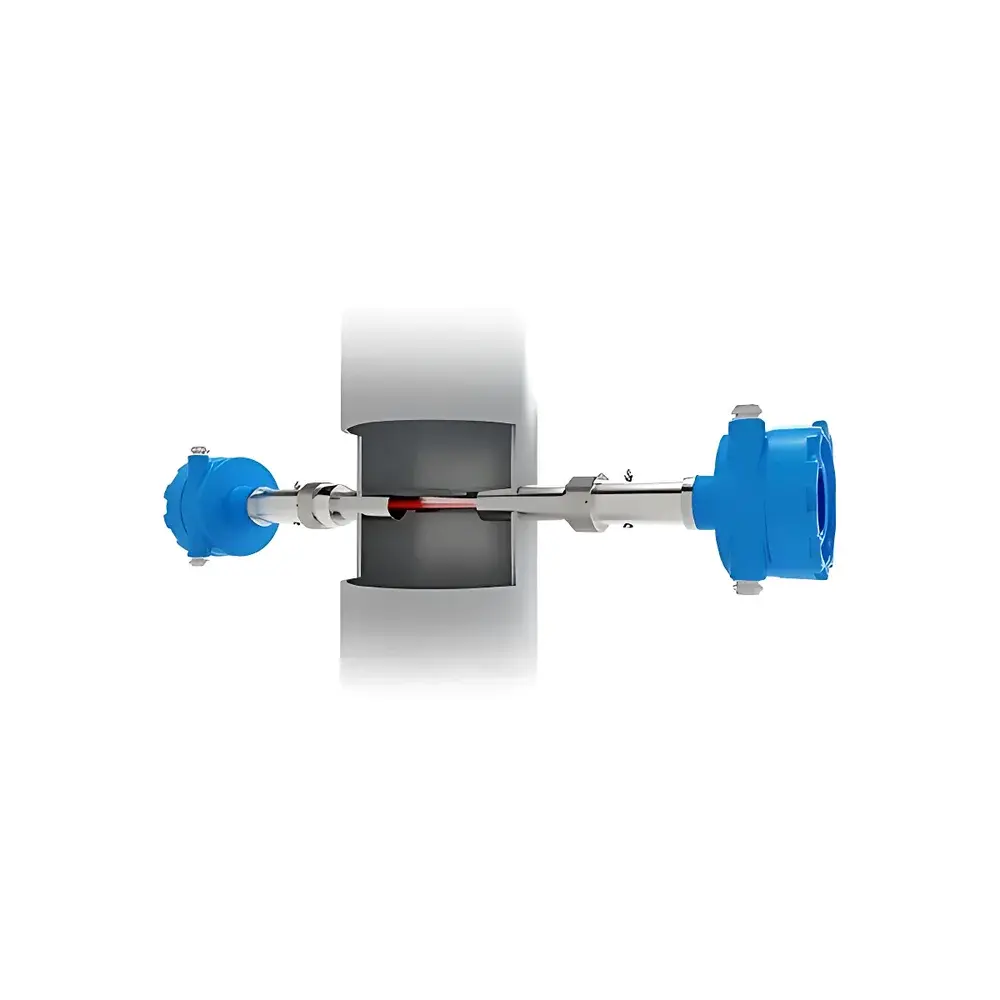
The CUBIC INSTRUMENTS GasTDL-3100 is an in-situ tunable diode laser absorption spectroscopy (TDLAS)-based optical gas analyzer engineered for real-time, high-fidelity oxygen concentration monitoring in demanding industrial process environments. Unlike extractive sampling systems that introduce transport delay, pressure drop, condensation risk, and calibration drift, the GasTDL-3100 performs direct, non-contact measurement across the process duct or pipe using a robust through-beam (transmission) optical path. Its core measurement principle relies on wavelength-specific absorption of near-infrared laser light by molecular oxygen — a technique inherently selective, immune to cross-interference from background gases such as CO₂, N₂, H₂O vapor, or hydrocarbons. This enables stable, interference-free quantification even in complex gas matrices typical of combustion control, syngas conditioning, inerting systems, and metallurgical off-gas streams.
Key Features
- True in-situ configuration: eliminates sample extraction, conditioning, and associated maintenance overhead — no pumps, filters, dryers, or heated lines required.
- TDLAS-based selectivity: spectrally resolved detection ensures immunity to spectral overlap from common interferents (e.g., CO, CO₂, CH₄, H₂O), delivering chemically specific O₂ measurement without software compensation.
- Sub-second dynamic response: T90 ≤ 1 s enables closed-loop feedback control in fast-transient processes such as furnace air-fuel ratio optimization or safety-critical inerting shutdown sequences.
- Ruggedized mechanical architecture: all-optical head with fused silica windows, IP66-rated housing, and integrated purge gas ports for operation in high-dust, high-moisture, high-temperature (up to 80°C ambient), and corrosive atmospheres.
- Intrinsically safe operation: certified to Exd II CT6 Gb and Ex tb IIIC T80°C Db standards for use in Zone 1/21 hazardous areas — suitable for petrochemical, refining, and coal gasification facilities.
- Maintenance-free design: no moving parts, consumables, or electrochemical cells; zero drift calibration strategy supported by built-in reference path verification.
Sample Compatibility & Compliance
The GasTDL-3100 is compatible with hot, wet, dusty, and corrosive process streams encountered in cement kilns, waste incinerators, biomass boilers, and chemical synthesis reactors. It meets structural and electrical safety requirements per IEC 60079-0, IEC 60079-1, and IEC 60079-31. While not pre-certified for FDA 21 CFR Part 11 or ISO 17025, its analog/digital output architecture supports integration into validated control systems compliant with GMP/GLP workflows. The instrument’s traceable calibration protocol aligns with ASTM D6299 and ISO 8573-1 for gas purity verification applications. Optional factory calibration certificates include uncertainty budgets referenced to NIST-traceable gas standards.
Software & Data Management
Data acquisition and configuration are managed via embedded firmware accessible through standard serial protocols (RS232/RS485) using Modbus RTU or ASCII command sets. Two isolated 4–20 mA outputs support connection to DCS/PLC systems with HART-compatible signal conditioning. Three programmable relay outputs provide configurable alarm thresholds (e.g., low-O₂ trip, sensor fault, purge failure). Local display (optional) shows real-time concentration, status flags, and diagnostic logs including laser power stability, beam alignment status, and temperature-compensated absorbance residuals. All operational parameters — including span gas assignment, zero offset, damping factor, and alarm hysteresis — are adjustable without hardware modification. Audit trail functionality (via external SCADA logging) supports regulatory review of configuration changes and alarm events.
Applications
- Combustion optimization in utility and industrial boilers — maintaining stoichiometric air excess while minimizing NOₓ formation.
- Inert gas blanketing and purging control in pharmaceutical reactors and solvent storage tanks — ensuring O₂ levels remain below LEL thresholds.
- Off-gas monitoring in metal heat treatment furnaces (e.g., annealing, sintering) where precise O₂ partial pressure governs oxide layer formation.
- Syngas quality assurance in gasification plants — detecting O₂ breakthrough indicating refractory failure or seal leakage.
- Environmental emission compliance monitoring (e.g., EPA Method 3A equivalent capability) for continuous O₂ reporting alongside regulated pollutants.
FAQ
Can the GasTDL-3100 measure oxygen at 100% volume concentration?
Yes — the standard configuration covers 0–5 %vol, but custom optical path length and detector gain settings enable full-scale calibration up to 100 %vol O₂ upon request.
Is the analyzer suitable for installation in high-velocity flue gas ducts?
Yes — the through-beam design is unaffected by flow velocity; however, mechanical mounting must accommodate thermal expansion and vibration isolation per ASME B31.1 guidelines.
Does the instrument require periodic calibration with span gas?
While zero calibration can be performed in situ using nitrogen purge, span verification requires traceable certified gas; recommended interval is every 3–6 months depending on process severity and QA/QC policy.
How is optical alignment maintained under thermal cycling?
The optical head employs monolithic kinematic mounts and low-CTE materials; factory alignment is verified over −20 to +60 °C, with automatic baseline correction algorithms compensating for minor thermal drift.
Can multiple gas species be measured simultaneously with one unit?
No — each GasTDL-3100 is configured for a single target analyte (e.g., O₂ only); multi-species capability requires separate analyzers or a customized multi-laser platform (GasTDL-3100-M series, available on request).