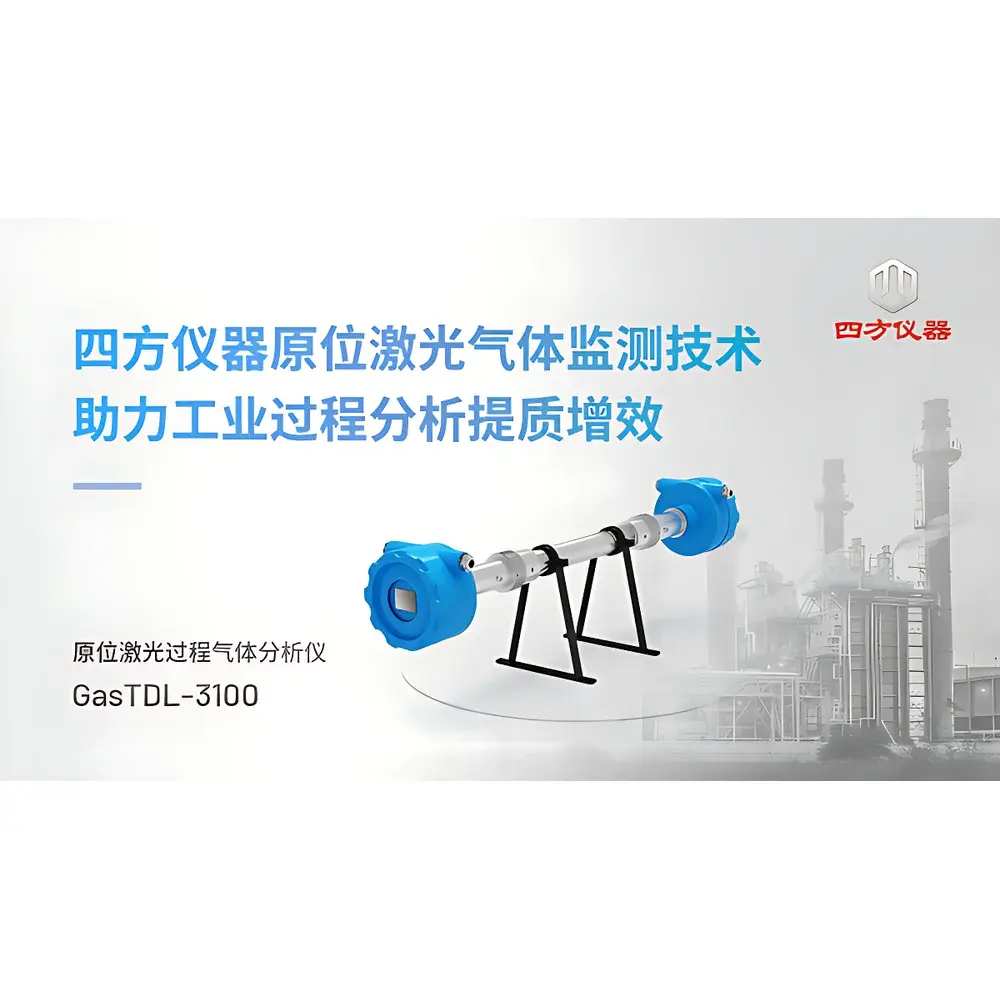
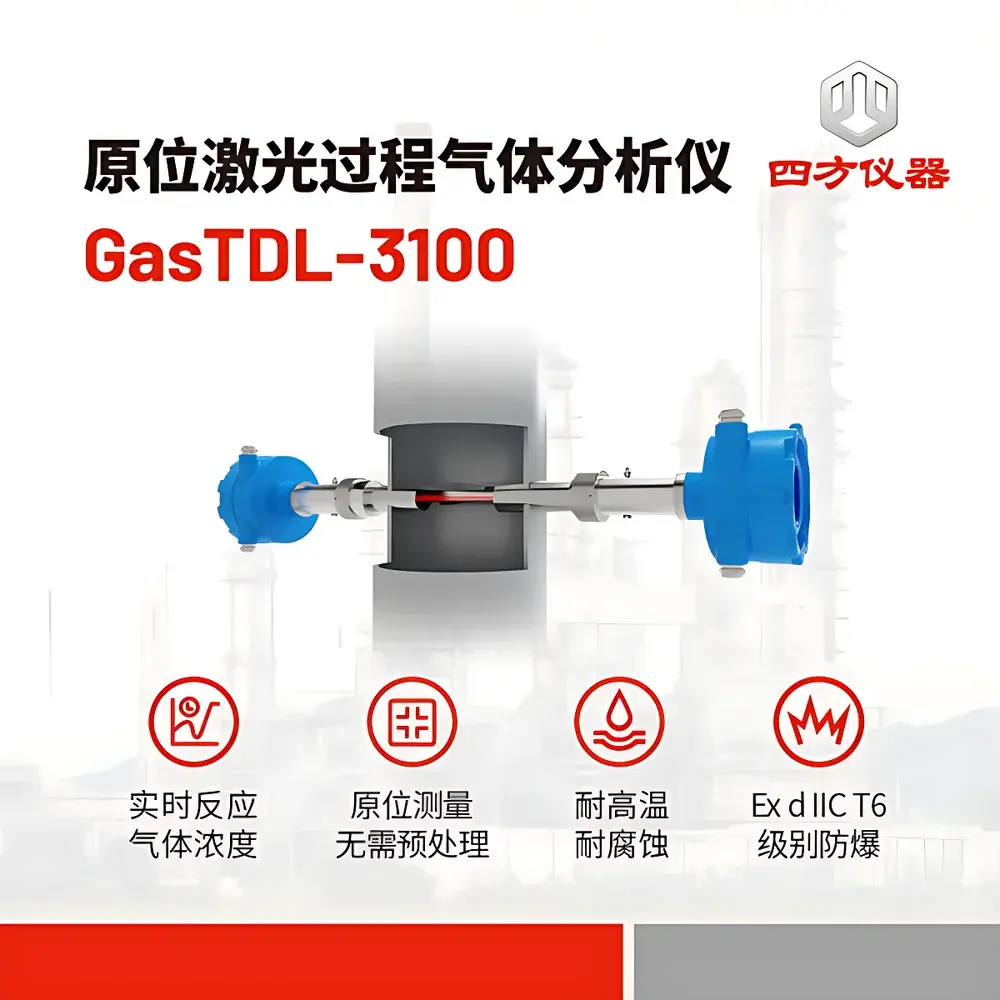
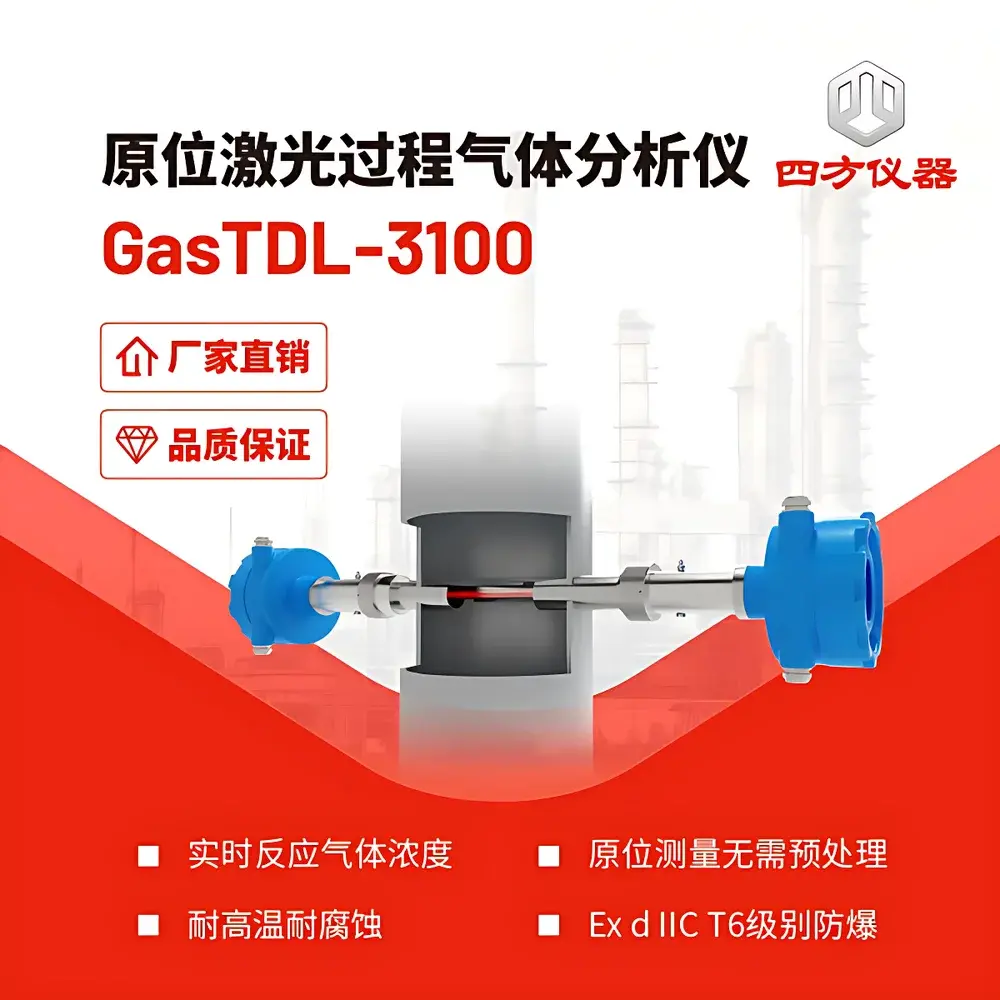
CUBIC INSTRUMENTS GasTDL-3100 In-Situ Tunable Diode Laser Oxygen Analyzer (Opposed-Beam Configuration)
| Brand | CUBIC INSTRUMENTS |
|---|---|
| Origin | Hubei, China |
| Model | GasTDL-3100 |
| Sensor Type | Tunable Diode Laser (TDLAS) |
| Measurement Ranges | H₂S: 0–100 ppm / 0–5000 ppm |
| O₂ | 0–5 %vol (customizable up to 100 %vol) |
| CO | 0–100 %vol |
| CO₂ | 0–100 %vol |
| CH₄ | 0–20 %vol |
| Accuracy | ≤ ±1 %FS |
| Repeatability | ≤ ±1 %FS |
| Resolution | 0.01 %vol |
| Response Time (T90) | ≤ 1 s |
| Explosion Protection | Exd II CT6 Gb / Ex tb IIIC T80°C Db |
| Power Supply | 24 V DC, 24 W |
| Ambient Temperature | −20 to +60 °C |
| Purge Gas | Industrial N₂, 0.3–0.8 MPa |
| Output Signals | 2 × 4–20 mA, 3 × relay |
| Communication | RS485, RS232 |
Overview
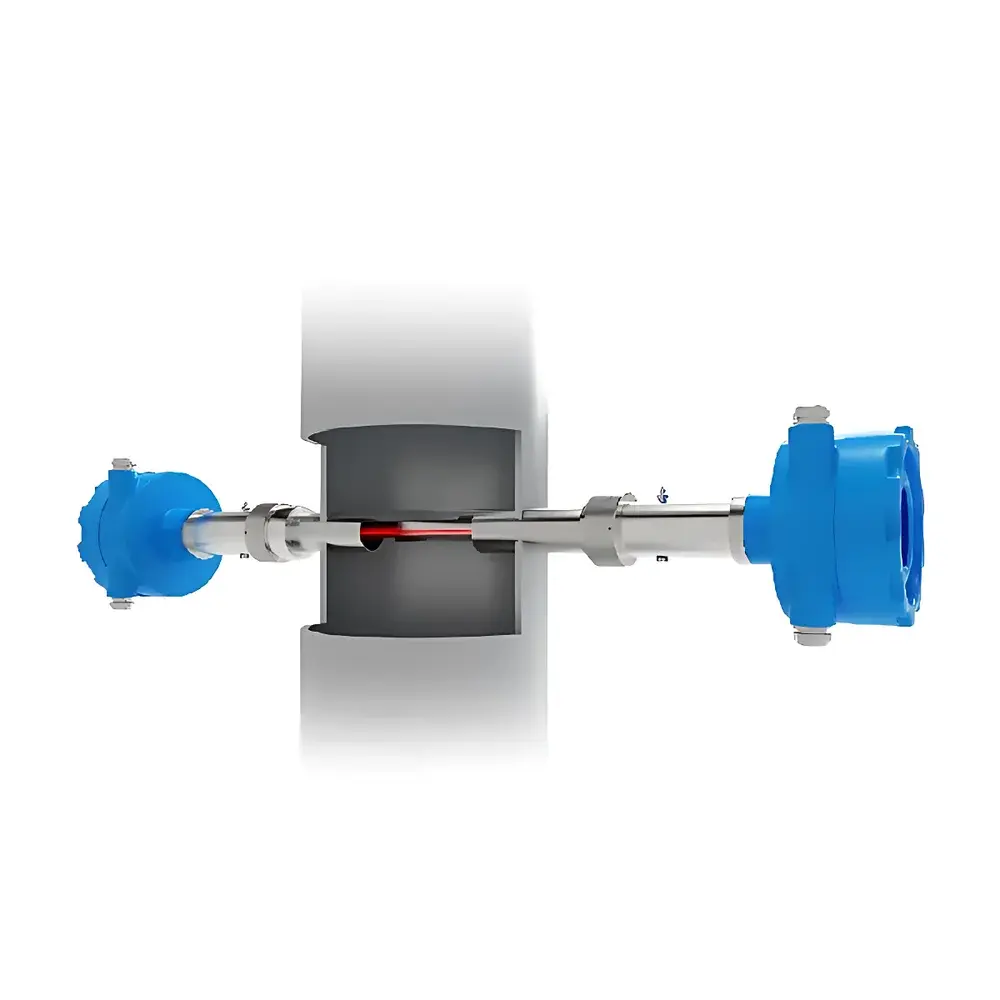
The CUBIC INSTRUMENTS GasTDL-3100 is an in-situ tunable diode laser absorption spectroscopy (TDLAS)-based oxygen analyzer engineered for real-time, high-fidelity gas concentration monitoring in demanding industrial process environments. Unlike extractive sampling systems, the GasTDL-3100 employs an opposed-beam optical configuration—comprising a laser transmitter and receiver mounted directly across a process duct or stack—to perform direct, non-contact measurement of gaseous O₂ within the process stream. This design eliminates sample transport delay, condensation artifacts, catalytic surface reactions, and calibration drift associated with heated sample lines and conditioning systems. The core measurement principle relies on wavelength-scanned near-infrared (NIR) laser absorption at specific rotational-vibrational transitions of molecular oxygen (e.g., around 760 nm), where absorbance is quantified via Beer–Lambert law under controlled path-length and temperature/pressure compensation. The system is intrinsically immune to cross-interference from common background gases (e.g., N₂, CO₂, H₂O vapor, CH₄) due to the narrow linewidth (<0.001 nm) and spectral selectivity of TDLAS, ensuring stable performance even in complex, multi-component flue or syngas streams.
Key Features
- True in-situ measurement without sampling probe, extraction line, or gas conditioning hardware—reducing maintenance burden and eliminating time lag (T90 ≤ 1 s)
- Robust optical architecture with no moving parts, consumables, or electrochemical cells—designed for continuous operation in harsh conditions including temperatures up to 60 °C ambient, high particulate loading, elevated moisture content, and corrosive atmospheres
- Integrated explosion-proof enclosure rated Exd II CT6 Gb and Ex tb IIIC T80 °C Db—certified for installation in Zone 1 and Zone 21 hazardous areas per IEC 60079 series
- Automatic baseline correction and pressure/temperature compensation algorithms ensure long-term stability and repeatability (≤ ±1 %FS)
- Modular optical alignment mechanism enables rapid field commissioning and re-alignment without specialized tools or recalibration
- Low-power consumption (24 V DC, 24 W) and dual analog outputs (4–20 mA) support seamless integration into DCS, PLC, and safety instrumented systems (SIS)
Sample Compatibility & Compliance
The GasTDL-3100 is validated for direct measurement of O₂ in gas matrices containing up to 100 %vol CO₂, 20 %vol CH₄, 100 %vol CO, and trace H₂S (0–5000 ppm). Its optical path tolerates dust loadings typical of cement kiln exhaust, biomass boiler flue gas, and metallurgical off-gas. While not certified to ISO 14001 or EPA Method 3A out-of-the-box, the analyzer meets functional requirements for continuous emission monitoring systems (CEMS) when deployed with appropriate data acquisition and audit-trail-enabled software. Its digital communication protocols (RS485 Modbus RTU, RS232) support integration into GLP/GMP-compliant environments when paired with validated SCADA platforms that provide electronic record integrity per FDA 21 CFR Part 11.
Software & Data Management
The GasTDL-3100 operates with embedded firmware supporting local configuration via front-panel keypad and LCD, or remotely via ASCII command set over serial interface. Optional PC-based configuration utility provides real-time spectral visualization, zero/span validation logs, and diagnostic trend history (laser drive current, photodetector signal-to-noise ratio, optical alignment status). All analog outputs include configurable damping, linearization, and range scaling. Relay outputs are programmable for alarm thresholds (e.g., low-O₂ trip in inerting systems) and can be assigned to fault conditions such as loss of beam alignment or purge failure. Audit-ready event logging—including parameter changes, calibration events, and power cycles—is stored internally for ≥30 days and exportable via serial dump.
Applications
- Oxygen control in thermal oxidizers and regenerative thermal oxidizers (RTOs) to optimize combustion efficiency and minimize NOₓ formation
- Inerting atmosphere monitoring in grain silos, pharmaceutical fluid-bed dryers, and lithium battery electrode coating lines
- Flue gas O₂ trimming in coal-, oil-, and biomass-fired boilers for adaptive air-fuel ratio control
- Safety-critical O₂ deficiency detection in confined-space entry systems and nitrogen-purged reactors
- Process gas purity verification in hydrogen production units (water-gas shift, PSA tail gas) and semiconductor fab bulk gas delivery
FAQ
Can the GasTDL-3100 measure multiple gases simultaneously?
Each unit is configured for a single target species (e.g., O₂ only); multi-gas capability requires separate analyzers or custom multi-line laser modules—not standard on the GasTDL-3100.
Is factory calibration traceable to NIST standards?
Calibration is performed using certified reference gases traceable to national metrology institutes; full calibration certificates with uncertainty budgets are available upon request.
What is the minimum optical path length required for reliable measurement?
The standard configuration supports path lengths from 0.3 m to 5 m; shorter paths may require sensitivity adjustment or higher-power laser options.
Does the analyzer require periodic optical cleaning?
No scheduled cleaning is needed under normal operation; the purge gas (industrial N₂) maintains positive pressure across optical windows to prevent fouling.
Can the 4–20 mA outputs be scaled to match legacy DCS input ranges?
Yes—each output channel is independently configurable for zero/span values, engineering units, and damping time constants via serial command or front-panel menu.