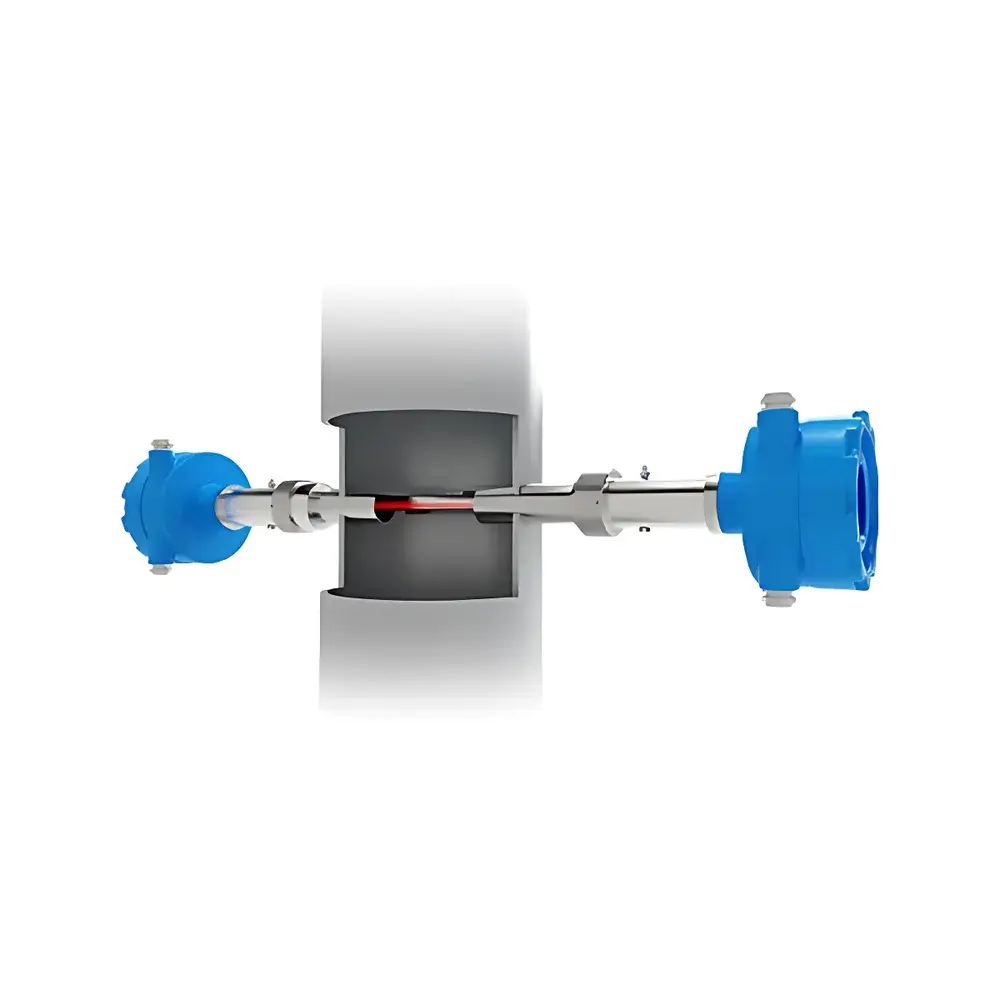
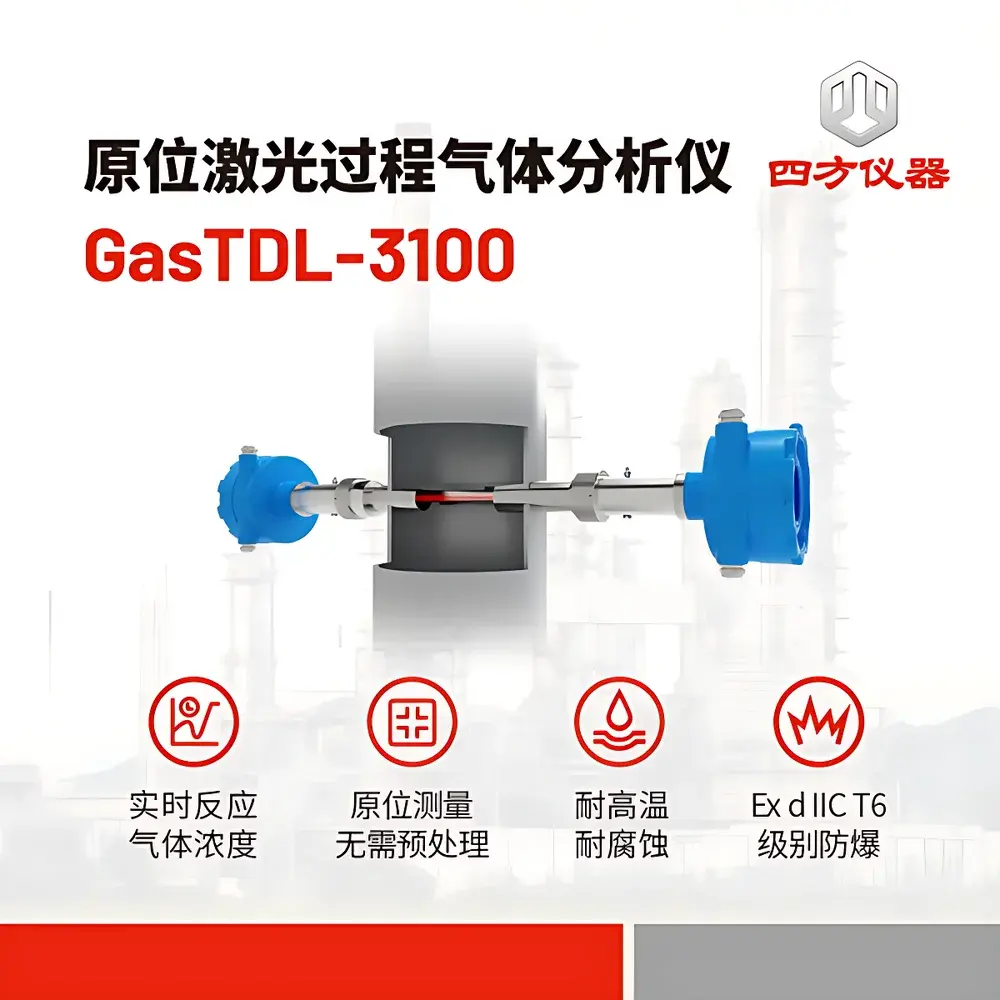
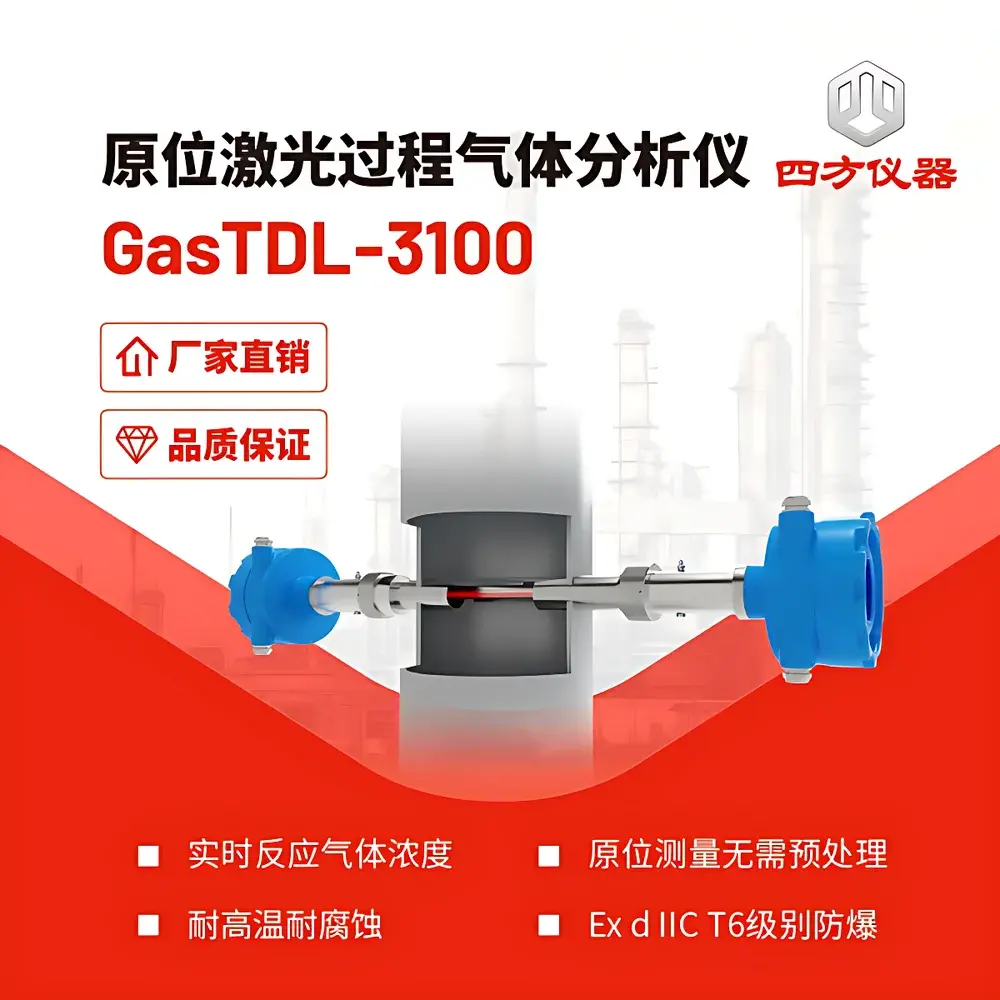
CUBIC INSTRUMENTS GasTDL-3100 Tunable Diode Laser Absorption Spectroscopy (TDLAS) In-Situ Online Gas Analyzer
| Brand | CUBIC INSTRUMENTS |
|---|---|
| Origin | Hubei, China |
| Model | GasTDL-3100 |
| Detection Principle | Tunable Diode Laser Absorption Spectroscopy (TDLAS) |
| Sampling Method | In-situ |
| Linearity Error | ≤±1% F.S. |
| Repeatability | ≤±1% |
| Span Drift | ≤±1% F.S. |
| Response Time | T90 ≤ 1 s |
| Explosion Protection Rating | Ex db IIC T6 Gb / Ex tb IIIC T80°C Db |
| Measured Gases | H₂S (0–100 ppm / 0–5000 ppm), O₂ (0–5 %vol, customizable to 100 %vol), CO (0–100 %vol), CO₂ (0–100 %vol), CH₄ (0–20 %vol) |
| Resolution | 0.01 %vol |
| Power Supply | 24 V DC, 24 W |
| Ambient Temperature Range | −20 to +60 °C |
| Purge Gas | Industrial nitrogen, 0.3–0.8 MPa |
| Output Signals | 2 × 4–20 mA, 3 × relay outputs |
| Communication Interface | RS485, RS232 |
Overview
The CUBIC INSTRUMENTS GasTDL-3100 is an in-situ, real-time online gas analyzer engineered for continuous, high-fidelity concentration monitoring in demanding industrial process environments. It employs Tunable Diode Laser Absorption Spectroscopy (TDLAS), a physics-based optical measurement technique that exploits the unique near-infrared absorption fingerprints of target gas molecules. Unlike extractive systems requiring sample conditioning, the GasTDL-3100 performs direct path-integrated measurements across the process stream using a dual-beam, opposed-transmission optical configuration. This eliminates transport delay, condensation artifacts, and catalytic degradation associated with sampling lines and pre-treatment hardware—ensuring traceable, time-synchronized data essential for closed-loop control, safety interlocks, and emissions compliance reporting.
Key Features
- In-situ measurement architecture: No sample extraction, no filtration, no drying, no calibration gas consumption—reducing system complexity and long-term operational cost.
- High-speed response: T90 ≤ 1 second enables detection of rapid process transients, such as furnace combustion anomalies or flare composition shifts, supporting dynamic process optimization.
- Gas-selective detection: TDLAS inherently rejects spectral interference from background gases (e.g., H2O, CO2, N2) due to narrow-linewidth laser scanning over isolated rotational-vibrational transitions—eliminating cross-sensitivity without software compensation.
- Robust mechanical design: Hermetically sealed optical head with fused silica windows; no moving parts, no consumables, no optical alignment required during field operation.
- Industrial-grade explosion protection: Certified to both gas (Ex db IIC T6 Gb) and dust (Ex tb IIIC T80°C Db) hazardous area standards—suitable for Zone 1/21 installations in refineries, chemical plants, and biogas facilities.
- Thermal and particulate resilience: Optimized optical path geometry and active window purge interface enable stable operation in flue gases up to 600°C (with optional high-temp probe), under high-dust loading (>10 g/m³), and in saturated moisture conditions.
Sample Compatibility & Compliance
The GasTDL-3100 is validated for continuous monitoring of H₂S, O₂, CO, CO₂, and CH₄ in raw process streams including syngas, coke oven gas, cement kiln exhaust, landfill biogas, and sulfur recovery unit (SRU) tail gas. Its measurement methodology conforms to the physical principles outlined in ISO 14057 (gas analysis — performance criteria for in-situ analyzers) and supports alignment with EPA Method 3A (for O₂), ASTM D6216 (for CO/CO₂), and EN 15267-3 (QAL1 certification framework). While not pre-certified to US EPA PS-11 or MCERTS, its metrological performance (≤±1% F.S. linearity, ≤±1% repeatability, ≤±1% span drift) meets the accuracy thresholds required for regulatory-grade continuous emission monitoring systems (CEMS) when integrated into auditable QA/QC workflows per ISO/IEC 17025 and GLP guidelines.
Software & Data Management
The analyzer embeds a deterministic real-time OS with local data buffering (72-hour history at 1-second resolution) and dual redundant communication interfaces (RS485 Modbus RTU and RS232 ASCII). Analog outputs (2 × 4–20 mA) are fully scalable and linearized per gas component, traceable to NIST-traceable reference standards. Digital relay outputs support fail-safe shutdown logic (e.g., H₂S > 10 ppm triggers scrubber activation). Remote configuration, spectral diagnostics, and zero/span verification logs are accessible via secure web interface or OPC UA server (optional). Audit trails—including parameter changes, calibration events, and fault codes—are timestamped and immutable, satisfying FDA 21 CFR Part 11 requirements for electronic records when deployed in pharmaceutical or food-grade sterilization processes.
Applications
- Combustion optimization in thermal oxidizers and incinerators via real-time O₂ and CO feedback.
- H₂S monitoring in amine regenerator overheads and Claus plant tail gas for sulfur recovery efficiency control.
- CH₄ and CO₂ quantification in biogas upgrading systems to ensure pipeline injection specifications (e.g., ISO 8573-1 Class 2).
- CO safety monitoring in steel mill off-gas ducts and blast furnace stoves per OSHA PEL and ACGIH TLV limits.
- Process gas purity assurance in hydrogen production units (PEM electrolysis, SMR) where trace O₂ or CO must remain below ppb-level thresholds.
FAQ
Is the GasTDL-3100 suitable for high-temperature flue gas applications?
Yes—when equipped with the optional high-temperature probe variant, it operates continuously in gas streams up to 600°C. Standard configuration supports ambient duct temperatures up to +60°C at the analyzer housing.
Can it measure multiple gases simultaneously?
No—it is configured for single-gas measurement per optical channel. Multi-component analysis requires either sequential channel switching (not supported) or co-installed units with dedicated lasers tuned to each target species.
What maintenance is required beyond periodic window inspection?
None. The absence of moving parts, electrochemical cells, or consumable filters means only annual visual verification of purge gas integrity and optical window cleanliness is recommended.
Does it comply with SIL2 functional safety requirements?
The base unit is not SIL2-certified; however, its 2-out-of-3 voting-ready relay outputs and deterministic response time allow integration into SIL2-rated safety instrumented systems (SIS) when validated per IEC 61511.
How is zero calibration performed in-situ?
Zero is established by injecting certified nitrogen (or clean air for O₂ mode) through the integrated purge port while maintaining optical path continuity—no optical shutter or mechanical bypass is used.