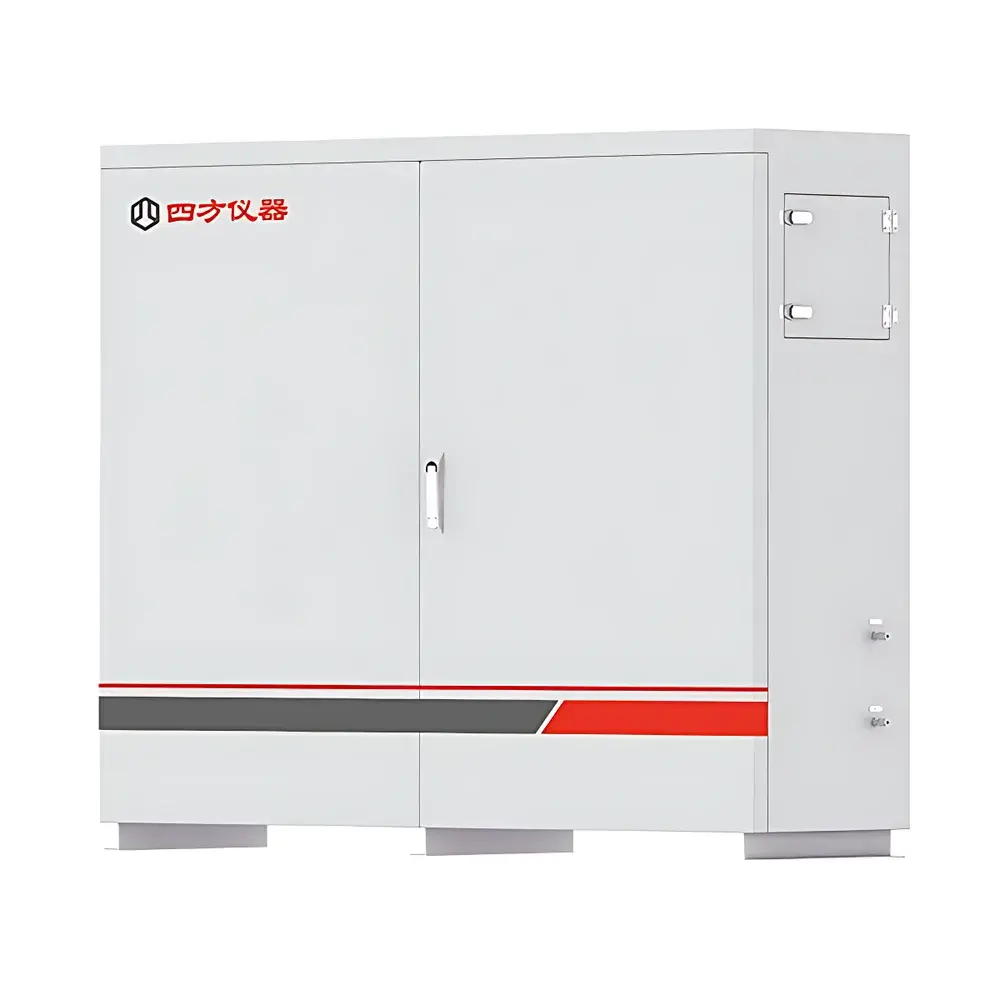
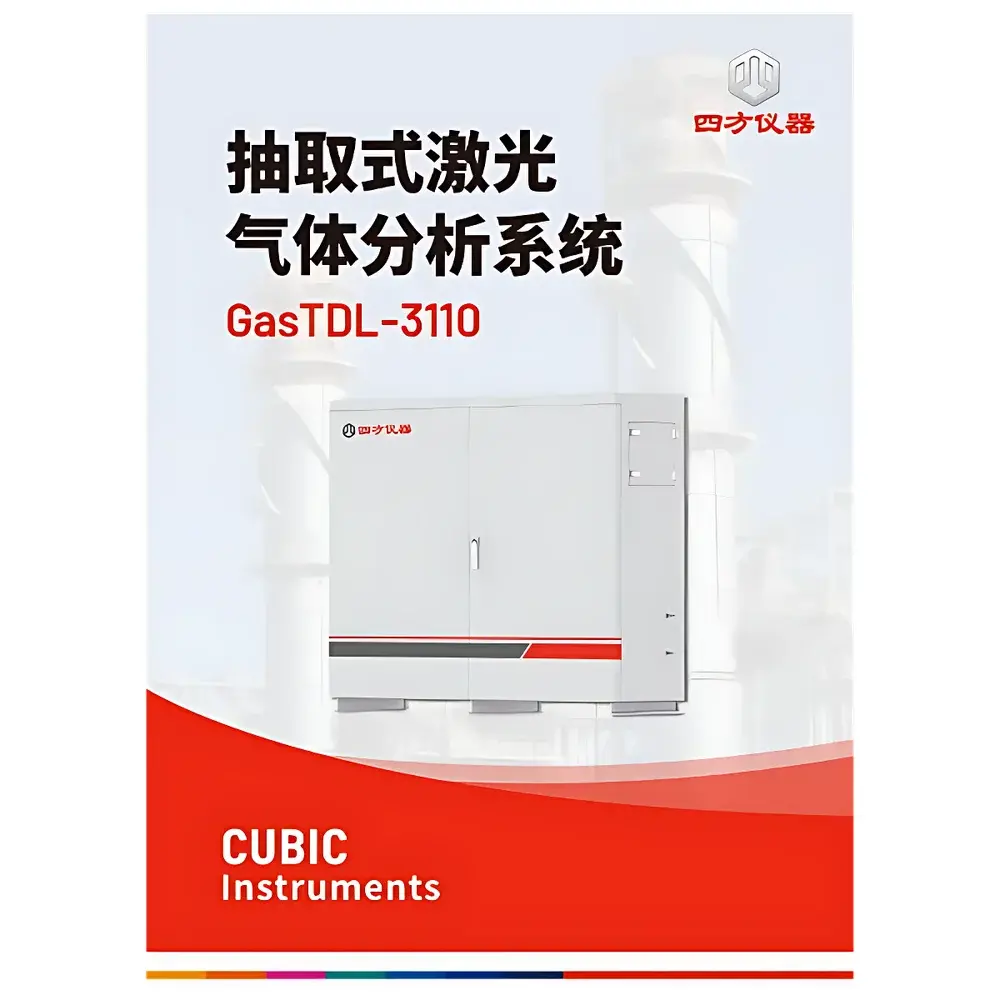
CUBIC INSTRUMENTS GasTDL-3110 Tunable Diode Laser Absorption Spectroscopy (TDLAS) Online Gas Analyzer
| Brand | CUBIC INSTRUMENTS |
|---|---|
| Origin | Hubei, China |
| Model | GasTDL-3110 |
| Linearity Error | ≤±1% F.S. |
| Repeatability | ≤±1% |
| Span Drift | ≤±1% F.S. |
| Explosion Protection Rating | Ex db IIC T6 Gb / Ex tb IIIC T80℃ Db |
| Measurement Principle | TDLAS (Transmittance Configuration) |
| Measured Gases | H₂S (0–100 ppm / 0–5000 ppm), O₂ (0–5% vol, optional up to 100%), CO (0–100% vol), CO₂ (0–100% vol), CH₄ (0–20% vol) |
| Resolution | 0.01% vol |
| Ambient Temperature Range | −20 to +60 °C |
| Power Supply | 220 V AC, 50 Hz |
| Sample Gas Pressure | 0.3–0.8 MPa |
| Output Signals | 2 × 4–20 mA, 3 × Relay |
| Communication | RS485, RS232 |
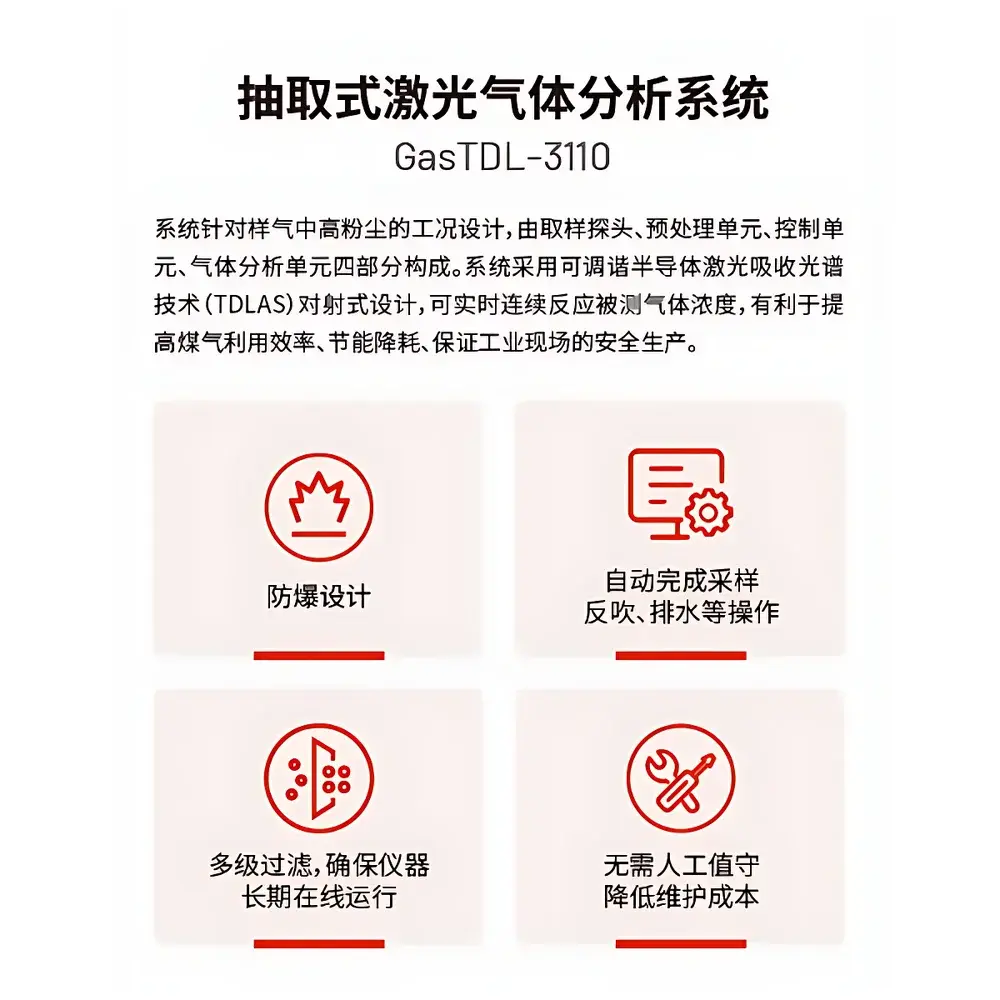
| Sample Conditioning | Multi-stage filtration, automatic probe purge, condensate drainage |
Overview
The CUBIC INSTRUMENTS GasTDL-3110 is an industrial-grade, in-situ online gas analyzer engineered for continuous, real-time concentration measurement of critical process gases—including H₂S, O₂, CO, CO₂, and CH₄—in harsh industrial environments. It employs Tunable Diode Laser Absorption Spectroscopy (TDLAS) in a transmittance (through-beam) configuration, leveraging the unique near-infrared absorption fingerprints of target molecules. Unlike extractive NDIR or electrochemical sensors, TDLAS provides inherent selectivity by tuning the laser wavelength to specific rotational-vibrational transitions—eliminating cross-sensitivity from background gases such as H₂O, CO, or N₂. This physical measurement principle ensures long-term stability, minimal calibration drift, and immunity to chemical poisoning. The system is purpose-built for high-dust, high-moisture, high-temperature, and corrosive flue or process streams—common in iron & steel, coking, non-ferrous metallurgy, and coal-fired power generation. Its modular architecture integrates four functional subsystems: a ruggedized sampling probe with integrated air-purge and auto-cleaning capability, a multi-stage particulate and moisture removal pre-conditioning unit, a temperature-stabilized optical measurement cell, and a microprocessor-based control and data acquisition module.
Key Features
- Explosion-proof certification compliant with IEC 60079-0, -1, and -31: Ex db IIC T6 Gb (for gas atmospheres) and Ex tb IIIC T80°C Db (for combustible dust environments), enabling safe deployment in Zone 1/21 hazardous areas.
- Probe-mounted automatic purge system using clean instrument air or nitrogen, preventing optical window fouling and extending maintenance intervals in high-dust applications (e.g., baghouse outlets, blast furnace hot blast mains).
- Fully automated sample handling: sequential sampling, reverse-blow cleaning, and condensate separation—reducing manual intervention and ensuring uninterrupted operation over extended periods.
- Multi-stage filtration (coalescing, cyclonic, sintered metal, and heated membrane stages) maintains optical path integrity under particulate loads exceeding 10 g/Nm³.
- Robust thermal management: internal temperature stabilization of the laser diode and detector enables stable performance across ambient temperatures from −20 °C to +60 °C without external climate control.
- Dual analog outputs (4–20 mA) with galvanic isolation support integration into DCS/PLC systems; three programmable relay outputs enable local alarm actuation or interlock signaling per regulatory requirements (e.g., OSHA 1910.119, EN 61511).
Sample Compatibility & Compliance
The GasTDL-3110 accommodates wet, hot, and abrasive sample streams typical of metallurgical off-gas systems—including raw coke oven gas (COG), blast furnace top gas (BFG), basic oxygen furnace (BOF) exhaust, and hot air from regenerative heating furnaces. Its optical path design tolerates particulate concentrations up to 500 mg/m³ and water vapor saturation at up to 80 °C. All wetted materials—including probe body, filter housings, and flow cells—are constructed from 316L stainless steel or Hastelloy C-276 where required for chloride resistance. The analyzer meets electromagnetic compatibility (EMC) standards per IEC 61326-1 (industrial environment) and conforms to safety requirements outlined in IEC 61010-1. While not certified to SIL2/SIL3, its architecture supports use in safety instrumented functions (SIFs) when integrated with third-party logic solvers compliant with IEC 61511. Documentation includes full traceable calibration records, material certificates, and explosion-proof test reports issued by nationally accredited laboratories (CNEx).
Software & Data Management
The embedded firmware supports local configuration via front-panel keypad and LCD, or remotely via Modbus RTU over RS485/RS232. Data logging is performed at user-configurable intervals (1 s to 1 h) with onboard storage capacity for ≥30 days of second-level trend data. Export options include CSV via USB port or Ethernet (optional). The system supports audit-trail functionality—including operator login timestamps, parameter change logs, and calibration event records—aligning with GLP and FDA 21 CFR Part 11 expectations when deployed in regulated manufacturing environments. Optional OPC UA server integration enables seamless connectivity to MES and historian platforms (e.g., OSIsoft PI, AVEVA System Platform). Firmware updates are delivered via signed binary packages to ensure integrity and version control.
Applications
- Blast furnace operations: Continuous monitoring of CO, CO₂, and CH₄ at baghouse outlet for calorific value calculation and blast optimization; O₂ measurement in hot blast main to prevent refractory damage and improve combustion efficiency.
- Coking plants: Real-time H₂S and O₂ detection downstream of electrostatic tar precipitators to mitigate explosion risk and ensure compliance with GB 16297–1996 emissions limits.
- Steelmaking: CO concentration profiling pre- and post-secondary venturi scrubbers to optimize recovery efficiency and verify decarburization kinetics during BOF tapping.
- Coal pulverizing systems: H₂S and O₂ surveillance at mill outlet and coal bunker to prevent spontaneous ignition and enforce NFPA 85-compliant inerting protocols.
- Heating furnace control: Dual-point CO/O₂ measurement in reheating furnace flue ducts to close-loop combustion air ratio control and reduce NOₓ formation.
FAQ
What gases can the GasTDL-3110 measure simultaneously?
It measures one gas per optical channel; multi-component analysis requires parallel TDLAS channels or time-multiplexed scanning. Standard configurations support H₂S, O₂, CO, CO₂, or CH₄—each calibrated independently.
Is field calibration required after installation?
Zero/span verification is recommended every 3–6 months using certified reference gases; full recalibration is typically needed only after optical component replacement or major environmental exposure events.
Can the analyzer operate without external cooling or conditioning?
Yes—the system is designed for direct in-situ mounting on ducts or stacks up to 200 °C process temperature; no external chiller or refrigerated dryer is required due to integrated thermal management and multi-stage dryers.
How is measurement traceability ensured?
Each unit ships with NIST-traceable calibration certificates for all configured gases, referencing ISO 6141 and ISO 6145-7 methodologies; laser wavelength accuracy is verified against certified gas cells prior to shipment.
Does it support integration with DCS systems using standard protocols?
Yes—Modbus RTU over RS485 is standard; optional Profibus DP, Foundation Fieldbus H1, or Ethernet/IP modules are available for legacy or modern control system integration.
Related Products