
CUBIC INSTRUMENTS LRGA-3100 Laser Raman Gas Analyzer
| Brand | CUBIC INSTRUMENTS |
|---|---|
| Origin | Hubei, China |
| Model | LRGA-3100 |
| Spectrometer Type | Grating-Based Raman Spectrometer |
| Spectral Range | 400–700 nm |
| Spectral Resolution | 0.01% |
| Spatial Resolution | 1 µm (lateral), 2 µm (axial) |
| Minimum Wavenumber | 10 cm⁻¹ |
| Spectral Repeatability | ≤1% |
| Measurement Accuracy | ≤±1% F.S. |
| Response Time | ≤10 s |
| Operating Temperature | 10–35 °C |
| Power Supply | AC 220 V / 50 Hz, <70 W |
| Dimensions (L×W×H) | 605 × 483 × 220 mm |
| Interface Options | USB, RS-232, RS-485, Ethernet |
| Measured Gases | H₂, N₂, O₂, CO, CO₂, CH₄, C₂H₂, C₂H₄, C₂H₆, C₃H₆, C₃H₈, H₂S |
Overview
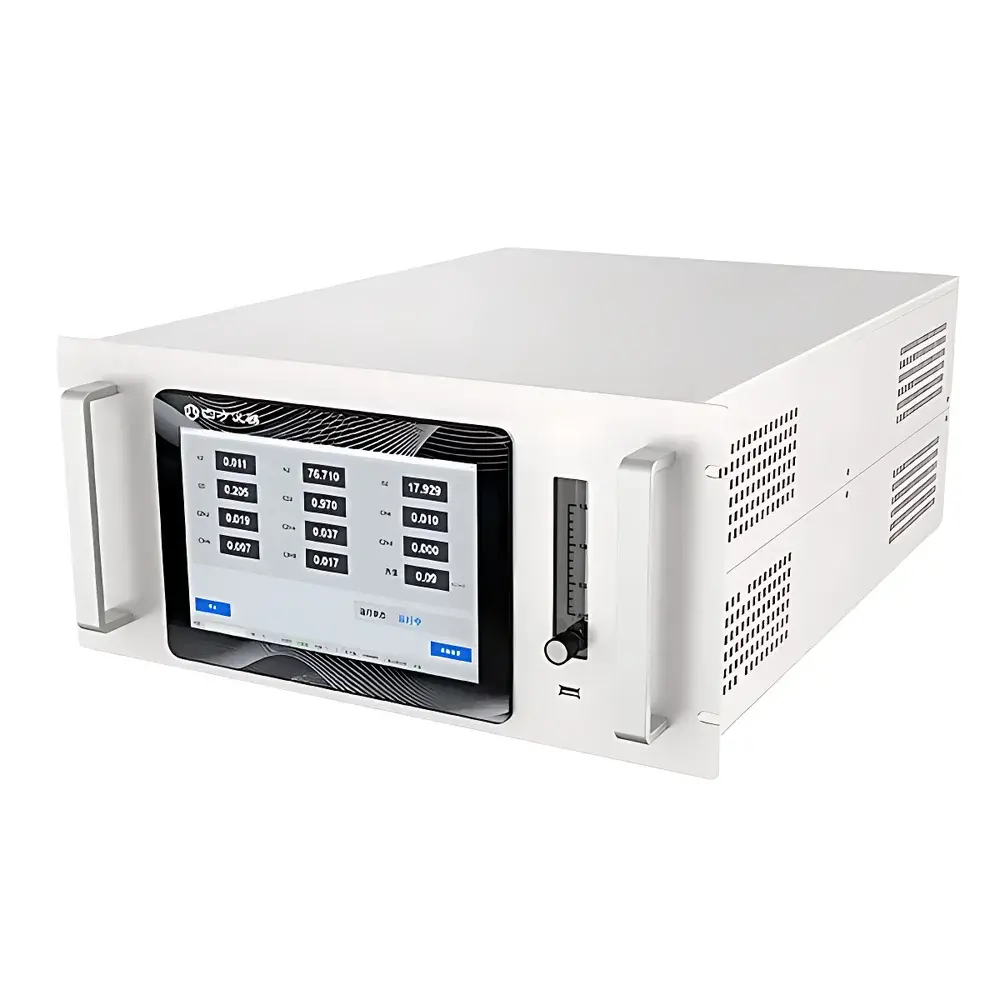
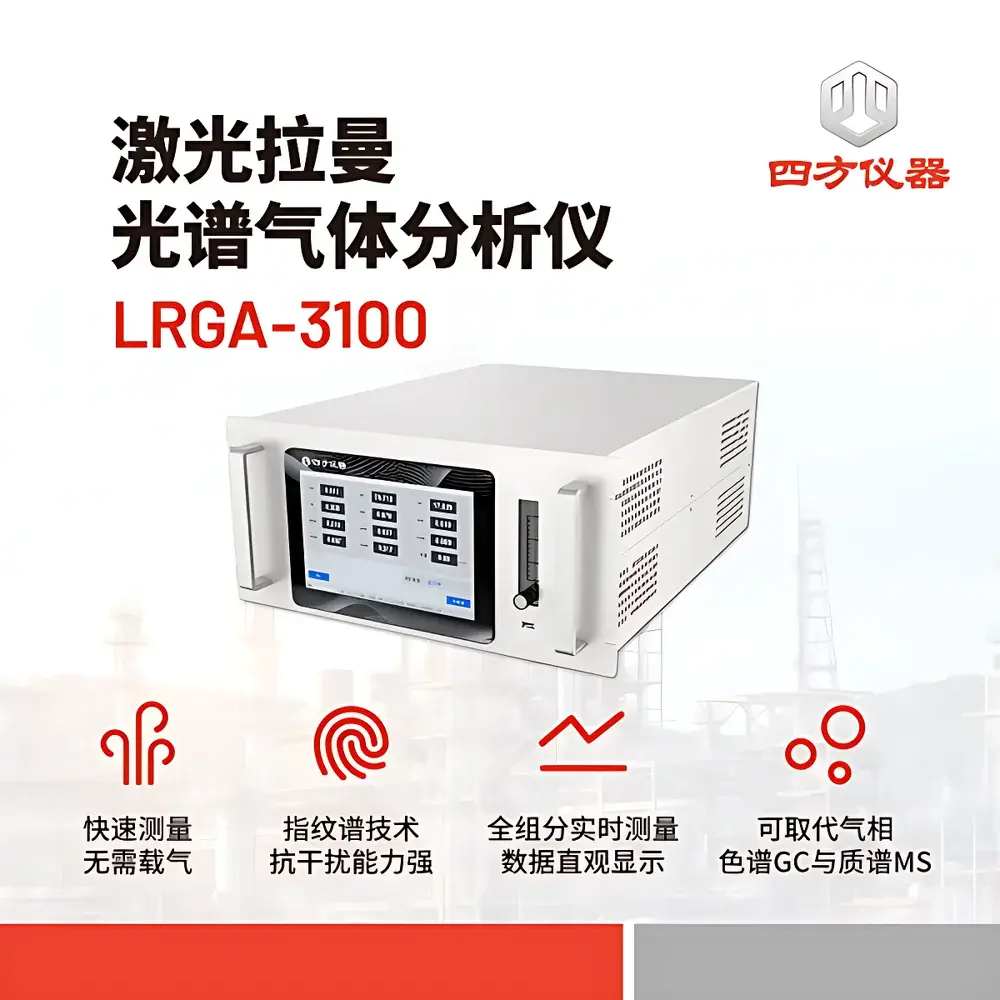
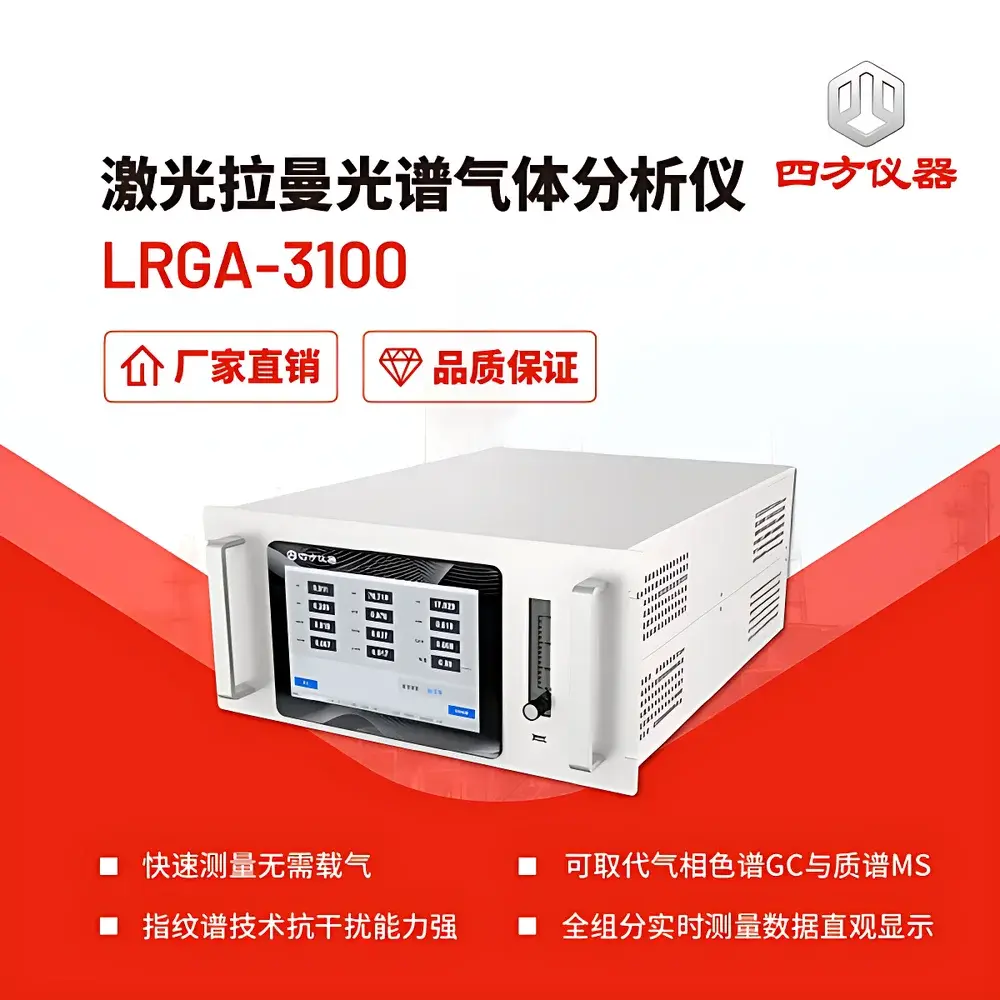
The CUBIC INSTRUMENTS LRGA-3100 is a compact, high-performance Laser Raman Gas Analyzer engineered for real-time, multi-component quantitative analysis of industrial process gases. Based on the fundamental principle of spontaneous Raman scattering, the LRGA-3100 employs a high-brightness monochromatic laser source focused into a gas cell, where incident photons interact with molecular vibrational modes to generate inelastic scattered light—characteristic Raman shifts unique to each chemical species. Unlike absorption-based techniques, Raman spectroscopy is inherently sensitive to homonuclear diatomic molecules (e.g., H₂, N₂, O₂), which lack infrared activity and are therefore undetectable by FTIR or NDIR methods. The instrument integrates optimized optical path design derived from the national-level LRGA-6000 platform, achieving reduced footprint without compromising spectral fidelity or signal-to-noise ratio. Its all-solid-state optical architecture eliminates moving parts in the spectrometer core, ensuring long-term stability under continuous operation in demanding industrial environments.
Key Features
- Real-time, continuous multi-gas quantification with ≤10-second system response time—enabling closed-loop process control and rapid leak detection.
- Simultaneous measurement of up to 13 industrially relevant gases—including H₂, CH₄, CO₂, H₂S, C₂H₄, and C₃H₈—without chromatographic separation or consumable carrier gases.
- Laser-excited Raman fingerprinting provides intrinsic selectivity; spectral interference from water vapor, dust, or background matrix is negligible due to narrow-band excitation and notch-filtered collection.
- Full-scale concentration measurement from 0–100% vol/vol, supported by internal reference calibration and robust peak-intensity normalization algorithms.
- Integrated touchscreen HMI with intuitive graphical interface; optional PC connectivity via USB or Ethernet for remote monitoring, data export (CSV, ASCII), and integration with DCS/SCADA systems.
- Zero consumables architecture: no carrier gas, zero-air generators, or calibration standards required during routine operation—reducing total cost of ownership and eliminating supply-chain dependencies.
Sample Compatibility & Compliance
The LRGA-3100 is designed for direct, non-invasive analysis of raw, unconditioned process streams—including humid, particulate-laden, or high-pressure gas samples—without sample conditioning systems. Its optical probe configuration supports in-situ installation on process lines or extraction manifolds, meeting API RP 14C and IEC 60079-28 requirements for optical intrinsically safe measurement in hazardous areas (certification documentation available upon request). While not classified as a GLP/GMP-compliant analytical instrument per se, its software architecture supports audit-trail logging, user-access controls, and electronic signature capability compliant with FDA 21 CFR Part 11 when deployed with validated firmware and procedural SOPs. Data integrity adheres to ALCOA+ principles (Attributable, Legible, Contemporaneous, Original, Accurate, Complete, Consistent, Enduring, Available), and spectral raw data files retain full metadata (timestamp, laser power, integration time, temperature compensation values).
Software & Data Management
The LRGA-3100 runs on embedded Linux with CUBIC’s proprietary RamanQuant™ analysis suite. Spectral acquisition, baseline correction, multivariate curve fitting (using constrained non-negative least squares), and concentration calculation occur in real time. Calibration models are stored as encrypted .rmdl files and support both single-component and multi-component cross-interference correction. Software includes built-in validation tools: spectral drift monitoring, intensity stability tracking, and automated signal quality scoring (SQI ≥ 0.95 required for valid quantification). All raw spectra and processed results are timestamped and archived locally on dual SD cards (mirrored storage); optional cloud sync enables centralized fleet monitoring across distributed sites. Export formats include CSV, HDF5, and vendor-neutral JCAMP-DX for third-party chemometric analysis (e.g., MATLAB, Python scikit-learn).
Applications
The LRGA-3100 delivers proven performance across ten critical industrial domains: natural gas composition verification (including H₂ blending certification); shale gas compositional profiling without C₄+ interference; drilling mud gas logging (meeting SY/T 5788.2–2018 specifications); refinery FCC off-gas monitoring; coal gasification syngas optimization; blast furnace top-gas analysis; coke oven gas safety surveillance; biomass-derived syngas characterization; tire pyrolysis gas speciation; and rubber pyrolysis reactor effluent control. Its immunity to water vapor, absence of consumables, and ability to quantify inert and symmetric diatomic species make it uniquely suited for applications where GC or MS face fundamental physical limitations—particularly in hydrogen-rich, low-molecular-weight hydrocarbon, or high-humidity environments.
FAQ
Does the LRGA-3100 require gas calibration standards for routine operation?
No. It uses an internal reference channel and laser power stabilization to maintain long-term photometric accuracy. Initial factory calibration is traceable to NIST-certified gas mixtures, but field recalibration is optional and only recommended after major optical maintenance.
Can the instrument measure gases in high-humidity or corrosive streams?
Yes. The optical measurement principle is unaffected by water vapor, and the gas cell is constructed from 316L stainless steel with Hastelloy C-276 wetted parts, rated for H₂S concentrations up to 5,000 ppm and HCl up to 100 ppm at 25 °C.
Is spectral library customization supported?
Yes. Users may import custom Raman cross-section databases and train new multivariate models using the RamanQuant™ SDK, subject to validation per ISO/IEC 17025 guidelines.
What is the minimum detectable concentration for H₂ in air?
At standard conditions (1 atm, 25 °C), the practical limit of detection (LOD) for H₂ is 0.1% vol/vol with 10-second averaging, based on signal-to-noise ratio >3 in the 4152 cm⁻¹ Q-branch region.
How is temperature compensation handled during measurement?
An integrated Pt100 sensor monitors gas cell temperature in real time; spectral peak positions and intensities are dynamically corrected using first-principles thermal expansion and population distribution models embedded in firmware.





