
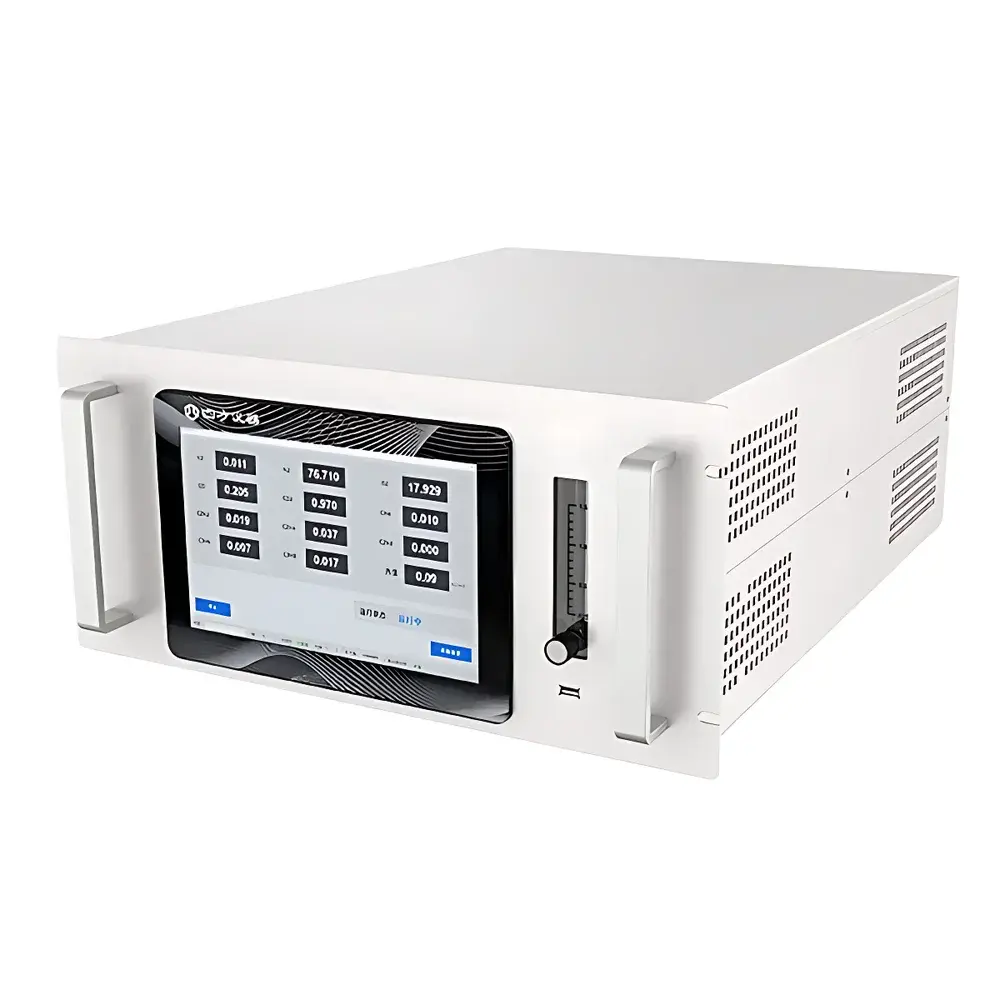
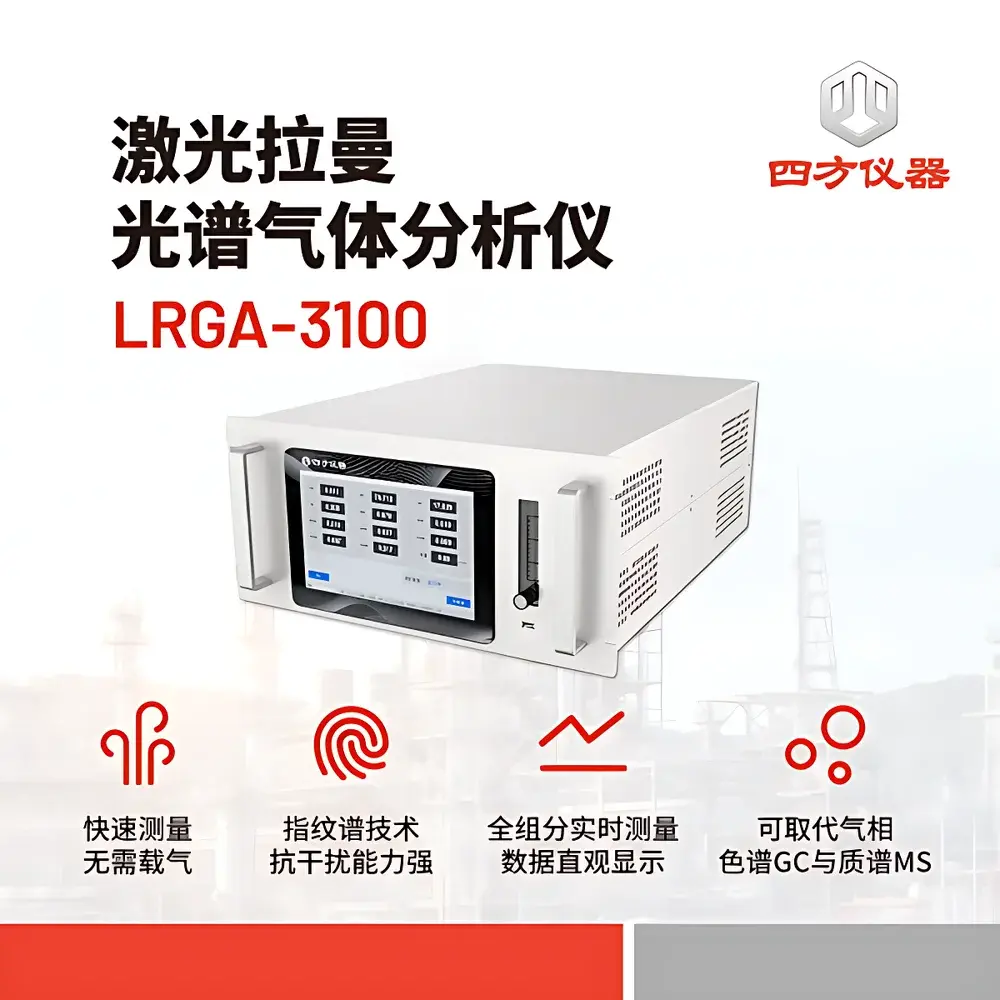
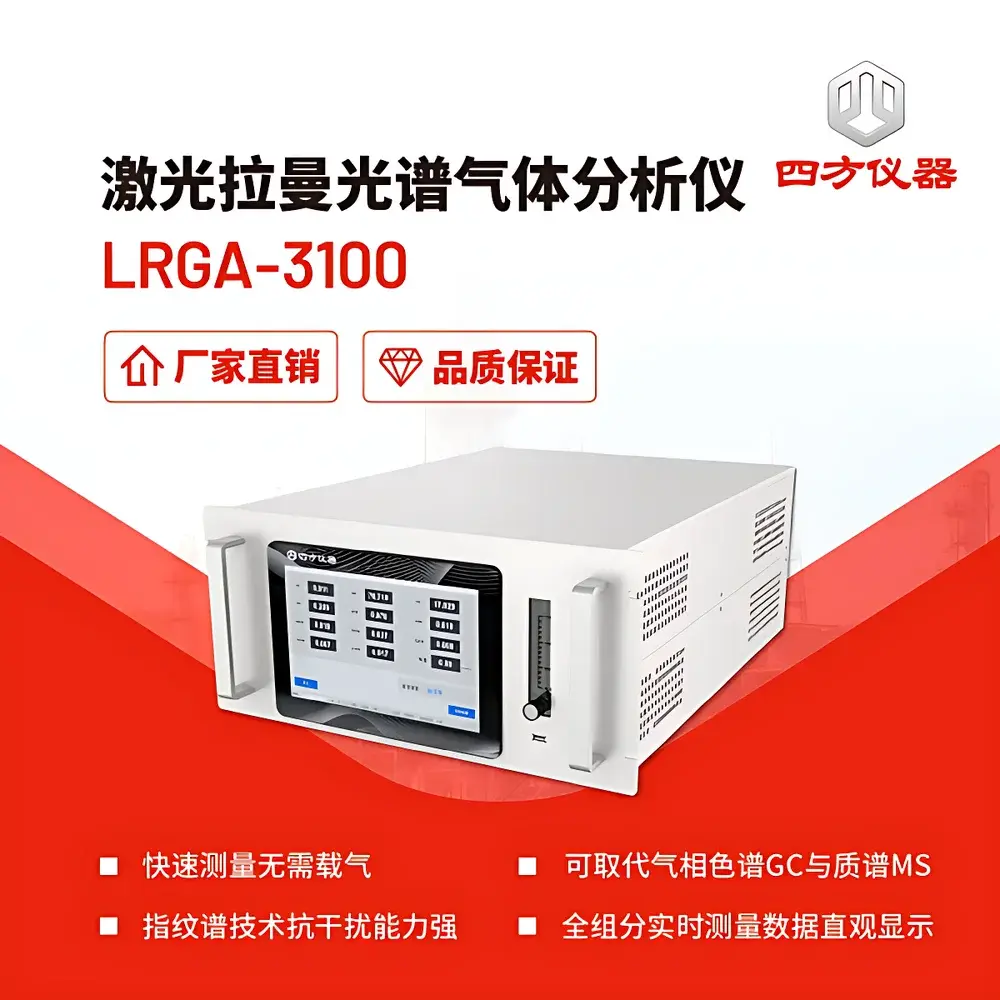
CUBIC INSTRUMENTS LRGA-3100 Laser Raman Gas Analyzer for Tire Pyrolysis
| Brand | CUBIC INSTRUMENTS |
|---|---|
| Origin | Hubei, China |
| Manufacturer Type | Authorized Distributor |
| Country of Origin | China |
| Model | LRGA-3100 |
| Instrument Type | Grating-Based Raman Spectrometer |
| Spectral Repeatability | ≤1% |
| Measurement Range | 0–100% (full-scale) |
| Accuracy | ≤±1% F.S. |
| Response Time | ≤10 s |
| Operating Temperature | 10–35 °C |
| Power Supply | AC 220 V / 50 Hz, <70 W |
| Interfaces | USB, RS-232, RS-485, Ethernet |
| Dimensions (L×W×H) | 605 × 483 × 220 mm |
| Detectable Gases | H₂, N₂, O₂, CO, CO₂, CH₄, C₂H₂, C₂H₄, C₂H₆, C₃H₆, C₃H₈, H₂S |
Overview
The CUBIC INSTRUMENTS LRGA-3100 Laser Raman Gas Analyzer is a compact, process-integrated spectroscopic instrument engineered for real-time, multi-component quantitative analysis of industrial gas streams—specifically optimized for tire pyrolysis off-gas monitoring. It operates on the fundamental principle of spontaneous Raman scattering: a monochromatic laser beam (typically 532 nm or 785 nm) interacts with gas molecules in a dedicated measurement cell, inducing inelastic scattering that yields molecule-specific vibrational fingerprints. Unlike absorption-based techniques, Raman spectroscopy relies on intrinsic molecular polarizability changes, enabling direct detection of homonuclear diatomic gases (e.g., H₂, N₂, O₂) that are IR-inactive and invisible to conventional NDIR or FTIR systems. The LRGA-3100 integrates a high-efficiency grating spectrometer, low-noise CCD detector, thermoelectrically stabilized laser source, and precision optical alignment—engineered to deliver robust spectral acquisition under fluctuating ambient conditions typical of pyrolysis plant environments. Its sub-10-second response time supports closed-loop process control, while its calibration-free operation over full 0–100% concentration ranges eliminates dependency on carrier gases, reference standards, or frequent recalibration—critical for continuous operation in resource-constrained industrial settings.
Key Features
- Real-time, multi-gas quantification without sample pre-treatment or gas conditioning—enabling direct in-line installation on reactor vent lines or condenser bypass streams
- Detection of 12+ key pyrolysis gases including H₂, CH₄, C₂H₄, C₂H₂, C₃H₆, CO, CO₂, H₂S, and inert components (N₂, O₂), all resolved simultaneously from a single spectrum
- Raman fingerprint discrimination ensures high selectivity in complex hydrocarbon matrices; minimal cross-sensitivity to water vapor, particulates, or background fluorescence
- Full-scale linear response (0–100%) with ≤±1% F.S. accuracy and ≤1% spectral repeatability—validated per ISO 13199:2013 for Raman-based gas analyzers
- Embedded ARM-based controller with 7-inch capacitive touchscreen interface; optional remote operation via Ethernet with Modbus TCP or OPC UA protocol support
- Modular optical design derived from the national Key Scientific Instrument Development Program (LRGA-6000 platform), achieving >40% volume reduction versus prior-generation benchtop systems
Sample Compatibility & Compliance
The LRGA-3100 is validated for direct analysis of hot, humid, and particulate-laden pyrolysis gases at temperatures up to 80 °C (with optional heated sampling line). Its non-contact, non-destructive measurement mode preserves sample integrity and avoids catalytic surface reactions common in electrochemical or semiconductor sensors. The analyzer complies with IEC 61000-6-2 (EMC immunity) and IEC 61000-6-4 (EMC emissions), and meets ATEX Zone 2/IECEx certification requirements when installed with appropriate purge or enclosure solutions. Data integrity protocols align with GLP and GMP expectations: audit trails, user access levels, electronic signatures, and 21 CFR Part 11-compliant data archiving are supported through optional software modules. All spectral calibrations are traceable to NIST-standard gas mixtures, and measurement uncertainty budgets adhere to ISO/IEC 17025:2017 principles for in-house calibration validation.
Software & Data Management
The embedded CUBIC RamanView™ software provides real-time spectral visualization, peak deconvolution using constrained non-negative least squares (NNLS), and multivariate quantification via partial least squares (PLS) regression models trained on representative pyrolysis gas matrices. Raw spectra and processed results are stored in HDF5 format with metadata tagging (timestamp, pressure, temperature, operator ID). Export options include CSV, PDF reports, and SQL database integration. Remote diagnostics, firmware updates, and model retraining are supported over secure TLS-encrypted Ethernet connections. Optional cloud synchronization enables centralized fleet monitoring across multiple pyrolysis units, with configurable alarm thresholds for H₂S breakthrough, CH₄/N₂ ratio shifts, or CO/CO₂ oxidation state drift—key indicators of feedstock variability or thermal cracking inefficiency.
Applications
Beyond tire pyrolysis, the LRGA-3100 is deployed in coal gasification, biomass syngas monitoring, coke oven gas analysis, and refinery flare gas composition verification. In tire recycling operations, it enables precise tracking of volatile organic compound (VOC) evolution during devolatilization stages, distinguishing natural rubber (high isoprene signature) from synthetic SBR or BR feedstocks via characteristic C=C and C–H stretching modes. Its ability to quantify H₂ alongside light hydrocarbons supports hydrogen balance calculations for energy recovery optimization. For QA/QC labs, the system serves as a reference method for validating GC-TCD/FID results—particularly where chromatographic co-elution (e.g., C₂H₄/C₂H₆ or C₃H₆/C₃H₈) compromises accuracy. Field deployments confirm stable performance over 12-month unattended operation in ambient temperatures ranging from 12 °C to 33 °C and relative humidity up to 85% RH (non-condensing).
FAQ
Does the LRGA-3100 require carrier gas or calibration gases for routine operation?
No. It performs absolute quantification using internal reference peaks and first-principles Raman cross-section databases—eliminating dependence on external standards or consumables.
Can it operate in explosive atmospheres?
Yes, when integrated with an approved purged enclosure or flameproof housing meeting ATEX II 2G Ex db IIB T4 Gb or equivalent IECEx requirements.
How is spectral interference from dust or window fouling mitigated?
The system employs real-time baseline correction algorithms and dual-wavelength laser referencing to compensate for optical path degradation; optional auto-cleaning air knives are available for high-particulate installations.
Is the analyzer compatible with existing DCS/SCADA systems?
Yes—via native Modbus TCP, OPC UA, or 4–20 mA analog output (optional); all communication drivers are pre-certified for Siemens PCS7, Honeywell Experion, and Yokogawa CENTUM VP platforms.
What maintenance is required beyond routine optical inspection?
None. Solid-state construction (no moving parts, no consumable detectors) yields MTBF >25,000 hours; only annual verification of laser wavelength stability and spectral resolution (≤8 cm⁻¹) is recommended.



