
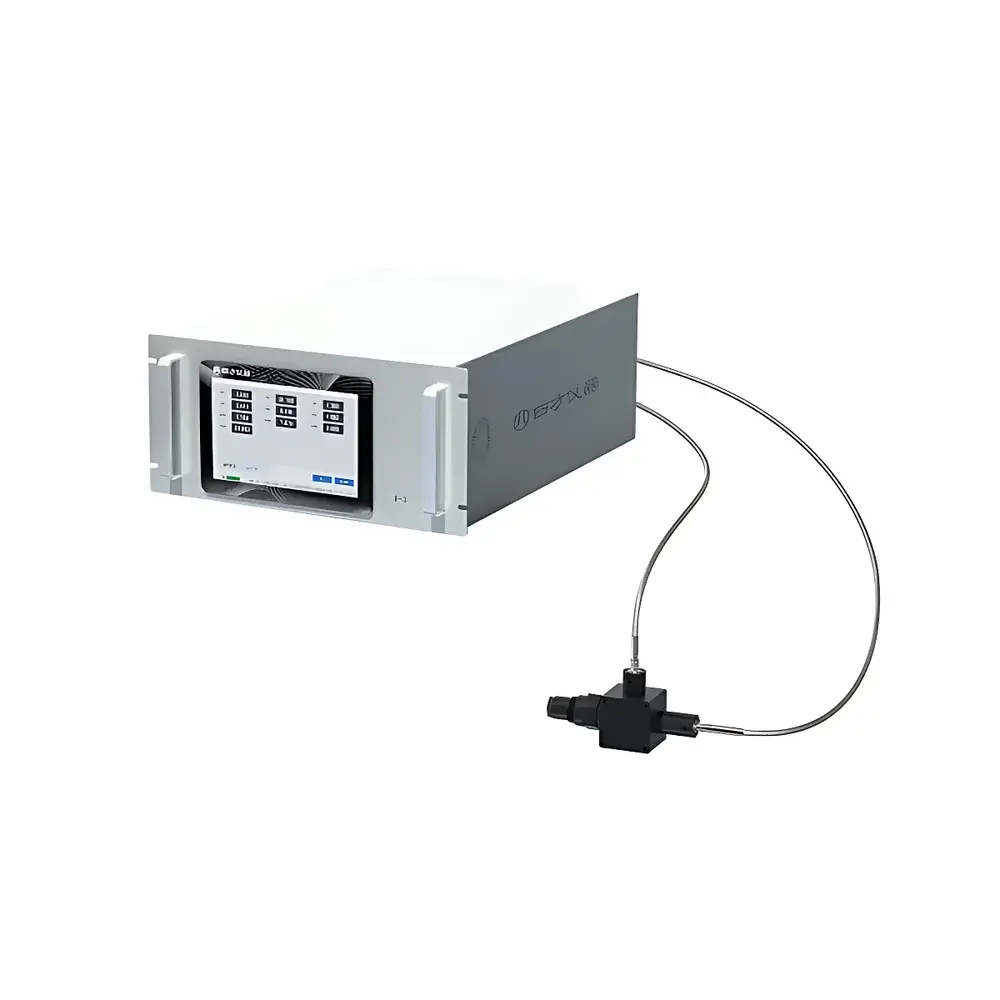
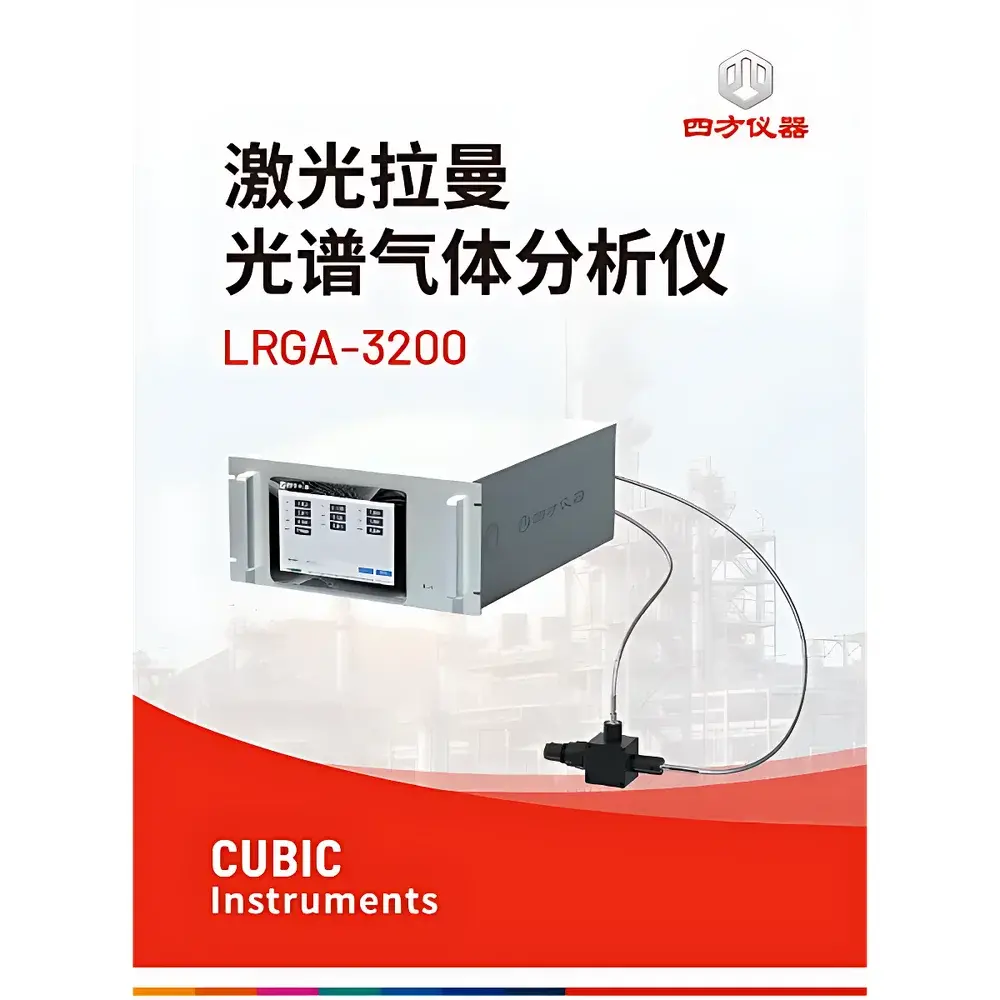
CUBIC INSTRUMENTS LRGA-3200 Laser Raman Gas Analyzer for Battery Thermal Runaway Off-Gas Monitoring
| Brand | CUBIC INSTRUMENTS |
|---|---|
| Origin | Hubei, China |
| Model | LRGA-3200 |
| Instrument Type | Portable Raman Spectrometer |
| Spectral Repeatability | ≤1% F.S. |
| Measurement Range | 0–100% (selectable by application) |
| Accuracy | ≤±1% F.S. |
| Response Time | ≤30 s |
| Operating Temperature (Analyzer) | 10–35 °C |
| Operating Humidity | ≤95% RH (non-condensing) |
| Input Voltage | 100–240 VAC, 50–60 Hz |
| Communication Interfaces | RS-232 / RS-485 / TCP/IP / USB |
| Display | Color Touchscreen |
| Probe Quantity | 1 Raman Fiber Probe |
| Probe Temp. Range | 0–200 °C |
| Probe Pressure Range | 80–4000 kPa |
| Measured Gases | H₂, N₂, O₂, CO, CO₂, CH₄, C₂H₂, C₂H₄, C₃H₆ |
Overview
The CUBIC INSTRUMENTS LRGA-3200 is a purpose-engineered laser Raman gas analyzer designed specifically for real-time, in-situ monitoring of off-gas composition during lithium-ion battery thermal runaway events. Unlike absorption-based or mass-dependent techniques, the LRGA-3200 leverages the intrinsic molecular fingerprinting capability of spontaneous Raman scattering—where monochromatic laser light interacts with vibrational modes of gas-phase molecules, generating spectrally shifted photons unique to each chemical species. This label-free, non-destructive optical method enables simultaneous quantification of both symmetric diatomic gases (e.g., H₂, O₂, N₂) and polyatomic hydrocarbons (e.g., CH₄, C₂H₄, C₃H₆) without chromatographic separation or ionization. The system integrates a compact Raman spectroscopy engine with a high-temperature/pressure-rated fiber-optic probe, allowing direct surface-mount deployment on battery modules or enclosure walls. With up to 100 m optical fiber transmission capability, the analyzer unit can be remotely located outside hazardous zones—ensuring operator safety while maintaining spectral fidelity through low-loss multimode fiber coupling.
Key Features
- Simultaneous multi-gas quantification: Capable of concurrent detection and concentration calculation for ≥9 key thermal runaway gases—including H₂, CO, CO₂, CH₄, C₂H₂, C₂H₄, C₃H₆, N₂, and O₂—without calibration drift between species.
- True in-situ measurement: Fiber-coupled probe operates continuously at temperatures up to 200 °C and pressures from 80 to 4000 kPa, enabling direct integration into battery abuse test chambers or pack-level monitoring systems.
- No consumables or carrier gases: Eliminates dependency on GC columns, MS filaments, or zero-air supplies—reducing operational overhead and long-term cost of ownership.
- High robustness and reproducibility: Optical architecture engineered for industrial environments; spectral repeatability maintained at ≤1% F.S. across extended operation cycles under variable ambient humidity (≤95% RH, non-condensing).
- Sub-30-second response time: Full spectral acquisition, baseline correction, peak deconvolution, and concentration output delivered within ≤30 s—critical for capturing rapid gas evolution kinetics during thermal propagation.
Sample Compatibility & Compliance
The LRGA-3200 is validated for direct analysis of undiluted, unfiltered battery off-gas streams containing particulates, condensables, and reactive species. Its fiber probe incorporates integrated particulate filtration and desiccant drying stages, ensuring optical path integrity during prolonged exposure to humid, soot-laden effluents. While not certified to IEC 60079 or ATEX standards out-of-the-box, the analyzer’s remote configuration supports compliance with functional safety requirements (e.g., SIL 2 per IEC 61508) when deployed with appropriate zone-rated enclosures. Data acquisition and reporting align with GLP and ISO/IEC 17025 documentation practices, including timestamped spectral records, raw intensity matrices, and traceable calibration logs. Optional audit-trail-enabled firmware supports 21 CFR Part 11 compliance for regulated R&D environments.
Software & Data Management
The embedded Linux-based control software provides real-time spectral visualization, automated peak identification via reference library matching (NIST Raman Gas Library v3.1), and stoichiometric concentration modeling using internal standard normalization. All spectra are stored in HDF5 format with metadata tags (time, temperature, pressure, probe ID). Export options include CSV (concentration vs. time), PNG/SVG (spectral overlays), and JSON (API-ready structured data). Remote access is supported via secure TCP/IP connection with TLS 1.2 encryption; RESTful API endpoints enable integration into battery management test platforms (e.g., Arbin, Bitrode, or custom LabVIEW/HIL systems). Firmware updates and spectral library expansions are delivered via signed OTA packages.
Applications
- Accelerated abuse testing of Li-ion cells and modules (UN 38.3, UL 1642, GB/T 31485)
- Thermal runaway propagation studies in multi-cell battery packs
- Off-gas reaction pathway validation for electrolyte decomposition mechanisms
- Real-time safety margin assessment during fast-charging or overcharge protocols
- Supporting failure mode and effects analysis (FMEA) for automotive OEMs and cell manufacturers
- Research-grade quantification of gas-phase intermediates in solid-electrolyte interphase (SEI) evolution studies
FAQ
Does the LRGA-3200 require periodic recalibration with certified gas standards?
No—Raman cross-sections are fundamental physical constants; the system relies on factory-characterized optical response curves and internal reference peaks (e.g., Rayleigh line, known solvent bands). Routine verification using ambient air (N₂/O₂ ratio) or synthetic gas blends is recommended every 3 months for QA/QC traceability.
Can the fiber probe be installed inside sealed battery test chambers?
Yes—the probe housing meets IP65 ingress protection and is rated for continuous operation at 200 °C and 4 MPa. Quartz fiber termination and stainless-steel body ensure compatibility with vacuum, inert, or corrosive atmospheres typical in nail penetration or oven test setups.
How does the LRGA-3200 handle spectral interference from water vapor or CO in complex mixtures?
Advanced multivariate curve resolution (MCR) algorithms decouple overlapping bands using constrained alternating least squares (ALS), leveraging known vibrational mode positions and relative intensities from quantum-chemical DFT simulations.
Is third-party software integration supported?
Yes—native support for MATLAB, Python (via PyRaman SDK), and National Instruments DIAdem is provided; all spectral and concentration data streams expose standardized SCPI command sets and Modbus TCP register maps.
What maintenance is required beyond routine optical cleaning?
Only quarterly replacement of the probe’s particulate filter and desiccant cartridge is necessary; no lasers, detectors, or gratings require field service or alignment during the specified 5-year operational lifetime.
Related Products




