
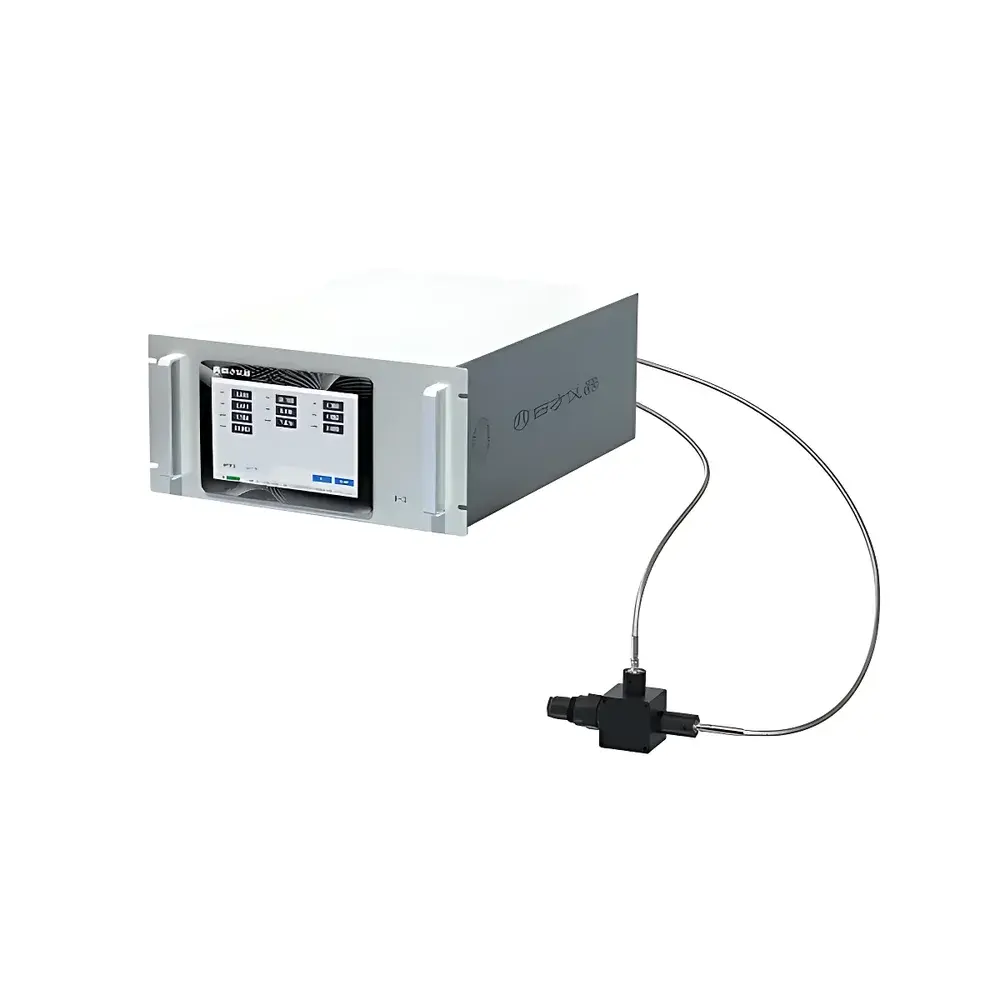
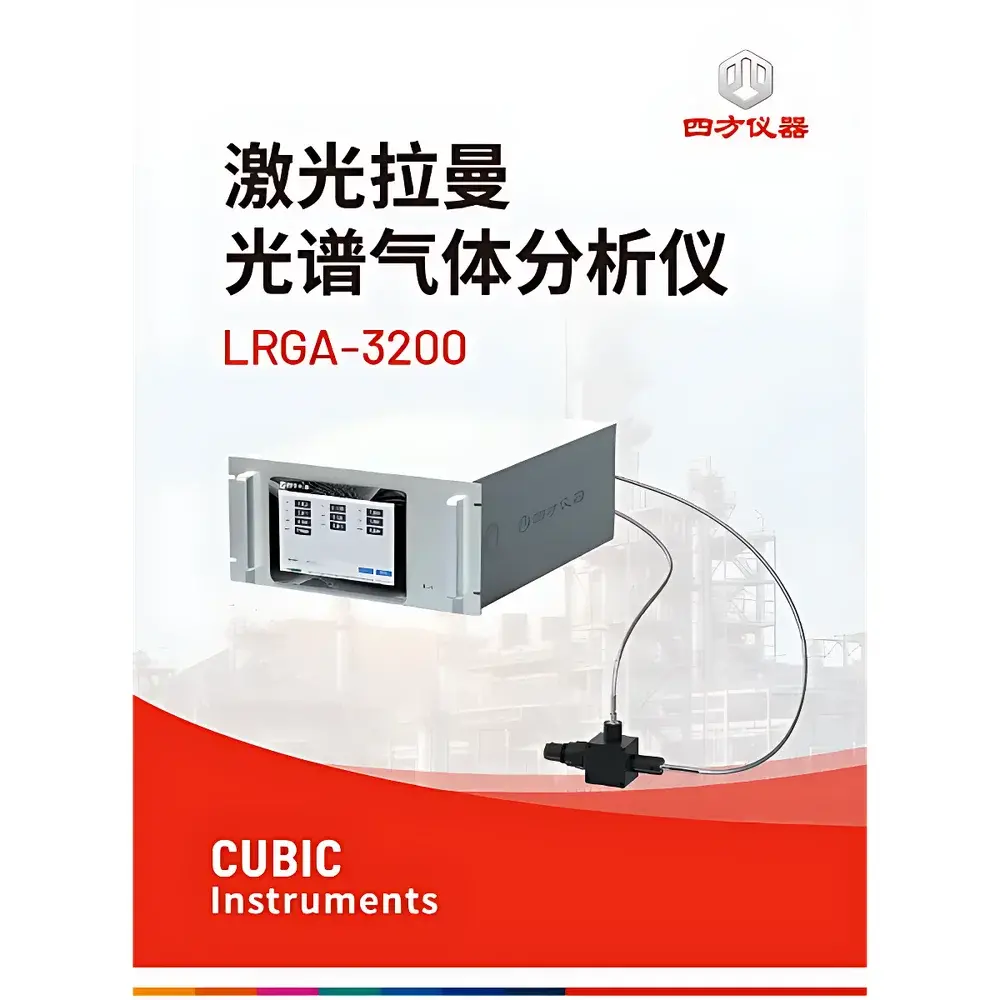
CUBIC INSTRUMENTS LRGA-3200 Laser Raman Gas Analyzer for In Situ Battery Gassing Monitoring
| Brand | CUBIC INSTRUMENTS |
|---|---|
| Origin | Hubei, China |
| Manufacturer Type | Authorized Distributor |
| Country of Origin | China |
| Model | LRGA-3200 |
| Price Range | USD 140,000–280,000 |
| Instrument Type | Portable/Handheld Raman Spectrometer |
| Spectral Repeatability | ≤1% F.S. |
| Measurement Components | H₂, N₂, O₂, CO, CO₂, CH₄, C₂H₂, C₂H₄, C₃H₆ |
| Concentration Range | 0–100% (configurable) |
| Accuracy | ≤±1% F.S. |
| Response Time | ≤30 s |
| Input Voltage | 100–240 VAC, 50–60 Hz |
| Communication Interfaces | RS-232, RS-485, TCP/IP Ethernet, USB |
| Display | Color Touchscreen Interface |
| Probe Quantity | 1 Raman Fiber Optic Probe |
| Probe Operating Temperature | 0–200 °C |
| Probe Pressure Rating | 80–4000 kPa |
| Analyzer Ambient Operating Temperature | 10–35 °C |
| Humidity Limit | 95% RH, non-condensing |
Overview
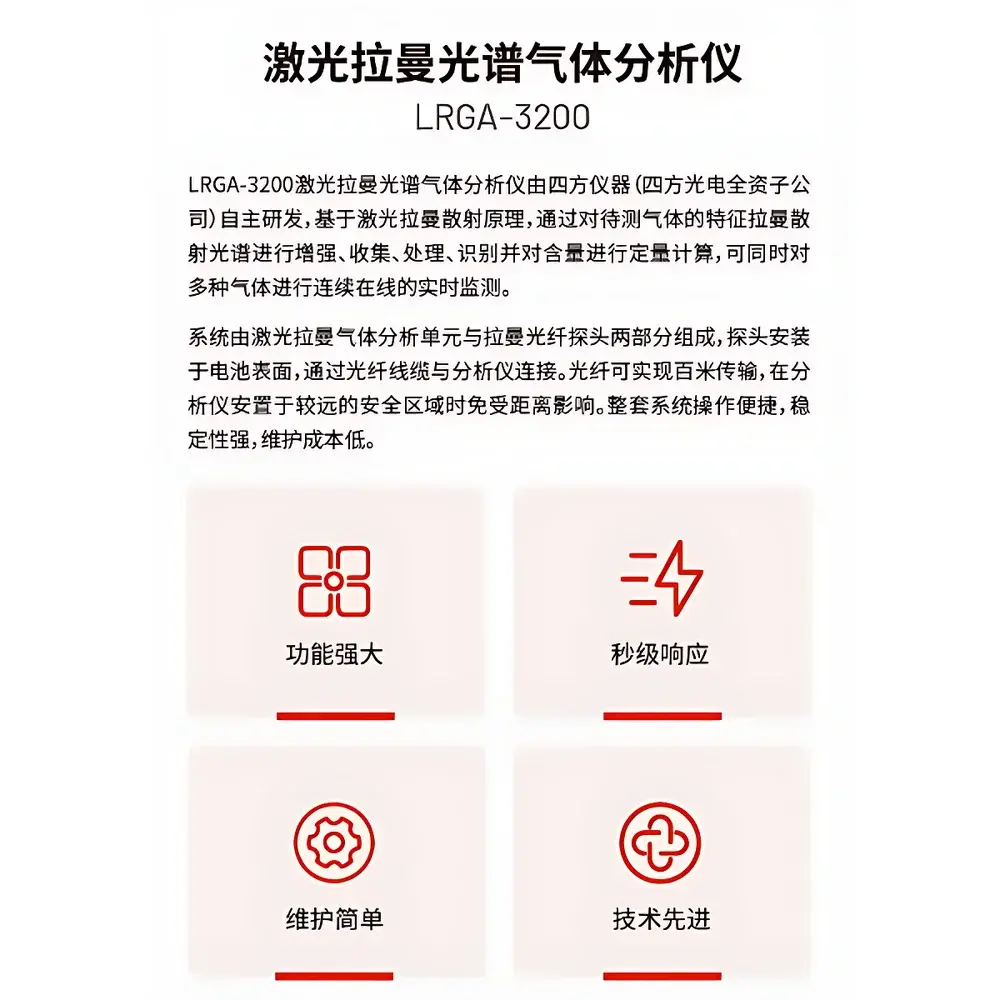
The CUBIC INSTRUMENTS LRGA-3200 is a purpose-built, portable laser Raman gas analyzer engineered for real-time, in situ monitoring of gaseous species evolved during electrochemical cycling of lithium-ion and next-generation batteries. Unlike absorption-based or mass-spectrometric techniques, the LRGA-3200 exploits the intrinsic vibrational fingerprinting capability of spontaneous Raman scattering—where monochromatic laser light interacts with molecular bonds, generating frequency-shifted photons uniquely characteristic of rotational and vibrational quantum states. This label-free, non-destructive optical method enables simultaneous quantification of multiple gases—including homonuclear diatomics (H₂, N₂, O₂) that are invisible to IR absorption—without sample extraction, pre-concentration, or chemical derivatization. The system integrates a compact Raman spectrometer unit with a high-temperature/pressure-rated fiber-optic probe mounted directly on battery cell housings or in sealed test chambers, enabling continuous measurement at distances up to 100 meters via low-loss multimode optical fiber. Designed for integration into battery safety labs, QC testing suites, and R&D prototyping lines, the LRGA-3200 delivers trace-to-bulk gas concentration data with metrological traceability aligned with ISO/IEC 17025 calibration practices.
Key Features
- Simultaneous multi-gas detection: Quantifies H₂, N₂, O₂, CO, CO₂, CH₄, C₂H₂, C₂H₄, and C₃H₆ in a single spectral acquisition without separation columns or carrier gases.
- True in situ capability: Fiber-coupled probe operates continuously at temperatures up to 200 °C and pressures from 80 to 4000 kPa—compatible with pouch, cylindrical, and prismatic cell configurations under thermal runaway or overcharge stress conditions.
- High spectral fidelity: Achieves ≤1% full-scale repeatability across repeated measurements under controlled environmental conditions (10–35 °C, <95% RH non-condensing), verified per ASTM E1840-22 guidelines for spectroscopic instrument performance validation.
- Zero consumables architecture: Eliminates reliance on GC columns, MS filaments, calibration gases, or chromatographic solvents—reducing total cost of ownership and operational downtime.
- Robust optical design: Utilizes thermally stabilized laser diodes (785 nm), notch-filtered collection optics, and back-illuminated CCD detector optimized for signal-to-noise ratio in low-light Raman scattering regimes.
- Plug-and-play connectivity: Supports industrial communication protocols including Modbus RTU (RS-485), TCP/IP Ethernet for SCADA integration, and USB host interface for local data export and firmware updates.
Sample Compatibility & Compliance
The LRGA-3200 is validated for direct interfacing with battery testing environments compliant with UN 38.3, IEC 62619, and UL 1642 safety evaluation protocols. Its fiber-optic probe meets IP65 ingress protection when installed with appropriate feedthroughs, and its optical path is compatible with inert gas purging (N₂ or Ar) to suppress ambient air interference during low-concentration H₂ detection (<100 ppm). The analyzer’s firmware implements audit-trail logging per FDA 21 CFR Part 11 requirements when operated in regulated GMP/GLP laboratories. All spectral libraries used for peak identification and multivariate quantification (e.g., PLS regression models) are traceable to NIST Standard Reference Materials (SRMs) for gas-phase Raman cross-sections. No hazardous materials or radioactive sources are employed; laser class complies with IEC 60825-1:2014 Class 3R safety standards.
Software & Data Management
The embedded Linux-based operating system hosts CUBIC’s proprietary RamanGasSuite™ software, featuring real-time spectral visualization, automated baseline correction (Asymmetric Least Squares), peak deconvolution (Voigt fitting), and dynamic library matching against >50 validated gas spectra. Time-series concentration plots support export in CSV, HDF5, and .mat formats for post-processing in MATLAB or Python (SciPy/Pandas). Remote access is enabled via secure HTTPS web interface with role-based user authentication (admin/operator/viewer). Data integrity safeguards include cyclic redundancy checks (CRC32) on all stored spectra, timestamp synchronization via NTP, and optional encrypted SD card backup. Software update packages undergo SHA-256 signature verification prior to installation.
Applications
- Electrolyte decomposition pathway analysis during formation cycling and calendar aging studies.
- Quantitative tracking of H₂ evolution as an early indicator of anode SEI instability or water contamination.
- In situ monitoring of CO₂ and CO generation linked to cathode oxygen release and transition metal dissolution.
- Validation of solid-state electrolyte hermeticity through long-term leakage profiling under thermal gradient stress.
- Correlation of gassing profiles with differential voltage-capacity (dV/dQ) and differential capacity (dQ/dV) signatures.
- Support for failure mode and effects analysis (FMEA) in DOE-based battery safety qualification per ISO 26262 functional safety frameworks.
FAQ
Does the LRGA-3200 require gas calibration standards for routine operation?
No—quantitative calibration is performed once using certified reference gas mixtures traceable to NIST SRM 1672b. Subsequent measurements rely on internal reference peaks (e.g., Rayleigh line intensity, solvent Raman bands) and built-in photometric stability monitoring.
Can the fiber optic probe be sterilized or cleaned in situ without disassembly?
Yes—the probe tip is constructed from fused silica and stainless steel 316L, rated for autoclaving (121 °C, 15 psi) and compatible with IPA, ethanol, and mild alkaline cleaning agents. A maintenance protocol for optical window cleaning is included in the operator manual.
Is spectral resolution sufficient to resolve overlapping peaks such as C₂H₄ and C₂H₂?
Yes—the spectrometer provides ≤8 cm⁻¹ spectral resolution (FWHM), enabling baseline separation of ethylene (C₂H₄, 1625 cm⁻¹) and acetylene (C₂H₂, 1974 cm⁻¹) under standard operating conditions, confirmed by inter-laboratory round-robin testing per ISO 13843:2020.
How is temperature drift compensated during extended runtime?
The system employs dual-temperature sensors (probe head and spectrometer core) feeding into a real-time wavelength recalibration algorithm based on known Raman shifts of internal reference materials (e.g., silicon at 520.7 cm⁻¹).
What cybersecurity measures are implemented for network-connected units?
All network interfaces support TLS 1.2+ encryption, configurable firewall rules, disabled default credentials, and periodic security patching aligned with IEC 62443-3-3 Level 1 requirements for industrial control systems.
Related Products





