
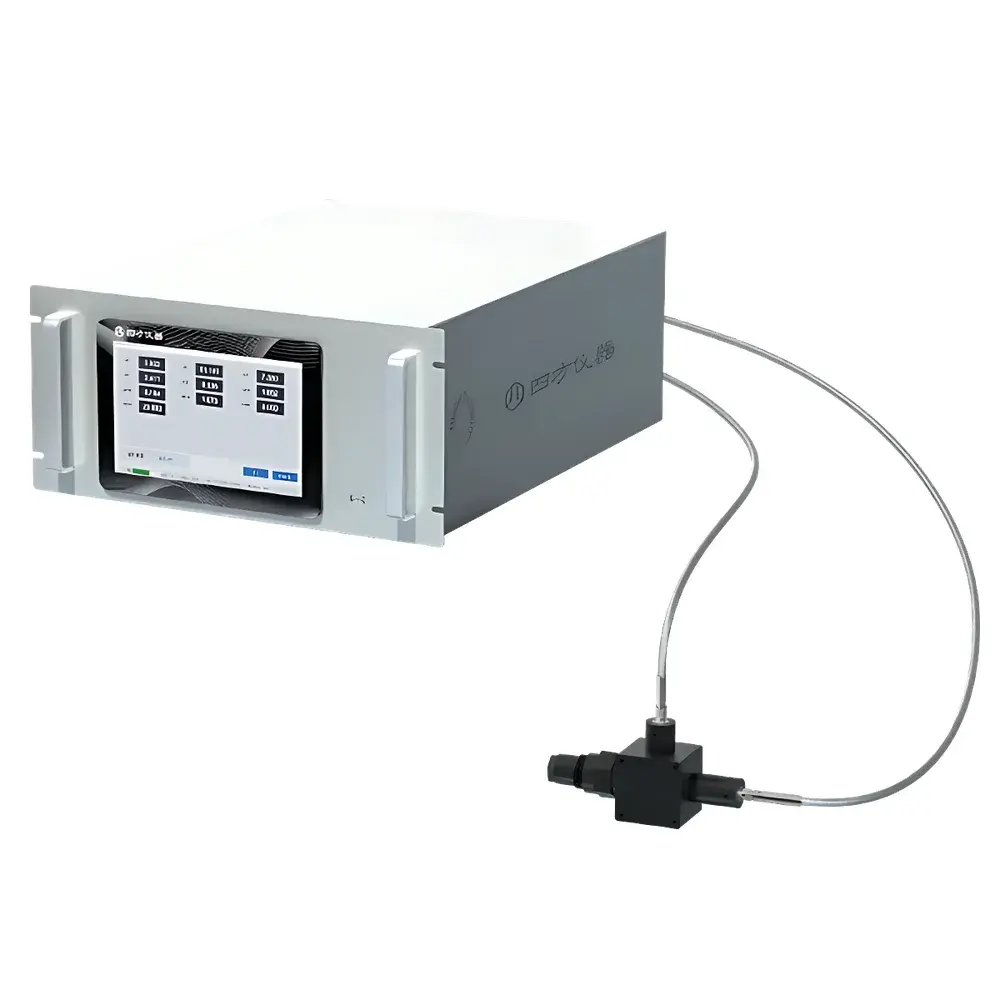
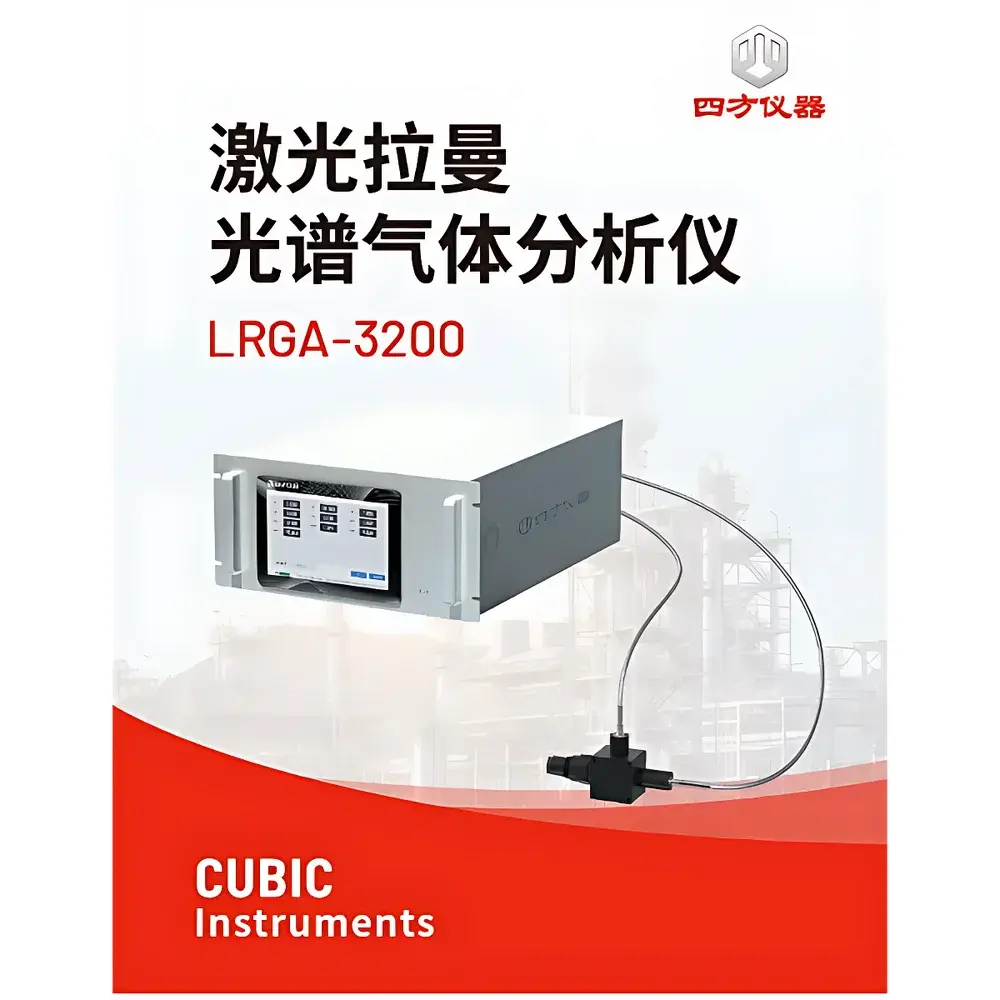
CUBIC INSTRUMENTS LRGA-3200 Portable Laser Raman Gas Analyzer
| Brand | CUBIC INSTRUMENTS |
|---|---|
| Origin | Hubei, China |
| Manufacturer Type | Authorized Distributor |
| Country of Origin | China |
| Model | LRGA-3200 |
| Instrument Type | Portable/Handheld Raman Spectrometer |
| Spectral Repeatability | ≤1% F.S. |
| Measurement Accuracy | ≤±1% F.S. |
| Response Time | ≤30 s |
| Operating Temperature (Analyzer) | 10–35 °C |
| Operating Humidity | ≤95% RH (non-condensing) |
| Input Voltage | 100–240 VAC, 50–60 Hz |
| Communication Interfaces | RS-232 / RS-485 / TCP/IP / USB |
| Display | Color Touchscreen |
| Probe Quantity | 1 Fiber-Optic Probe |
| Probe Temperature Range | 0–200 °C |
| Probe Pressure Range | 80–4000 kPa |
| Measured Gases | H₂, N₂, O₂, CO, CO₂, CH₄, C₂H₂, C₂H₄, C₃H₆ |
Overview
The CUBIC INSTRUMENTS LRGA-3200 is a portable laser Raman gas analyzer engineered for continuous, real-time, in-situ quantitative analysis of multi-component gas mixtures. It operates on the physical principle of spontaneous Raman scattering: monochromatic laser light (typically 532 nm or 785 nm) interacts with molecular vibrational modes in the gas phase, generating wavelength-shifted scattered photons whose spectral positions and intensities are uniquely characteristic of molecular identity and concentration. Unlike absorption-based techniques (e.g., NDIR or TDLAS), Raman spectroscopy inherently detects homonuclear diatomic gases—such as H₂, N₂, and O₂—that lack permanent dipole moments and are therefore invisible to infrared methods. The LRGA-3200 integrates a high-stability diode-pumped solid-state (DPSS) laser source, a thermoelectrically cooled CCD or CMOS spectrometer, and a ruggedized fiber-optic probe capable of withstanding process temperatures up to 200 °C and pressures up to 4 MPa. Its optical architecture employs notch filtering and background subtraction algorithms to suppress Rayleigh scatter and fluorescence interference, ensuring robust signal-to-noise performance under industrial ambient conditions.
Key Features
- Simultaneous quantification of up to 10+ gas species—including H₂, N₂, O₂, CO, CO₂, CH₄, C₂H₂, C₂H₄, and C₃H₆—without calibration gas standards for each component, leveraging pre-characterized cross-section libraries and multivariate curve resolution (MCR) modeling.
- True in-situ measurement via a single fiber-optic probe installed directly on process equipment (e.g., battery vents, reactor headspaces, or pipeline taps), eliminating sample extraction, conditioning, or dilution systems.
- No consumables required: operates without carrier gas, chromatographic columns, catalysts, or electrochemical cells—reducing total cost of ownership and minimizing downtime for maintenance.
- Optical path stability maintained through passive thermal management and mechanical decoupling between laser, spectrometer, and fiber interface—achieving ≤1% full-scale (F.S.) spectral repeatability over 72-hour continuous operation.
- Modular design supports remote deployment: fiber optic cable lengths up to 100 m enable analyzer placement in controlled environments (e.g., instrument shelters or control rooms), isolating sensitive electronics from hazardous or high-EMI zones.
Sample Compatibility & Compliance
The LRGA-3200 is validated for direct analysis of unmodified gas streams across petrochemical, energy storage, semiconductor fabrication, and hydrogen infrastructure applications. It complies with IEC 61000-6-2 (immunity) and IEC 61000-6-4 (emissions) for industrial electromagnetic compatibility. While not intrinsically certified for Zone 0/1 hazardous areas, the fiber-optic probe may be installed in Class I Div 1 locations when paired with appropriate barrier systems per UL 60079-11 and ATEX 2014/34/EU guidelines. Data integrity meets GLP/GMP-aligned requirements: all spectral acquisitions, calibration logs, and user actions are timestamped and stored locally with optional audit trail export compliant with FDA 21 CFR Part 11 when integrated with enterprise LIMS platforms.
Software & Data Management
The embedded firmware runs on a real-time Linux OS with a 7-inch capacitive touchscreen interface supporting intuitive configuration, live spectral visualization, and alarm threshold setup. Onboard software includes baseline correction, peak deconvolution, and PLS (partial least squares) regression models trained on NIST-traceable reference mixtures. Raw spectra (ASCII or HDF5 format), processed concentration time-series (CSV), and diagnostic logs are exportable via USB or network protocols. Optional PC-based RamanView™ Suite enables advanced chemometric model development, remote monitoring via MQTT/OPC UA, and integration with DCS/SCADA systems using Modbus TCP or RESTful APIs. All data exports include metadata headers specifying instrument ID, acquisition parameters, environmental conditions, and calibration validity status.
Applications
- Hydrogen production & purity monitoring: real-time detection of H₂ impurities (O₂, N₂, CO, H₂O vapor) in PEM electrolyzer off-gas and compression train outlets.
- Lithium-ion battery safety: in-situ tracking of vent gas composition (CO, CO₂, C₂H₄, H₂) during thermal runaway testing and formation cycling.
- Industrial furnace atmosphere control: closed-loop feedback for carburizing, nitriding, and annealing processes via simultaneous O₂/N₂/CH₄ monitoring.
- Biogas upgrading: continuous measurement of CH₄, CO₂, H₂S, and siloxanes in raw and purified biogas streams prior to grid injection.
- Chemical synthesis reactors: non-invasive reaction progress tracking (e.g., hydrogenation, oxidation) by quantifying reactant depletion and product formation rates.
FAQ
Does the LRGA-3200 require daily calibration with standard gases?
No. It relies on factory-established Raman cross-section databases and internal reference peaks (e.g., Rayleigh line, water vapor bands) for drift compensation. Periodic verification with a single-point check gas is recommended every 30 days for critical applications.
Can it measure moisture or H₂O vapor content?
Yes—H₂O exhibits strong, resolvable Raman bands near 3657 cm⁻¹ and 3756 cm⁻¹. Quantitative accuracy is maintained across 10 ppmv–100% v/v with optional heated probe and desiccant filtration.
Is spectral resolution sufficient to distinguish isomers such as C₂H₄ and C₂H₂?
Yes. The spectrometer delivers ≤8 cm⁻¹ resolution (FWHM), enabling baseline separation of acetylene (1974 cm⁻¹) and ethylene (1627 cm⁻¹) ν(C≡C) and ν(C=C) stretching modes.
What maintenance intervals are recommended for field operation?
Optical windows require cleaning every 3–6 months depending on particulate load; desiccant and particulate filters should be replaced quarterly; no laser or detector replacement is anticipated within 5 years of continuous use.
How is temperature compensation handled for high-temperature probe measurements?
The probe integrates dual Pt100 RTDs—one at the tip, one at the fiber coupling junction—feeding real-time thermal drift correction into the spectral fitting algorithm to maintain quantitative fidelity across 0–200 °C.
Related Products





