

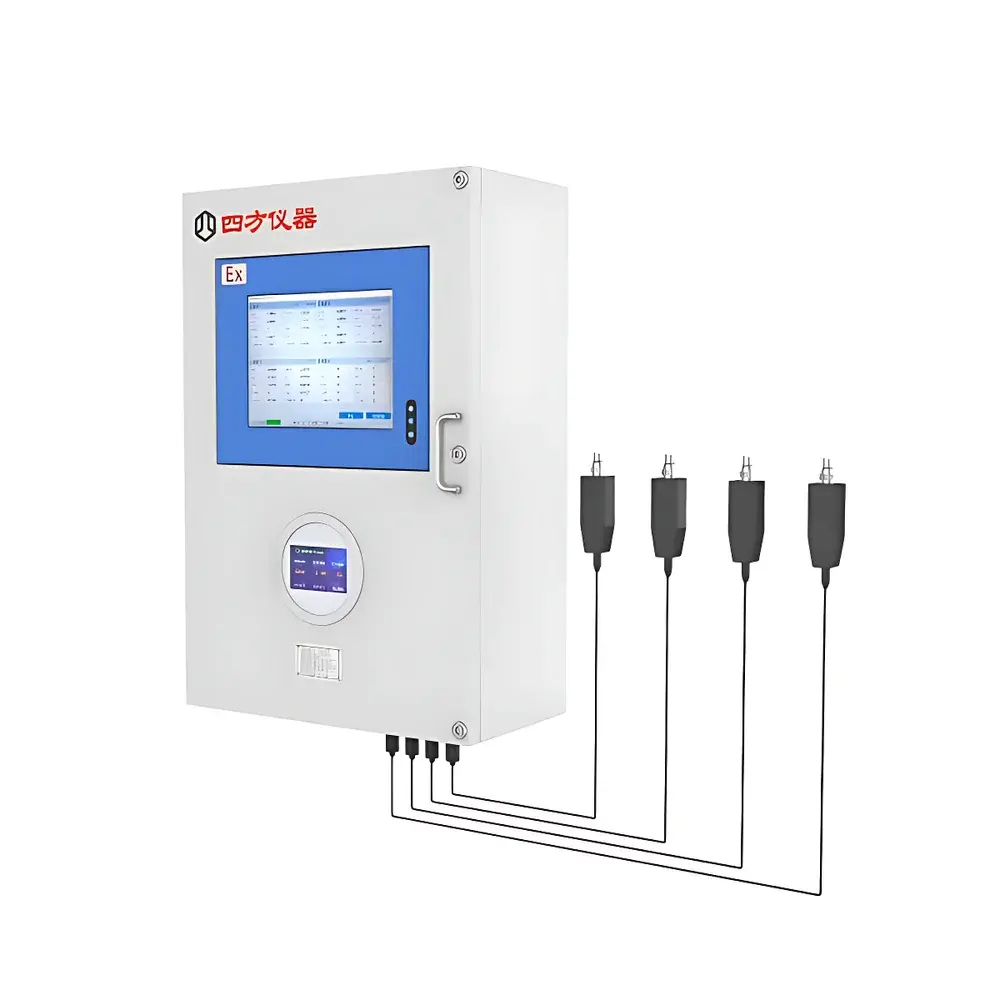
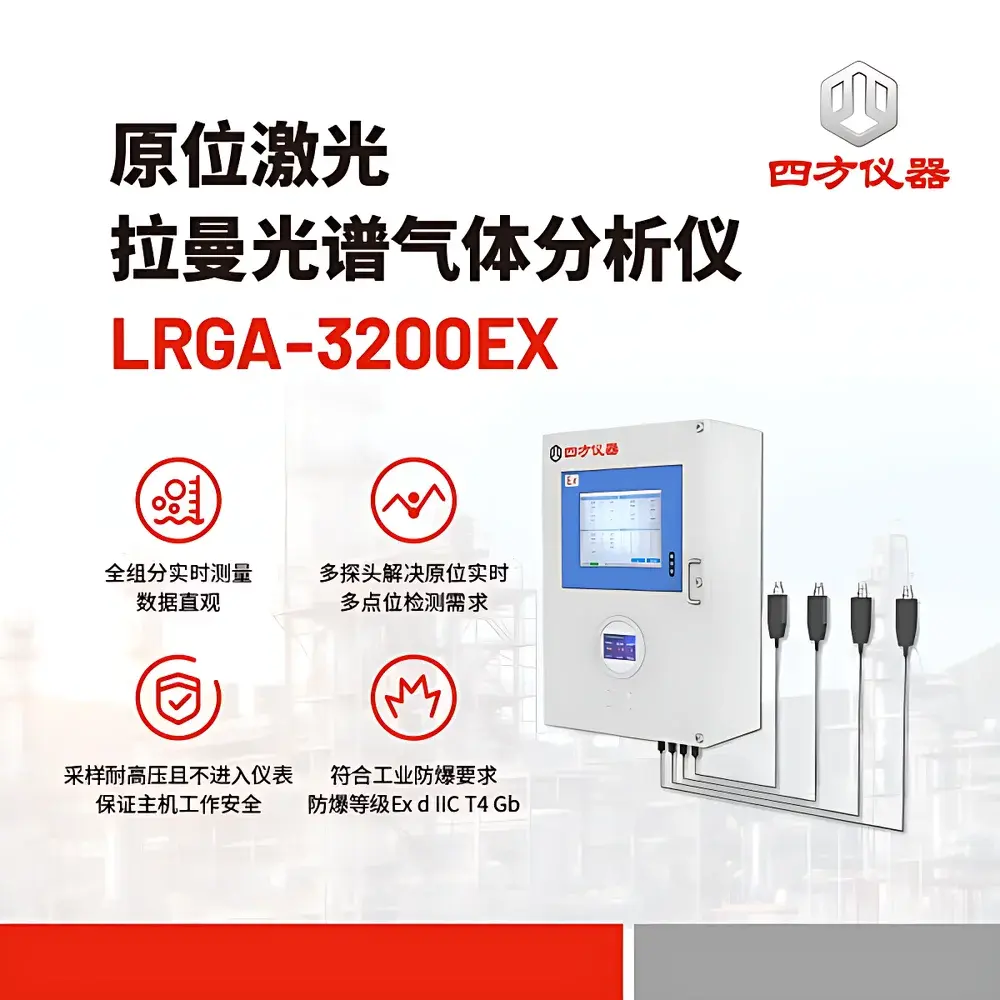
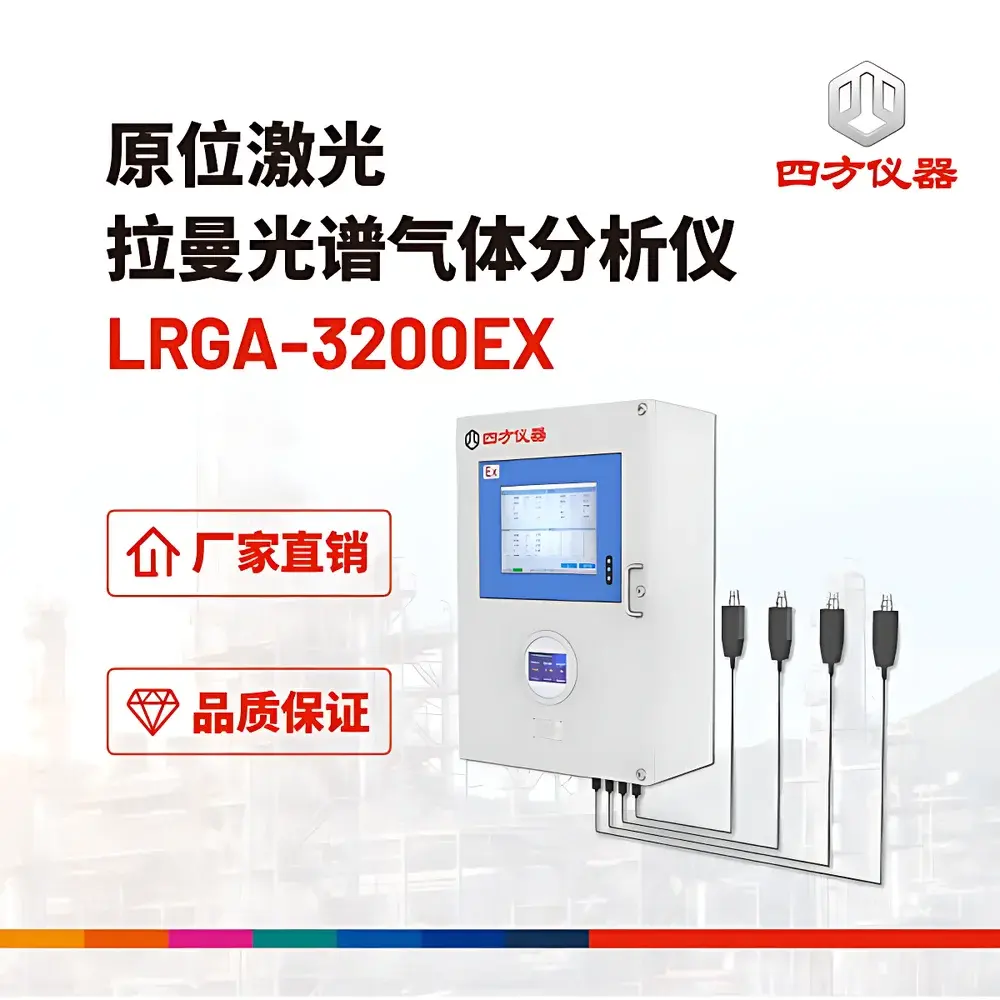
CUBIC INSTRUMENTS LRGA-3200EX In-situ Laser Raman Gas Analyzer
| Brand | CUBIC INSTRUMENTS |
|---|---|
| Origin | Hubei, China |
| Model | LRGA-3200EX |
| Spectral Range | 0–100% (v/v) |
| Spectral Repeatability | ±1% F.S. |
| Measurement Accuracy | ±1% F.S. |
| Response Time | <1 s |
| Operating Pressure | up to 4 MPa |
| Probe Quantity | 4 |
| Fiber Optic Cable Length | 5 m (standard, customizable) |
| Enclosure Rating | IP65 |
| Explosion Protection | Ex d II C T4 Gb |
| Ambient Operating Temperature (Analyzer) | 10–35 °C |
| Probe Operating Temperature | –20 to +200 °C |
| Humidity | 0–95% RH (non-condensing) |
| Power Supply | 100–240 VAC, 50–60 Hz |
| Max. Power Consumption | <200 W |
| Communication Interfaces | RS-232, RS-485, TCP/IP Ethernet, USB, 4–20 mA analog output |
| Dimensions (L×W×H) | 540 × 300 × 900 mm |
| Weight | 75 kg |
Overview
The CUBIC INSTRUMENTS LRGA-3200EX is an in-situ laser Raman gas analyzer engineered for real-time, non-invasive molecular identification and quantification of multi-component gas streams under industrial process conditions. Unlike absorption-based techniques (e.g., FTIR or tunable diode laser), the LRGA-3200EX exploits the inelastic scattering of monochromatic laser light—Raman scattering—to generate vibrational fingerprints unique to each chemical species. This principle enables direct detection of homonuclear diatomic molecules (e.g., H2, N2, O2) that are optically silent in IR spectroscopy. The system performs simultaneous qualitative and quantitative analysis of up to 20 gas components without sample extraction, chromatographic separation, or consumables—eliminating calibration drift, maintenance downtime, and cross-sensitivity artifacts associated with wet chemistry or sensor-based methods.
Key Features
- In-situ measurement via ruggedized Raman probe: No gas sampling lines, pumps, valves, or columns required—minimizing dead volume, lag time, and contamination risk.
- Explosion-proof design compliant with Ex d II C T4 Gb: Suitable for Zone 1/21 hazardous areas handling flammable (e.g., CH4, C2H2, H2) and toxic gases (e.g., H2S, CO).
- High-pressure capability: Probes rated for continuous operation up to 4 MPa, enabling direct integration into high-pressure reactors, syngas lines, and hydrogen compression systems.
- Multi-probe architecture: Supports up to four independent fiber-coupled probes (standard 5 m length, customizable), allowing distributed monitoring across process nodes without multiplexing compromises.
- Real-time spectral acquisition: Sub-second response time (<1 s) with full-spectrum capture, enabling dynamic process control and transient event detection.
- Integrated industrial-grade touch interface: IP65-rated防爆 touchscreen with intuitive visualization of concentration trends, spectral overlays, alarm status, and diagnostic logs—operable without external peripherals.
Sample Compatibility & Compliance
The LRGA-3200EX is validated for continuous analysis of industrially relevant gas matrices including syngas, refinery off-gases, biogas, ammonia synthesis loops, ethylene crackers, and hydrogen purification streams. It quantifies key components such as H2, N2, O2, CO, CO2, CH4, C2H2, C2H4, C3H6, and H2S across full-scale ranges (0–100% v/v) with ±1% full-scale accuracy and repeatability. The system meets IEC 60079-0/-1 for explosive atmospheres and conforms to electromagnetic compatibility requirements per EN 61326-1. While not certified to FDA 21 CFR Part 11 out-of-the-box, its data logging architecture supports audit-trail-ready configurations when deployed with validated third-party SCADA or DCS platforms compliant with GMP/GLP documentation standards (e.g., ISA-88/ISA-95 frameworks).
Software & Data Management
The embedded firmware provides real-time spectral preprocessing—including cosmic ray removal, baseline correction (Asymmetric Least Squares), and peak normalization—prior to multivariate calibration (PLS, PCR) applied to concentration prediction. Calibration models are stored in encrypted, version-controlled files with metadata tracking (date, operator ID, reference standard lot). Raw spectra and processed results are timestamped and exportable via USB or network transfer in CSV, HDF5, or ASTM E1382-compliant formats. Remote access is supported via secure TCP/IP connection for configuration updates, model retraining, and diagnostic telemetry. All analog (4–20 mA) and digital outputs maintain traceable linearity verification logs aligned with ISO/IEC 17025 metrological principles.
Applications
- Hydrogen production & purity assurance in PEM electrolysis and steam methane reforming units.
- Real-time composition control in Fischer–Tropsch synthesis and methanol synthesis loops.
- Leak detection and stoichiometric monitoring in ethylene oxide and acetylene hydrogenation reactors.
- Biogas upgrading verification (CH4/CO2/H2S ratio optimization prior to membrane separation).
- Safety-critical H2S and CO monitoring in sour gas processing and amine regeneration units.
- Quality assurance during semiconductor process gas delivery (e.g., N2/O2 blends for ALD/CVD).
FAQ
Does the LRGA-3200EX require gas conditioning or pre-treatment before measurement?
No. The in-situ probe design eliminates the need for filtration, drying, pressure regulation, or temperature stabilization upstream of the measurement point.
Can the system distinguish between isotopic variants (e.g., 12CH4 vs. 13CH4)?
Not at standard resolution; the instrument’s spectral resolution (~8 cm−1) is optimized for industrial component quantification rather than isotopic fine structure resolution.
Is calibration transfer possible between different LRGA-3200EX units?
Yes—calibration models are portable across identical hardware configurations when accompanied by matching probe alignment and laser power validation reports.
What maintenance is required over a 5-year operational cycle?
Annual verification of laser wavelength stability and detector dark current; no optical alignment or consumable replacement is needed due to solid-state probe construction and sealed spectrometer module.
How is measurement uncertainty reported for regulatory submissions?
Uncertainty budgets follow ISO/IEC Guide 98-3 (GUM), incorporating contributions from spectral noise, calibration standard uncertainty, temperature-induced peak shift, and pressure broadening effects—documented per user-defined SOPs.
Related Products



