
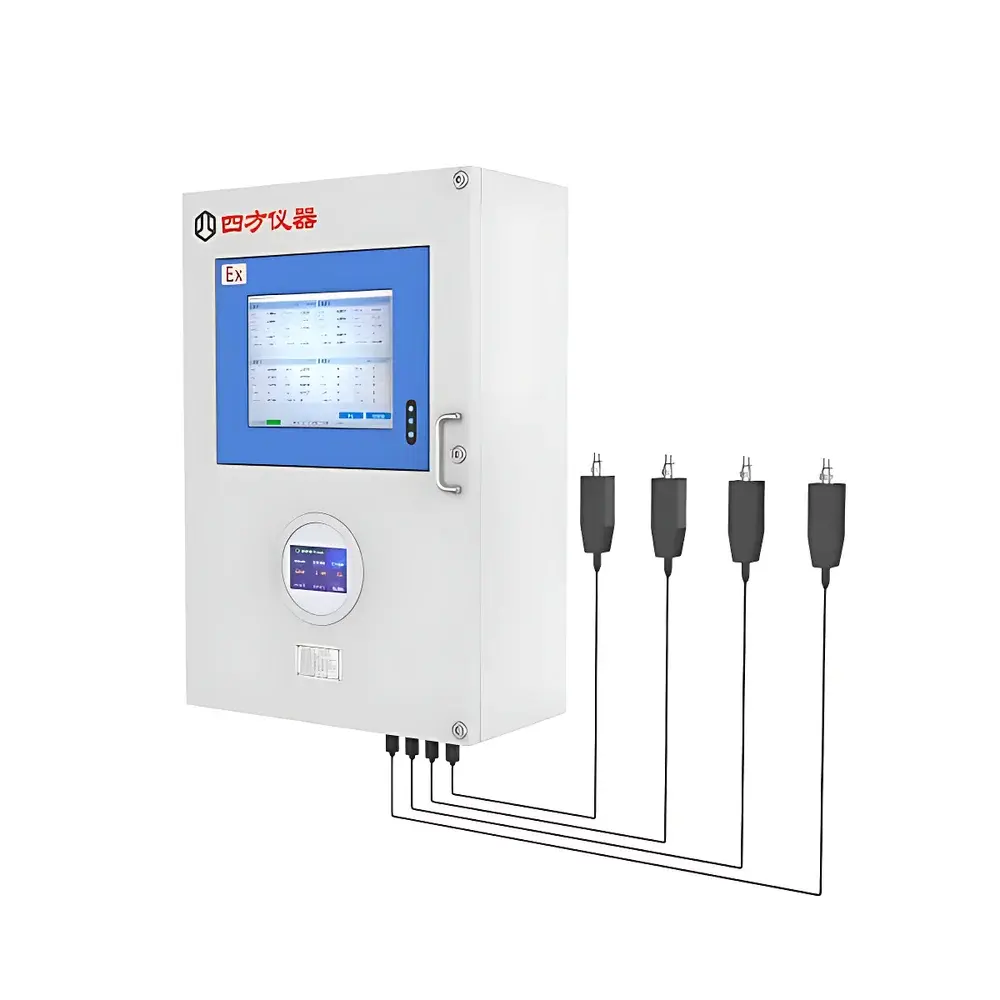
CUBIC INSTRUMENTS LRGA-3200EX In-situ Laser Raman Gas Analyzer
| Brand | CUBIC INSTRUMENTS |
|---|---|
| Origin | Hubei, China |
| Model | LRGA-3200EX |
| Spectral Range | 0–100% (relative intensity) |
| Spectral Repeatability | ±1% F.S. |
| Measurement Accuracy | ±1% F.S. |
| Response Time | <1 s |
| Operating Pressure (probe) | up to 4 MPa |
| Probe Operating Temperature | −20 to 200 °C |
| Analyzer Operating Temperature | 10–35 °C |
| Humidity | 0–95% RH (non-condensing) |
| Power Input | 100–240 VAC, 50–60 Hz |
| Max. Power Consumption | <200 W |
| Enclosure Rating | IP65 |
| Explosion Protection | Ex d II C T4 Gb |
| Probe Quantity | 4 |
| Standard Fiber Length | 5 m (customizable) |
| Dimensions (L×W×H) | 540 × 300 × 900 mm |
| Weight | 75 kg |
| Communication Interfaces | RS-232, RS-485, TCP/IP Ethernet, USB, 4–20 mA analog outputs |
Overview
The CUBIC INSTRUMENTS LRGA-3200EX is an in-situ laser Raman gas analyzer engineered for real-time, non-invasive compositional analysis of industrial process streams. It operates on the fundamental principle of spontaneous Raman scattering: monochromatic laser light interacts with molecular vibrational modes in the gas phase, generating frequency-shifted scattered photons whose spectral positions and intensities are uniquely characteristic of chemical species and concentrations. Unlike absorption-based techniques (e.g., FTIR or tunable diode laser), Raman spectroscopy enables direct detection of homonuclear diatomic molecules—such as H2, N2, and O2—which lack permanent dipole moments and are therefore invisible to infrared methods. The LRGA-3200EX integrates high-stability 532 nm or 785 nm excitation lasers, optimized fiber-coupled probe optics, and a thermoelectrically cooled CCD spectrometer to deliver robust signal-to-noise performance under harsh plant conditions. Designed for permanent mounting directly onto process piping or reactors, it eliminates sample extraction, conditioning, and transport delays—ensuring true in-situ measurement fidelity with sub-second response latency.
Key Features
- In-situ measurement architecture: Four integrated explosion-proof Raman probes mount directly onto process lines—no gas extraction, no sample conditioning systems, no consumables (e.g., chromatographic columns, valves, or pumps).
- Homonuclear diatomic gas capability: Simultaneous quantification of H2, N2, and O2 alongside CO, CO2, H2S, CH4, C2H2, C2H4, C3H6, and other hydrocarbons—up to 20 components per measurement cycle.
- Industrial-grade safety compliance: Probes certified to Ex d II C T4 Gb for use in Zone 1 hazardous areas; full system rated IP65 for dust and water ingress protection.
- Thermal and pressure resilience: Probe head operational from −20 °C to 200 °C; compatible with process pressures up to 4 MPa (580 psi) without external pressure regulation.
- Embedded touch interface: 10.1-inch防爆 (explosion-proof) capacitive touchscreen running a deterministic Linux-based OS; supports optional external keyboard/mouse via USB.
- Low-maintenance design: Solid-state optical path, no moving parts in the probe or spectrometer; typical calibration interval ≥6 months under stable operating conditions.
Sample Compatibility & Compliance
The LRGA-3200EX is validated for continuous monitoring of corrosive, toxic, flammable, and high-temperature process gases—including syngas, refinery off-gas, biogas, ammonia synthesis loops, and hydrogen production streams. Its non-contact optical sampling avoids cross-contamination and catalytic surface interference. All hardware and firmware comply with IEC 60079-0 (Explosive Atmospheres – General Requirements) and IEC 60079-1 (Flameproof Enclosures “d”). The system supports audit-ready operation under GLP and GMP frameworks: measurement logs include timestamped spectra, raw intensity arrays, calibration metadata, and user action records. While not pre-certified to FDA 21 CFR Part 11, its data export architecture (CSV, HDF5, XML) and role-based access control enable straightforward validation for regulated environments.
Software & Data Management
The embedded RamanSoft™ v4.x platform provides real-time spectral acquisition, multivariate curve fitting (using constrained non-negative least squares), and stoichiometric concentration calculation based on internal reference standards and pressure/temperature compensation algorithms. Spectral libraries are editable and expandable—users may import custom reference spectra (e.g., from NIST or in-house calibration cells). Data is stored locally on dual-redundant industrial SSDs (≥1 TB capacity) and simultaneously streamed via TCP/IP to DCS/SCADA systems using Modbus TCP or OPC UA (compliant with OPC Foundation specifications). Historical trends, alarm thresholds (with hysteresis), and batch reports are exportable in ISO/IEC 17025-aligned formats. Remote diagnostics and firmware updates are supported over secure SSH or TLS-enabled HTTP.
Applications
- Hydrogen purity verification in PEM electrolyzer and steam methane reformer (SMR) outlets.
- Real-time calorific value (CV) and Wobbe index calculation for natural gas and biomethane grid injection.
- Combustion optimization in fired heaters and gas turbines via O2/CO ratio feedback.
- Leak detection and composition drift monitoring in ethylene cracker overheads and polyolefin purge streams.
- Process safety interlock support—e.g., H2S breakthrough detection in amine regenerators or Claus tail gas units.
- Research-scale catalytic reaction monitoring under operando conditions (combined with furnace or reactor integration kits).
FAQ
Does the LRGA-3200EX require periodic recalibration with certified gas standards?
Yes—initial factory calibration uses NIST-traceable gas mixtures. Field recalibration is recommended every 6 months or after major maintenance events; users may perform span/zero checks using portable certified blends or inline reference cells.
Can the system operate in high-dust or high-humidity environments?
The probe’s sapphire window and purge gas port (optional N2 or instrument air) maintain optical clarity in particulate-laden streams; the IP65-rated analyzer enclosure withstands ambient humidity up to 95% RH non-condensing.
Is spectral resolution adjustable?
Fixed at 4 cm−1 (FWHM) across the 100–4000 cm−1 Raman shift range—optimized for gas-phase peak separation and signal throughput; no user-adjustable grating or slit settings.
What cybersecurity protocols are implemented?
Role-based authentication (local and LDAP), TLS 1.2+ for remote connections, disabled default accounts, and configurable firewall rules via CLI; no open Telnet or FTP services enabled by default.
How is temperature compensation handled during high-temperature measurements?
Each probe integrates dual Pt100 RTDs—one at the window surface, one in the gas boundary layer—to feed real-time thermal expansion and rotational-vibrational population corrections into the quantification algorithm.
Related Products





